

Can I Put A CNC Machine In My Garage?
The image of a sophisticated CNC machine humming away in a personal garage, transforming raw materials into precision parts, is an increasingly common and achievable dream for makers, small business owners, and prototyping enthusiasts. The short answer is a resounding yes, you absolutely can. However, successfully integrating a CNC machine into a garage workshop is not as simple as plugging in a power tool. It requires careful consideration of space, power, environment, and the machine’s capabilities versus your needs. This guide will walk you through the critical factors to ensure your garage CNC operation is not only possible but also productive, safe, and efficient.
H2: Assessing Your Garage: The Foundation for Success
Before you even start shopping for a machine, a thorough assessment of your garage space is paramount. This goes beyond just measuring floor space.

1. Physical Space and Layout:
Footprint: Measure the machine’s dimensions (length, width, and crucially, height), and add at least 3-4 feet of clearance on all sides. This space is needed for material loading, tool changes, maintenance, and safe operator movement.
Weight and Flooring: Even benchtop CNC routers can weigh several hundred pounds. Ensure your concrete slab is in good condition and can support the concentrated load. For heavier mills, a professional assessment might be wise.
Access: Consider how you will get the machine into the garage. Measure door widths and heights. Some machines may require partial disassembly for entry.
2. Power Requirements – The Lifeline:
This is often the most significant hurdle. Garage outlets are typically 110-120V/15-20A, suitable for smaller routers.
Small CNC Routers (Wood, Plastics, Soft Metals): Often run on standard 110V power.
CNC Mills & Larger Routers: Most require 220-240V single-phase or even 3-phase power. Installing a new 240V circuit is a common necessity and must be done by a licensed electrician to meet code and ensure safety.
Spindle and Controller Power: Account for the simultaneous draw of the spindle, controllers, coolant pump, and computer. Undersized wiring is a fire hazard.
3. Environmental Control:
Garages are not inherently controlled environments.
Dust and Chips: CNC machining creates enormous amounts of debris. A high-quality dust collection system is non-negotiable for health, safety (slipping, fire risk), and machine longevity (debris can ruin bearings and ways).
Temperature and Humidity: Extreme temperature swings can affect machine accuracy and electronic reliability. Humidity can promote rust on precision ground surfaces. Consider insulation, a dehumidifier, or space heater for critical operations.
Noise and Vibration: CNC machines can be loud. Inform neighbors and consider sound-dampening measures if needed. Vibration can affect precision; a solid, level foundation is key.
H2: Choosing the Right CNC Machine for Your Garage
The term “CNC machine” encompasses a wide range. Your project goals dictate the type.
CNC Router: Ideal for woodworking, sign-making, plastics, and non-ferrous metals (aluminum, brass) at lower tolerances. Best for larger, sheet-based work. Generally more affordable and common in garage setups.
CNC Mill (Milling Machine): Designed for precision machining of metals (steel, titanium, etc.). Offers higher rigidity, torque, and accuracy (±0.001″ or better). Requires more power and a sturdier foundation. Essential for functional mechanical parts.
CNC Lathe: For creating cylindrical parts. Less common in home garages due to space and complexity but invaluable for specific projects.
Desktop/Benchtop Machines: A great entry point. They sacrifice work envelope for smaller size and lower power needs.
Key Selection Criteria:
Work Envelope: The maximum part size (X, Y, Z travel) you can produce.
Rigidity and Construction: Cast iron or heavy steel frames minimize vibration for better finishes and accuracy.
Spindle Power and Speed: Determines what materials you can cut and how quickly.
Control System: User-friendly software (like Mach3, GRBL, or proprietary systems) is crucial for the operator experience.
H2: The Practicalities of Operation and Maintenance
Running a garage CNC is an ongoing commitment.
Software Stack: You’ll need CAD (Computer-Aided Design) software to draw the part, CAM (Computer-Aided Manufacturing) software to generate the toolpaths (G-code), and the machine control software to run it. The learning curve can be steep.
Tooling and Workholding: Budget for end mills, collets, vices, clamps, and fixtures. These are recurring costs.
Coolant and Lubrication: Essential for metal machining to control heat, improve finish, and extend tool life. Mist systems or flood coolant require management to contain fluid.
Safety Gear: Safety glasses, hearing protection, and no loose clothing are mandatory. An emergency stop button within easy reach is critical.
H2: When to Partner with a Professional CNC Machining Service
While a garage CNC is empowering, it has inherent limitations in scale, material capability, precision, and time investment. For critical components, higher volumes, or advanced materials, partnering with a professional service is the smarter choice.
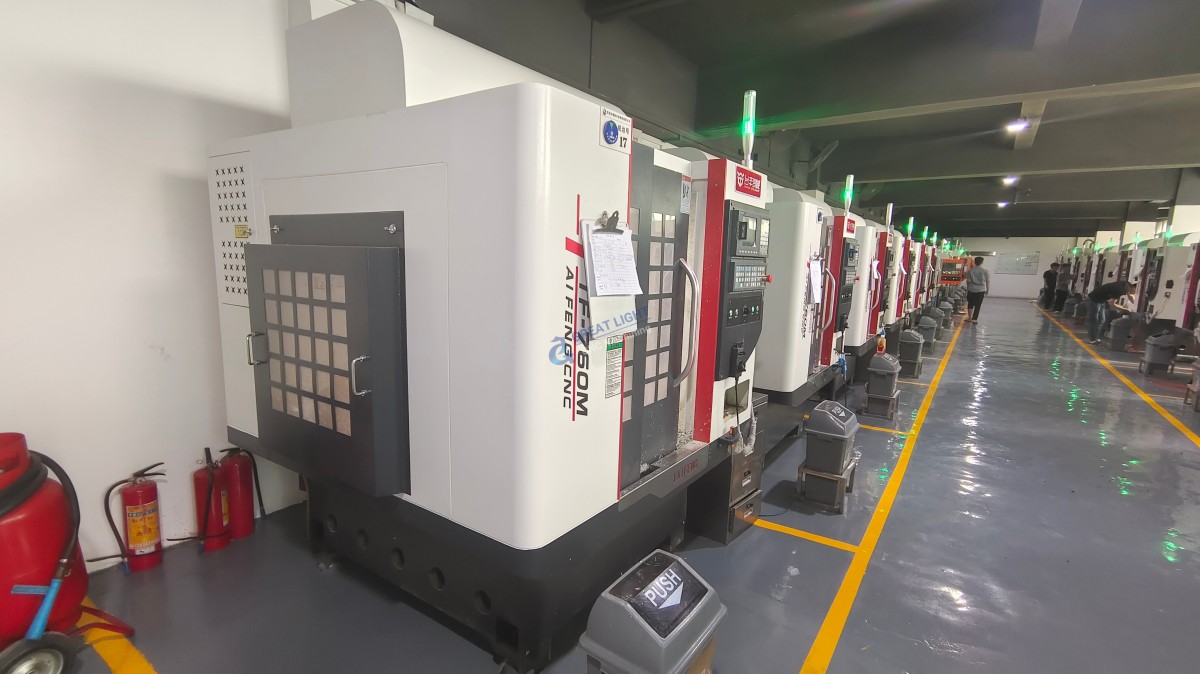
This is where a manufacturer like GreatLight CNC Machining Factory provides immense value. As a professional five-axis CNC machining manufacturer, they bridge the gap between garage-scale prototyping and industrial production.
Overcoming Technical Limits: Your garage 3-axis machine might struggle with a complex aerospace bracket requiring 5-sided machining from titanium. GreatLight CNC Machining Factory, with its advanced five-axis CNC machining centers, specializes in solving such complex metal parts manufacturing challenges, achieving tolerances to ±0.001mm that are unattainable in a home shop.
Material and Process Expertise: They can quickly customize and process “most materials,” from common alloys to advanced engineering plastics, with the correct tooling, speeds, and feeds pre-optimized.
One-Stop Finishing: Beyond machining, they provide comprehensive post-processing—anodizing, plating, powder coating, heat treatment—delivering a ready-to-use part.
Quality and Certification: For industries like automotive or medical, their ISO 9001:2015, IATF 16949, and ISO 13485 certifications provide the necessary documentation and traceability that a garage operation cannot. Their in-house precision measurement equipment validates every specification.
Scalability: Need 1 prototype or 10,000 production parts? A professional factory like GreatLight has the capacity and workflow to handle both efficiently, freeing you to focus on design and innovation.
Investing in a garage CNC is about gaining control and capability for prototyping and small-scale production. For projects that demand ultimate precision, complex geometries, certified quality, or larger volumes, leveraging the expertise and advanced equipment of a partner like GreatLight CNC Machining Factory ensures your vision is realized with professional-grade reliability. They act as an extension of your workshop, handling the heavy lifting of high-stakes manufacturing.
Conclusion
Installing a CNC machine in your garage is a feasible and highly rewarding endeavor that opens up a world of creation and manufacturing. Success hinges on meticulous planning around space, power, and environment, followed by selecting a machine aligned with your core projects. Embrace the learning curve in software and operation. However, recognize the practical and technical boundaries of a home setup. For mission-critical parts, advanced materials, or production runs, the sophisticated capabilities of a professional service provider like GreatLight CNC Machining Factory become indispensable. They complement the garage machinist’s spirit by offering a seamless path from concept to high-precision, certified reality, ensuring that no matter the complexity of your design, it can be manufactured to the highest standard.
Frequently Asked Questions (FAQ)
Q1: What is the cheapest type of CNC machine I can put in my garage?
A: The most affordable entry point is a desktop CNC router kit, often based on open-source GRBL controllers. These can cost a few hundred to a couple thousand dollars and are suitable for wood, plastics, and very light aluminum work. Remember to budget for essential accessories like a dust collector, computer, and basic tooling.
Q2: Do I need 3-phase power for a garage CNC mill?
A: Not necessarily. Many modern CNC mills designed for smaller shops use 220V single-phase power. True 3-phase power offers smoother spindle operation but is rare in residential areas. Single-phase 220V is a common upgrade that an electrician can install from your main panel. Always check the machine’s specific power requirements first.
Q3: How much noise does a CNC machine make? Is it a neighborhood nuisance?
A: Noise levels vary. A router cutting wood is loud (90+ dB), similar to a vacuum cleaner or table saw. A mill cutting steel with coolant is also very audible. Sound-dampening enclosures can help significantly. It’s courteous to inform close neighbors and avoid running it during very early or late hours.
Q4: Can I realistically machine steel or titanium in my garage?
A: Yes, but it requires the right machine. You need a rigid CNC mill, not a router. Machining steel demands high torque, low speeds, proper coolant, and rigid workholding. Titanium is even more challenging, requiring specific tool geometries and parameters. It’s at the extreme end of garage CNC capabilities and requires significant experience.
Q5: Why would I use a service like GreatLight CNC Machining Factory if I have my own machine?
A: A garage machine excels at prototyping, learning, and small jobs. You would partner with a professional service for:
Parts requiring tighter tolerances than your machine can hold.
Complex 5-axis geometries your 3-axis machine cannot produce.
High-volume production runs that would tie up your machine for weeks.
Specialized materials (e.g., hardened steels, Inconel) that require exotic tooling and expertise.
Industrially certified parts needed for automotive, aerospace, or medical applications, where documentation and traceability are required.



















