
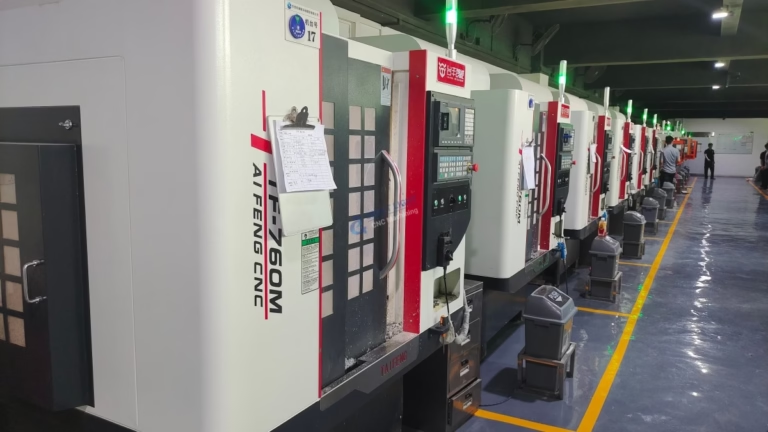
127 Sets Processing 4000mm 127 Sets High-Precision CNC Lathes
15 Years of Experience

Can CNC Machine Sumps Sit Directly On The Concrete Floor?

The Foundation of Precision: Why Proper CNC Machine Sump Installation Isn’t Just About the Floor In the world of precision parts machining and customization, every detail matters—from the tolerances on a complex aerospace component to the foundational stability of the machinery producing it. A question we often encounter from clients setting up new production lines […]

The Foundation of Precision: Why Proper CNC Machine Sump Installation Isn’t Just About the Floor

In the world of precision parts machining and customization, every detail matters—from the tolerances on a complex aerospace component to the foundational stability of the machinery producing it. A question we often encounter from clients setting up new production lines or workshops is: can CNC machine sumps sit directly on the concrete floor? The short, practical answer is: It is strongly discouraged and often a suboptimal practice, despite concrete’s apparent sturdiness. While a concrete slab provides a solid base, directly placing a CNC machine’s coolant sump on it ignores critical engineering considerations for machine performance, longevity, maintenance, and environmental safety.

Treating the sump—the reservoir that holds and circulates coolant—as an afterthought during installation can undermine the significant investment in a high-precision CNC machine. Let’s delve into the reasons why a more deliberate approach is necessary and outline the professional best practices that ensure your precision machining operations are built on a truly solid foundation.

The Critical Role of the Sump in CNC Machining

Before addressing installation, it’s essential to understand the sump’s function. It is far more than a simple tank. The sump is the heart of the machine’s coolant system, responsible for:

Coolant Storage and Supply: Maintaining a consistent volume of coolant for heat dissipation and chip flushing.
Chip Separation: Allowing metal chips (swarf) to settle or be separated via conveyors or filters.
Filtration: Housing or connecting to filtration units that keep coolant clean, extending its life and protecting pump and machine components.
Containment: Preventing coolant, oil, and sludge from leaking into the environment.

Why Direct Placement on Concrete is Problematic

Placing a sump directly onto a bare concrete floor introduces several interconnected risks:

1. Corrosion and Concrete Degradation:
Modern coolants, tramp oils, and metal particles are chemically active. Over time, they will seep into porous concrete, causing:

Spalling and Deterioration: The concrete can soften, crack, and crumble, compromising the floor’s integrity and the levelness critical for machine alignment.
Staining and Permanent Damage: The area becomes a permanent, contaminated eyesore that is difficult and expensive to remediate.
Reinforcement Corrosion: If the concrete has steel reinforcement, chemical ingress can cause it to rust and expand, leading to severe structural damage.

2. Leak Detection and Environmental Compliance Failure:
A primary sump directly on concrete makes early leak detection impossible. A slow seepage or a developing crack will be absorbed by the concrete long before it forms a visible puddle. This presents severe environmental and regulatory hazards, especially with regulated coolants or oils. Secondary containment is a fundamental requirement in many industrial safety (OSHA) and environmental (EPA) guidelines to prevent soil and groundwater contamination.

3. Maintenance and Cleanout Nightmares:
CNC sumps require regular cleaning to remove settled sludge and chips. With the sump fixed to the floor:
图片

Access is Severely Limited: It is extremely difficult to thoroughly clean all corners and surfaces.
Sludge Removal Becomes a Major Project: Instead of cleaning a portable tank, you are cleaning a pit, often requiring manual scooping, vacuums, and prolonged downtime.
Promotes Bacterial Growth: Inaccessible, unclean areas become breeding grounds for anaerobic bacteria that degrade coolant, cause foul odors (“Monday morning smell”), and create health hazards.

4. Compromised Machine Stability and Alignment:
While the machine itself is anchored, the associated sump and coolant system are part of the overall installation. If the concrete beneath the sump degrades or settles unevenly, it can stress connected pipes, pumps, and filtration units. In integrated systems, this can indirectly affect the stability of the machining process.

Professional Best Practices for Sump Installation

The goal is to create a system that is protected, maintainable, and compliant. Here is the methodology followed by professional machine shops and installation engineers:

1. Secondary Containment is Non-Negotiable:
This is the single most important principle. The sump should sit within a secondary containment system. Common solutions include:
图片

Integral Spill Decks/Basins: Many modern sump designs are self-contained units with a built-in spill deck that holds 110% of the sump’s capacity.
Curbing or Diking: Building a low, impermeable curb around the sump area on the floor to contain any leaks or spills.
Containment Pallets: Placing the entire sump assembly on a heavy-duty, chemical-resistant spill pallet.

2. Utilize a Non-Porous, Chemical-Resistant Liner or Coating:
If the sump must be in a pit or a specific location, the concrete must be sealed.

Apply a high-performance epoxy or polyurethane coating specifically designed for chemical and industrial environments. This creates a seamless, impermeable barrier that protects the concrete and allows for easy leak detection and cleanup.

3. Elevate and Facilitate Access for Maintenance:
Design the installation with maintenance in mind.

Use heavy-duty leveling pads or rails to elevate the sump slightly off the floor (even within containment). This improves air circulation, simplifies inspection for leaks underneath, and makes connection points more accessible.
Ensure ample clearance around the sump for personnel and equipment to perform cleanouts and pump/filter servicing.

Case in Point: The GreatLight Metal Tech Philosophy on Foundational Integrity

At GreatLight CNC Machining Factory, our perspective extends beyond just machining parts for our clients. We understand that the entire manufacturing ecosystem must be robust. Our own facility’s planning reflects these principles. While we leverage advanced precision 5-axis CNC machining services to produce complex components, we ensure the infrastructure supporting our equipment is engineered to the same high standard.

For instance, when installing new machining centers, the sump and coolant management system are integrated into the facility plan with:

Sealed, coated concrete floors throughout the production area.
Designated, contained zones for coolant handling and recycling equipment.
Preventative maintenance schedules that are feasible because the equipment is accessible and designed for serviceability.

This systematic approach minimizes unscheduled downtime, ensures environmental compliance, and protects our capital investment—principles we advocate for and help our clients implement in their operations. When you partner with a manufacturer that pays attention to these foundational details, it reflects a deeper commitment to quality, reliability, and long-term partnership.

Conclusion

So, can a CNC machine sump sit directly on the concrete floor? Technically, it might “sit” there, but doing so jeopardizes your floor’s integrity, hides critical failures, creates maintenance burdens, and risks non-compliance with environmental regulations. The professional answer is to always incorporate secondary containment and protect the concrete surface.
图片

Investing in a proper sump installation is not an extraneous cost; it is an essential part of safeguarding your precision machining capabilities. It ensures that the foundation of your production process is as reliable and durable as the precision components you aim to produce. By addressing this fundamental aspect, you build a workshop that is not only productive but also sustainable, safe, and prepared for the long haul of high-precision manufacturing.


Frequently Asked Questions (FAQ)

Q1: What is the simplest solution if my sump is already on the concrete floor?
A: The most immediate and effective action is to install a universal spill containment pallet underneath the sump. Choose one with sufficient capacity (at least 110% of your sump volume) and a load rating to support the full sump. This instantly provides secondary containment and leak detection. For a more permanent fix, consider having a professional apply an industrial epoxy coating to the affected area and then place the sump on leveled, chemical-resistant pads within a constructed curb.

Q2: Are there any exceptions where direct placement might be acceptable?
A: In very rare cases, such as with small, benchtop CNC routers that use minimal coolant and have integrated, sealed sump trays, the risk is lower. However, for any industrial-grade CNC milling machine, lathe, or machining center with a significant coolant volume, the principles of containment and protection always apply. Always consult the machine tool builder’s installation manual for specific requirements.

Q3: How often should a CNC sump be cleaned, and does installation affect this?
A: The frequency depends on material volume and type, but a general rule is a full cleanout every 3-6 months for heavy production. Proper installation dramatically affects this task. An accessible sump on a containment pallet can be cleaned in hours with the right equipment. A sump sealed to or sitting directly on concrete can turn the same job into a multi-day, labor-intensive ordeal with higher disposal costs.

Q4: What are the potential costs of NOT doing this correctly?
A: The costs can be severe:

Environmental Fines: Significant penalties for soil/groundwater contamination.
Remediation Costs: Excavating and replacing contaminated concrete and soil is exponentially more expensive than preventative measures.
Extended Downtime: Unplanned downtime for emergency cleanups or repairs.
Machine Damage: Unstable foundations or coolant system failure leading to machine damage.
Reduced Coolant Life: Poor maintenance leading to more frequent and costly coolant replacement.

Q5: Does GreatLight Metal provide guidance on workshop setup for clients?
A: Absolutely. As a partner deeply invested in our clients’ success, GreatLight Metal often consults on manufacturing best practices beyond part production. Our engineering team can share insights on machine installation, maintenance protocols, and shop floor layout based on our decade of experience running a high-precision, multi-process facility. Engaging with a partner who understands the full manufacturing lifecycle, from facility planning to finished part, is a key strategic advantage. You can learn more about our operational philosophy and connect with our team on our professional network at GreatLight on LinkedIn.


CNC Experts

Picture of JinShui Chen

JinShui Chen

Rapid Prototyping & Rapid Manufacturing Expert

Specialize in CNC machining, 3D printing, urethane casting, rapid tooling, injection molding, metal casting, sheet metal and extrusion

CNC Recent Posts

CNC News

Welcome to GreatLight Metal,Maximum Processing Size 4,000 mm

Precision Machining CNC Quote Online

Loading file

Upload Click here to upload or drag and drop your model to the canvas.

The model is too large and has been resized to fit in the printer's build tray. [Hide]

The model is too large to fit in the printer's build tray. [Hide]

The model is too large, a fitting printer is selected. [Hide]

The model is too small and has been upscaled. [Hide]

Warning: The selected printer can not print in full color [Hide]

Warning: obj models with multiple meshes are not yet supported [Hide]

Warning: Unsupported DXF entity  [Hide]

Warning: could not arrange models [Hide]

[Hide]


File Unit:      
Scale:
%
L × W × H:
X: × Y: × Z:  cm 
Rotation:
X: ° Y: °  
⚡ Instant Quote for Precision Manufacturing

Submit your design files (STEP/IGES/DWG) and receive a competitive quote within 1 hour, backed by ISO 9001-certified quality assurance.

📋 How It Works

  1. Upload & SpecifyShare your 3D model and select materials (Aluminum/Stainless Steel/Titanium/PEEK), tolerances (±0.002mm), and surface treatments.

  2. AI-Powered AnalysisOur system calculates optimal machining strategy and cost based on 10+ years of automotive/aerospace data.

  3. Review & ConfirmGet a detailed breakdown including:
    - Volume pricing tiers (1-10,000+ units)
    - Lead time (3-7 days standard)
    - DFM feedback for cost optimization

Unit Price: 

Loading price
5 Axis CNC Machining Equipment
4 Axis CNC Machining Equipment
3 Axis CNC Machining Equipment
CNC Milling & Turning Equipment
Prototype and Short-Run Injection Moldings Exact plastic material as final design
Volume Metal Die Casting Services - Precision Cast Parts
Bridge the Gap From Prototype to Production – Global delivery in 10 days or less
Custom high-precision sheet metal prototypes and parts, as fast as 5 days.
Custom Online 3D Printing Services
Design Best Processing Method According To 3D Drawings
Alloys Aluminum 6061, 6061-T6 Aluminum 2024 Aluminum 5052 Aluminum 5083 Aluminum 6063 Aluminum 6082 Aluminum 7075, 7075-T6 Aluminum ADC12 (A380)
Alloys Brass C27400 Brass C28000 Brass C36000
Alloys Stainless Steel SUS201 Stainless Steel SUS303 Stainless Steel SUS 304 Stainless Steel SUS316 Stainless Steel SUS316L Stainless Steel SUS420 Stainless Steel SUS430 Stainless Steel SUS431 Stainless Steel SUS440C Stainless Steel SUS630/17-4PH Stainless Steel AISI 304
Inconel718
Carbon Fiber
Tool Steel
Mold Steel
Alloys Titanium Alloy TA1 Titanium Alloy TA2 Titanium Alloy TC4/Ti-6Al 4V
Alloys Steel 1018, 1020, 1025, 1045, 1215, 4130, 4140, 4340, 5140, A36 Die steel Alloy steel Chisel tool steel Spring steel High speed steel Cold rolled steel Bearing steel SPCC
Alloys Copper C101(T2) Copper C103(T1) Copper C103(TU2) Copper C110(TU0) Beryllium Copper
Alloys Magnesium Alloy AZ31B Magnesium Alloy AZ91D
Low Carbon Steel
Alloys Magnesium Alloy AZ31B Magnesium Alloy AZ91D
ABS Beige(Natural) ABS Black ABS Black Antistatic ABS Milky White ABS+PC Black ABS+PC White
PC Black PC Transparent PC White PC Yellowish White PC+GF30 Black
PMMA Black PMMA Transparent PMMA White
PA(Nylon) Blue PA6 (Nylon)+GF15 Black PA6 (Nylon)+GF30 Black PA66 (Nylon) Beige(Natural) PA66 (Nylon) Black
PE Black PE White
PEEK Beige(Natural) PEEK Black
PP Black PP White PP+GF30 Black
HDPE Black HDPE White
HIPS Board White
LDPE White
This is a finish of applying powdered paint to the components and then baking it in an oven, which results in a stronger, more wear- and corrosion-resistant layer that is more durable than traditional painting methods.
No coating required, product’s natural color!
This is a finish of applying powdered paint to the components and then baking it in an oven, which results in a stronger, more wear- and corrosion-resistant layer that is more durable than traditional painting methods.
This finishing option with the shortest turnaround time. Parts have visible tool marks and potentially sharp edges and burrs, which can be removed upon request.
Sand blasting uses pressurized sand or other media to clean and texture the surface, creating a uniform, matte finish.
Polishing is the process of creating a smooth and shiny surface by rubbing it or by applying a chemical treatmen
A brushed finish creates a unidirectional satin texture, reducing the visibility of marks and scratches on the surface.
Anodizing increases corrosion resistance and wear properties, while allowing for color dyeing, ideal for aluminum parts.
Black oxide is a conversion coating that is used on steels to improve corrosion resistance and minimize light reflection.
Electroplating bonds a thin metal layer onto parts, improving wear resistance, corrosion resistance, and surface conductivity.
This is a finish of applying powdered paint to the components and then baking it in an oven, which results in a stronger, more wear- and corrosion-resistant layer that is more durable than traditional painting methods.
Please provide additional text description for other surface treatment requirements!
Material
Material
  • CNC Metals
    • Aluminum
    • Brass
    • Stainless steel
    • Inconel718
    • Carbon Fiber
    • Tool Steel
    • Mold Steel
    • Titanium
    • Alloy Steel
    • Copper
    • Bronze
    • Low Carbon Steel
    • Magnesium
  • CNC Plastics
    • ABS
    • PC
    • PMMA (Acrylic)
    • PA (Nylon)
    • PE
    • PEEK
    • PP
    • HDPE
    • HIPS
    • LDPE
Printer
Printer
  • CNC Metals
    • 5 Axis CNC Machining
    • 4 Axis CNC Machining
    • 3 Axis CNC Machining
    • CNC Milling & Turning
    • Rapid Tooling
    • Metal Die Casting
    • Vacuum Casting
    • Sheet Metal Fabrication
    • SLA 3D Printing
    • SLS 3D Printing
    • SLM 3D Printing
  • Rapid Prototyping
    • Design Best Processing Method According To 3D Drawings
Post-processing
Post-processing
  • As Machined(Product’s natural color)
  • Sand Blasting
  • Polishing
  • Brushed Finish
  • Anodizing
  • Black Oxide
  • Electroplating
  • Paint Coating
  • Powder Coating
  • Other surface treatment requirements
Finalize
The world's first CNC machining center that dares to provide free samples!

Free for first product valued at less than $200. (Background check required)

precision machining cnc quote online

15 Years CNC Machining Services

When you’re ready to start your next project, simply upload your 3D CAD design files, and our engineers will get back to you with a quote as soon as possible.
Scroll to Top

ISO 9001 Certificate

ISO 9001 is defined as the internationally recognized standard for Quality Management Systems (QMS). It is by far the most mature quality framework in the world. More than 1 million certificates were issued to organizations in 178 countries. ISO 9001 sets standards not only for the quality management system, but also for the overall management system. It helps organizations achieve success by improving customer satisfaction, employee motivation, and continuous improvement. * The ISO certificate is issued in the name of FS.com LIMITED and applied to all the products sold on FS website.

greatlight metal iso 9001 certification successfully renewed
GB T 19001-2016 IS09001-2015
✅ iso 9001:2015
greatlight metal iso 9001 certification successfully renewed zh

IATF 16949 certificate

IATF 16949 is an internationally recognized Quality Management System (QMS) standard specifically for the automotive industry and engine hardware parts production quality management system certification. It is based on ISO 9001 and adds specific requirements related to the production and service of automotive and engine hardware parts. Its goal is to improve quality, streamline processes, and reduce variation and waste in the automotive and engine hardware parts supply chain.

automotive industry quality management system certification 01
Certification of Production Quality Management System for Engine Hardware Parts Engine Hardware Associated Parts
automotive industry quality management system certification 00
发动机五金零配件的生产质量管理体系认证

ISO 27001 certificate

ISO/IEC 27001 is an international standard for managing and processing information security. This standard is jointly developed by the International Organization for Standardization (ISO) and the International Electrotechnical Commission (IEC). It sets out requirements for establishing, implementing, maintaining, and continually improving an information security management system (ISMS). Ensuring the confidentiality, integrity, and availability of organizational information assets, obtaining an ISO 27001 certificate means that the enterprise has passed the audit conducted by a certification body, proving that its information security management system has met the requirements of the international standard.

greatlight metal technology co., ltd has obtained multiple certifications (1)
greatlight metal technology co., ltd has obtained multiple certifications (2)

ISO 13485 certificate

ISO 13485 is an internationally recognized standard for Quality Management Systems (QMS) specifically tailored for the medical device industry. It outlines the requirements for organizations involved in the design, development, production, installation, and servicing of medical devices, ensuring they consistently meet regulatory requirements and customer needs. Essentially, it's a framework for medical device companies to build and maintain robust QMS processes, ultimately enhancing patient safety and device quality.

greatlight metal technology co., ltd has obtained multiple certifications (3)
greatlight metal technology co., ltd has obtained multiple certifications (4)

Get The Best Price

Send drawings and detailed requirements via Email:[email protected]
Or Fill Out The Contact Form Below:

All uploads are secure and confidential.











