
Buy CNC Aluminum Machined Parts Service: What Engineers Should Check First
This page is for design engineers and buyers who are about to buy CNC aluminum machined parts and want to know which questions decide the outcome. It covers alloy selection, tolerance and finish limits, setup strategy, inspection paperwork, and the inputs that make a quote usable.
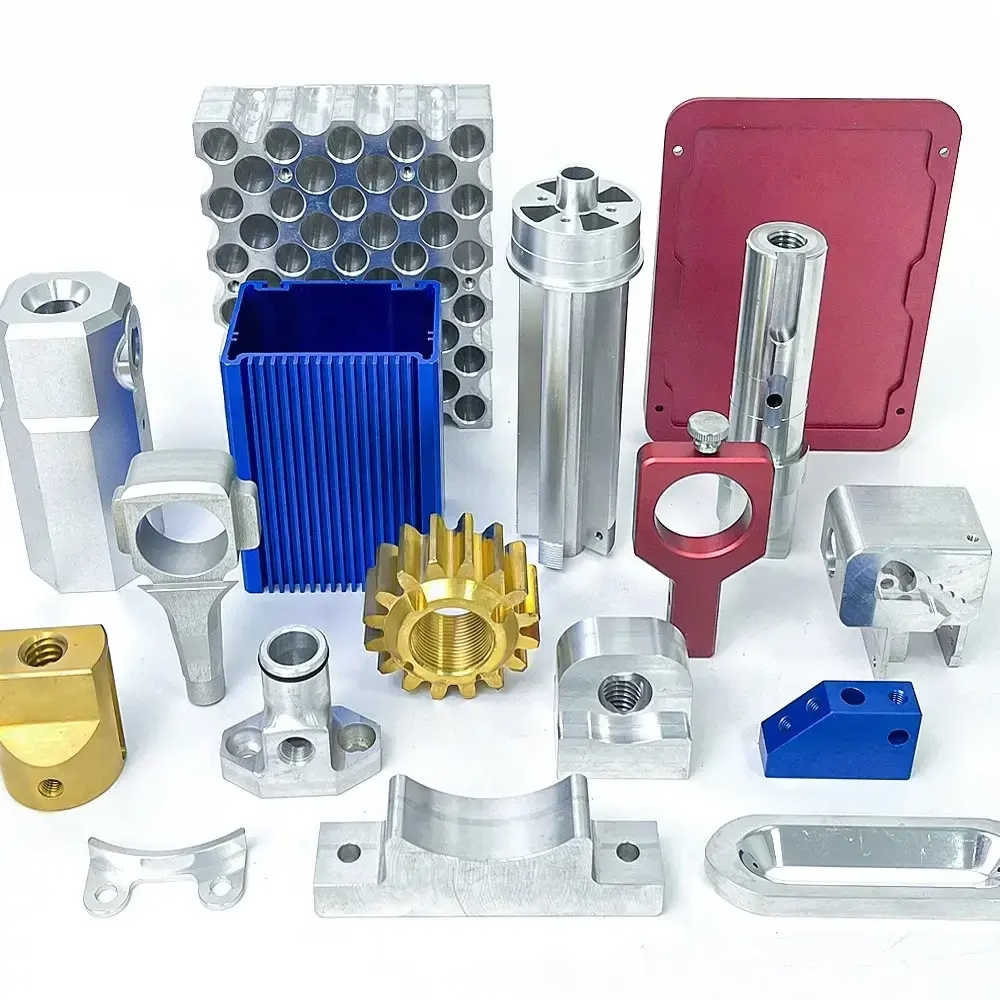
Aluminum parts are easy to cut. Getting them right is the work.
Work through the sections in order when comparing suppliers, or jump to the table if you already know your alloy and only need numbers.
Pick the aluminum grade before you ask for a price
Most aluminum parts fail in service for one of two reasons: the wrong alloy, or the right alloy machined with the wrong wall thickness. Grade choice comes first, because it sets your strength, corrosion behavior, anodize result, and how much material the cutter can remove per pass.
6061-T6 is the default for brackets, housings, heatsink plates, and fixtures. It machines cleanly, welds, anodizes to a consistent color, and holds ±0.005 mm on stable features. Thin walls below 1.0 mm start to deflect, so rib them or thicken them.
When strength per kilogram matters, 7075-T6 gives roughly twice the yield strength of 6061. It also machines well, but it is less weldable and it costs more. Use it for load-bearing arms, tooling jaws, and stressed brackets rather than large panels.
2024-T4 cuts fast and takes a fine finish, which is why it shows up in aerospace skins and fittings. Its corrosion resistance is poor without cladding or coating, so plan the surface treatment at the same time you choose the grade.
For corrosion and forming work, 5052 and 5083 hold up better in salt spray and bend without cracking. 6082 and 6063 suit profiles and welded frames. ADC12 is a die-casting alloy, not a billet grade, so it belongs in a different process conversation.
- 16061-T6General purpose. Good finish, welds, anodizes.
- 27075-T6High strength. Poor weldability, higher cost.
- 32024-T4Aerospace fatigue parts. Needs coating.
- 45052 / 5083Marine and chemical exposure. Bends well.
Where ±0.005 mm is realistic and where it is not
A tolerance callout is only meaningful against a feature. On aluminum, ±0.005 mm is achievable on bores, pin holes, and mating faces that are machined in one setup on a rigid machine. It is not a blanket number for the whole drawing.
Long thin parts move. A 500 mm aluminum rail will grow about 0.012 mm for every 1 °C of temperature change, so a hot afternoon on the shop floor can eat your whole tolerance band. That is a physics problem, not a machine problem.
Deep pockets and tall walls deflect under cutting force. When a wall is 0.8 mm thick and 20 mm tall, no amount of spindle accuracy saves it. Add a rib, reduce the height, or accept a looser tolerance on that feature and hold the tight band on the datum faces.
Datum strategy decides the inspection result. Tell us which face locates the part in your assembly. If that face is also used to clamp the part during machining, expect arguments at incoming inspection.
- 1Hold tightBores, pin holes, mating faces, one setup.
- 2LoosenLong spans, thin walls, non-critical edges.
- 3WatchThermal growth on parts over 300 mm.
Five-axis setups remove the tolerance stack
Every additional setup adds a re-clamp error. On a three-axis machine, a part with features on five sides needs three or four setups, and each one can shift the part by 0.01 mm or more. Five-axis work holds the part once and reaches the other faces with the tool.
We run 16 simultaneous 5-axis machining centers with a Ø400 mm rotary table, plus 12 four-axis mills and 27 three-axis machines. The right choice is not always the biggest machine. A compact 500 × 500 × 450 mm envelope often gives better rigidity for small, tight-tolerance parts.
Large aluminum structures go on machines with 4,000 × 400 × 150 mm travel, and our 4,000 mm maximum processing size covers long extrusions and frame rails. If your part fits in one of those envelopes with room for the fixture, it can be machined in a single setup.
Mill-turn centers handle parts that are mostly round with milled flats, cross holes, or slots. Turning and milling in one cycle avoids the concentricity error that comes from moving a shaft between two machines.
- 116Simultaneous 5-axis machining centers
- 212Four-axis mills
- 34,000 mmMaximum processing size
- 4Ø400 mmRotary table on 5-axis centers
Aluminum grade and process quick reference
Use this as a starting point, then confirm against your load case and environment.
| Grade | Typical use | Machining note |
|---|---|---|
| 6061-T6 | Brackets, housings, plates | Easy to cut. Holds tight tolerance. |
| 7075-T6 | Arms, jaws, stressed parts | Strong. Less weldable, higher cost. |
| 2024-T4 | Aerospace skins, fittings | Cuts fast. Needs corrosion protection. |
| 5052 / 5083 | Marine, tanks, bent panels | Tough and corrosion resistant. |
| 6082 / 6063 | Frames, profiles, weldments | Good for welded assemblies. |
| ADC12 | Die-cast housings | Cast alloy, not billet machining. |
Surface finish, anodize, and the paperwork you should ask for
As-machined aluminum sits around Ra 1.6–3.2 μm. A high-quality cosmetic finish lands at Ra 0.8–1.6 μm, and fine finishing reaches Ra 0.2–0.8 μm on sealing faces and sliding surfaces. Specify the finish per face, not for the whole part.
Anodizing adds 5–15 μm per surface and grows the part. A Ø10.000 mm bore will not stay Ø10.000 mm after hardcoat. Mask the features that matter, or machine them undersize before coating and tell the finisher the target.
Clear anodize reveals alloy differences. A 6061 housing welded to a 5052 bracket will show a color line after anodizing, because the two alloys respond differently to the bath. If color match matters, keep the assembly to one grade.
Ask for the inspection report before you place the order, not after. We inspect 100% of parts before shipment, covering raw material check, in-process monitoring, and final inspection, with reports on request. A first article report with actual measured values is more useful than a certificate of conformance alone.
Laser marking is available down to 1.5 mm character height. Put your part number, revision, and serial on the drawing if traceability matters to your quality system. We hold ISO 9001:2015, IATF 16949:2016, ISO 13485:2016, and ISO 27001:2022.
- 1As-machinedRa 1.6–3.2 μm, general surfaces.
- 2High finishRa 0.8–1.6 μm, visible cosmetic faces.
- 3Fine finishRa 0.2–0.8 μm, seals and slides.
What makes an aluminum quote usable in 12 hours
A usable quote needs five things: a STEP file, a 2D drawing with tolerances and datums, the alloy and temper, the finish per face, and the quantity you actually intend to order. Send a PDF of the model instead of a STEP file and the first email is spent asking for the file, not quoting.
Quantity changes the process, not just the price. One prototype is machined from billet with no fixture. A 10,000-part run may move to die casting or a dedicated fixture with soft jaws. We have no minimum order quantity and quote from one prototype to 10,000+ part runs, but tell us the target volume early.
Send the full assembly if the part mates with something. A hole position that looks arbitrary on one part is often driven by a mating bracket. Knowing the stack-up lets us flag a tolerance that will not close before the toolpath is generated.
We return a quotation and a free DFM analysis within 12 hours, and production can start within 24 hours. Parts normally ship in 3–5 days. Uploads are handled as confidential, and an NDA is available on request.
- 1STEP fileNative 3D model, not a PDF.
- 22D drawingTolerances, datums, finish per face.
- 3VolumePrototype, pilot, or production target.
- 4Mating partsAssembly context for tolerance checks.
Common questions
Can you machine a single aluminum prototype?
Yes. There is no minimum order quantity, so a one-off prototype goes through the same DFM review as a production run. The setup is billed as machine time rather than amortized over parts, which is why unit price drops sharply at higher quantities.
How tight a tolerance can you hold on aluminum?
We work to ±0.005 mm ( ±0.0002 in ) on features machined in a single setup with a rigid fixture. Long spans, thin walls, and parts over 300 mm are limited more by thermal growth and deflection than by machine accuracy, so we agree the critical features first.
What surface finishes do you offer for aluminum parts?
Anodizing in clear, color, hardcoat, and conductive versions; electroless nickel, zinc, silver, and gold plating; powder coating and black oxide; bead blasting, tumbling, brushing, and polishing; plus laser marking and engraving with a minimum character height of 1.5 mm.
How do you protect my design files?
Uploads are treated as secure and confidential. We hold ISO 27001:2022 for information security, and we will sign a non-disclosure agreement before you send any file if your process requires it.
Do you provide inspection reports with the parts?
Inspection covers raw material check, in-process monitoring, and final inspection, with 100% of parts inspected before shipment. Reports are available on request, including first article reports with measured values when your quality system needs them.
Which industries do you machine aluminum parts for?
Aerospace, automotive and EV, medical devices, robotics and automation, electronics, industrial machinery, and new energy. Each of those carries its own documentation expectations, and we match the inspection level to the application rather than applying one standard everywhere.
Send a STEP file and get a quote with DFM feedback
Tell us the alloy, tolerance, finish, and quantity. We reply with a quotation and a free DFM analysis within 12 hours.
12-hour quoteFree DFM analysis100% inspectionNDA on request









