
Buy Aluminum CNC Machining Service Wholesale
This page is for engineers and sourcing staff who need aluminum parts in volume and want to judge a supplier before releasing a purchase order. It covers alloy selection, wall thickness and tolerance decisions, finishing, inspection evidence, and the questions that separate a shop that can scale from one that cannot.
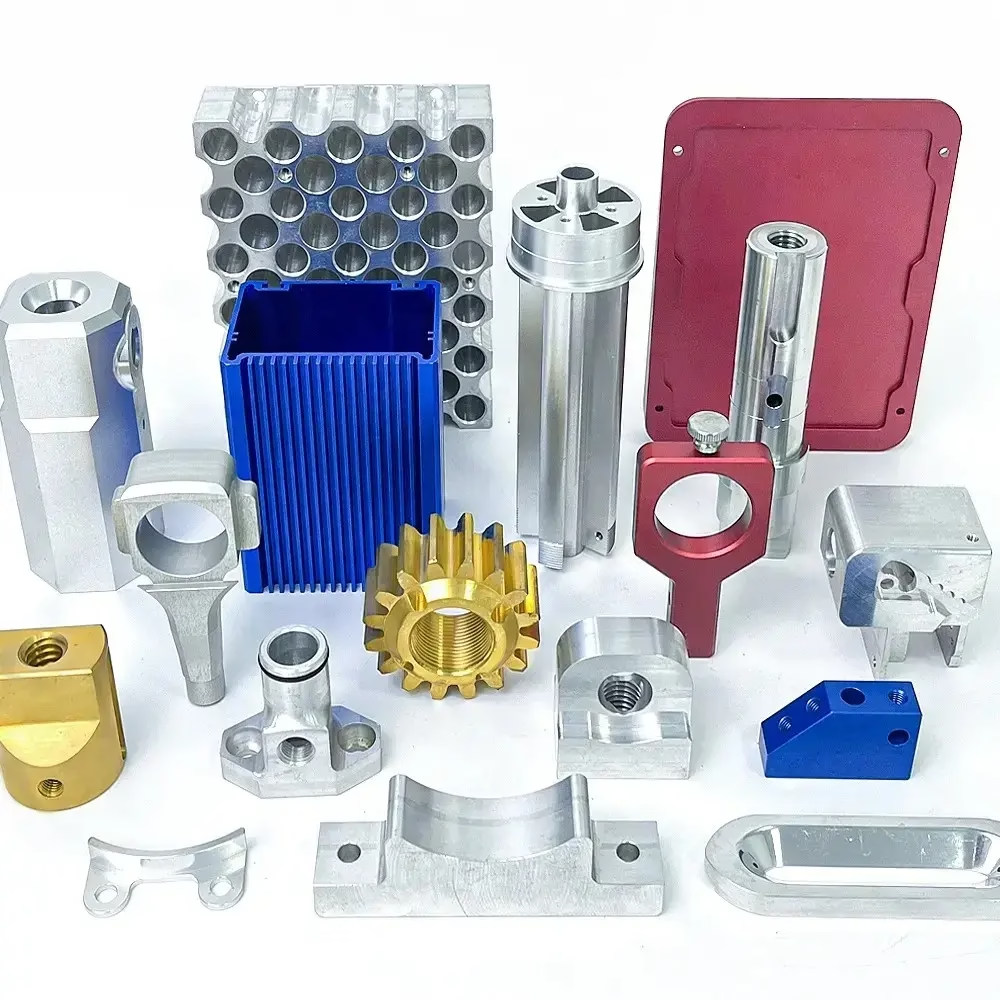
What changes when aluminum machining moves to volume
A prototype run forgives a lot. A 10,000-part run does not.
Pick the aluminum grade before you pick the price
Most wholesale aluminum parts land on 6061-T6 because it machines cleanly, welds, anodizes predictably, and holds a ±0.005 mm tolerance on stable geometry. If a drawing says only "aluminum," 6061-T6 is the safe default unless someone can explain why another grade is needed.
2024 and 7075 buy strength at a cost. Both cut well but are less corrosion resistant and behave differently under anodizing. 7075 in particular tends to show color variation across a batch after clear anodize, which matters when parts from the same order sit side by side on an assembly. If the part is structural and stays indoors, 7075 is reasonable. If it sees weather or salt, think again.
For sheet-metal style housings and brackets, 5052 and 5083 bend without cracking where 6061 would tear. 6082 is common on European drawings and machines close to 6061. ADC12 is a die-casting alloy; it belongs in a casting quote, not a machining quote, unless you are only machining features onto a casting.
- 16061-T6Default for machined parts, good finish, good anodize, widely stocked.
- 27075High strength. Expect anodize color shift and lower corrosion resistance.
- 35052 / 5083Formable alloys for bent panels and enclosures.
- 4ADC12Casting alloy. Quote as a casting first, then machine.
Wall thickness, radii, and the features that raise unit cost
Thin walls are where volume aluminum machining goes wrong. Below about 0.8 mm on a large flat face, the cutter pushes the material instead of shearing it, and you get chatter marks that show through anodize. For parts over 100 mm across, we usually ask for 1.5 mm minimum and add a rib rather than fight deflection.
Deep pockets are the second cost driver. A pocket deeper than four times its width needs a long, slender tool, which means slower feed rates and more passes. Opening the corner radius to at least one third of the pocket depth lets a larger cutter in and can cut cycle time noticeably.
Threads and small holes deserve a look too. Threads below M2 in aluminum strip easily during assembly, and holes under 1 mm need a spot drill and a peck cycle. Laser marking has a minimum character height of 1.5 mm; if your part number is smaller than that, expect it to be unreadable after bead blasting.
Aluminum feature limits and what drives cost
Typical values for volume aluminum machining. Tighten only where the function needs it.
| Feature | Practical limit | Cost impact |
|---|---|---|
| Wall thickness, large part | 1.5 mm minimum | Thinner walls need extra passes and fixtures |
| Pocket depth to width | 4:1 without a special cutter | Deeper pockets slow the cycle |
| Corner radius | 1/3 of pocket depth | Small radii force small tools |
| General tolerance | ±0.05 mm | Standard for most aluminum parts |
| Tight tolerance | ±0.005 mm | Needs temperature control and extra inspection |
| Surface finish | Ra 0.8–1.6 μm | Fine finishes add a finishing pass |
| Thread size | M2 and above | Smaller threads risk stripping |
| Laser marking | 1.5 mm character height | Below this, legibility drops |
Finishing choices that hold up across a batch
Anodizing is the standard finish for aluminum, and the type matters more than the color. Clear anodize shows machining marks and alloy differences, so parts from different heats can look slightly different. Hardcoat builds a thicker oxide layer and improves wear resistance, but it changes dimensions on tight-tolerance bores. Tell your machinist which surfaces are functional before the anodizer sees the parts.
Bead blasting hides tool marks and gives a matte surface, though it slightly rounds edges. Brushing leaves a directional grain that reads well on flat panels. For parts that need conductivity, a conductive anodize or masked anodize keeps selected areas bare. Laser marking after finishing is more legible than marking before anodize, since the oxide layer can blur fine text.
Inspection is where wholesale orders are won or lost. We check raw material against mill certificates, monitor dimensions in process, and inspect 100% of parts before shipment. Reports are available on request. For a run of thousands, ask for the sampling plan and the gauge list up front. If a supplier cannot describe how they will measure your tightest tolerance, the tolerance is a guess.
- 1Anodize typesClear, color, hardcoat, and conductive. Each changes dimensions differently.
- 2Bead blastingHides tool marks, matte finish, slightly softens edges.
- 3Laser markingMinimum 1.5 mm character height for reliable legibility.
- 4Inspection100% before shipment, with reports on request.
What to verify before releasing a volume order
Ask how many machines can run your part and what happens when one goes down. A shop with a single 5-axis center and no backup is a single point of failure. Our capacity is 127 high-precision CNC machines across three plants, including 16 simultaneous 5-axis centers, 12 four-axis mills, 27 three-axis machines, and 16 mill-turn centers. Maximum part size is 4,000 mm, and we run a Ø400 mm rotary table for round work.
Materials should be traceable to the mill. If a batch of aluminum arrives without a certificate, you cannot prove what you received. That matters in aerospace, medical, and automotive work where the paper trail is part of the deliverable.
Certifications tell you which quality systems are already in place. We hold ISO 9001:2015, IATF 16949:2016, ISO 13485:2016, and ISO 27001:2022. The last one covers information security, which matters if your drawings are confidential. Uploads are secure, and an NDA is available on request.
What to send for an accurate wholesale quote
| Item | Why it matters | Format |
|---|---|---|
| 3D model and 2D drawing | Defines geometry and tolerances | STEP plus PDF |
| Alloy and temper | Drives material cost and finish | e.g. 6061-T6 |
| Annual and batch quantity | Sets tooling and setup strategy | Numbers per release |
| Critical tolerances | Determines inspection plan | Marked on drawing |
| Finish and color | Affects lead time and handling | Spec plus sample if available |
| Assembly or marking needs | Adds secondary operations | Notes or drawings |
From one prototype to 10,000 parts without a second supplier
The usual reason buyers split an order across two shops is that the first shop cannot scale. Moving from a prototype to volume should not mean a new supplier, a new fixture, and a new set of first-article checks. We run from one piece to 10,000-plus part runs with no minimum order quantity, so the process that made the prototype is the process that makes the production batch.
We quote and return a free DFM analysis within 12 hours, and production can start within 24 hours of approval. Parts ship in 3–5 days for standard work. Historical late-delivery probability is below 2%. Those numbers come from how the shop schedules, not from a promise that every order beats the clock.
If your project needs a specific alloy, a tight tolerance on one bore, and anodize on the rest, say so in the quote request. The DFM review will flag where the tolerance or finish conflicts with the geometry, and that conversation is cheaper before the chips fly.
Aluminum CNC machining questions buyers ask
What is the smallest quantity for a wholesale aluminum order?
There is no minimum order quantity. We run from a single prototype to 10,000-plus parts. Volume pricing improves with batch size because setup and tooling are spread across more parts, but there is no floor you have to reach before we will quote.
Can you hold ±0.005 mm on aluminum parts?
Yes, on features that allow it. Aluminum moves with temperature, so tight tolerances need stable geometry, controlled inspection conditions, and a clear datum scheme. We will tell you during DFM review if a tolerance on your drawing is unrealistic for the feature.
Which aluminum grades do you machine most?
6061 and 6061-T6 are the most common. We also machine 2024, 5052, 5083, 6063, 6082, 7075, and ADC12. If you are unsure, send the drawing and we will suggest a grade based on strength, corrosion, and finishing needs.
How do you handle confidential drawings?
Uploads are secure and confidential. We hold ISO 27001:2022 for information security, and we can sign an NDA on request before you share files. The NDA page on this site explains the process.
What lead time should I expect for a volume aluminum order?
Quotation and free DFM analysis come back within 12 hours. Production can start within 24 hours of approval, and parts ship in 3–5 days for standard work. Larger runs and finishing steps add time, which we confirm in the quote.
Do you finish parts in-house?
We offer anodizing in clear, color, hardcoat, and conductive types, plus electroless nickel, zinc, silver, and gold plating, powder coating, black oxide, bead blasting, tumbling, brushing, polishing, laser marking, and engraving. Keeping finishing and machining under one roof reduces handling and keeps quality control in one place.
Send your aluminum parts for a volume quote
Upload your models and drawings for a quote and free DFM analysis within 12 hours. No minimum order quantity.
12-hour quote100% inspectionNo MOQ±0.005 mm tolerance









