
CNC Machining Companies Services: What to Compare
This guide is for engineers and buyers shortlisting CNC machining companies services for a real part. It covers the criteria that actually change your outcome: tolerance capability, machine mix, material range, quality system, and how a shop handles design for manufacturing. Read it and you can rank suppliers against your drawing instead of against a price list.
Start with the drawing, not the supplier list
A shop is a good fit or a bad fit for one part at one tolerance. Not in general.
The five numbers that decide whether a shop can run your part
Most supplier lists rank companies by size or reputation. That tells you almost nothing about whether a specific shop can hold your tolerance on your geometry. Five numbers do most of the work.
Tolerance comes first. A shop quoting ±0.05 mm is not competing with one quoting ±0.005 mm; they are different businesses. Check what the shop can hold across a production run, not what a single sample reached once. Position tolerance, flatness and surface finish usually decide the machine, not the material.
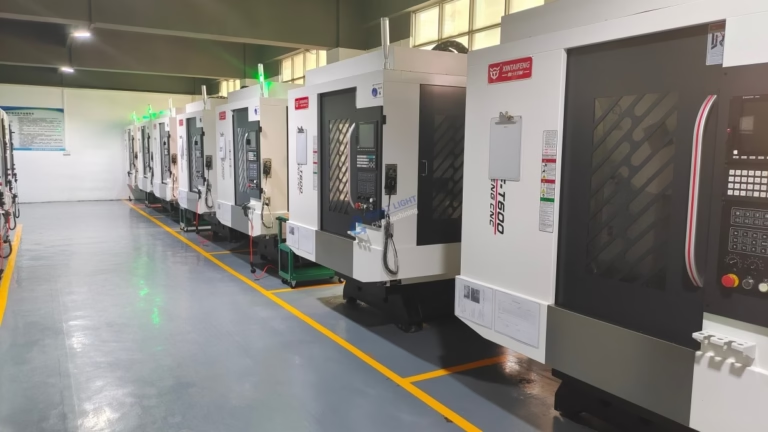
Then machine mix. Five-axis capability matters when your part has features on four or more faces, deep cavities, or undercuts that would otherwise need multiple fixtures. GreatLight runs 16 simultaneous 5-axis machining centers, 12 four-axis mills, 27 three-axis machines and 16 mill-turn centers. That spread lets us route a part to the machine that holds it cheaply instead of forcing every job onto one platform.
Maximum part size sets the ceiling. The largest travel here is 4,000 × 400 × 150 mm, with medium platforms at 750 × 1,150 × 550 mm and 600 × 600 × 600 mm, and compact platforms at 500 × 500 × 450 mm and 500 × 310 × 200 mm. A Ø400 mm rotary table covers most round and cylindrical work. If your part is bigger than the envelope, no amount of skill fixes it.
Material range and finish range matter for cost. Aluminum 6061, 7075 and 2024 machine fast and cheap; 17-4PH stainless, Inconel and TC4 titanium cut slowly and wear tooling. Surface finish is priced the same way: Ra 1.6–3.2 μm as machined, Ra 0.8–1.6 μm for most mating surfaces, Ra 0.2–0.8 μm only where the function demands it.
Finally, the quality system. ISO 9001:2015 covers general process control. IATF 16949:2016 is what automotive and EV programs expect. ISO 13485:2016 applies to medical devices. ISO 27001:2022 covers information security, which matters when you send CAD files to an outside shop.
- 1ToleranceAsk for the production tolerance, not the best-ever sample.
- 2Machine mixFive-axis removes fixtures; mill-turn removes second operations.
- 3EnvelopeConfirm maximum travel before quoting a large part.
- 4CertificationMatch the certificate to your industry, not to a logo wall.
What to send for a real quote
A price without a process plan is a guess. Send the 3D model, the 2D drawing with tolerances and datums, the material spec, the surface finish callouts, and the quantity you expect over the next year. Quantity changes the answer more than anything else on the list.
We quote and return a free DFM analysis within 12 hours. That analysis flags thin walls, tool access problems, tolerances tighter than the function needs, and features that would be cheaper as a separate operation. Production can start within 24 hours after you approve, and parts ship in 3–5 days for standard work.
There is no minimum order quantity. One prototype and a 10,000+ part run go through the same review. That matters when a design is still moving and you need three revisions before committing to tooling or a long production schedule.
Uploads stay confidential, and an NDA is available on request. If your program requires one, sign it before the first file transfer rather than after.
- 1SendSTEP model, 2D drawing, material, finish, annual quantity.
- 2Get backQuote plus DFM notes within 12 hours.
- 3ThenApprove, start within 24 hours, ship in 3–5 days.
How the criteria map to what you should ask
Use this as a checklist when you talk to any CNC machining supplier, including us.
| Criterion | What to ask | Red flag |
|---|---|---|
| Tolerance | What tolerance holds in production? | Only a sample number is given |
| Machine mix | How many 5-axis and mill-turn centers? | Every job pushed to 3-axis |
| Envelope | What is the largest travel and rotary size? | Size confirmed after quoting |
| Materials | Which grades are stocked or sourced? | No titanium or Inconel experience |
| Finishing | In-house or subcontracted anodizing? | Finish lead time never stated |
| Quality system | Which certificates, and scope? | Certificate not tied to your industry |
| Inspection | What is inspected, and are reports available? | Final check only, no data |
| Capacity | Prototype to production on one line? | Prototype shop, no production cell |
When a large supplier is the wrong choice
Bigger is not automatically better. A very large shop optimizes for volume, so a five-part prototype can sit in a queue behind a 50,000-part order. If your program is early-stage, a mid-size shop with dedicated prototype cells usually moves faster.
Watch for capability that only exists on paper. A supplier may list five-axis machining while subcontracting the actual cutting. That adds a handoff, and every handoff adds tolerance stack-up and schedule risk. Ask where the part is cut and who inspects it.
Communication style is a real criterion. If your questions come back as sales answers instead of engineering answers, you will spend the project re-explaining the drawing. A short call with the process engineer before you place the order saves weeks later.
Cost is the last filter, not the first. Two quotes that differ by 30 percent usually differ in process, not in margin. Compare the operation list, the fixture plan, and the inspection plan before you compare the number at the bottom.
How GreatLight fits into this comparison
GreatLight Metal Technology Co., Ltd. was founded in 2011 and now runs 3 wholly-owned plants covering 7,600 m², with 150 technicians and 127 high-precision CNC machines. The main plant is in Dongguan, China, with a second factory at No.3 Joo Koon Circle, Singapore 629032.
Tolerance capability is ±0.005 mm (±0.0002 in), with a 99.99% qualification rate and 100% inspection before shipment. Inspection covers raw material check, in-process monitoring and final inspection, with reports on request.
Services cover 5-axis, 4-axis and 3-axis machining, CNC milling and turning, rapid prototyping, sheet metal fabrication, 3D printing, die casting, vacuum casting and surface finishing. Finishes include anodizing, electroless nickel, zinc, silver and gold plating, powder coating, black oxide, bead blasting, tumbling, brushing, polishing, and laser marking down to 1.5 mm character height.
We work across aerospace, automotive and EV, medical devices, robotics and automation, electronics, industrial machinery and new energy. Different industries carry different paperwork, so tell us which one you are in at the start.
- 1Scale3 plants, 7,600 m², 150 technicians.
- 2Machines127 CNC machines, 16 of them simultaneous 5-axis.
- 3Quality±0.005 mm, 100% inspection, reports on request.
Questions engineers ask before switching suppliers
How do I compare quotes when the prices are far apart?
Compare the operation list first. A cheap quote often assumes fewer setups, simpler fixtures or a looser finish than your drawing allows.
Ask each supplier to state the tolerance they will hold, the inspection they will perform, and whether finishing is in-house. Those three answers explain most price gaps.
Do I need a 5-axis shop for a simple part?
No. If your part has features on one or two faces and no undercuts, a 3-axis machine with a good fixture will be faster and cheaper.
Five-axis pays off when you would otherwise need three or more setups, or when re-fixturing would eat your tolerance budget.
What tolerance should I put on the drawing?
Put tight tolerance only where the function needs it. Blanket ±0.005 mm across every dimension raises cost and inspection time with no benefit.
Datum the critical features, leave the rest at general tolerance, and let the shop propose the machining plan.
Can one supplier handle prototype and production?
Yes, if the shop has both prototype cells and production platforms. Ask how the prototype process transfers to the production line.
At GreatLight there is no minimum order quantity, so a single prototype and a 10,000+ part run follow the same route, which keeps the process consistent.
How is my design data protected?
Look for an information security system, not just a promise. ISO 27001:2022 covers how files are stored, accessed and transferred.
Uploads here are confidential and an NDA is available on request. Sign it before sending the first file.
What lead time is realistic?
We return a quote and free DFM analysis within 12 hours, start production within 24 hours of approval, and ship standard parts in 3–5 days.
Complex parts, special materials or outsourced finishing add time. Ask for the schedule in writing before you commit.
Send the drawing and get an engineer's answer
Model, drawing, material and quantity is enough. You get a quote and DFM notes within 12 hours.
12-hour quoteFree DFM analysis100% inspectionNo MOQ









