
Chinese Rapid Tooling Company Reviews: What Actually Matters
Most review pages rank suppliers by price and marketing spend. This guide is for engineers and sourcing staff who need to compare a Chinese rapid tooling company on machine capability, tolerance control, certification scope, and how fast a real quote comes back. Read it and you can build your own shortlist instead of borrowing someone else's.
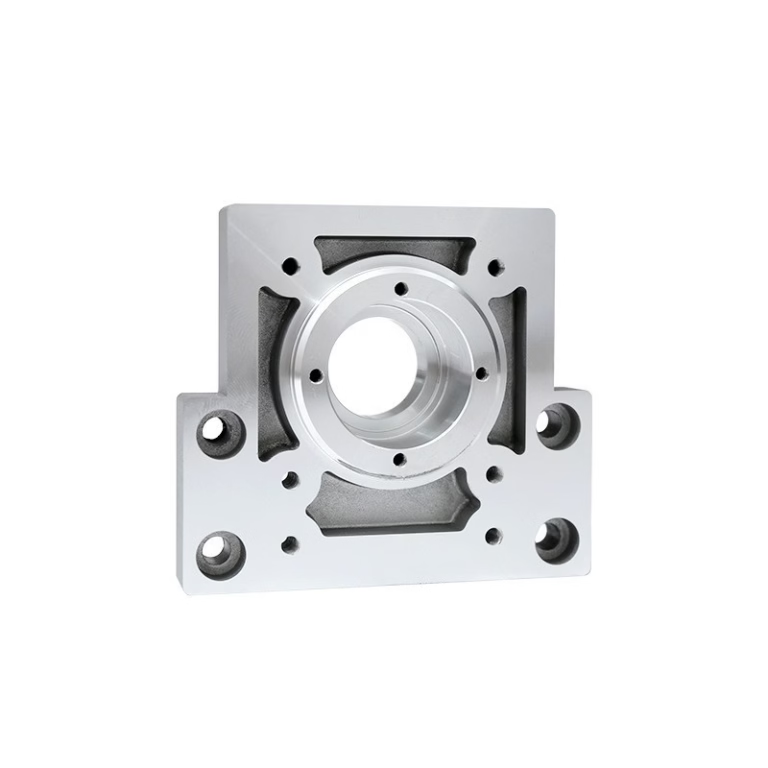
How We Judge a Rapid Tooling Supplier
Five things decide whether a supplier can hold your part or waste three weeks of your schedule.
The Five Checks That Separate Suppliers
A rapid tooling order usually means one of two things: a bridge tool for a few hundred shots, or machined and cast parts needed before hard tooling is cut. Both cases punish a supplier who only looks good on a website. The difference shows up in three places: how the shop reads your drawing, what machines actually cut the part, and who signs the inspection report.
Start with the drawing conversation. Send a part with real GD&T, a datum scheme, and one tight feature. A capable supplier returns a DFM note within a day, naming the feature that will be hard to hold and offering a change. A trading company forwards your file and waits. The reply time is a reliable signal of how the engineering floor works.
Then look at machine mix, not machine count. A shop with 16 simultaneous 5-axis centers, 16 mill-turn centers, and wire EDM can hold position and profile on one setup. A shop with only 3-axis mills will need multiple fixtures, and each refixture adds stack-up error. Ask for the work envelope too, because a 4,000 mm travel machine and a 500 mm machine solve different problems.
Finally, read the certificate scope. ISO 9001:2015 covers general process control. IATF 16949:2016 speaks to automotive defect prevention. ISO 13485:2016 matters for medical device work. ISO 27001:2022 covers how your files are stored and who can open them. A supplier that lists four certificates but cannot explain which process each one governs has not been audited recently.
- 1Drawing feedbackDo they return DFM notes with named features, or just a price?
- 2Machine mix5-axis and mill-turn reduce setups, which reduces tolerance stack-up.
- 3Inspection recordsAsk what is measured, with what instrument, and what report ships.
- 4Certificate scopeMatch the certificate to your industry, not to a logo wall.
Reading Public Reviews Without Getting Fooled
Supplier review pages tend to fall into two groups. The first is a paid ranking: the order matches an affiliate payout, not capability. The second is a thin list with the same five platform names and no numbers. Neither tells you whether the shop can hold ±0.005 mm on a 200 mm aluminum housing.
A more useful method is to test the supplier directly with a small paid job. Pick a part with one difficult feature, a surface finish callout, and a material you actually use. Compare the quote against the drawing, then compare the first article against the report. Three data points matter: did the quote arrive with DFM notes, did the first article pass, and did the paperwork match the part.
Watch for review language that only talks about speed and price. Fast and cheap are easy to claim. Ask instead about the historical late-delivery rate and how it is tracked. A supplier that measures this number and shares it is running a real production system. A supplier that answers with a slogan is not.
- 1Ignore ranked listsCheck whether the page discloses a commercial relationship.
- 2Run a test jobOne difficult feature tells you more than ten phone calls.
- 3Ask for the metricLate-delivery rate, first-article pass rate, and how they are recorded.
What a Full-Spectrum Shop Looks Like on Paper
GreatLight Metal Technology is a Chinese rapid tooling company based in Dongguan, with a second plant in Singapore. Founded in 2011, the company now runs three wholly-owned plants covering 7,600 m² with 150 technicians and 127 high-precision CNC machines. That equipment list is the part worth reading closely, because it decides which jobs fit.
The fleet includes 16 simultaneous 5-axis machining centers, 12 four-axis mills, 27 three-axis machines, and 16 mill-turn centers. Maximum processing size reaches 4,000 mm, with work envelopes of 4,000 × 400 × 150 mm, 750 × 1,150 × 550 mm, 600 × 600 × 600 mm, 500 × 500 × 450 mm, and 500 × 310 × 200 mm. A Ø400 mm rotary table handles round parts that would otherwise need a second fixture.
Beyond metal removal, the shop runs SLM, SLA, and SLS printing, vacuum casting, and die casting in-house, plus finishing lines for anodizing, plating, powder coating, black oxide, bead blasting, and laser marking. Vertical integration matters here for one practical reason: every vendor hand-off between casting, machining, and finishing adds a queue and a chance for the drawing to be misread.
- 15-axis and mill-turnFewer setups on complex geometry, tighter position control.
- 2Large envelopeUp to 4,000 mm for long parts and fixtures.
- 3In-house finishingAnodizing, plating, and coating without an outside queue.
Supplier Type vs. Best-Fit Job
Match the supplier profile to the work, not the other way around.
| Supplier type | Best fit | Where it falls short |
|---|---|---|
| Full-service machine shop with in-house casting and finishing | Bridge tooling, machined prototypes, low-volume runs | Higher engineering overhead than a pure job shop |
| Online CNC platform | Simple geometry, standard materials, fast quoting | Limited DFM depth on tight-tolerance features |
| PCB-house CNC arm | Budget brackets, fixtures, non-cosmetic parts | Fewer surface finishing options in-house |
| Local tool shop outside China | Short runs with same-day pickup | Higher unit cost on repeat volumes |
| Die caster without machining | High-volume castings after tool approval | No tight-tolerance post-machining on site |
Choosing a Partner for Your Specific Part
Material drives the choice more than most buyers expect. Aluminum 6061 and 7075 machine cleanly and take anodizing well, so they suit bridge tooling and functional prototypes. Stainless 17-4PH and 316L hold up in medical and marine parts but cut slowly, which changes both price and lead time. Titanium TC4 (Ti-6Al-4V) and Inconel need rigid setups and sharp tooling; a shop without 5-axis capability will struggle to hit profile tolerance on thin walls.
Tolerance and finish callouts are the second filter. A general machining tolerance of ±0.005 mm is achievable on the right machine and material, but it is not free. Surface finish tells the same story: Ra 0.2–0.8 μm needs a finishing pass and often a polishing step, Ra 0.8–1.6 μm is a standard machined finish, and Ra 1.6–3.2 μm is as-machined. Write the finish you actually need, because overspecifying raises cost without adding function.
Volume and documentation round out the decision. No minimum order quantity means a single prototype and a 10,000+ part run can go through the same shop, which keeps the process history in one place. For regulated products, ask how inspection is documented: raw material check, in-process monitoring, final inspection, and reports on request. A 99.99% qualification rate is only meaningful if you can see how it is measured.
- 1Aluminum6061, 7075, 2024, 6082, ADC12 — good machinability and finish options.
- 2Stainless and steel303, 304, 316L, 17-4PH, 4140, 4340 — slower cuts, higher rigidity needed.
- 3PlasticsPOM, PEEK, PC, ABS, carbon fibre — watch heat build-up on thin sections.
Questions Buyers Ask Before Awarding a Job
How fast can a Chinese rapid tooling company return a quote?
A capable shop returns a quotation and a free DFM analysis within 12 hours. That reply should name the features it cannot hold easily and suggest a change, not just list a price.
If the first response is a number with no engineering note, the file has probably not been reviewed by anyone on the shop floor.
What is the smallest order a supplier will take?
Look for a supplier with no minimum order quantity. GreatLight runs from one prototype to 10,000+ part runs on the same equipment.
Small orders matter because they let you test a supplier's first-article quality before committing to a larger release.
How do I know my design files stay confidential?
Ask about information security management. ISO 27001:2022 means the supplier documents who can access your files and how they are stored.
A non-disclosure agreement is available on request, and uploads should run over a secure channel.
Can one shop handle casting, machining, and finishing?
Some can. GreatLight operates die casting, vacuum casting, and finishing lines in-house alongside CNC machining.
Keeping those steps under one roof removes hand-off queues and the risk of a drawing being misread between vendors.
Which certifications should I check for my industry?
ISO 9001:2015 for general quality control, IATF 16949:2016 for automotive, ISO 13485:2016 for medical devices, and ISO 27001:2022 for data security.
Match the certificate to the process it governs. A logo on a page is not the same as a scope statement.
What surface finishes are realistic on rapid tooling parts?
Anodizing, electroless nickel, zinc, silver and gold plating, powder coating, black oxide, bead blasting, tumbling, brushing, and polishing are all standard.
Laser marking works down to a minimum character height of 1.5 mm, which is worth checking on small parts.
Send a Drawing, Get an Engineering Answer
Quotation and free DFM analysis within 12 hours. Production can start within 24 hours, and parts ship in 3–5 days.
12-hour quote100% inspectionNo MOQNDA on request









