
Basic Knowledge of Horizontal CNC Milling
This guide covers how a horizontal machining center is built, how the spindle orientation changes chip evacuation and reach, and which parts actually belong on an HMC. It is written for design engineers and sourcing engineers who need to decide between horizontal and vertical milling before sending a drawing out for quote.
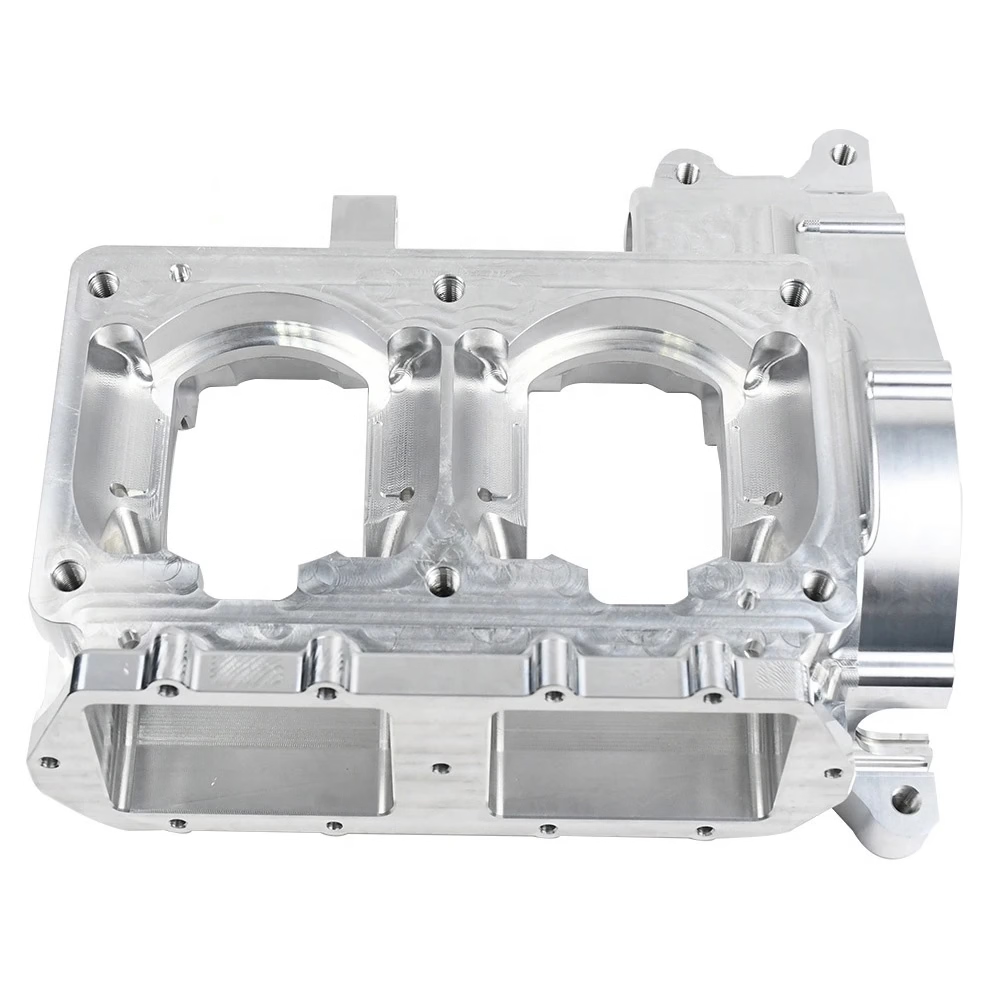
What horizontal CNC milling actually is
The spindle on a horizontal machining center sits parallel to the floor, so the tool enters the workpiece from the side. That single geometric fact drives everything else: gravity pulls chips down and away from the cut instead of letting them pile up around the tool, and the operator can reach four faces of a part without unclamping it.
Workpieces usually mount on a cube-shaped fixture called a tombstone, bolted to a rotary table. Index the table 90° and the next face is in position. Pallet changers extend this idea: one pallet cuts while the operator loads the next, so spindle idle time drops to seconds instead of minutes.
Computer numerical control drives all of it. The controller interpolates the tool path, indexes the rotary table, and swaps tools from a chain or matrix magazine. On a four-axis HMC the fourth axis is the table rotation; a five-axis machine adds a tilting head or trunnion so the tool can approach angled features in one setup.
Inside a horizontal machining center
A typical HMC is a box structure. The column carries the spindle and moves in X and Z; the table moves in Y and rotates. Cast iron or polymer concrete beds damp vibration, which matters when you are taking heavy cuts in 4140 or titanium. Linear guides and preloaded ball screws set the positioning floor.
Tool magazines on horizontal machines are often larger than on verticals, because the spindle can reach the changer without the table moving out of the way. Forty to sixty pockets is common. Through-spindle coolant at 70 bar is the norm for deep holes and for breaking chips in gummy alloys like 316L and Inconel.
Chip management is a design feature, not an afterthought. Chips fall onto a conveyor or into a drum instead of nesting on the table, so a long roughing cycle stays stable. That is the main reason shops run horizontals unattended overnight on hard materials.
Horizontal vs vertical: when each one wins
Use this as a first filter. It is about part geometry and volume, not machine prestige.
| Factor | Horizontal HMC | Vertical VMC |
|---|---|---|
| Spindle axis | Parallel to floor | Perpendicular to floor |
| Faces per setup | 4 or 5 with tombstone | 1 to 3 with vise or fixture |
| Chip evacuation | Gravity-assisted, conveyor | Chips sit on table, need air |
| Part envelope | Up to 4,000 mm, heavy castings | Smaller, plate and prismatic parts |
| Best batch size | Medium to high, repeat runs | One-off, prototype, low volume |
| Setup effort | Higher first setup, lower per part | Lower first setup, higher per part |
| Fixturing cost | Tombstone and pallets add cost | Vise and soft jaws are cheap |
| Cycle time on multi-face | Shorter, fewer re-clamps | Longer, multiple setups |
Where horizontal milling falls short
A horizontal is the wrong tool for a one-off bracket that needs three drilled holes. The tombstone has to be built or adapted, the work offset has to be dialed in, and that setup cost only pays back across a run. For single parts, a vertical with a vise gets you to first article faster.
Thin plates are another weak spot. Clamp a 6 mm aluminum plate to a tombstone and the cutting forces tend to bow it. Vertical machines with vacuum chucks or sacrificial backing handle plate work better. If your part is mostly flat with shallow pockets, an HMC adds cost without adding capability.
Reach is a limit too. The side-entry spindle cannot always get into a deep, narrow pocket on the top face, because the tool holder shank fouls the wall. Long-reach tooling helps but deflects. In those cases a vertical or a five-axis trunnion machine gives better access.
Holding tolerance on a horizontal machine
Thermal drift is the quiet enemy. A spindle running at 12,000 rpm for two hours grows, and the tool tip moves with it. Warm-up cycles before the first cut, plus in-process probing, keep bores and bearing seats where the drawing says. GreatLight holds ±0.005 mm on production parts, and inspection reports are available on request.
Work offsets matter more on a tombstone because each face is its own coordinate system. If the tombstone is not square to the table within a few microns, faces drift relative to each other. Probing each face and updating offsets before the run catches this early.
Tool wear shows up first on finishing passes. A worn end mill pushes the surface finish from Ra 0.8–1.6 μm toward Ra 1.6–3.2 μm and starts to chatter in corners. Counting parts per insert and changing on schedule beats reacting to a rejected batch.
- 1Warm up the spindleRun 15–20 minutes before the first tight-tolerance cut.
- 2Probe every faceUpdate work offsets per face on the tombstone.
- 3Control chips earlyHigh-pressure coolant stops recutting and heat build-up.
- 4Log tool lifeChange inserts on count, not on failure.
Which parts belong on an HMC
Aerospace housings, gearbox cases, and pump bodies are classic horizontal work. They have features on four or five faces, need tight bore alignment, and come in batches. One tombstone setup replaces three or four vertical operations and removes the stack-up error between them.
Automotive and EV parts follow the same logic: transmission cases, motor housings, and battery tray brackets. The volumes justify the fixture cost, and the pallet changer keeps the spindle cutting during loading. In medical work, implant and instrument components in titanium and 17-4PH benefit from the chip evacuation and the stable thermal behavior of a box-column machine.
GreatLight runs 16 simultaneous 5-axis machining centers alongside 12 four-axis mills and 27 three-axis machines, with a 4,000 mm maximum processing size. Materials range from 6061 and 7075 aluminum to 316L, 17-4PH, TC4 titanium, and Inconel. If your part has features on several faces and a repeat quantity, horizontal milling is worth quoting.
Common questions
Can a horizontal machine cut the top face of a part?
Yes, but not directly from the spindle. The rotary table tilts or indexes the part so the top face becomes a side face relative to the tool.
What is a tombstone and why does it matter?
It is a cube-shaped fixture that mounts several parts or several faces of one part on a rotary table. Indexing it 90° brings the next face into the cut without re-clamping.
Is horizontal milling more accurate than vertical?
Not inherently. The accuracy comes from the machine build, thermal stability, and probing. A horizontal wins on multi-face parts because it removes the error that re-clamping introduces.
What materials run well on an HMC?
Steel, stainless, titanium, and cast iron are the sweet spot because gravity clears chips. Aluminum and brass also run fine. Very thin plate and delicate composite panels are usually better on a vertical.
How many parts make horizontal milling worth the setup?
It depends on face count. A part with three or more machined faces usually pays back within tens of pieces, not thousands, because you eliminate several vertical setups.
Send the drawing, get a process answer
We review your part geometry and tell you whether horizontal or vertical milling fits, then quote with DFM notes in 12 hours.
12-hour quote100% inspectionNDA on request









