
Axis CNC Machining Services: Choosing 3, 4 or 5 Axes
This page explains what each axis count actually buys you in a machined part, where the setup count and tolerance stack change, and which geometries justify the higher hourly rate. Written for design engineers and sourcing engineers who have to pick a process before the drawing is released.
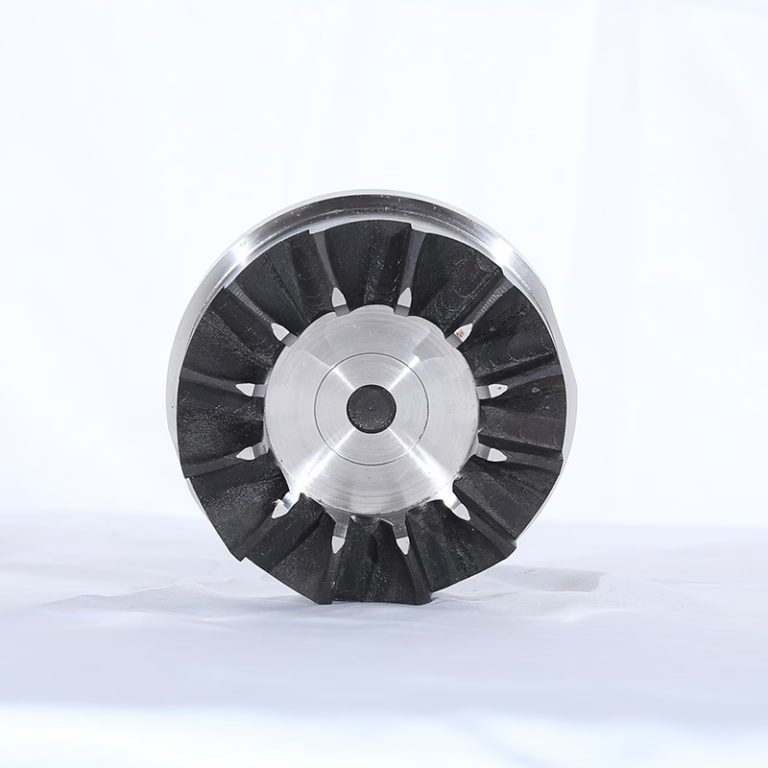
The axis decision is a setup decision
More axes do not make a part better. They remove setups, and setups are where error and cost accumulate.
What the axes actually do
A 3-axis mill moves the tool in X, Y and Z. The tool always points down. That single constraint decides everything else: any face the tool cannot reach from above needs a second setup, a fixture, and a re-datum. Two or three setups on a tight part can eat more time than the cutting itself.
Adding a fourth axis puts the work on a rotary table. Now the part can index around one axis, usually A or B, so four sides get machined without unclamping. Holes on a bolt circle, slots around a shaft, and side pockets all become one-setup features. Position repeatability of the rotary table matters more than the table diameter for most work.
Five axes add a second rotary on top of a trunnion or a swivel head. During cutting, the two rotaries move in coordination with the three linear axes. The tool can stay normal to a curved surface while it cuts, instead of stepping across it. That is the difference between a faceted surface and a true contoured one.
- 13-axisPrismatic parts, flat faces, through holes, one or two setups.
- 24-axisCylindrical and box parts, features on several sides, indexing between cuts.
- 35-axisFreeform surfaces, deep cavities, undercuts, compound angles.
Simultaneous 5-axis versus 3+2 positioning
Two very different processes share the label 5-axis. In 3+2 positioning, the rotaries tilt the part to an angle, lock, and the cut happens in three axes. The machine has five axes but only three move while cutting. This is fast, rigid, and cheap to program. Most angled holes and flat faces at compound angles belong here.
In simultaneous machining, all five axes move at once. The post processor has to keep the tool axis, the feed rate at the contact point, and the machine kinematics in agreement. Programming takes longer and the machine is slower, but this is the only way to cut a continuous blade surface or a deep rib without witness marks.
The practical question is whether your surface needs to be continuous. If the drawing calls out a profile tolerance of ±0.02 mm across a curved surface, positioning will leave steps. If the surface is a cosmetic blend or a flow path, simultaneous is the right call. If it is a flat face at 37°, positioning wins on cost every time.
Axis count compared on the shop floor
Typical values for aluminum and stainless work in the 100-600 mm size range.
| Factor | 3-axis | 4-axis | Simultaneous 5-axis |
|---|---|---|---|
| Setups for a 5-face part | 3 to 4 | 2 | 1 |
| Achievable tolerance | ±0.005 mm | ±0.005 mm | ±0.005 mm |
| Compound-angle holes | Needs a fixture | Good | Overkill |
| Freeform surface finish | Faceted | Faceted | Continuous |
| Programming effort | Low | Medium | High |
| Best batch size | 1 to 10,000+ | 50 to 5,000 | 1 to 500 |
Where each process fits, and where it does not
Simultaneous 5-axis earns its rate on parts with deep pockets and thin walls. A mold insert with a 6:1 depth-to-width cavity cannot be reached by a 3-axis tool without long reach holders that chatter. Tilting the tool keeps the flute length short and the cut stable. The same logic applies to impellers, turbine blades and heat-sink fins.
Undercuts and re-entrant features are the second clear case. If a feature is hidden behind a wall, no 3-axis setup will reach it. You either split the part, add a cross hole, or move to five axes. Splitting adds a joint and a leak path. Five axes keeps the part monolithic, which is usually what the designer wanted in the first place.
The process does not fit every job. Simple brackets, plates, and turned shafts are cheaper on 3-axis or a lathe. Small batches of prismatic parts rarely justify the setup cost of a trunnion fixture. If the geometry is reachable in two setups, extra axes add hourly rate without removing any work. We quote both ways when the drawing is borderline.
What to check before you award the order
Machine count is not the same as capacity. Ask how many of the five-axis machines run simultaneous control and how many are 3+2 positioners. A shop with 16 simultaneous centers and a Ø400 mm rotary table can take on a wider range than a shop with two. The size envelope matters too: our largest five-axis travel is 4,000 × 400 × 150 mm, which suits long extrusions and rails rather than large blocks.
Ask how the shop proves the part. Five-axis work hides error in the rotary alignment, and a machine that is out of square will still cut a smooth-looking surface. We check raw material on arrival, monitor in process, and inspect 100% before shipment, with reports on request. First article inspection on a five-axis part should include the rotary center position, not just the linear dimensions.
Certifications tell you what management system is in place, not what the machine can do. For medical work we hold ISO 13485:2016; for automotive, IATF 16949:2016; for information security on customer files, ISO 27001:2022; and ISO 9001:2015 as the base. These matter when your own quality system has to audit the supplier. They do not replace a capability study.
Finally, ask what happens when the geometry is wrong. A shop that runs DFM analysis before quoting will flag a 0.5 mm corner radius that needs a 0.4 mm tool, or a wall too thin to hold against cutting force. We return quotation and free DFM notes within 12 hours, and production can start within 24 hours of approval.
- 1Simultaneous controlConfirm the machine moves five axes at once, not just positions them.
- 2Rotary table sizeØ400 mm table sets the practical part envelope.
- 3Inspection planRotary center and datum check on the first article.
- 4DFM feedbackFeature-level notes before the order, not after.
Common questions
Is 5-axis machining more accurate than 3-axis?
Not by itself. The tolerance is set by the machine, the tool and the fixturing, and we hold ±0.005 mm on all three configurations.
The accuracy gain comes from removing setups. Every re-clamp adds a datum shift, and those shifts stack. One setup removes that stack entirely.
When is 3+2 positioning better than simultaneous cutting?
When the features are flat or cylindrical and the angles are fixed. Positioning is faster and the tool stays rigid because the rotaries are locked.
Compound-angle holes, angled pads and side faces in a single setup are the classic cases. It also costs less to program.
What part sizes can you machine?
Our five-axis travel goes up to 4,000 × 400 × 150 mm for long parts, and 750 × 1,150 × 550 mm and 600 × 600 × 600 mm for medium work.
Compact cells cover 500 × 500 × 450 mm and 500 × 310 × 200 mm. The rotary table is Ø400 mm.
Which materials are available?
Aluminum grades 6061, 6061-T6, 2024, 5052, 5083, 6063, 6082, 7075 and ADC12; stainless 303, 304, 316, 316L, 420, 430, 431, 440C and 17-4PH; steels 1018, 1045, 4130, 4140, 4340 and A36.
We also machine titanium TA1, TA2 and TC4, Inconel, magnesium AZ31B and AZ91D, plus copper alloys and engineering plastics such as PEEK and POM.
Do you have a minimum order quantity?
No. We run from one prototype to 10,000+ part runs on the same process.
Uploads are secure and confidential. An NDA is available on request before you send drawings.
How fast can parts ship?
Quotation and free DFM analysis come back within 12 hours. Production can start within 24 hours of approval, and parts normally ship in 3-5 days.
That depends on material availability and finishing. Anodizing, plating and powder coating add time on top of the machining window.
Send the drawing, get a process recommendation
We quote the axis count that fits the geometry, not the one with the highest rate, and return DFM notes with the price.
12-hour quote100% inspectionNDA on request









