
ATC CNC Basics: How Automatic Tool Change Works
This guide covers the hardware, control logic and tooling rules behind automatic tool change, written for engineers and buyers specifying machined parts. Read it to judge which configuration fits a job, and when a tool changer adds nothing.
From spindle taper to tool offset
One spindle, many tools, and a control system that has to keep track of every one of them.
What an automatic tool changer actually does
An automatic tool changer moves cutting tools between a storage magazine and the spindle without an operator opening the machine door. On a manual mill, changing from a Ø12 mm end mill to a Ø6 mm drill means stopping the program, releasing the drawbar, wiping the taper, seating the new holder and re-zeroing the length offset. That sequence takes minutes and introduces human error every time.
The changer removes that sequence from the operator's hands. The program calls a tool number, and the machine performs the swap, verifies the holder is seated and applies the stored length and diameter offsets. Cycle time drops, and more importantly, the process becomes repeatable. Two operators running the same program get the same result.
The payback is not only speed. Tool change time on a typical 20-tool vertical mill runs 3 to 8 seconds per swap. A job with 12 tools and 200 tool changes per shift saves roughly 40 minutes of spindle-idle time per shift. On high-mix work, the real gain is that nobody forgets to reset an offset.
- 1Spindle idle timeEach swap costs 3–8 seconds; the count adds up fast on multi-tool parts.
- 2Offset disciplineLength and diameter offsets load automatically with the tool number.
- 3RepeatabilityThe same program produces the same result across operators and shifts.
Anatomy of a tool change: magazine, arm, spindle
A tool change is a chain of mechanical events, and every link has a tolerance. The magazine indexes the requested pocket to the exchange position. The arm grips the old holder in one claw and the new holder in the other. The spindle stops, orientates to a fixed angular position, and releases the drawbar. The arm pulls both holders out, rotates 180°, and pushes the new holder into the taper.
The spindle taper is where accuracy lives. A BT30 or HSK-A63 holder seats on a ground taper, and any chip or coolant film on that surface becomes runout at the tool tip. Machines with air-blast taper cleaning reduce this risk. So does a clean, dry holder kept in a covered magazine.
The drawbar holds the holder with a Belleville spring stack. If spring force drops, the holder creeps under load and the cut goes off-size. Drawbar force is a maintenance item, not a one-time setup value.
- 1MagazineIndexes the pocket; chain, drum or matrix layouts change capacity and speed.
- 2Change armTwin-claw arm swaps holders in one 180° rotation.
- 3DrawbarSpring force clamps the holder; it must be checked on a schedule.
- 4Taper interfaceBT, HSK or Capto; cleanliness here sets tool runout.
Tool changer types and what they suit
Tool changers are usually sorted by magazine layout, because that layout drives capacity, swap speed and floor space. Drum and umbrella magazines sit close to the spindle and swap in a few seconds, but they hold 8 to 24 tools. Chain magazines hold 30 to 60+ tools and index more slowly. Matrix or shelf magazines serve large gantry and five-axis machines where the spindle travels to the tool.
The choice follows the part, not the catalog. A shop cutting one family of aluminum brackets needs 10 tools and fast swaps. A job shop running medical housings, fixtures and prototype work needs 40 tools resident so it can switch jobs without pulling holders by hand.
There is a second axis to the decision: whether the machine changes tools with the spindle stationary or on the move. Some five-axis centers pick tools from a shelf while the table indexes, which hides part of the change time. That matters on long cycle parts with many features.
- 1Umbrella / drum8–24 tools, fast swaps, compact footprint. Best for repetitive 3-axis work.
- 2Chain30–60+ tools. Suits high-mix shops and long lights-out runs.
- 3Matrix / shelfLarge capacity on gantry and five-axis machines; spindle travels to the tool.
Matching a tool changer to the job
Use this to narrow the configuration before quoting a part.
| Machine type | Typical magazine | Swap time | Good fit |
|---|---|---|---|
| 3-axis vertical mill | Umbrella, 8–24 tools | 3–6 s | Repetitive brackets, plates, simple housings |
| 4-axis horizontal | Chain, 30–40 tools | 5–10 s | Multi-face parts in one setup |
| 5-axis simultaneous | Matrix or chain, 30–60+ tools | 6–15 s | Complex contours, impellers, medical parts |
| Mill-turn center | Drum with live-tool pockets | 4–8 s | Shafts and parts needing turn plus mill |
| Large gantry | Shelf, 20–40 tools | 10–20 s | Long parts up to 4,000 mm |
Why five-axis work leans on tool changers
Five-axis machining reaches undercuts, compound angles and contoured surfaces that a three-axis machine cannot touch without multiple fixtures. Re-fixturing a part two or three times costs setup hours and stacks tolerance. A tool changer lets the same setup carry 20 or 30 tools, so the part is finished in one clamping.
The combination also changes tool strategy. A five-axis path can use a short, stiff tool held at a better angle instead of a long tool reaching from one direction. Shorter tools deflect less, which helps hold ±0.005 mm on thin walls and deep pockets.
On our 16 simultaneous five-axis centers, an ATC and a Ø400 mm rotary table work together so the tool changes while the table is still positioning. That overlap is where the cycle time actually comes from on contoured parts.
Keeping a tool changer reliable
Most tool changer faults trace back to three things: chips on the taper, low drawbar force and worn arm grippers. None of them announce themselves until a part is scrapped or a holder drops. Scheduled checks catch them early.
Runout checking at the tool tip is the fastest daily signal. If runout creeps up on a holder that used to run true, the taper or the holder needs attention. Drawbar force should be measured against the machine builder's spec on a fixed interval, and the Belleville stack replaced when it falls short.
Tool data discipline matters as much as hardware. A holder loaded into the wrong pocket, or a tool number with a stale length offset, will cut air or crash. Many shops keep holders pre-set offline and verify offsets at the machine before the first cut.
- 1Taper cleanlinessWipe holders, use air blast, keep the magazine covered.
- 2Drawbar forceCheck on schedule; replace the spring stack when it drops.
- 3Arm grippersInspect for wear; a loose grip misaligns the holder.
- 4Offset verificationConfirm length and diameter offsets before the first cut.
Where automatic tool change pays off, and where it does not
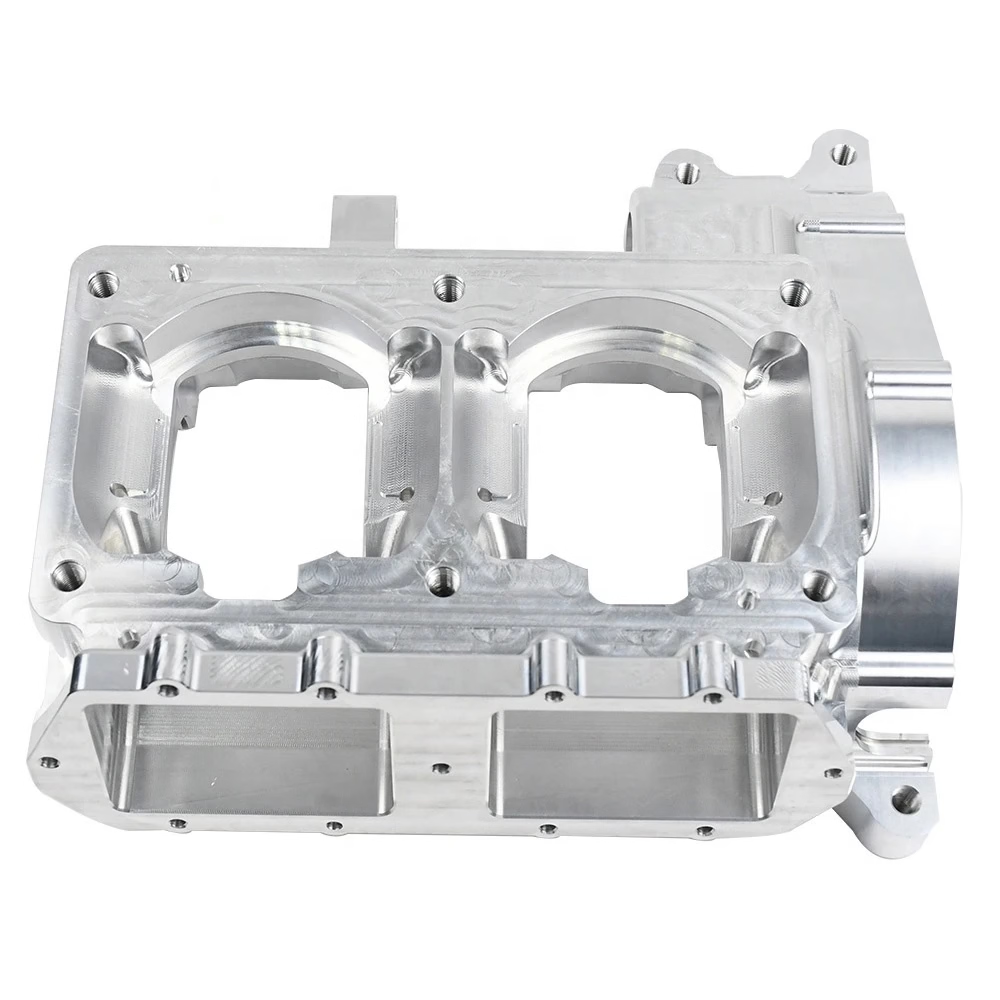
The clearest payback is a part with many features and several tools: a machined aluminum housing with drilled, tapped, bored and contoured faces. Every tool change is a chance for the operator to make a mistake, and the changer removes that chance.
Materials change the calculus only slightly. Aluminum 6061 and 7075 cut fast and let the machine spend more time in the cut between swaps. Stainless 316L and 17-4PH wear tools faster, so more tool changes per part and more offset management. Titanium Ti-6Al-4V and Inconel need conservative speeds and frequent tool replacement, which is exactly where a magazine pays for itself.
Where it does not pay off: one-off parts with two or three tools, rough plate work held to loose tolerance, and jobs where the setup dominates cycle time. Adding a large magazine to that work just adds maintenance surface.
- 1Good fitMulti-feature parts, high-mix job shops, lights-out runs.
- 2Marginal fitTwo-tool jobs, one-off roughing, loose-tolerance plate.
- 3Material noteWear-resistant alloys increase tool changes and reward a big magazine.
Common questions about ATC CNC
How many tools should a job keep resident in the magazine?
Count the tools the part actually needs, then add the tools for the next job you plan to run on the same setup. If that total sits near the magazine capacity, move up a size.
Running a magazine at 100% full removes any slack. A holder out for regrinding can stall the setup.
Does a tool changer change achievable tolerance?
Not directly. Tolerance comes from the machine, the fixture, the tool and the cutting conditions. What the changer does is remove the offset errors that creep in when tools are swapped by hand.
A clean taper, correct drawbar force and verified offsets keep the process inside ±0.005 mm. A dirty taper will not, no matter how good the machine is.
What is the difference between a drum magazine and a chain magazine?
A drum or umbrella magazine sits close to the spindle and swaps in a few seconds, but holds fewer tools. A chain magazine carries 30 to 60+ tools and indexes more slowly.
Choose by tool count first, then by cycle time. On short cycles, the slower index shows up in the numbers.
Can a tool changer handle a probe or a special holder?
Yes, if the holder shank matches the machine taper and the magazine pocket can carry the weight. Probes and large face mills often need a dedicated pocket and a reduced index speed.
Confirm the pocket assignment with the machine builder's limits before loading anything unusual.
What causes a tool changer to miss a tool?
Usually a chip on the taper, a worn arm gripper or a pocket that was not indexed fully. Some faults come from a stale tool offset in the control.
The fix is routine: clean the taper, inspect the grippers, and verify the pocket map after any manual intervention.
When is a tool changer not worth it on a project?
When the part needs two or three tools, when the setup time dominates the cycle, or when tolerances are loose enough that manual swaps are fine.
In those cases a simple machine with good fixturing is faster to set up and cheaper to maintain.
Send the drawing, get a manufacturability read
Upload your CAD files and our engineers will review tool access, tool count and fixturing before quoting.
12-hour quote100% inspectionNDA on request









