
Are Used CNC Lathe Machines Worth It?
This guide is for engineers and shop owners weighing a second-hand turning center against sending the work out. It covers what actually drives the cost per part, which checks separate a sound machine from a worn one, and the point where outsourcing wins.
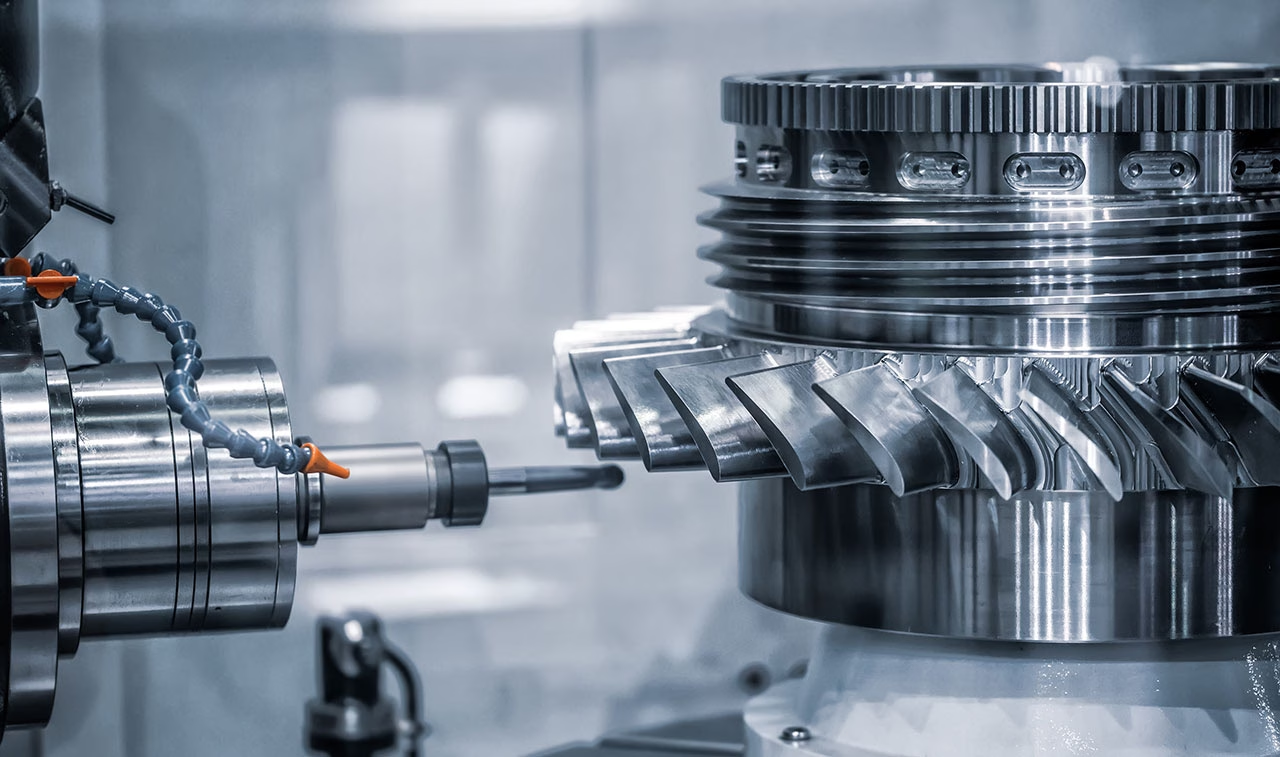
The short answer depends on your part mix
A used lathe is cheap to buy and expensive to be wrong about.
Where a used lathe pays off
A used CNC lathe makes sense when your part family is stable and your annual volume is high enough that machine time, not purchase price, sets your cost. A turning center that runs 4,000 hours a year at a low hourly rate will beat a new machine on cost per part for years, provided it holds tolerance and does not sit waiting for a repair.
The financial argument is straightforward. A used machine has already taken its largest depreciation hit, so resale value stays flat. If you buy at a fair price and sell in three years, the machine may cost you less than the rent on the floor space it occupied. That is real money for a shop that expects to grow out of the machine.
Availability matters too. Most used lathes can be rigged and cutting within days of delivery. New builds and installations can run into weeks or months, which is a problem when a customer wants first articles next month.
- 1Stable part familySame diameters, same material, same tolerances month after month.
- 2High machine utilizationTwo shifts or more, otherwise the hourly rate never amortizes.
- 3In-house turning know-howSomeone on staff can program, set up and diagnose the control.
- 4Floor space and powerYou have the footprint, the transformer and the coolant handling.
What actually goes wrong with a used lathe
The purchase price is the smallest number in the deal. Spindle bearings, ball screws, linear guides, turret indexing, hydraulic units and the control itself all wear. A machine that turns a test bar quietly can still fail a 50-part run because the X-axis ball screw has backlash that only shows up under thermal growth.
Controls are the other trap. An older control may still run, but replacement boards, drives and servo motors get harder to source every year. If a single board is the only thing keeping the machine alive, you are one failure away from a machine-shaped paperweight. Ask for the control model, the software version and the last time a board was replaced.
Geometry is not negotiable. A lathe with worn bed ways or a twisted bed will cut a taper over 300 mm even if the spindle is perfect. That error does not show up on a single short test cut. It shows up when the customer measures the part on a CMM.
- 1Spindle runoutIndicator on a test bar, cold and after a 30-minute warm-up.
- 2BacklashCommand small increments in X and Z and read the indicator.
- 3Turret repeatabilityIndex 20 times and check tool position with a dial indicator.
- 4Control supportConfirm boards, drives and parameters are still obtainable.
Used lathe vs. new lathe vs. outsourcing
The right column is usually the one nobody wants to discuss.
| Factor | Used lathe | New lathe | Outsourced turning |
|---|---|---|---|
| Upfront cost | Low, already depreciated | High, full list price | None beyond part price |
| Time to first part | Days after rigging | Weeks to months | Quote in 12 hours, parts in 3–5 days |
| Accuracy risk | Unknown until measured | Known and warranted | Held to ±0.005 mm by contract |
| Best fit | High volume, simple family | High volume, tight tolerance | Low to mid volume, prototypes |
| Hidden cost | Repairs and downtime | Depreciation and install | Freight and margin in part price |
How to evaluate a specific machine
Bring an indicator, a test bar and a dial test indicator with a magnetic base. Do not rely on the seller's paperwork alone. Start cold: measure spindle nose runout and face runout, then run the spindle at 60 to 70 percent of its rated speed for 30 minutes and measure again. Thermal drift of more than a few microns tells you the bearings are on their way out.
Check backlash on X and Z by approaching a point from both directions. A few microns is normal on a used machine. Anything above 0.02 mm needs compensation in the control, and compensation hides a problem rather than fixing it. Watch the axis load meters while jogging. Spikes on a light cut mean the guideways or ball screw are damaged.
Run a real part, not a demo. Take a drawing with a tolerance that matters, ideally with a bore, a face and a thread on the same setup. Measure everything after the machine cools. If the seller will not let you cut a part to print, that is your answer.
Ask for the maintenance file: service records, alarm history, spindle hours, and any crash reports. A machine that has been crashed and repaired can still be a good buy, but only if you know what was replaced and who did the work.
- 1Spindle hoursA better wear indicator than calendar age.
- 2Alarm logRepeated servo or spindle alarms point to a chronic fault.
- 3Way and guide conditionLook for scoring, pitting and uneven wear marks.
- 4Tooling packageChucks, turret holders and bar feeders add real value.
When a retrofit makes sense and when it does not
Retrofitting a used lathe with a modern control, new drives and a new turret can extend its life by years. It also costs money, and the math only works when the mechanical structure is still good. If the bed is worn, a new control will faithfully command a worn machine to cut inaccurate parts.
A retrofit is reasonable when the iron is solid, the spindle is sound and the machine is a size you cannot buy new at a sensible price. It is not reasonable when the machine is a commodity model that you could replace with a running used unit for less than the retrofit bill.
There is also a skills cost. A new control means new programs, new post-processors and operator retraining. Shops underestimate this. The machine may be ready in six weeks, but the team may take six months to use it well.
When sending the work out is the better call
Plenty of shops should not buy a lathe at all. If your turning work is intermittent, if the parts change every quarter, or if your volumes sit between 50 and 2,000 pieces a year, an outside shop will usually deliver a lower total cost. You pay a margin, but you avoid capital, floor space, maintenance, tooling and the risk of scrapping a run on a machine you are still learning.
Outsourcing also buys capability you would not install yourself. Complex parts often need live tooling, sub-spindles or a second operation on a mill. A shop running 16 mill-turn centers and 16 simultaneous 5-axis machining centers can combine turning and milling in one setup, which removes a re-fixture and the position error that comes with it.
For prototypes and low-volume production, outsourcing is the default. There is no minimum order quantity at GreatLight, so a single prototype and a 10,000-piece run go through the same process. Quotation and a free DFM analysis come back within 12 hours, and production can start within 24 hours. Parts ship in 3–5 days.
Quality control is the part buyers forget. We inspect 100 percent of parts before shipment, with raw material checks, in-process monitoring and a final inspection, and reports are available on request. Holding ±0.005 mm and Ra 0.8–1.6 μm on a turned part is routine work, not a special request.
- 1Intermittent demandTurning work arrives in bursts you cannot schedule around.
- 2Mixed operationsParts need turning plus milling, drilling or a second face.
- 3Tight deadlinesYou need parts in days, not after a rigging and setup cycle.
- 4Material range316L, 17-4PH, Ti-6Al-4V, Inconel and engineering plastics.
Common questions
What is the average lifespan of a used CNC lathe?
There is no honest single number. Spindle hours, cut material and maintenance history matter far more than the year of manufacture. A lightly used machine cutting aluminum can run for many years; a machine that has spent its life in cast iron will show wear sooner.
Judge the machine on measured runout, backlash and guideway condition rather than on age. Those three checks tell you more than any service record.
How can I verify the maintenance history of a used CNC lathe?
Ask for the service log, alarm history and spindle hour meter, and cross-check the dates against the machine's own control log. Look for replaced ball screws, spindle bearings and drive boards.
Then verify by inspection. Pull covers, look at the guideways and ball screws, and run a test cut. Paperwork supports a decision; it does not replace measurement.
When should I choose a machining service over buying a used lathe?
Choose a service when your annual turning volume is low, your part mix changes often, or you need milling and turning on the same part. Capital equipment only pays back when it is loaded.
If you need parts within days and do not yet have programming and setup capacity in-house, an outside shop removes that whole ramp-up period.
Does GreatLight offer consulting for companies considering in-house CNC equipment?
We can review your drawings and volumes and give you a manufacturing opinion, but our role is production, not equipment brokerage. In practice, most teams get a faster answer by quoting the part first.
A quote shows the real cost per part at your volume. That number is the benchmark any machine purchase has to beat.
What industries does GreatLight serve?
We machine parts for aerospace, automotive and EV, medical devices, robotics and automation, electronics, industrial machinery and new energy.
The shop runs 127 high-precision CNC machines across three wholly-owned plants, with ISO 9001, IATF 16949, ISO 13485 and ISO 27001 certifications.
Can a used lathe hold the tolerances my drawings call for?
Sometimes, but it has to be measured to know. A sound machine with good bearings and guideways can hold ±0.005 mm on turned features. A worn one cannot, no matter how the control is programmed.
If your drawing includes tight bores, threads and faces on one setup, test the machine with a part that includes all three before you buy.
Send us the part, not the purchase order
Upload your drawing and get a quotation with a free DFM analysis within 12 hours. No minimum order quantity, from one prototype to 10,000+ parts.
12-hour quote±0.005 mm100% inspectionNDA on request









