
Application and Challenges of Processing and Milling Technology
A shop-floor view of where milling works well and where it fights back. Written for design engineers and buyers who need to judge a part before it reaches the machine. Read this and you can tell which features drive cost, which tolerances are realistic, and when to change the process instead of the cutter.
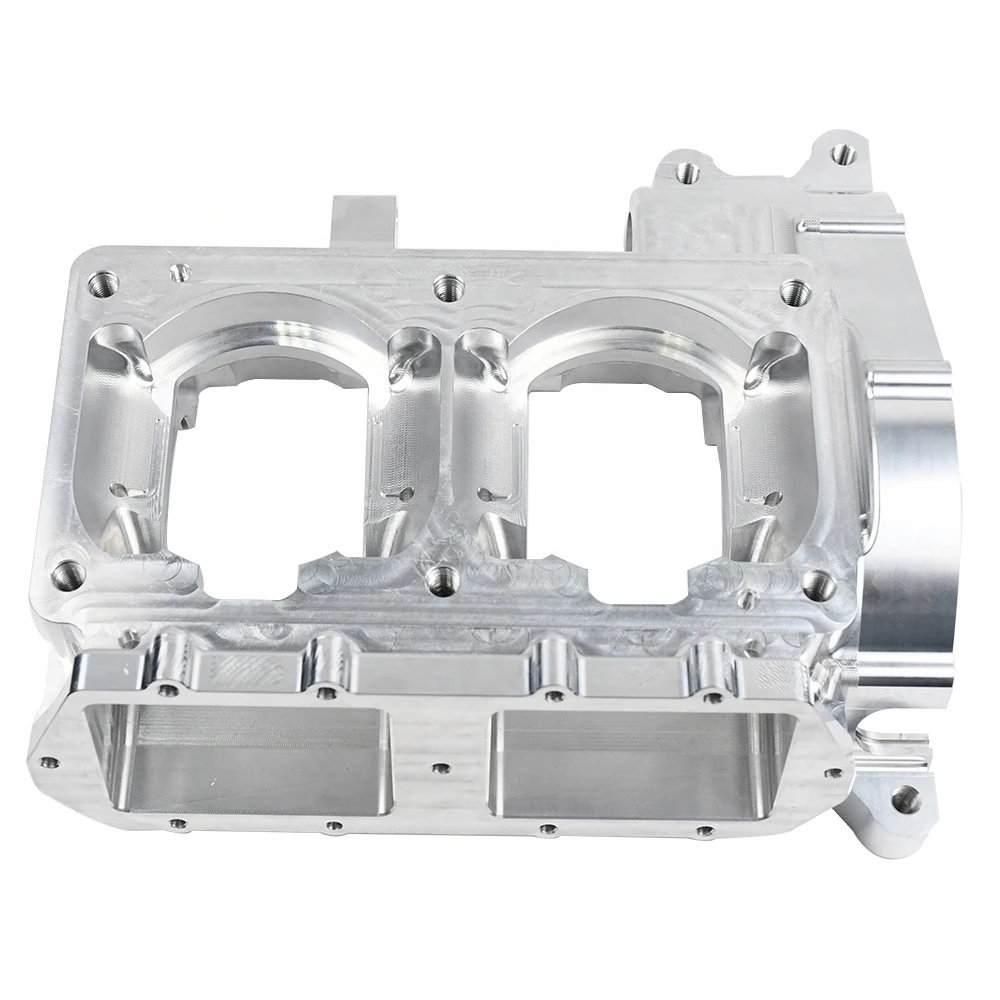
What this page covers
Milling is the default answer for prismatic metal parts. The interesting engineering happens at the edges of that default.
Where milling applies, and where it does not
Milling removes material with a rotating multi-tooth cutter while the part or the tool moves along controlled axes. That simple description covers a wide range of work: engine brackets, mold cavities, robot arms, medical housings, heat sinks, fixture plates. If a part has flat faces, pockets, slots, bosses, or holes that need positional accuracy, milling is usually the cheapest way to get there.
The process gets less comfortable as geometry turns round and deep. A shaft that is mostly a turned profile wastes machine time under a milling spindle. A pocket deeper than four times its cutter diameter forces long, thin tools that deflect and chatter. A part with undercuts on five sides may need 5-axis work or a second fixture. Those are not failures of milling, they are signals to re-plan.
The practical rule is simple. Milling wins when the tolerance is tight, the quantity is low to medium, and the geometry is mostly open. It loses when the feature is a deep bore, an internal thread, or a surface that a lathe can reach in one pass. We quote both routes when the choice is close, because the cheaper process is not always the obvious one.
- 1Good fitPrismatic parts with pockets, slots, flat sealing faces, bolt patterns.
- 2Good fitPrototypes and bridge tooling where no dedicated mold exists yet.
- 3Poor fitLong slender shafts better suited to turning or grinding.
- 4Poor fitDeep narrow bores where a drill or EDM reaches first.
The cutting parameters that decide the outcome
Surface speed, feed per tooth, axial depth, radial width. Four numbers that set everything downstream: tool life, surface finish, heat, and dimensional drift. Push surface speed too high in aluminum and you get built-up edge; too low in stainless and the tool rubs instead of cuts, which work-hardens the surface and ruins the next pass.
Feed per tooth matters more than most people expect. A cutter that is fed too slowly rubs the material and burns the edge. A cutter fed correctly takes a real chip, and the chip carries heat away from the part. That is why a heavier, confident cut often produces better finish and longer tool life than a timid one.
Axial and radial engagement set the cutting forces and the tendency to chatter. Full-width cuts in a deep slot are the hardest case on any machine. Reducing radial width to 30–40 percent of the cutter diameter and increasing axial depth spreads the load along the flute and lowers vibration. This is standard practice in high-efficiency milling and it is why the same part can run at very different cycle times on two machines.
Coolant choice follows the material. Aluminum and brass run dry or with air blast in many cases. Stainless steel, titanium and Inconel need flood coolant or high-pressure through-spindle coolant to control heat at the edge. Cast iron is usually cut dry because the graphite in the chip lubricates the cut. Wrong coolant choice shows up as thermal cracking on the insert or discoloration on the part.
Typical milling parameters by material
Starting points for roughing with carbide tooling. Finish passes run 20–40 percent faster with lighter engagement.
| Material | Surface speed (m/min) | Feed per tooth (mm) | Coolant | Notes |
|---|---|---|---|---|
| Aluminum 6061 | 300–600 | 0.10–0.25 | Air blast or flood | High speed, watch built-up edge |
| Stainless 304 | 80–150 | 0.05–0.12 | Flood, high pressure | Work-hardens if rubbed |
| Steel 1045 | 120–200 | 0.08–0.15 | Flood | Rigid setup matters most |
| Titanium Ti-6Al-4V | 40–70 | 0.04–0.10 | High-pressure flood | Heat at the edge, not the chip |
| Inconel 718 | 25–45 | 0.03–0.08 | High-pressure flood | Low speed, sharp edge, no dwell |
| Brass C36000 | 200–400 | 0.10–0.20 | Dry or mist | Free cutting, easy finish |
| POM / PEEK | 200–500 | 0.10–0.30 | Air blast | Sharp tool, high rake |
Chatter, deflection and thermal drift
Chatter is vibration between the tool and the workpiece. It leaves a patterned surface, wears the cutter unevenly, and can scrap a part on the final pass. The common causes are a long tool overhang, a thin wall, a weak fixture, or a spindle speed sitting on a natural frequency of the setup. The fix is rarely one thing: shorten the tool, add a support, change the speed, or reduce radial engagement.
Deflection is different. The tool bends under cutting force and cuts less than commanded. On a Ø10 mm end mill with 60 mm of overhang, a 0.05 mm deflection is easy to reach in steel. The pocket comes out tapered and the floor is not flat. Measuring the part after a spring pass tells you whether deflection or tool wear is the real cause.
Thermal drift shows up in long cycles and tight tolerances. The spindle grows, the part heats, and the last feature is cut 10–20 μm off from the first. On a part held to ±0.005 mm, that matters. Shops handle it by roughing, letting the part cool, then finishing in a separate operation. On our 5-axis centers with Ø400 mm rotary tables, we often leave 0.2–0.3 mm of stock for a cooled finish pass rather than chasing the tolerance in one continuous run.
Tool wear is the slow version of all three. A worn edge rubs, raises cutting temperature, and pushes the dimension out of tolerance gradually. Tool life monitoring and scheduled replacement between batches is cheaper than scrapping the last ten parts of a run.
Geometry choices that reduce milling cost
Corner radii are the single biggest lever. A pocket with sharp internal corners needs a small cutter, and a small cutter must run slower and shallower. Give the corner a radius at least one third of the pocket depth and the same tool that roughed the pocket can finish it. On deep pockets, a radius equal to half the depth removes the need for a second, smaller tool.
Wall thickness drives vibration. Thin walls below 1 mm in aluminum or 1.5 mm in steel deflect under cutting force. If the design allows, add a rib or increase the wall to 1.5–2 mm. If the wall must stay thin, plan for a support or a sacrificial web that is cut away at the end.
Thread depth and hole depth are worth thinking about too. A tapped hole deeper than 2.5 times the diameter adds risk of tap breakage with little strength gain. A drilled hole deeper than 4 times the diameter needs a peck cycle and a longer cycle time. Both are cheap to change on the drawing and expensive to change on the machine.
Finally, datum selection. A part that can be located from one face and two holes in a single setup will hold tolerance far more reliably than one that needs three re-fixturings. If a feature can be reached from the same side as the main bore, move it there.
- 1Pocket cornersUse corner radius ≥ one third of pocket depth.
- 2Wall thicknessKeep above 1 mm aluminum, 1.5 mm steel where possible.
- 3Tapped holes2–2.5 × diameter depth is usually enough.
- 4SetupsDesign datums so one face plus two holes locate the part.
Tolerance, finish and size limits in practice
A tolerance of ±0.005 mm is achievable on a milling machine, but it is not achievable on every feature. It depends on the feature size, the material, the setup, and whether the measurement is made at 20 °C. We hold ±0.005 mm on critical bores and mating faces, and we say so on the inspection report. On a 400 mm long aluminum bracket, thermal expansion alone moves the part 9 μm over a 10 °C shop swing.
Surface finish follows the same logic. Ra 0.8–1.6 μm is a normal milled finish on aluminum and steel with a sharp cutter and a clean finish pass. Ra 0.2–0.8 μm needs a wiper insert, a very light finish pass, or a secondary operation such as lapping or polishing. Asking for Ra 0.2 μm on a deep pocket floor is usually better solved by a different process than by more passes.
Size is the other boundary. Our largest travel is 4,000 × 400 × 150 mm, and we run parts up to 4,000 mm maximum processing size on the long machines. Medium frames cover 750 × 1,150 × 550 mm and 600 × 600 × 600 mm. Compact work sits in 500 × 500 × 450 mm and 500 × 310 × 200 mm envelopes. If a part exceeds the envelope, it gets split, welded, or moved to a different process.
Material choice changes all of these limits. Titanium and Inconel cut at a quarter of the speed of aluminum, so cycle time and tool cost rise sharply. Plastics cut fast but move with temperature and clamp pressure. Magnesium needs care with chips and coolant. There is no single parameter set that covers every job.
Realistic milling tolerances by feature
| Feature | Normal | Tight | Method |
|---|---|---|---|
| Milled face | ±0.05 mm | ±0.01 mm | Finish pass, sharp insert |
| Bored hole | ±0.02 mm | ±0.005 mm | Boring head, cooled part |
| Pocket width | ±0.05 mm | ±0.02 mm | Rough, relieve, finish |
| Slot position | ±0.05 mm | ±0.02 mm | One setup, probe check |
| Surface finish | Ra 1.6–3.2 μm | Ra 0.8–1.6 μm | Wiper or light finish |
| Fine finish | Ra 0.8–1.6 μm | Ra 0.2–0.8 μm | Secondary polish or lap |
Common questions from engineers
When should I choose 5-axis milling over 3-axis?
Choose 5-axis when the part has features on multiple faces, when a single setup is needed to hold position between features, or when the geometry has compound angles that would need several fixtures on a 3-axis machine.
For simple prismatic parts with all features reachable from one direction, 3-axis is faster and cheaper. We run 16 simultaneous 5-axis centers and 27 three-axis machines, so we quote whichever route fits the part rather than forcing one process.
Can you hold ±0.005 mm on any part?
No. It depends on size, material and feature. We hold ±0.005 mm on critical bores and mating surfaces, but on long parts thermal expansion and machine positioning set a wider practical floor.
We tell you which features can be held tight and which need a secondary operation. A tolerance that cannot be verified at 20 °C is not a tolerance, it is a hope.
How do you prevent chatter on thin walls?
We reduce radial engagement, shorten tool overhang, and add support or a sacrificial web where the design allows. Sometimes the answer is a different cutter geometry or a lower spindle speed.
If the wall is below 1 mm in aluminum, we will flag it in the DFM review. A small geometry change often removes the problem entirely.
What surface finish can I expect as-machined?
Ra 1.6–3.2 μm is standard as-machined. Ra 0.8–1.6 μm is available with a wiper insert or a dedicated finish pass.
Ra 0.2–0.8 μm needs polishing, lapping or another secondary process, and we will quote it as a separate operation.
Do you work from a 3D model or only 2D drawings?
Both work. A STEP file gives us the geometry directly; a 2D drawing carries tolerances and notes that the model does not.
We prefer STEP plus a drawing with critical dimensions marked. The DFM review comes back within 12 hours, with any features we think will cause trouble highlighted.
What is the smallest lot size you run?
One part. There is no minimum order quantity, and we run from a single prototype up to 10,000+ part runs.
For prototypes we often use the same 5-axis setup as production, so the first article and the production part behave the same way in assembly.
Send us the part that is giving you trouble
Upload a STEP file and a drawing. We review the geometry, flag the milling risks, and send a quote with a DFM note within 12 hours. No minimum order quantity. NDA on request.
12-hour quote100% inspection±0.005 mmNo MOQ









