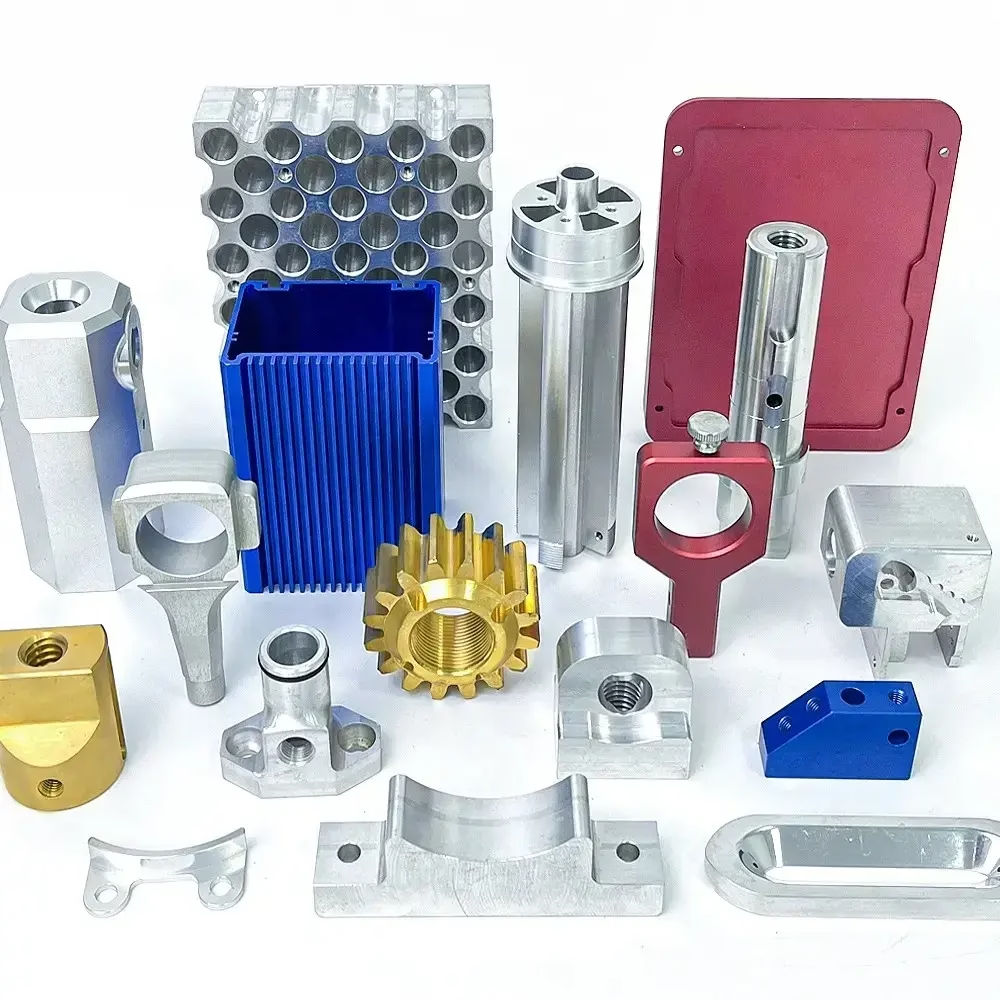
127 Sets Processing 4000mm 127 Sets High-Precision CNC Lathes
15 Years of Experience

Aluminum CNC Tool Guide

Mastering the process: Basic Guide to CNC Tools for Aluminum Processing aluminum. Its name alone attracts images of lightweight strength, excellent processability and versatility. Aerospace, automotive, electronics, medical – countless industries rely on precise mechanisms of aluminum components. However, unlocking its full potential on a CNC machine requires more than just pressing to start. It […]

introduction to sensors on the cnc cnc system

Mastering the process: Basic Guide to CNC Tools for Aluminum Processing

aluminum. Its name alone attracts images of lightweight strength, excellent processability and versatility. Aerospace, automotive, electronics, medical – countless industries rely on precise mechanisms of aluminum components. However, unlocking its full potential on a CNC machine requires more than just pressing to start. It requires the right tools, with knowledge and precision. Whether you are an experienced mechanic or specifying parts for your next project, understanding aluminum CNC tools is critical to achieving efficiency, surface quality and dimensional accuracy. This guide delves into key aspects to help you browse your choices and optimize your results.

Why aluminum? Understand the canvas

Before choosing a brush, learn about the canvas. Aluminum alloys (e.g. 6061, 7075, 2024) offer unique mixtures:

  • Excellent processability: Generally, it is easier to cut than steel or titanium, allowing for higher processing speeds and feeding, thereby reducing cycle time.
  • Good strength to weight ratio: It is crucial for weight-sensitive applications without sacrificing structural integrity.
  • Conductivity and conductivity: For the radiator, housing and electrical components are crucial.
  • Corrosion resistance: Especially alloys such as 6061-T6 provide good durability.
  • Racyclity: Highly sustainable material selection.

However, there are challenges: the relatively low melting point and ductility of aluminum may lead to build edges (BUE), surface effects are poor if the tool is blunt or the parameters are wrong, and potential material adhesion (accumulation). The right tool strategy mitigates these risks.

Choosing a scalpel: Key CNC tools for aluminum

Choosing the “Best Tool” is not a situation where the size is right. Consider these key factors:

  1. Tools and materials: Carbide domination supreme

    • Uncoated carbides (microcrystals/submicrobody): The most common and universal choice. The soft properties of the fine-grained structure are crucial. Look for grades specially formulated for non-produced metals.
    • coating: While not always necessary, specialized coatings such as diamond-like carbon (DLC) or advanced smooth Altin variants (such as Nacro³ or similar) able Benefitable. They mainly reduce friction and chip adhesion, minimize BUE, extend tool life in large quantities, and generate higher feed rates by reducing heat. notes: Conventional Altin or tin coatings are not recommended as they work like sandpaper on aluminum.

  2. Tool geometry: Sharpness is not negotiable

    • Sharp tip: The razor tip is basic. It reduces cutting force, prevents application, minimizes heat buildup, and ensures clean shear. Any dullness can lead to increased pressure, poor heat and surface quality.
    • High spiral angle (40-50 degrees): High spiral design promotes effective chip evacuation. This is essential for aluminum processing to prevent chip re-cutting, packaging with flutes, scraping the surface of the part, and even causing tool breakage.
    • Big flute esophagus: Enough flute space can freely flow out of the chip (usually stringed or segmented but bulky), reducing the risk of clogging.
    • High radial rake angle: Positive rake angles significantly enhance shearing, reduce cutting force and power consumption while improving surface effect. Helps prevent materials from welding to the tool.
    • Polished flute: The aurora smooth flute minimizes friction and further helps the chip flow.

  3. Flute number: Find balance

    • 2 or 3 flutes: Usually ideal for aluminum. Less flutes translate into larger esophageal volumes, enhancing chip evacuation that is critical to deep pockets, slots and large amounts of material removal. More popular in terms of roughness and versatility.
    • 4+ flute: It can be used effectively, especially for completing operations with higher feed rates and finer finishes per revolution. However, Chip evacuation becomes key – Ensure that flood coolant is optimized, or use high pressure through factory coolant (TSC). Careful parameter selection is required to avoid packaging risks.

Optimization reduction: machining strategies and parameters

Having the right tools is half the battle. To perfect your usage is another:

  • High speed and feed: Aluminum allows for significantly higher spindle speed (SFM) and feed rate (IPM) than steel. Push boundaries within machine stability to maximize productivity. See the manufacturer chart, but don’t be afraid to experiment carefully.
  • Chip evacuation is the king: The stagnant chips are the enemy. Use a lot of Flood coolant Used for lubrication, cooling and rinsing chips. High pressure pass spindle coolant (TSC) The system (>250 psi) is very effective for deep cavity operation and complex geometry, blasting the chip from the cutting area. Optimized tool paths Strategically managing chip sparseness and rupture is crucial.
  • Climbing and milling: Almost generally preferred. It provides better finishes, reduces cutting forces and improves tool life compared to traditional milling. Ensure machine stiffness and eliminate rebound.
  • Minimize vibration: Aluminum can enlarge chat. Using a shorter tool extension, a secure rigid tool holder (such as heat shrink or hydraulic chucks) ensures workpiece clamping is safe and adopts an adaptive/Trochoidal tool path to maintain a constant chip load and reduce harmonics.
  • Coolant selection: Emulsible oils or synthetic coolants designed specifically for aluminum are ideal. Avoid chlorine additives if possible to prevent potential stress corrosion rupture in some high-strength alloys. Proper concentration and filtration are crucial.

Five-axis advantage: precise complexity release

As a senior provider Five-axis CNC machiningGremplight utilizes the unique advantages of simultaneous multi-axis movement of aluminum components:

  1. Single setup complexity: The machine’s complex features, deep cavity, undercut and composite angles in one clamp. Eliminates setup errors and improves overall accuracy of complex geometries commonly found in air trays, medical implants, or automotive manifolds.
  2. Best tool direction: Maintain the required tools to the part geometry to ensure continuous cutting forces across combat. Crucially, complex surfaces require non-vertical methods. 5 axes are excellent here.
  3. Shorter tools and improved rigidity: Depth coverage is achieved with shorter tools by tilting the tool shaft, increasing stiffness, reducing deflection, improving surface finish, and allowing for more aggressive MRR.
  4. Advanced tool path features: Maximize surface quality and accuracy of contoured surfaces using refined tool paths such as constant scallop height or tilt/lead strategies optimized for 5-axis.
  5. Accessibility: Tools can be manipulated around obstacles without the need for complex fixture access functions – essential for complex engine blocks or turbine components.

Greglime: Your Precision Aluminum Partner

exist GreatWe are not only machine aluminum; we master it. Our expertise goes far beyond simple running machines:

  • Advanced five-axis functions: Equipped with the most advanced 5-axis CNC machining center, we handle the most complex aluminum parts with unrivalled accuracy and efficiency. Complex aerospace bays, sophisticated automotive prototypes and critical medical equipment housings are inside our cab.
  • Materials Science Applications: We understand the nuances of a variety of aluminum alloys (1000 series to 7000 series) and choose the best tool geometry, coating and processing strategies for each aluminum alloy. Need help choosing Correct Does the alloy meet your functional needs? We consult.
  • Overall tool strategy: Our engineers are based on you Specific Part geometry, tolerance requirements, batch size and required surface finish. We optimize feed and speed to maximize throughput and quality.
  • One-stop solution: From initial material procurement (considering metal hull certification) to complex machining to comprehensive Post-processing (burr, blasting – walnut shell with alumina, anodized type II/III, chemical film, painting, plating) we handle all of this. Need a tight tolerance hole? Our proprietary micro-drilling process is reusable below 0.005mm. Complex thin walls? Our chater suppression tool paths maintain stiffness.
  • Batch Agility: Whether it is a single prototype, requiring complex hand-drawing or mass production batches, requiring automated lines, we will scale effectively. Our in-house CMM laboratory (capable of ±0.5 µm) ensures that each batch meets stringent standards.
  • Cost Optimization: Leveraging DFM’s depth of experience and lean workflow, we identify and implement cost-saving opportunities – suggesting material alternatives, optimizing nesting to improve yields or reduce finish complexity – without compromising quality.

Conclusion: Processing aluminum – Art conforms to precision engineering

CNC machining aluminum is a fusion of science, engineering and practical experience. Excellent results are determined by the perfect combination of tool geometry, materials, coatings (applicable), cutting parameters and complex machining strategies, especially in the functions of five-axis machines. Understanding material behavior – for example, the cumulative trend of the 2000 series alloys – mastering chip control is basic.

For projects requiring complex geometry, strict tolerance is reduced to ±0.005mm, and superior finishes, working with experts like this Great It’s the key. Our advanced five-axis capabilities, coupled with comprehensive post-processing expertise and deep metallurgical knowledge, ensure that your aluminum parts are accurate, efficient and efficient from prototype to complete production operation. Don’t just machine aluminum, but it.

Ready to turn your aluminum design into accurate reality?
[GreatLight URL or Contact Button Here]


FAQ: CNC machining aluminum

Q: Why do carbides prefer aluminum CNC processing than HSS?

A: Carbide tools have significantly longer clarity than high-speed steel (HSS), allowing for higher cutting speeds and aluminum processability inherent in feed. This greatly improves productivity and finishes while reducing tool change frequency. Modern fine-grained carbide grades provide the required toughness.

Q: Do I need coating when processing aluminum? Why or why not?

A: While uncoated microcrystalline carbides are very effective, specialized coatings such as diamond-like carbon (DLC) or advanced smooth Altin variants can significantly improve performance. They greatly reduce friction and adhesion (accumulation), resulting in higher cutting parameters, extend tool life and improve surface finish consistency, especially in mass production. avoid Standard Altin or tin coating.

Q: How important is chip evacuation, and what is the best way to ensure a chip?

one: Critical. Inadequate chip evacuation can lead to re-cutting of the chip, poor surface effect, tool rupture and shortening tool life. Usage Tools High spiral angle (40-50°) and Large library. use Rich flood coolant Directly targeting the incision. High pressure pass spindle coolant (TSC) Very effective for deep pockets and complex paths. optimization Tool path Designing for aluminum (such as adaptive cleaning) is also crucial.

Q: Why is aluminum milling recommended?

A: Climbing milling cuts downward into the workpiece and table, reducing vibration and tremor. It also provides cleaner shearing action, resulting in superior finishes and reduces the tendency of tools to push materials and produce poorer edges or burrs. It requires minimal machine rebound.

Q: How can five-axis CNC machining benefit aluminum parts production?

Answer: 5-axis machining is allowed A settingeliminate alignment errors. It provides Right to use 3-axis impossible or inefficient features (undercut, deep cavity, composite angle). It can be enabled Best direction Cut tools throughout complex geometry, maintaining constant engagement to improve results and tool life. It allows use Shorter, more rigid tools For more in-depth.

Q: What are the common post-processing options for CNC machining aluminum parts?

Answer: Ordinary finishes include:

  • Media explosion: (glass beads, walnut shells, alumina) are used in cosmetic textures or matte surfaces.
  • Anodizing: (Type II – Transparent / Color; Type III – Crosted) to enhance corrosion resistance, wear resistance and color/paint adhesion.
  • Chromate conversion coating (Alodine/Chem Film): Mainly used for corrosion resistance and adhesion primer.
  • Powder coating/painting: Durable cosmetics and protective finishes.
  • Polish/brushing: Used for aesthetic mirror or satin finishes.
  • Precision burrs: It is crucial to function and safety. Greatlight uses vibration, thermal energy (TEM) and automatic robotic burr processes, depending on tolerance requirements – especially critical for aerospace hydraulic or biomedical fluid channels.

Q: What design aspects have improved the machiningability of aluminum parts?

Answer: Consider Spacious interior radius (minimum 0.5 times the tool), Avoid deep and narrow cavity,,,,, Add Draft Corner On the wall, Specify the actual tolerance (Don’t tolerate it too much), Minimize thin walls/features Easy to chat and for Effective fixation. Consulting manufacturers like Greatlight to early design manufacturability (DFM) feedback is very beneficial.

Q: How fast does Greatlight’s custom aluminum parts turn around?

A: We take pride in our rapid turnaround without compromising quality. For standard aluminum alloys, the initial prototype can usually be shipped to 3-7 working daysdepending on complexity. Production leadership time is efficiently scaled and we offer viable expedited options. Our automated tool path verification system cuts cam preparation time by more than 30% compared to industry specifications.

CNC Experts

Picture of JinShui Chen

JinShui Chen

Rapid Prototyping & Rapid Manufacturing Expert

Specialize in CNC machining, 3D printing, urethane casting, rapid tooling, injection molding, metal casting, sheet metal and extrusion

CNC Recent Posts

CNC News

Welcome to GreatLight Metal,Maximum Processing Size 4,000 mm

Precision Machining CNC Quote Online

Loading file

Upload Click here to upload or drag and drop your model to the canvas.

The model is too large and has been resized to fit in the printer's build tray. [Hide]

The model is too large to fit in the printer's build tray. [Hide]

The model is too large, a fitting printer is selected. [Hide]

The model is too small and has been upscaled. [Hide]

Warning: The selected printer can not print in full color [Hide]

Warning: obj models with multiple meshes are not yet supported [Hide]

Warning: Unsupported DXF entity  [Hide]

Warning: could not arrange models [Hide]

[Hide]


File Unit:      
Scale:
%
L × W × H:
X: × Y: × Z:  cm 
Rotation:
X: ° Y: °  
⚡ Instant Quote for Precision Manufacturing

Submit your design files (STEP/IGES/DWG) and receive a competitive quote within 1 hour, backed by ISO 9001-certified quality assurance.

📋 How It Works

  1. Upload & SpecifyShare your 3D model and select materials (Aluminum/Stainless Steel/Titanium/PEEK), tolerances (±0.002mm), and surface treatments.

  2. AI-Powered AnalysisOur system calculates optimal machining strategy and cost based on 10+ years of automotive/aerospace data.

  3. Review & ConfirmGet a detailed breakdown including:
    - Volume pricing tiers (1-10,000+ units)
    - Lead time (3-7 days standard)
    - DFM feedback for cost optimization

Unit Price: 

Loading price
5 Axis CNC Machining Equipment
4 Axis CNC Machining Equipment
3 Axis CNC Machining Equipment
CNC Milling & Turning Equipment
Prototype and Short-Run Injection Moldings Exact plastic material as final design
Volume Metal Die Casting Services - Precision Cast Parts
Bridge the Gap From Prototype to Production – Global delivery in 10 days or less
Custom high-precision sheet metal prototypes and parts, as fast as 5 days.
Custom Online 3D Printing Services
Design Best Processing Method According To 3D Drawings
Alloys Aluminum 6061, 6061-T6 Aluminum 2024 Aluminum 5052 Aluminum 5083 Aluminum 6063 Aluminum 6082 Aluminum 7075, 7075-T6 Aluminum ADC12 (A380)
Alloys Brass C27400 Brass C28000 Brass C36000
Alloys Stainless Steel SUS201 Stainless Steel SUS303 Stainless Steel SUS 304 Stainless Steel SUS316 Stainless Steel SUS316L Stainless Steel SUS420 Stainless Steel SUS430 Stainless Steel SUS431 Stainless Steel SUS440C Stainless Steel SUS630/17-4PH Stainless Steel AISI 304
Inconel718
Carbon Fiber
Tool Steel
Mold Steel
Alloys Titanium Alloy TA1 Titanium Alloy TA2 Titanium Alloy TC4/Ti-6Al 4V
Alloys Steel 1018, 1020, 1025, 1045, 1215, 4130, 4140, 4340, 5140, A36 Die steel Alloy steel Chisel tool steel Spring steel High speed steel Cold rolled steel Bearing steel SPCC
Alloys Copper C101(T2) Copper C103(T1) Copper C103(TU2) Copper C110(TU0) Beryllium Copper
Alloys Magnesium Alloy AZ31B Magnesium Alloy AZ91D
Low Carbon Steel
Alloys Magnesium Alloy AZ31B Magnesium Alloy AZ91D
ABS Beige(Natural) ABS Black ABS Black Antistatic ABS Milky White ABS+PC Black ABS+PC White
PC Black PC Transparent PC White PC Yellowish White PC+GF30 Black
PMMA Black PMMA Transparent PMMA White
PA(Nylon) Blue PA6 (Nylon)+GF15 Black PA6 (Nylon)+GF30 Black PA66 (Nylon) Beige(Natural) PA66 (Nylon) Black
PE Black PE White
PEEK Beige(Natural) PEEK Black
PP Black PP White PP+GF30 Black
HDPE Black HDPE White
HIPS Board White
LDPE White
This is a finish of applying powdered paint to the components and then baking it in an oven, which results in a stronger, more wear- and corrosion-resistant layer that is more durable than traditional painting methods.
No coating required, product’s natural color!
This is a finish of applying powdered paint to the components and then baking it in an oven, which results in a stronger, more wear- and corrosion-resistant layer that is more durable than traditional painting methods.
This finishing option with the shortest turnaround time. Parts have visible tool marks and potentially sharp edges and burrs, which can be removed upon request.
Sand blasting uses pressurized sand or other media to clean and texture the surface, creating a uniform, matte finish.
Polishing is the process of creating a smooth and shiny surface by rubbing it or by applying a chemical treatmen
A brushed finish creates a unidirectional satin texture, reducing the visibility of marks and scratches on the surface.
Anodizing increases corrosion resistance and wear properties, while allowing for color dyeing, ideal for aluminum parts.
Black oxide is a conversion coating that is used on steels to improve corrosion resistance and minimize light reflection.
Electroplating bonds a thin metal layer onto parts, improving wear resistance, corrosion resistance, and surface conductivity.
This is a finish of applying powdered paint to the components and then baking it in an oven, which results in a stronger, more wear- and corrosion-resistant layer that is more durable than traditional painting methods.
Please provide additional text description for other surface treatment requirements!
Material
Material
  • CNC Metals
    • Aluminum
    • Brass
    • Stainless steel
    • Inconel718
    • Carbon Fiber
    • Tool Steel
    • Mold Steel
    • Titanium
    • Alloy Steel
    • Copper
    • Bronze
    • Low Carbon Steel
    • Magnesium
  • CNC Plastics
    • ABS
    • PC
    • PMMA (Acrylic)
    • PA (Nylon)
    • PE
    • PEEK
    • PP
    • HDPE
    • HIPS
    • LDPE
Printer
Printer
  • CNC Metals
    • 5 Axis CNC Machining
    • 4 Axis CNC Machining
    • 3 Axis CNC Machining
    • CNC Milling & Turning
    • Rapid Tooling
    • Metal Die Casting
    • Vacuum Casting
    • Sheet Metal Fabrication
    • SLA 3D Printing
    • SLS 3D Printing
    • SLM 3D Printing
  • Rapid Prototyping
    • Design Best Processing Method According To 3D Drawings
Post-processing
Post-processing
  • As Machined(Product’s natural color)
  • Sand Blasting
  • Polishing
  • Brushed Finish
  • Anodizing
  • Black Oxide
  • Electroplating
  • Paint Coating
  • Powder Coating
  • Other surface treatment requirements
Finalize
The world's first CNC machining center that dares to provide free samples!

Free for first product valued at less than $200. (Background check required)

precision machining cnc quote online

15 Years CNC Machining Services

When you’re ready to start your next project, simply upload your 3D CAD design files, and our engineers will get back to you with a quote as soon as possible.
Scroll to Top

ISO 9001 Certificate

ISO 9001 is defined as the internationally recognized standard for Quality Management Systems (QMS). It is by far the most mature quality framework in the world. More than 1 million certificates were issued to organizations in 178 countries. ISO 9001 sets standards not only for the quality management system, but also for the overall management system. It helps organizations achieve success by improving customer satisfaction, employee motivation, and continuous improvement. * The ISO certificate is issued in the name of FS.com LIMITED and applied to all the products sold on FS website.

greatlight metal iso 9001 certification successfully renewed
GB T 19001-2016 IS09001-2015
✅ iso 9001:2015
greatlight metal iso 9001 certification successfully renewed zh

IATF 16949 certificate

IATF 16949 is an internationally recognized Quality Management System (QMS) standard specifically for the automotive industry and engine hardware parts production quality management system certification. It is based on ISO 9001 and adds specific requirements related to the production and service of automotive and engine hardware parts. Its goal is to improve quality, streamline processes, and reduce variation and waste in the automotive and engine hardware parts supply chain.

automotive industry quality management system certification 01
Certification of Production Quality Management System for Engine Hardware Parts Engine Hardware Associated Parts
automotive industry quality management system certification 00
发动机五金零配件的生产质量管理体系认证

ISO 27001 certificate

ISO/IEC 27001 is an international standard for managing and processing information security. This standard is jointly developed by the International Organization for Standardization (ISO) and the International Electrotechnical Commission (IEC). It sets out requirements for establishing, implementing, maintaining, and continually improving an information security management system (ISMS). Ensuring the confidentiality, integrity, and availability of organizational information assets, obtaining an ISO 27001 certificate means that the enterprise has passed the audit conducted by a certification body, proving that its information security management system has met the requirements of the international standard.

greatlight metal technology co., ltd has obtained multiple certifications (1)
greatlight metal technology co., ltd has obtained multiple certifications (2)

ISO 13485 certificate

ISO 13485 is an internationally recognized standard for Quality Management Systems (QMS) specifically tailored for the medical device industry. It outlines the requirements for organizations involved in the design, development, production, installation, and servicing of medical devices, ensuring they consistently meet regulatory requirements and customer needs. Essentially, it's a framework for medical device companies to build and maintain robust QMS processes, ultimately enhancing patient safety and device quality.

greatlight metal technology co., ltd has obtained multiple certifications (3)
greatlight metal technology co., ltd has obtained multiple certifications (4)

Get The Best Price

Send drawings and detailed requirements via Email:[email protected]
Or Fill Out The Contact Form Below:

All uploads are secure and confidential.