
Advanced Bulk Rapid Prototyping Solutions
This page explains how to move from one approved prototype to a batch of 50, 200 or 1,000+ parts without losing tolerance, finish or material properties. It is written for design engineers and sourcing engineers who have to pick a process, a material and an inspection plan before the run starts. After reading it you can judge which parts belong on 5-axis CNC, which belong on a casting or printing route, and where the batch will drift.
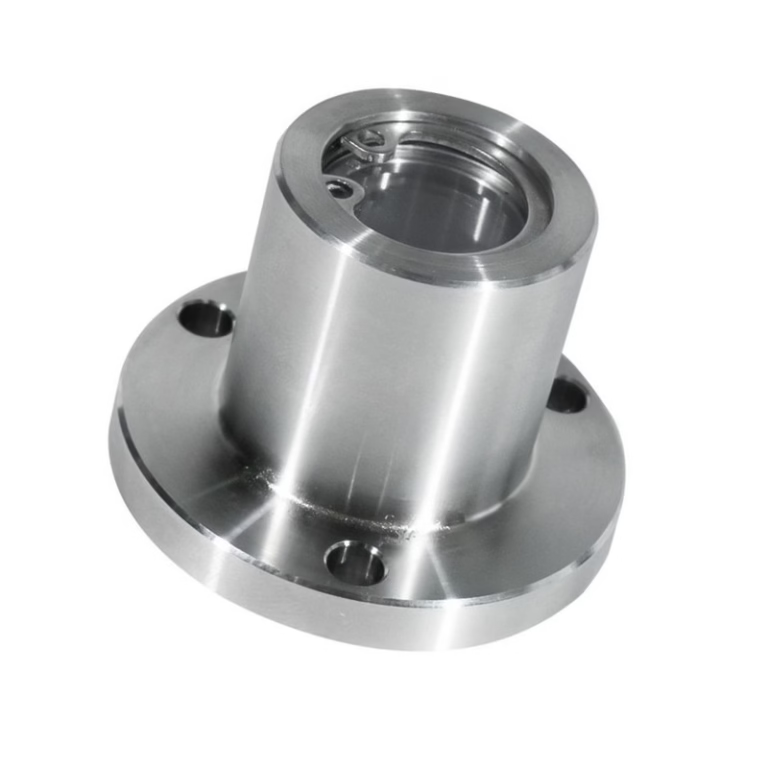
What changes when the order is 200 parts instead of one
Bulk prototyping is a process-control problem, not a scheduling problem.
Tolerance drift is the first thing that breaks
A single prototype can be adjusted part by part. Once the quantity reaches 50 or more, the process has to hold the same result without a human decision on every piece. Tool wear, thermal growth in the spindle, coolant temperature and the hardness spread inside one bar of 7075 all push dimensions in the same direction over a run.
The number that matters is not the best part in the batch. It is the spread. A ±0.005 mm tolerance achieved on part one is meaningless if part 180 sits 0.03 mm away. Batch runs need a stable process window: verified stock, indexed tools, warm-up cycles and in-process probing that flags drift before the parts are finished.
Fixtures decide how repeatable the run really is. A vise that locates on a rough casting face gives a different origin every load. Dedicated soft jaws, or a tombstone that holds eight parts at once, cut load-to-load variation and let the machine run unattended overnight.
Why 5-axis CNC carries most bulk prototype volume
Five-axis machining fits the middle ground between one-off prototyping and hard-tooled production. Setup count drops because the tool reaches five faces in one clamping, so position error from re-fixturing does not multiply across 300 parts. Our 16 simultaneous 5-axis centers run the same program for a batch that a 3-axis shop would split across four operations.
Cycle time is where batch economics are won. Toolpaths get reworked for bulk: high-feed cutters, trochoidal roughing, and one finishing pass instead of three. On aluminum housings that change alone often takes 20 to 30 percent off the per-part cycle. The savings stay real only if the reworked path still holds the drawing tolerance, so we verify the first article before the run is released.
Size sets the machine. Our 5-axis travel covers 4,000 × 400 × 150 mm for long parts such as extrusion rails, and 750 × 1,150 × 550 mm or 600 × 600 × 600 mm for mid-size plates and housings. A Ø400 mm rotary table handles round work. Parts beyond those envelopes are quoted on a different route rather than forced onto a machine that cannot reach the feature.
Hard materials change the plan. Ti-6Al-4V and Inconel cut slowly and wear tools fast, so batch cost is dominated by tool life, not by machine time. We plan roughing with ceramic or carbide inserts and leave stock for a single finishing pass, which keeps the last 0.1 mm predictable across the run.
When to leave CNC and use another process
Not every batch belongs on a mill. Vacuum casting makes sense for 20 to 50 polyurethane parts from a silicone tool when the geometry is thin-walled and the surface needs to look like injection molding. Custom 3D printing covers lattice, internal channels and organic shapes that a cutter cannot reach, and it is the faster route when the part count is below roughly 30.
Sheet metal fabrication handles brackets, chassis panels and enclosures where the part is essentially a folded or stamped blank. Metal die casting takes over above several thousand units when the wall thickness is uniform and the tooling cost can be spread. Mixing routes inside one program is normal: a machined aluminum frame, a printed duct and a formed steel bracket can ship as one kit.
The decision rule is geometry and quantity, not preference. Deep pockets, tight bores and flat sealing faces go to CNC. Hollow closed volumes go to printing or casting. If a part needs both, machine the critical faces after the near-net process rather than printing the whole thing to tolerance.
We quote the alternatives instead of pushing one process. If a design will be cheaper as a casting at 5,000 pieces, it is worth saying so before 500 parts are machined.
Material and finish consistency across a batch
Buying the whole batch of stock at once is the cheapest way to remove material variation. One heat number keeps hardness, machinability and anodize response the same from the first part to the last. Aluminum grades we run daily include 6061, 7075, 2024, 5052, 6082 and ADC12; stainless covers 303, 304, 316L, 17-4PH and 440C; titanium work is usually TA2 or TC4.
Finish is a separate process with its own spread. Anodizing builds a coating that grows into the tolerance, so masking and rack position matter on thin walls. Bead blasting gives a matte look but can round a sharp edge by 0.05 mm. We plan the finish before machining and adjust the pre-finish dimension accordingly.
Colour matching is the hard part in anodize. Two batches dyed weeks apart can differ by a shade even with the same alloy and rack. When a customer needs 500 matched covers, we run them through one dye lot and keep spares from that lot.
For functional surfaces, we hold Ra 0.2–0.8 μm on sealing and bearing fits, Ra 0.8–1.6 μm on general mating faces, and leave Ra 1.6–3.2 μm as-machined where appearance does not matter. Laser marking is available down to 1.5 mm character height for part traceability.
Routing guide for bulk prototype quantities
Use this as a first filter. The final route depends on wall thickness, tolerance and surface requirement.
| Quantity | Best-fit process | Watch out for |
|---|---|---|
| 1–30 parts | 3D printing or 3-axis CNC | Printed parts need machining on fits |
| 30–100 parts | Vacuum casting or 4-axis CNC | Silicone tool life limits the run |
| 50–1,000 parts | 5-axis CNC | Fixture repeatability drives spread |
| 1,000–10,000 parts | CNC or die casting | Casting tooling cost must amortize |
| Any quantity | Sheet metal for flat parts | Bend radius and springback control |
Inspection and documentation that hold up in a supplier audit
Inspection at batch scale is a sampling problem. We check raw material certificates on arrival, monitor dimensions in process, and inspect 100 percent of parts before shipment. Where a feature is critical, the report lists the actual measured value rather than a pass mark.
Certification scope matters to regulated buyers. Our quality system is certified to ISO 9001:2015, IATF 16949:2016, ISO 13485:2016 and ISO 27001:2022, which covers automotive, medical device and information security requirements. That means the paperwork trail exists before a customer asks for it.
Process capability is tracked, not assumed. Our historical qualification rate is 99.99 percent, and the late-delivery probability on record is below 2 percent. Neither number replaces a first-article inspection on your drawing.
Uploads are treated as confidential and an NDA is available on request. We do not publish customer names or part programs.
Quoting, lead time and running the batch
A quotation and a free DFM analysis come back within 12 hours of receiving drawings and quantity. The DFM note points out features that will be expensive in bulk: a 0.4 mm internal corner that needs a 0.3 mm cutter, a deep slot that forces a long reach tool, a thread that breaks into a thin wall.
Production can start within 24 hours of approval. Standard parts ship in 3–5 days depending on quantity and finish. There is no minimum order quantity, so the same program runs one piece or 10,000.
Capacity is spread across 127 high-precision CNC machines in three wholly-owned plants covering 7,600 m², with 150 technicians and a second site in Singapore. That spread is what allows a 1,000-piece run and a one-off repair to sit in the same week.
Send the drawing, the quantity and the critical dimensions. We will tell you which route is cheaper and where the risk sits.
Questions engineers ask before a bulk run
How many parts can you run before the process becomes uneconomical?
CNC stays competitive into the low thousands for most machined geometries. Above roughly 5,000 identical parts with uniform walls, die casting usually wins once tooling is amortized.
The crossover is not fixed. It moves with part size, tolerance and surface requirement, so we quote both routes when the quantity is near the boundary.
Can you hold ±0.005 mm across a full batch?
Yes, on features that the process can reach and that the drawing calls out. The limit is geometry: deep bores, thin walls and long unsupported sections move under cutting force.
We flag those features during DFM and agree on a realistic tolerance before the run starts rather than after the parts are measured.
How do you keep anodize colour consistent over 500 parts?
Rack the parts together and run one dye lot. Alloy and temper must also match, because 6061 and 6063 take dye differently.
We keep spares from the same lot in case a few parts are damaged later during assembly.
What if the design changes halfway through the batch?
Stop the run and re-quote. Parts already machined cannot be reworked to a new revision unless the change is additive.
If the change is still being evaluated, we can hold the remainder and ship the completed quantity first.
Do you sign an NDA for prototype work?
Yes. An NDA is available on request and uploads are handled as confidential. We do not use customer parts in marketing material.
Which materials are usually problematic in bulk?
Magnesium AZ31B and AZ91D need chip control and fire-safe handling, which limits machine choice. Beryllium copper machines well but stock lead time can be long.
For those cases we suggest a substitute that meets the same mechanical or thermal requirement and confirm it with the customer before cutting.
Send the drawing and the quantity
We will come back within 12 hours with a quote, a DFM note and a routing recommendation for your batch.
12-hour quote100% inspectionNo MOQ









