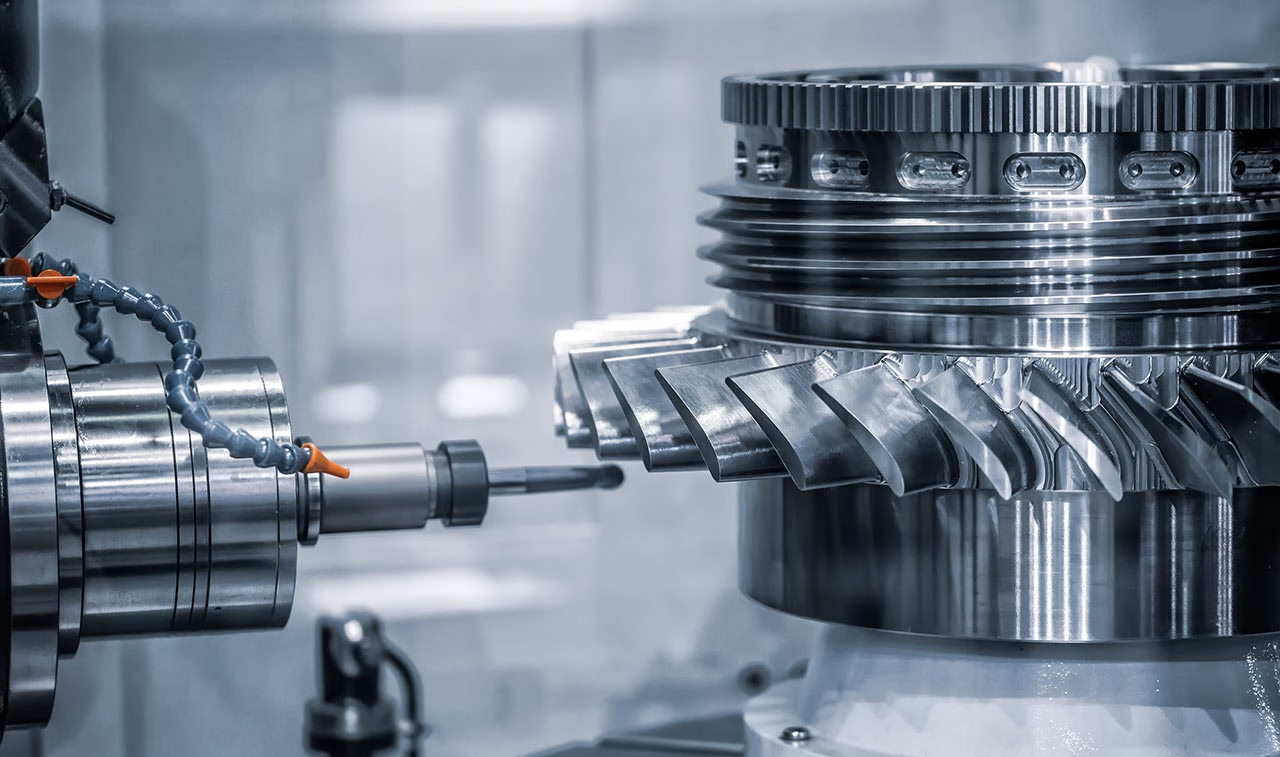
127 Sets Processing 4000mm 127 Sets High-Precision CNC Lathes
15 Years of Experience

CNC Knowledge: A comprehensive collection of factory technical specifications for CNC programming engineers!

1. Clarify the responsibilities of the programmer – he is fully responsible for the processing quality, processing efficiency, cost control and error control of the entire CNC mold manufacturing process. 2. When receiving a new mold, the programmer should understand the requirements of the mold, the rationality of the mold structure, the steel used in […]

1. Clarify the responsibilities of the programmer – he is fully responsible for the processing quality, processing efficiency, cost control and error control of the entire CNC mold manufacturing process.

2. When receiving a new mold, the programmer should understand the requirements of the mold, the rationality of the mold structure, the steel used in the upper and lower molds, the tolerance requirements of the product and the plastic materials . Clearly distinguish where the glue position is, where the PL surface is, where penetration and friction are, and where can be avoided. At the same time, you need to communicate with the technician to determine the content of CNC processing.

3. After receiving the new mold, the programmer will normally establish a list of copper materials as soon as possible. Before completing the list, the copper material must be dismantled. It can be taken down, but it must be webbed. The size, copper material code and spark size must be determined. The first batch of copper materials must be issued within 2 days, and all copper materials must be issued within 10 days. The nomenclature can be divided into 4 times.

4. The construction drawings of Tonggongchou and Xiaogong are respectively filled with two program lists. Parts that can be processed on old machine tools or parts that need to be machined at high speed should be explained and accounted for in the blank space of “Part”. Placement Direction”. Tonggong is represented by the “TFR-ISO” view in the blank space of “Part Placement Direction”, and the steel material is represented by the “TOP” and “TFR-ISO” views in the blank space of “Placement Direction of Part”. added The steel material must be compared to the part. actual in person to confirm the reference direction, part size and processing area.

5. When roughing steel material, the Z-cutting quantity is 0.5-0.7mm. When roughing the copper material, the Z-cut amount is 1.0-1.5mm (the internal roughness is 1.0mm and the base edge is 1.5mm).

6. During parallel finish milling, the maximum pitch is set according to the “Optimal Contour Parameters Table for Parallel Finish Milling”. The remaining quantity before fine milling should be as small as possible, steel material is 0.10-0.2mm. Copper material 0.2-0.5mm. Do not use a flat surface with a large surface area.

7. Leave a margin of 0.05mm on the friction surface or friction surface for FIT molding. For some friction surfaces with small significant areas, leave a margin of 0.1 mm on the friction surface and the surrounding PL. the surface must be treated on site. The largest bottom position of the PL surface sealant of the mold is 10mm to 25mm (the standard is 18mm), and the outer gap can be avoided by 0.15mm (determined by the supervisor of this department).

8. When cutting quickly up to a height of 3 mm, the approach feed (relative to the machining depth) is always 600 mm/m. The Z cutting speed with spiral cutting and external feed is always 1000 mm/m. with walking zone The tool speed F is always 300 mm/m and the internal feed of the rapid movement (travel) is always 6,500 mm/m (G01 must be used).

9. When using Φ63R6, Φ40R6, Φ30R5 flying knives to roughen, leave a margin of 0.8mm on one side of the side wall and 0.4mm on the bottom. The phenomenon of stepping on the knife cannot occur, and the inner frame with a small processing range of Φ63R6 cannot be used. When using Φ32R0.8, Φ25R0.8, Φ20R0.8 and Φ16R0.8 tools for semi-finishing, reprocess the larger plane to ensure a 0.15mm margin at the bottom, so that the next tool can directly finish the bottom of the workpiece.

10. Before fine milling, the corner allowance must be roughly removed with a smaller diameter tool. When the corner cannot be cleared, a curved surface should be used to block it to avoid tool damage caused by excessive corner allowance during fine milling. The tolerance is uniform when fine milling.

11. Tool clamping length does not require maximum depth or exceeds maximum depth. When it is necessary to use an extended nozzle or a tool with a certain clearance length, the data L, B and D should be noted in the. remarks column of the program list. L—represents the tool clamping length, B—represents the tool clearance length, and D—represents the diameter of the deployed screw.

12. When roughing the male copper, increase the positive Z direction of the mold base material to +5mm and increase the single side of the XY direction to +3mm.

13. When disassembling the copper pin, be sure to check whether the bottom of the palm is enough to prevent air. Be sure to insert the disassembled copper pin into the part that requires spark treatment and color it carefully to check whether it is sufficient. to avoid air. For approximately symmetrical copper pins, check if they are completely symmetrical and the clearances are all the same. Don’t be so self-righteous that you don’t check.

14. Treated copper must meet the standards:

⑴ Dimensions are accurate, tolerance: small male ±0.02mm, thick male ±0.04mm;

⑵ No deformation;

⑶ The knife pattern is clear and there is no particularly rough knife pattern;

⑷ The lines are clear and there is no step where the knife is connected;

⑸ There is no cloak that is obviously difficult to remove;

⑹The thickness of the bottom of the palm is guaranteed to be 15-25mm, and the standard is 20mm;

⑺The copper code is correct;

⑻The spark level should be reduced around the reference position.

15. Principles to consider when dismantling Tonggong:

⑴ Feasibility of treatment;

⑵ Practical;

⑶ Sufficient strength and no deformation;

⑷ Convenient for treatment;

⑸Cost of copper;

⑹ Beautiful appearance;

⑺ The less copper dismantled, the better;

⑻For symmetrical products, try to bring the left and right copper pins closer together and offset the processing.

16. Reference Guidelines for Using the Tools

⑴ When roughing general size steel materials, try to use Φ30R5, and try to use Φ63R6 for larger steel materials;

⑵ For exposed copper surfaces with a gross height of less than 70mm, use M16 tools; if the height is between 70-85mm, use M20 tools if the height is between 85-120mm, use M25 tools if the height exceeds 120mm; use Φ25R0.8, Φ32R0.8 flying knife handles;

⑶ For the copper male 2D shape light knife, choose M12 tool if the height is less than 50mm; choose the M16 tool if the height is between 50 and 70 mm; choose M20 if the height is between 70 and 85 mm; 85-120mm; if it exceeds 120mm, the above items are processed with Φ25R0.8 and Φ32R0.8 flying tool handles;

⑷ For flatter curved surfaces or higher profile curved surfaces, try using Φ20R4, Φ25R5 and Φ40R6 as light knife tools;

⑸ For specific processing parameters, see the roughing and finishing parameter tables.

17. Rules for inspecting parts:

⑴ The programmer is responsible for the results of the working tests;

⑵ The workpiece must be inspected in accordance with the seven requirements of Article 14;

⑶ Basically, steel materials are inspected on the machine tool before being removed from the machine. Steel materials processed during the night shift must be inspected by the programmer tomorrow morning before being removed from the machine. the machine in the middle of the night will be inspected by the head of the machine operator and will be inspected by the programmer the next day to confirm. For large parts, the team leader or clerk will notify the technician to pick up the workpiece;

⑷ In principle, Tonggong carries out the inspection in the “inspection area”. After the inspection is completed, the programmer will place it in the “qualified zone” in time. The mold technician is only authorized to remove the part. in the “qualified zone”;

⑸ If unqualified parts are detected, they should be reported to the department supervisor, who will decide whether to reprocess, modify the materials or accept them as qualified parts;

⑹ If the supervisor of this department accepts unqualified parts as qualified parts and causes a mold quality accident, the supervisor of this department will bear the main responsibility.

18. The relevant standards stipulate:

⑴ The mold materials in the upper and lower molds are divided into four sides, and the lower surface is zero;

⑵ The original mold base is divided into four sides. When the PL surface is a planar surface, the number is taken from the planar surface; when the PL surface is not a flat surface, the number is taken from the lower surface. Take the reference angle of the non-original mold bottom (the reference angle mark △);

⑶ The two sides of the row position are divided into centers, the bottom of the row position touches one side, and the depth reaches the bottom to zero;

⑷ Tong Gong is represented by “T” for extra-coarse steel, “R” for coarse steel and “F” for small steel;

⑸ The corner where the mold number is printed on the mold material in the upper and lower molds is the reference angle;

⑹ The shape of the R package copper cap is reduced by 0.08mm to ensure that the product does not scratch your hands;

⑺ Regarding the processing and placement direction of the workpiece, in principle, the X direction is the long dimension and the Y direction is the short dimension;

⑻ When using “Contour Shape” and “Best Contour” methods for finishing, the machining direction should be “uphill milling” as much as possible; when using a flying tool handle for finish milling, “uphill milling” should be used;

⑼ When fine milling copper public curved surfaces, it is recommended to give priority to the “parallel + equal height” processing method, which is 55 degrees parallel and 52 degrees equal height, there is overlap 2 degrees; The tool used should be a ball cutter with a spark position requirement in the depth direction of the same height + 0.02 mm;

⑽ In principle, among the bottom four corners of the copper palm, one corner corresponds to the chamfer angle of the C6 mold reference angle, and the other three corners are rounded R2, the C and R corners of the larger copper male can be larger; therefore;

⑾ In principle, it is stipulated that the highest point of the workpiece is Z zero when writing the program. The goal is:

① Avoid knife collisions caused by forgetting to adjust the safety height;

② Cutting depth reflects the most conservative length required for the tool;

⑿ When using a white steel knife to process the copper male shape, the spark position parameter should be 0.015mm more negative than required;

⒀ The copper male reference position should be processed downward, leaving 0.2mm at the bottom (to prevent the tool from hitting the code plate);

⒁ Compile the tool path and calculate the surface tolerance: rough cutting 0.05mm, rough polishing 0.025mm, smooth knife 0.008mm;

⒂ When finishing the straight surface of steel materials, the amount of Z-cutting is 1.2mm when using an alloy knife and 0.50mm when using a tool handle. Processing of straight surfaces should be carried out by downward milling;

⒃ In the public list of copper materials, in principle, the length should be controlled within 250mm and the height should be controlled within 100mm.

⒄ The steel materials processed on No. 7 and No. 8 machine tools are rough and medium coarse, with side margins ≥ 0.3mm and bottom margins ≥ 0.15mm (the side margins of the bottom mold of the big Alice box can be ≥ 0.15mm);

⒅ Standard coding card M8 20×20 (multiples) M10 30×30 (multiples)

⒆ Entity simulation should be used for all steel material processing programs to determine program accuracy and reduce processing errors.

19. When cutting copper material, the length and width should be 2.5mm on each side, and the overall height should be 2-3mm, that is, 100 × 60 × 42 must be cut to 105 × 65 × 45. The length and width dimensions must be multiples of 5 and the height can be any integer. The minimum outer dimension of the copper male is 40 × 20 × 30 (the dimensions after processing are correct).

20. The Spark Number Paper should be concise, clear and easy to understand. The lines of copper drawings should be thicker and the dimensions should be marked as whole numbers as much as possible. The reference angle of the copper pin should be clearly marked, including the mold number, the copper pin number, the 3D drawing of the copper pin, the spark position size and the precautions (connection order, transfer processing, rotation processing, post-production). -processing after removing the insert, and cutting the copper pin wire) etc.), signed by the programmer for confirmation, and reviewed by the service supervisor (especially on the basis of the model).

21. Cutting drawings of copper bus cables should be concise, clear and easy to understand. The place where the wire is to be cut should be represented by hatching and should have the mold number, copper number, spark position size, computer drawing reference position, die size wire cutting slope, precautions, computer diagram website, signature and confirmation of programmer and department. Supervisor review (specifically model based).

22. Internal shared files CNC\CNC1CNC*.*

23. Unified regulations on copper numbering:

TN25252 A1 (TN25252 upper mold copper male 1)

TN25252 R1 (TN25252 male copper lower mold 1)

TN25252 SL1-1 (TN25252 row 1 copper male 1)

TN25252 AIN1-1 (upper mold insert TN25252 1 copper male 1)

TN25252 RIN1-1 (TN25252 bottom mold insert 1 male copper 1)

TN25252 XD1-1 (TN25252 rhombic 1 male copper 1)

TN25252 TB1 (TN25252 male copper push plate 1)

TN25252 P1 (Miscellaneous copper male 1 not specified)

TN25252 MG1 (TN25252 modified copper male 1)

24. Uniform provisions for the storage of images:

D: 4TN25252D.part (3D product photo)

ASM.part (internal mold assembly diagram)

CAVTN25252CAV.part (upper mold drawing and copper diagram used for the upper mold)

CAV-CNC.part (upper mold tool path diagram)

A1.part (diagram of male 1 copper toolpath of upper mold)

AIN1.part (upper mold insert 1 and its copper drawing)

AIN1-CNC.part (upper mold insert 1 toolpath diagram)

AIN1-1.part (top mold insert 1 copper male 1 toolpath diagram)

CORTN25252COR.part (lower mold diagram and copper diagram used in lower mold)

COR-CNC.part (lower die toolpath diagram)

R1.part (bottom mold copper male 1 toolpath diagram)

RIN1.part (lower mold insert 1 and its copper drawing)

RIN1-CNC.part (public drawing of lower mold insert 1 toolpath)

RIN1-1.part (bottom mold insert 1 copper male 1 toolpath diagram)

SLTN25252SL1.part (line 1 and its copper card)

SL1-CNC.part (row 1 toolpath diagram)

SL1-1.part (row 1 male copper 1 toolpath diagram)

XDTN25252XD1.part (Rhombus 1 and its public copper photo)

XD1-CNC.part (diamond toolpath diagram 1)

XD1-1.part (diamond 1 male copper 1 toolpath diagram)

TBTN25252TB.part (push plate and its copper diagram)

TB-CNC.part (thrust plate toolpath diagram)

TB1 (male copper push plate 1 toolpath diagram)

MG1.Part (modified copper male 1 toolpath diagram)

P1.part (various copper toolpath diagram 1 without regulations)

EDW*.part (all line cutting drawings)

MODIFY1*.Part (first photo of the modified model)

25. Program naming convention

For example: model number TN25152

N52AV1.NC (the first program of the upper mold) N52AV11.NC (the first program of the first upper mold)

N52CR1.NC (the first program of the lower mold) N52CR11.NC (the first program of the first lower mold)

N52A11.NC (the first program of the first copper pin of the upper mold)

N52R11.NC (the first program of the first copper pin of the lower mold)

A52N11.NC (the first program of the first upper mold insert)

A52A11.NC (the first program of copper pin 1 of upper mold insert 1) insert code 1, 2, 3… is represented by A, B, C…

R52N11.NC (the first program of the first lower mold insert)

R52A11.NC (the first program of the copper pin 1 of the lower insert of the mold 1) The insert code 1, 2, 3… is represented by A, B, C…

N52S11.NC (the first program of the first line)

S52A11.NC (the first program of copper pin 1 of row 1) Row codes 1, 2, 3… are represented by A, B, C…

N52X11.NC (the first program of the first inclined roof)

X52A11.NC (the first program of copper pin 1 of inclined top 1) The codes of inclined top 1, 2, 3… are represented by A, B, C…

N52P11.NC (the first Divers Cuivre Public 1 program without regulation)

N52M11.NC (the first program to change the copper mold)

Daguang focuses on providing solutions such as precision CNC machining services (3-axis, 4-axis, 5-axis machining), CNC milling, 3D printing and rapid prototyping services.

CNC Experts

Picture of JinShui Chen

JinShui Chen

Rapid Prototyping & Rapid Manufacturing Expert

Specialize in CNC machining, 3D printing, urethane casting, rapid tooling, injection molding, metal casting, sheet metal and extrusion

CNC Recent Posts

CNC News

Welcome to GreatLight Metal,Maximum Processing Size 4,000 mm

Precision Machining CNC Quote Online

Loading file

Upload Click here to upload or drag and drop your model to the canvas.

The model is too large and has been resized to fit in the printer's build tray. [Hide]

The model is too large to fit in the printer's build tray. [Hide]

The model is too large, a fitting printer is selected. [Hide]

The model is too small and has been upscaled. [Hide]

Warning: The selected printer can not print in full color [Hide]

Warning: obj models with multiple meshes are not yet supported [Hide]

Warning: Unsupported DXF entity  [Hide]

Warning: could not arrange models [Hide]

[Hide]


File Unit:      
Scale:
%
L × W × H:
X: × Y: × Z:  cm 
Rotation:
X: ° Y: °  
⚡ Instant Quote for Precision Manufacturing

Submit your design files (STEP/IGES/DWG) and receive a competitive quote within 1 hour, backed by ISO 9001-certified quality assurance.

📋 How It Works

  1. Upload & SpecifyShare your 3D model and select materials (Aluminum/Stainless Steel/Titanium/PEEK), tolerances (±0.002mm), and surface treatments.

  2. AI-Powered AnalysisOur system calculates optimal machining strategy and cost based on 10+ years of automotive/aerospace data.

  3. Review & ConfirmGet a detailed breakdown including:
    - Volume pricing tiers (1-10,000+ units)
    - Lead time (3-7 days standard)
    - DFM feedback for cost optimization

Unit Price: 

Loading price
5 Axis CNC Machining Equipment
4 Axis CNC Machining Equipment
3 Axis CNC Machining Equipment
CNC Milling & Turning Equipment
Prototype and Short-Run Injection Moldings Exact plastic material as final design
Volume Metal Die Casting Services - Precision Cast Parts
Bridge the Gap From Prototype to Production – Global delivery in 10 days or less
Custom high-precision sheet metal prototypes and parts, as fast as 5 days.
Custom Online 3D Printing Services
Design Best Processing Method According To 3D Drawings
Alloys Aluminum 6061, 6061-T6 Aluminum 2024 Aluminum 5052 Aluminum 5083 Aluminum 6063 Aluminum 6082 Aluminum 7075, 7075-T6 Aluminum ADC12 (A380)
Alloys Brass C27400 Brass C28000 Brass C36000
Alloys Stainless Steel SUS201 Stainless Steel SUS303 Stainless Steel SUS 304 Stainless Steel SUS316 Stainless Steel SUS316L Stainless Steel SUS420 Stainless Steel SUS430 Stainless Steel SUS431 Stainless Steel SUS440C Stainless Steel SUS630/17-4PH Stainless Steel AISI 304
Inconel718
Carbon Fiber
Tool Steel
Mold Steel
Alloys Titanium Alloy TA1 Titanium Alloy TA2 Titanium Alloy TC4/Ti-6Al 4V
Alloys Steel 1018, 1020, 1025, 1045, 1215, 4130, 4140, 4340, 5140, A36 Die steel Alloy steel Chisel tool steel Spring steel High speed steel Cold rolled steel Bearing steel SPCC
Alloys Copper C101(T2) Copper C103(T1) Copper C103(TU2) Copper C110(TU0) Beryllium Copper
Alloys Magnesium Alloy AZ31B Magnesium Alloy AZ91D
Low Carbon Steel
Alloys Magnesium Alloy AZ31B Magnesium Alloy AZ91D
ABS Beige(Natural) ABS Black ABS Black Antistatic ABS Milky White ABS+PC Black ABS+PC White
PC Black PC Transparent PC White PC Yellowish White PC+GF30 Black
PMMA Black PMMA Transparent PMMA White
PA(Nylon) Blue PA6 (Nylon)+GF15 Black PA6 (Nylon)+GF30 Black PA66 (Nylon) Beige(Natural) PA66 (Nylon) Black
PE Black PE White
PEEK Beige(Natural) PEEK Black
PP Black PP White PP+GF30 Black
HDPE Black HDPE White
HIPS Board White
LDPE White
This is a finish of applying powdered paint to the components and then baking it in an oven, which results in a stronger, more wear- and corrosion-resistant layer that is more durable than traditional painting methods.
No coating required, product’s natural color!
This is a finish of applying powdered paint to the components and then baking it in an oven, which results in a stronger, more wear- and corrosion-resistant layer that is more durable than traditional painting methods.
This finishing option with the shortest turnaround time. Parts have visible tool marks and potentially sharp edges and burrs, which can be removed upon request.
Sand blasting uses pressurized sand or other media to clean and texture the surface, creating a uniform, matte finish.
Polishing is the process of creating a smooth and shiny surface by rubbing it or by applying a chemical treatmen
A brushed finish creates a unidirectional satin texture, reducing the visibility of marks and scratches on the surface.
Anodizing increases corrosion resistance and wear properties, while allowing for color dyeing, ideal for aluminum parts.
Black oxide is a conversion coating that is used on steels to improve corrosion resistance and minimize light reflection.
Electroplating bonds a thin metal layer onto parts, improving wear resistance, corrosion resistance, and surface conductivity.
This is a finish of applying powdered paint to the components and then baking it in an oven, which results in a stronger, more wear- and corrosion-resistant layer that is more durable than traditional painting methods.
Please provide additional text description for other surface treatment requirements!
Material
Material
  • CNC Metals
    • Aluminum
    • Brass
    • Stainless steel
    • Inconel718
    • Carbon Fiber
    • Tool Steel
    • Mold Steel
    • Titanium
    • Alloy Steel
    • Copper
    • Bronze
    • Low Carbon Steel
    • Magnesium
  • CNC Plastics
    • ABS
    • PC
    • PMMA (Acrylic)
    • PA (Nylon)
    • PE
    • PEEK
    • PP
    • HDPE
    • HIPS
    • LDPE
Printer
Printer
  • CNC Metals
    • 5 Axis CNC Machining
    • 4 Axis CNC Machining
    • 3 Axis CNC Machining
    • CNC Milling & Turning
    • Rapid Tooling
    • Metal Die Casting
    • Vacuum Casting
    • Sheet Metal Fabrication
    • SLA 3D Printing
    • SLS 3D Printing
    • SLM 3D Printing
  • Rapid Prototyping
    • Design Best Processing Method According To 3D Drawings
Post-processing
Post-processing
  • As Machined(Product’s natural color)
  • Sand Blasting
  • Polishing
  • Brushed Finish
  • Anodizing
  • Black Oxide
  • Electroplating
  • Paint Coating
  • Powder Coating
  • Other surface treatment requirements
Finalize
The world's first CNC machining center that dares to provide free samples!

Free for first product valued at less than $200. (Background check required)

precision machining cnc quote online

15 Years CNC Machining Services

When you’re ready to start your next project, simply upload your 3D CAD design files, and our engineers will get back to you with a quote as soon as possible.
Scroll to Top

ISO 9001 Certificate

ISO 9001 is defined as the internationally recognized standard for Quality Management Systems (QMS). It is by far the most mature quality framework in the world. More than 1 million certificates were issued to organizations in 178 countries. ISO 9001 sets standards not only for the quality management system, but also for the overall management system. It helps organizations achieve success by improving customer satisfaction, employee motivation, and continuous improvement. * The ISO certificate is issued in the name of FS.com LIMITED and applied to all the products sold on FS website.

greatlight metal iso 9001 certification successfully renewed
GB T 19001-2016 IS09001-2015
✅ iso 9001:2015
greatlight metal iso 9001 certification successfully renewed zh

IATF 16949 certificate

IATF 16949 is an internationally recognized Quality Management System (QMS) standard specifically for the automotive industry and engine hardware parts production quality management system certification. It is based on ISO 9001 and adds specific requirements related to the production and service of automotive and engine hardware parts. Its goal is to improve quality, streamline processes, and reduce variation and waste in the automotive and engine hardware parts supply chain.

automotive industry quality management system certification 01
Certification of Production Quality Management System for Engine Hardware Parts Engine Hardware Associated Parts
automotive industry quality management system certification 00
发动机五金零配件的生产质量管理体系认证

ISO 27001 certificate

ISO/IEC 27001 is an international standard for managing and processing information security. This standard is jointly developed by the International Organization for Standardization (ISO) and the International Electrotechnical Commission (IEC). It sets out requirements for establishing, implementing, maintaining, and continually improving an information security management system (ISMS). Ensuring the confidentiality, integrity, and availability of organizational information assets, obtaining an ISO 27001 certificate means that the enterprise has passed the audit conducted by a certification body, proving that its information security management system has met the requirements of the international standard.

greatlight metal technology co., ltd has obtained multiple certifications (1)
greatlight metal technology co., ltd has obtained multiple certifications (2)

ISO 13485 certificate

ISO 13485 is an internationally recognized standard for Quality Management Systems (QMS) specifically tailored for the medical device industry. It outlines the requirements for organizations involved in the design, development, production, installation, and servicing of medical devices, ensuring they consistently meet regulatory requirements and customer needs. Essentially, it's a framework for medical device companies to build and maintain robust QMS processes, ultimately enhancing patient safety and device quality.

greatlight metal technology co., ltd has obtained multiple certifications (3)
greatlight metal technology co., ltd has obtained multiple certifications (4)

Get The Best Price

Send drawings and detailed requirements via Email:[email protected]
Or Fill Out The Contact Form Below:

All uploads are secure and confidential.