
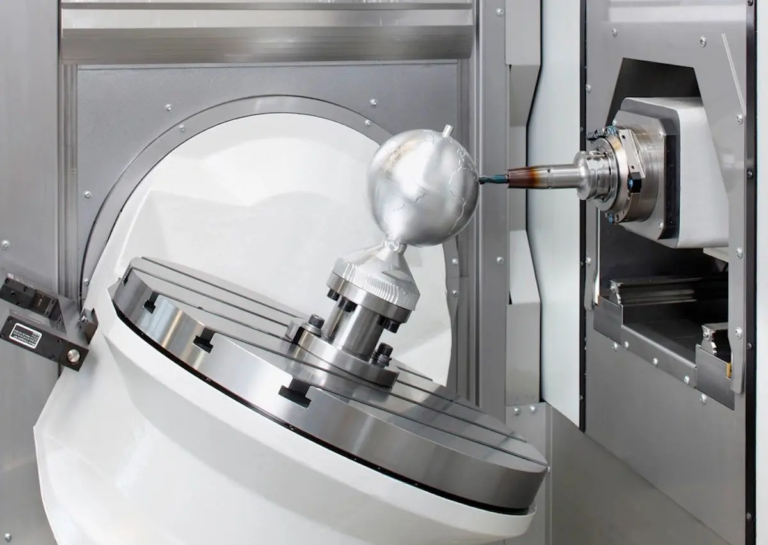
CNC Milling and Turning: A Deep Dive into Subtractive Manufacturing
CNC (computer numerical control) machining has revolutionized manufacturing, providing unparalleled precision and efficiency in manufacturing complex parts. At its core, CNC machining is a subtractive manufacturing process, meaning it forms an object by removing material from a solid block. The two most common and basic CNC machining processes are milling and turning. While both achieve the same goal—producing high-precision parts—their methods are very different. This article delves into the basics of CNC milling and turning, highlighting their key principles, processes, advantages, and applications. At Honglaite, we utilize advanced five-axis CNC machining technology to provide top-notch metal part manufacturing solutions, supplemented by one-stop post-processing and finishing services, making us your first choice for custom precision machining.
Learn about CNC milling
Milling is a versatile machining process in which a rotating cutting tool (milling cutter) removes material from a stationary or moving workpiece. Think of it like a sculptor chiseling into a piece of stone. Milling cutters come in a variety of shapes and sizes and can move along multiple axes to create the desired features.
- Main principles:
- Multi-axis motion: Milling machines typically operate on three or more axes (X, Y, and Z), allowing complex 3D shapes. Advanced machines employ five or more axes, allowing for greater geometric freedom.
- Rotary cutter: The cutting tool rotates at high speed, removing material as it comes into contact with the workpiece.
- Material removal: Milling removes material in small increments, gradually shaping the part into its final shape.
- Milling process:
- design: Create 3D CAD (Computer Aided Design) models.
- CAM programming: The CAD model is imported into CAM (computer-aided manufacturing) software, which generates a CNC program (G-code) containing specific instructions for the milling machine. This includes tool paths, cutting speeds and feed rates.
- set up: The workpiece is securely clamped to the milling machine’s table or fixture. Select and install a suitable milling cutter.
- Processing: The CNC program is executed and the milling cutter moves according to the programmed instructions, gradually removing material to create the part.
- finishing: After initial machining, parts may undergo additional milling operations to achieve finer details, tighter tolerances, or improved surface finish. This may involve different tools and changing parameters.
- Milling type:
- Face milling: Create a flat surface.
- Perimeter milling: Cut along the edge of the workpiece.
- Cavity milling: Creates a closed cavity or cavity within a workpiece.
- drilling: Create holes.
- analyze: Cut complex contours.
- Advantages of milling:
- High precision: Milling enables tight tolerances and precise dimensions.
- Versatility: Suitable for a variety of materials, from metals and plastics to composites.
- Complex geometric shapes: Ability to produce complex shapes and features.
- Good surface finish: Achieve a relatively smooth surface finish.
- Milling applications:
- Aerospace components: Aircraft structural parts, engine parts.
- Auto parts: Engine block, cylinder head, transmission components.
- Medical devices: Implants, surgical instruments.
- Electronic products: Shell, radiator.
- Mold making: Create plastic injection molding and die casting molds.
Explore CNC Turning
Turning is another basic CNC machining process in which the workpiece is rotated while a stationary cutting tool removes material. Picture a potter shaping clay on a spinning wheel. The main results of turning are cylindrical or conical shapes.
- Main principles:
- Rotating workpiece: The workpiece is held in a chuck or chuck and rotates at high speed.
- Stationary cutting tools: Cutting tools are mounted on a carriage that moves along one or more axes to remove material.
- Same diameter: Turning is ideal for making parts with uniform diameters.
- Turning process:
- design: Create a 2D or 3D CAD model, focusing on the outline of the part.
- CAM programming: The CAD model is imported into CAM software, which generates the CNC program (G-code) for the lathe. Tool paths, cutting speeds and feed rates are defined.
- set up: The workpiece is securely mounted in the lathe’s chuck or chuck. Select and install appropriate cutting tools.
- Processing: As the CNC program is executed, the workpiece rotates while the cutting tool moves along the programmed path, removing material to form the desired shape.
- finishing: Similar to milling, subsequent turning operations can be performed with different tools to improve surface finish or tighter tolerances.
- Types of turning operations:
- face: Creates a flat surface at the end of the work piece.
- Turning (outer diameter): Reduce the diameter of the workpiece.
- Boring (inner diameter): Enlarge the existing hole.
- Grooving: Create grooves or channels in the workpiece.
- Thread: Cut threads on the workpiece.
- Separate (cut off): Separate finished parts from remaining inventory.
- Advantages of turning:
- High precision: Turning can produce very precise cylindrical parts.
- High material removal rate: For cylindrical shapes, turning is usually faster than milling.
- Excellent surface finish: Turning generally produces a superior surface finish compared to milling.
- Cylindrical parts are cost-effective: It is often the most economical method of producing cylindrical parts in high volumes.
- Turning applications:
- Axes and spindles: Important components of machinery and equipment.
- Fasteners (bolts, screws): Mass production of threaded fasteners.
- Bushings and Bearings: Key elements in rotation components.
- Hydraulic and pneumatic cylinders: Fluid power system components.
- Connectors and accessories: Suitable for fluid, gas and electrical systems.
Huilite Advantage: Five-axis CNC machining expertise
At Ferrite, we specialize in five-axis CNC machining, which significantly enhances our milling and turning capabilities. Five-axis machining allows simultaneous movement along five axes, enabling the creation of highly complex geometries with fewer setups. This can be translated as:
- Shorten delivery time: Less setup means faster production cycles.
- Improve accuracy: Minimizing settings reduces the possibility of errors.
- Enhanced surface finish: Better tool access allows for smoother cuts.
- Greater design freedom: Complex shapes that cannot be created using traditional three-axis machining become easy to achieve.
We offer comprehensive post-processing and finishing services to ensure your parts meet the highest quality and performance standards. Our expertise in material selection, mold optimization and process control ensures you get precision machined parts that meet your exact requirements.
in conclusion
CNC milling and turning are integral parts of modern manufacturing, and each technology offers unique advantages for producing a variety of parts. Milling excels at creating complex 3D shapes, while turning is ideal for producing cylindrical parts with high precision and efficiency. By understanding the principles, processes and applications of these two basic technologies, manufacturers can make informed decisions about the best approach to meet their specific needs. No matter how complex your project is, GreatLight’s advanced five-axis CNC machining capabilities and one-stop service ensure superior results. Contact us today to customize your precision parts at the best price!
Frequently Asked Questions (FAQ)
Q: What are the main differences between CNC milling and CNC turning?
one: In CNC milling, a rotating cutting tool removes material from a stationary or moving workpiece. In CNC turning, the workpiece rotates while a stationary cutting tool removes material. Milling is better suited for complex 3D shapes, while turning is best for cylindrical parts.
Q: What is G code?
one: G-code is a programming language used to control CNC machine tools. It contains instructions for the machine to follow, including tool paths, cutting speeds, feed rates and other parameters.
Q: What materials can be CNC machined?
one: A variety of materials can be CNC machined, including metals (aluminium, steel, stainless steel, titanium, brass, copper), plastics (ABS, polycarbonate, acrylic, nylon), composites (carbon fiber, fiberglass) and wood.
Q: What is five-axis CNC machining?
one: Five-axis CNC machining involves simultaneous motion along five axes: X, Y, Z, A, and B. This provides greater design freedom, improved accuracy and shorter lead times for highly complex parts.
Q: What is tolerance in CNC machining?
one: Tolerance refers to the allowable deviation in the dimensions of a part. Tighter tolerances indicate higher precision and accuracy requirements.
Q: What are the common post-processing services for CNC machined parts?
one: Common post-processing services include deburring, polishing, anodizing, powder coating, painting, heat treatment and electroplating.
Q: How do I get a quote for GreatLight’s CNC machining services?
one: You can contact us via our website or by phone with your CAD files and specifications. We will review your requirements and provide a competitive quote based on your needs.
Q: What is the typical lead time for CNC machining projects?
one: Delivery times vary based on part complexity, material and quantity. We strive to provide fast turnaround times while maintaining the highest quality standards.
Q: What file formats are accepted for CNC machining?
one: We generally accept CAD files in formats such as STEP, STP, IGES, IGS, DXF, DWG and SolidWorks files.
Q: How do I choose between CNC milling and CNC turning for my project?
one: Consider the shape and features of the part. If your part is primarily cylindrical, turning may be a better option. For complex 3D shapes with multiple features on different faces, milling is often more suitable. Contact us for a free consultation based on your design requirements.



















