
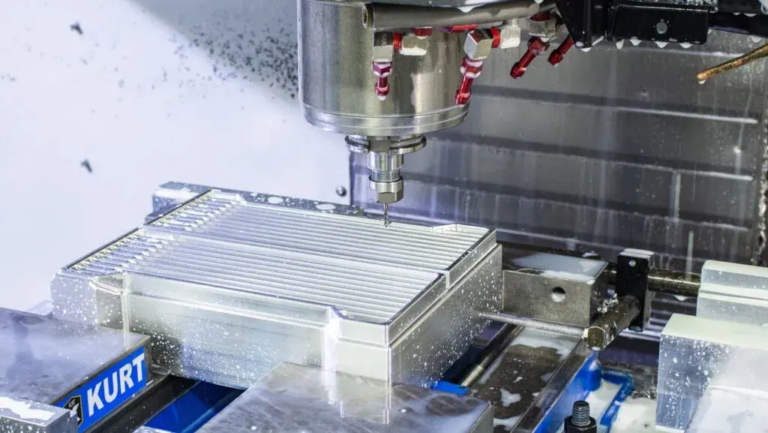
The science and art of precision CNC surface finishing: Achieve perfect functional and aesthetic surfaces
In the world of precision manufacturing, the part journey does not end when it is disengaged from a CNC machine. The final surface condition – its texture, reflectivity, hardness and even aesthetic appeal – plays a crucial role in its function, lifespan and overall success. This is where the precise CNC finishing steps are made, turning the processed ingredients from raw cuts into refined masterpieces ready to be performed in demanding environments. At Greatlight, we recognize that achieving a perfect finish is more than just add-ons. This is an integral part of the precise machining process, especially when utilizing the advanced features of five-axis CNC machining.
Beyond Tool Marking: Why Surface Finishes Can’t Be Negotiable
CNC machining, even with the ultraproprietary tool path that can be achieved with five-axis equipment, inherently leaves microscopic peaks and valves (tool markers) on the surface of the part. While these may be invisible to the naked eye, they have tangible consequences:
- Performance: A rough surface increases friction in moving parts, promotes wear, leading to premature failure of bearings and seals, and port contamination. Controlled finishes reduce friction and enhance part of life.
- Function: Needs tightly sealed surfaces (e.g., hydraulic components, fuel systems), electrical conductivity, or specific light reflection characteristics Require Accurate completion features. Adhesion, coating adhesion and corrosion resistance also depend heavily on surface preparation.
- aesthetics: Visual appeal and tactile sensation are crucial for consumer products, medical devices or highly visible components. The perfect finish conveys quality and precision.
- Dimensional stability: Aggressively process materials with pressure near the surface. The finishing process can remove this micro-damaged layer, thereby increasing fatigue resistance.
Utilizing five-axis CNC: The basis of the upper finish
Greatlight’s commitment to advanced five-axis CNC machining is more than just complex geometry. Excellent surface quality can be achieved from the start, resulting in a more efficient and precise finish:
- Best Tools Access and Continuous Engagement: The five-axis machine operates the cutting tools around the workpiece with unparalleled dexterity. This allows the optimal tool to be maintained throughout the cutting process to the working point, thus greatly reducing tool marking, chatting and scallops, thus creating inherent roughness. Smoother cuts mean less aggressive finishes are needed later.
- Reduced settings, enhanced consistency: Complex parts that need to be completed usually require multiple orientations on a 3-axis machine. Each setting introduces potential errors. Five-axis machining creates complex surfaces in a single setup, ensuring geometric and surface consistency throughout the section – a fundamental basis for uniform finishing results.
- Complete complex outlines: It is well known that parts in deep cavity, undercut or organic shapes are difficult to complete uniformly. The five-axis function enables finishing tools to access these hard-to-reach areas with consistent pressure and contact, enabling homogeneity using less complex equipment.
- Pre-positioning accuracy: The accuracy and repeatability of our five-axis system means that dimensional tolerances remain tight before completion. This prevents excessive material from being removed during finishing, thus preserving key features and mechanical integrity.
Palette of precision surface finishing technology
Greatlight provides a comprehensive set of surface finishing services selected and applied based on materials, partial geometry, functional requirements and aesthetic goals:
- Quality completion: Ideal for smaller parts produced in larger volumes. include:
- Vibration collapse: Place the parts in a vibrating bowl or bathtub with abrasive media and place the compound to be gentle, broken and smooth.
- Bucket roll (rotate): Similar to vibration, but uses a rotating barrel for a more even finish for a specific part type.
- Centrifugal disc/barrel: Combine centrifugal forces with rotation to make cycle times faster and have a highly uniform finish on robust parts.
- Abrasive blasting (gravel explosion): Drive abrasive particles toward the surface of the part at high speeds. Controls include:
- Media Type: Sand, alumina, glass beads, plastic, walnut shells – each offering a different finish and effect.
- Pressure and angle: Determines aggressiveness and texture.
- app: Burrs, cleans, creates matte/textured surfaces, improves paint adhesion, relieves stress (shooting).
- Brushing and polishing: Manually or increasingly automated processes using CNC, using abrasive tapes, discs or wheels that gradually smooth the surface.
- Satin finish: Consistent directional grain pattern.
- Mirror polishing agent: High force flow, reflective finish, requires multiple gravel steps.
- electricity: Electrochemical process of removing microscopic layers of surface material. This is the level of micropores, enhances corrosion resistance, passivates the surface (stainless steel) and creates a bright, smooth, clean finish for medical, semiconductor and food-grade applications.
- Slap and hone: Ultra-precision completion techniques achieved using abrasive compounds on tools (LAP) or stone (matte):
- Extremely flat/geometric: Sealing the surface is crucial.
- Tight size control: Complete the hole or cylinder surface to the exact size.
- Specific surface texture: Designed for optimal oil retention rates for engines.
- Paints and coatings: When technically adding materials, processes such as anodization (aluminum), hard chrome plating or passivation (stainless steel) are often applied back Mechanical finishes to impart enhanced surface properties such as extreme hardness, wear resistance, corrosion resistance or specific colors. The quality of the base surface finish is crucial for the adhesion and performance of the coating.
- Laser texture: Different laser parameters can create specific microtexts (e.g., frictional modification, fluid retention, light diffusion) or unique aesthetics for functional purposes.
Material mastery and application versatility
Greatlight’s completion expertise covers a wide range of processable materials:
- Metal: Aluminum (various alloys and tempers), stainless steel (300, 400 series, 17-4ph, etc.), titanium, magnesium, brass, copper, copper, tool steel, exotic alloys (Inconel, Hastelloy).
- Plastics and composites: PEEK, DELRIN, Nylon, ULTEM, Carbon Fiber Reinforced Polymer (CFRP) – A specialized, gentle modification method is required to avoid damage to the fiber or melting.
These finished parts find key roles in the industry:
- aerospace: Hydraulic components, turbine blades, require structural elements that resist fatigue and wear properties.
- Medical: Implants (HIPAA compliant process!), surgical instruments, diagnostic equipment, biocompatibility and infertility required.
- car: Performance engine parts, transmission assembly, sensor housing, aesthetic decoration.
- semiconductor: Wafer processing components, vacuum chamber parts, require ultra-clean particle-free surfaces.
- Industrial: Valve body, pump assembly, mold and mold, robotics technology.
- Consumer Electronics: High-precision housing, bezel, radiator that requires thermal performance and aesthetics.
Why cooperate with your processing and finishing?
Choosing Greatlight means investing in a seamless journey from raw materials to impeccable finish:
- Internal expertise and control: We seamlessly integrate surface finishes in advanced five-axis CNC machining workflows. There are no outsourcing delays or communication gaps. Our engineers understand the entire process chain.
- Technical Advantages: Our advanced five-axis machine provides excellent pre-determined surfaces, simplifying and improving the final outcome. We invest in state-of-the-art finishing equipment.
- Matter agnosticism: Whether it is complex titanium medical components or large-capacity aluminum automotive components, we have the material knowledge and ability to complete the process.
- Problem Solver: We go beyond simply running parts. Our team works with you to understand Function Parts and recommend the most effective and economical finishing solutions for their specific requirements.
- Quality and consistency: Strict process and final inspections (including surface validator if required) ensure that each section reliably meets strict specifications, batch after batch.
- One-stop efficiency: Eliminate the hassle of managing multiple vendors. Greatlight offers fully machined, finished, inspected and frequently assembled parts – accelerating your market time.
- Agility and value: Combining precise five-axis machining with optimized finishes means we efficiently produce complex high-quality parts that offer extraordinary value even when demanding low-capacity prototypes or challenging production runs.
in conclusion
An accurate CNC finish is far more than just making the parts look good. This is crucial for unlocking peak performance, reliability and life. From reducing friction in critical driveline components to ensuring biocompatibility in life-saving implants, the right finish makes the difference between success and failure. Greatlight leverages the precise foundation of advanced five-axis machining as our launch pad for fully functional completion. We combine technical expertise, cutting-edge technology, and a deep understanding of materials and applications to deliver parts that not only meet specifications but exceed expectations for functionality, durability and aesthetics. Don’t leave the final surface quality to the opportunity – pair with good cooperation to achieve perfect results.
Frequently Asked Questions about CNC Surface Finishings (FAQs)
Q1: What is the difference between processing tolerance and surface finish?
one: tolerant Refers to the allowable dimensional deviation that a part can have from its designed dimensions and geometry (eg, ±0.01mm). Surface finish (usually measured by RA, RZ or RMS values) describes the texture, roughness or smoothness of a part surface itself, independent of its overall shape. The parts can be of perfect size but have rough or uneven surface texture.
Q2: How to measure and specify surface finishes?
one: The surface finish is usually specified using the standard roughness parameters on the technical drawings:
- RA (Arithmetic Average Roughness): The most common measure. This is the average height of the surface profile deviating from the average line.
- RZ (Average Maximum Height): The mean difference between the highest peak and the deepest valley over several sampling lengths.
- RMS (root mean square): Not very common now, similar to RA, but the calculation method is different.
Surface profilers (contact stylus or contactless laser/optical) are used to accurately measure these values. The drawing will specify the desired RA value (for example, "RA 0.8 µm").
Q3: Will a very smooth mirror finish have a negative impact on the function?
one: Sometimes, yes! While aesthetically pleasing, ultra-smooth surfaces may not be ideal:
- Adhesion/adhesion: Very smooth surfaces can reduce surface energy, so difficult bonding or paint bonding without a specific surface treatment.
- Lubrication retention rate: In the sliding bearing or gear surface, some controlled roughness ("Plateau completed") is ideal for trap lubricant films. A true mirror surface may cause lubrication failure.
- Grip/Safety: The surface (handle, foothold) that needs to be held is usually textured. Function determines the ideal finish profile.
Question 4: Why choose electrical polish instead of mechanical polish?
one: Electric polishing offers unique advantages:
- Unified material removal to achieve excellent micro smoothness while retaining geometry (No) "soften" edges such as mechanical polishing).
- Even tiny internal edges and difficult-to-access areas are excluded at the same time.
- Remove embedded contaminants and hardened layers.
- Passivation of stainless steel (reinforced oxide layer) can significantly enhance innate corrosion.
- Create a clean, sterilizable, bright finish for critical applications (medical, food, semiconductors). Mechanical polishing can leave embedded abrasive particles and apply the surface.
Q5: How to specifically improve surface finish for five-axis CNC machining?
one: Five-axis machining creates an excellent starting surface:
- Less initial roughness: Continuous optimal tool orientation minimizes tool marking.
- consistency: Complex surfaces are uniformly processed in one setting, avoiding completion changes in multiple settings.
- Accessibility: Complete hard-to-reach geometric shapes without compromise.
- Reduce post-processing: Smoother cuttings often reduce the time and aggressiveness of the required steps to complete. Our engineers keep in mind the final machining strategy.
Question 6: Can Greatlight handle functional and pure aesthetic finishing requirements?
one: Absolutely. We understand subtle needs. For functional surface treatments (e.g., wear resistance, sealing, corrosion protection), we select processes based on engineering data and materials science. For aesthetic finishes (e.g., custom textures, specific colors, mirror/satin look), we utilize polishing, blasting and potential finishing techniques combined with the appropriate coatings (e.g., specific anode color) to achieve the visual and tactile results you need without sacrificing quality.
Q7: How to specify the required finish for my part?
one: The most effective way is your technical drawings:
- Indicate what is required RA value (For example, "⌀25mm hole, RA≤0.4µm").
- Specify Area or surface This is required (e.g. "All surfaces" or call a specific face/function).
- If the finish type exceeds the roughness (e.g. "Media Explosion (Alox Grit #220)",,,,, "Every time ASTM B912",,,,, "Directional satin finish"), clearly pointed out.
- For critical functional surfaces, consult with our engineers early in the design phase to ensure that the required finish is achieved and optimal for the application and selected materials. We are here to help and suggest!



















