
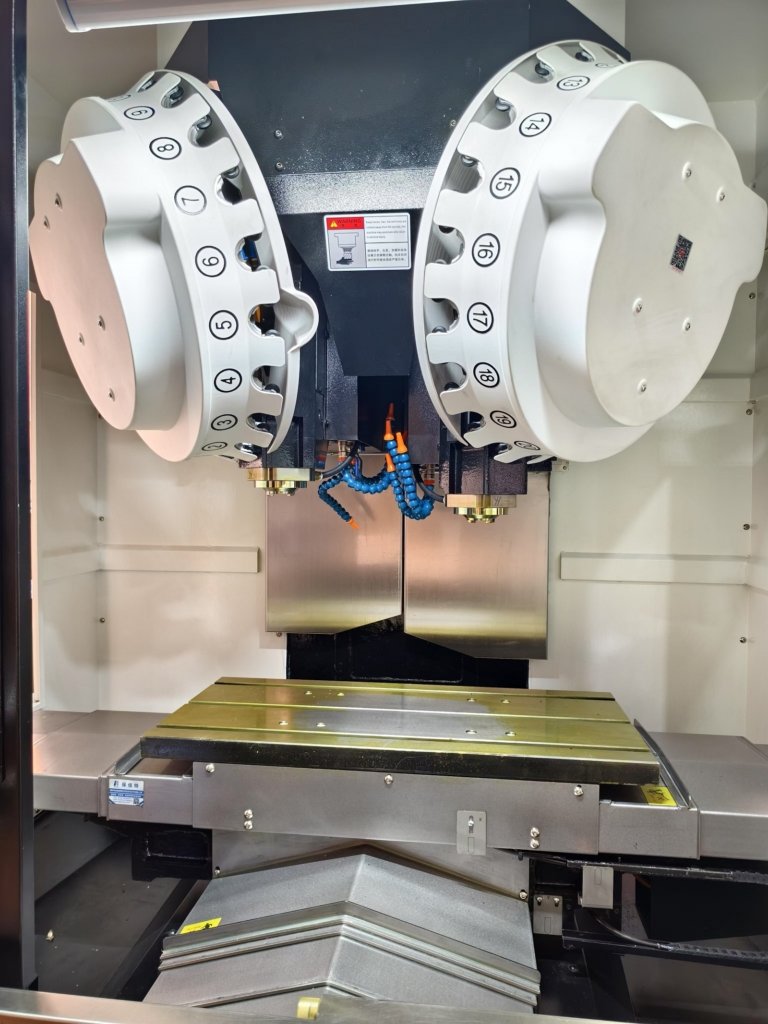
The Fundamentals of CNC Machine Tools: Movement Control, Kinematics, Dynamics, and Structural Design
In the era of rapid technological advancements, Computer Numerical Control (CNC) machine tools have become an essential component in various industries, from manufacturing to healthcare. To produce high-precision and efficient manufacturing processes, it is crucial to understand the fundamental principles of CNC machine tools, including movement control, kinematics, dynamics, and structural design.
Movement Control: Open Loop vs. Closed Loop Control
CNC machine tools use two primary approaches to control movement: open loop control and closed loop control. Open loop control involves direct control of the program instructions by the CNC system, without real-time surveillance of the movement process. This method is simple and cost-effective but may compromise precision and stability. In contrast, closed loop control uses sensors to monitor the movement of the machine tool in real-time, adjusting the servo motor’s control signals accordingly. This approach ensures high precision and stability but is more complex and expensive.
Pulse Encoders: Absolute vs. Incremental Feedback
Pulse encoders play a vital role in position feedback during CNC machine tool movement. There are two types: absolute encoders and incremental encoders. Absolute encoders measure absolute position, eliminating the need for zero-point calibration. While more accurate and stable, they are more expensive. Incremental encoders measure relative position, requiring zero-point calibration each time the machine is powered on.
Servomotors: High-Precision and High-Stability Movement Control
Servomotors and stepping motors are the primary driving components in CNC machine tool movement. Servomotors exhibit high reactivity, precision, and stability, making them suitable for high-speed and high-precision applications. Stepping motors, with a simpler structure and lower cost, are ideal for low-speed and low-precision applications.
Kinematics and Dynamics: Realizing Precise Movement
Kinematics and dynamics are crucial for achieving precise movement in CNC machine tools. Kinematics involves calculating the actual movement of each axis based on input instructions. Dynamics, on the other hand, studies the stress conditions during machine movement, including inertial forces and centrifugal forces.
Interpolation Algorithms: Smooth Trajectories and High-Precision Movement
Interpolation algorithms play a vital role in generating smooth trajectories for complex movements. Popular algorithms include linear interpolation, arc interpolation, and spline interpolation, each suitable for specific movement types.
Structural Design: Rigid and Light, Thermal Stability, and Modal Analysis
Effective structural design is essential for CNC machine tools, balancing rigidity and lightness to ensure optimal movement performance. Thermal stability is also critical, as machine tools can generate heat, causing deformation. Modal analysis, frequency response analysis, and temporal domain analysis are techniques used to evaluate and improve the performance of CNC machine tools.
Conclusion
In conclusion, the fundamental principles of CNC machine tools, including movement control, kinematics, dynamics, and structural design, are essential for achieving high-precision and efficient manufacturing processes. By understanding the intricacies of open loop and closed loop control, pulse encoders, servomotors, and interpolation algorithms, industries can develop more accurate and efficient CNC machine tools, revolutionizing the manufacturing landscape.



















