
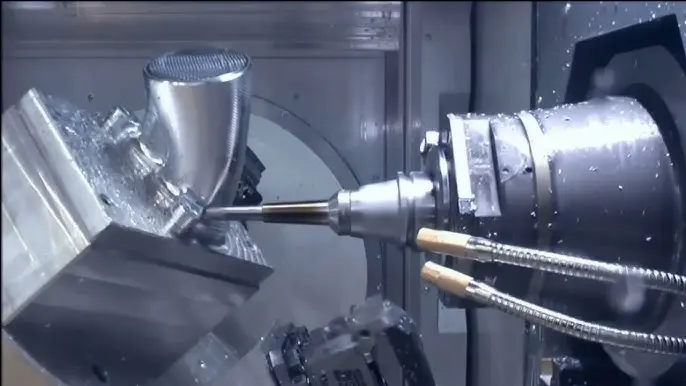
Principle of five-axis connection CNC machining
The world of CNC machining is vast and complex, with various types of machining technologies to achieve precise and efficient manufacturing of parts. Among these technologies, five-axis interlocking CNC machining has become increasingly popular in recent years because of its ability to produce complex shapes and surfaces with high precision. In this article, we will dig into the five-axis links of CNC machining, explore its advantages, and discuss its application in various industries.
Principle of five-axis connection CNC machining
In traditional CNC machining, cutting tools are limited to specific axes, which limits the complexity of the shapes that can be generated. On the other hand, five-axis interlocking CNC machining allows cutting tools to move on multiple axes, allowing for the creation of complex shapes and surfaces with high precision. This technique is achieved by a combination of two or more motion axes, including the X, Y and Z axes, as well as the rotation axes (B axes) and the tilt axes (A axes).
The core principle of five-axis linkage CNC machining is the ability to move the cutting tool with multiple axes, so that the cutting process can be precisely controlled. This can produce complex shapes, including free form surfaces and high-precision manufacturing of complex parts. Five-axis machining technology is particularly useful in industries that require precision, such as aerospace, automotive and medical equipment manufacturing.
Advantages of five-axis interlocking CNC machining
CNC machining has several key advantages of five-axis connection, making it an ideal solution for various industries. Some key benefits include:
*Improving accuracy: The ability to move cutting tools with multi-axis can accurately control the cutting process, resulting in high-precision manufacturing.
* Complex shape generation: Five-axis machining enables complex shapes with high precision, including free-shaped surfaces.
*Reduced manufacturing time: The ability to process complex shapes in a single setup reduces manufacturing time and cost.
*Improved surface surface: Accurate control of cutting tools enables surface generation with high quality.
Application of five-axis connection CNC machining
CNC machining five-axis connections are widely used in various industries, including:
*Aerospace: Five-axis machining is used to produce precise aircraft components such as engine parts, flight control components and satellite components.
*Auto: This technology is used to produce complex engine parts such as cylinder heads, engine blocks and transmission components.
*Medical Equipment Manufacturing: Five-axis processing is used to produce precise medical equipment such as surgical instruments, implants and implants.
*Energy: This technology is used to produce precise components such as wind turbine blades and power generation equipment.
in conclusion
In short, five-axis interlocking CNC machining is a powerful technology that produces complex shapes and surfaces with high precision. Its advantages include improved precision, complex shape production, reduced manufacturing time and improved surface finishes, making it an ideal solution for a variety of industries. Whether you are producing precision aircraft components, medical equipment or energy equipment, five-axis interlocking CNC machining is an excellent choice for high-precision manufacturing.
FAQ:
Q: What is five-axis connection CNC machining?
A: Five-axis interlocking CNC machining is a CNC machining that allows cutting tools to move on multiple axes, thereby enabling high precision in the production of complex shapes and surfaces.
Q: What are the advantages of five-axis chain CNC machining?
A: The advantages of five-axis interlocking CNC machining include improved accuracy, complex shape generation, reduced manufacturing time and improved surface finish.
Q: Which industries use five-axis chain CNC machining?
A: Five-axis chain CNC machining is used in various industries including aerospace, automotive, medical equipment manufacturing and energy.
Q: What is the difference between five-axis chain CNC machining and traditional CNC machining?
Answer: Five-axis connecting rod CNC machining can move on multiple axes, while traditional CNC machining is limited to single-axis motion.



















