
Breaking the Mold: Revolutionary Coating Technology for Low Friction and High Wear Resistance
In the pursuit of reducing CO2 emissions, the scientific community has been searching for innovative solutions to minimize the environmental impact of industrial processes. One such solution lies in the realm of coating technology, which has been gaining popularity in the automotive industry due to its ability to reduce friction and improve wear protection. In this blog post, we’ll delve into the cutting-edge world of coating technology and explore the benefits of a new parametric coating that shows immense potential for reducing friction and wear in high-temperature applications.
The Limitations of Traditional Coatings
Traditional coatings have been the go-to solution for reducing friction and wear, but they have their limitations. High-temperature applications, in particular, pose a significant challenge for these coatings, as the increased heat can cause them to degrade and lose their effectiveness. This has led to the development of parametric coatings, which can be tailored to meet the specific demands of high-temperature environments.
The Emergence of Parametric Coatings
Parametric coatings are a type of coating that can be precisely controlled to create a unique set of properties that are tailored to a specific application. In the case of high-temperature applications, parametric coatings offer several advantages over traditional coatings. They can maintain their integrity and effectiveness even in extreme temperatures, reducing the risk of degradation and ensuring optimal performance.
The W-Parameter Coating: A Game-Changer in High-Temperature Applications
Researchers have been working tirelessly to develop a coating that can withstand the harsh conditions of high-temperature environments. Recently, a team of scientists at Hauzer made a breakthrough discovery that led to the development of the W-parameter coating. This coating is designed to be used in high-temperature applications, where its unique properties can minimize friction and wear while maintaining a low coefficient of friction.
The Results
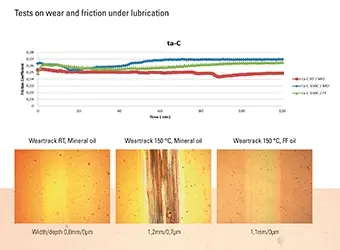
To test the effectiveness of the W-parameter coating, a series of experiments were conducted at 450°C and 150°C. The results were nothing short of astounding. In dry conditions, the W-parameter coating showed minimal wear, with the exception of the AC: H-SI coating, which exhibited considerable wear due to the lack of water vapor. In lubricated conditions, the W-parameter coating performed exceptionally well, with a friction coefficient that was comparable to that of the T-C coating.
A Breakthrough in Wear Protection
The W-parameter coating also showed excellent wear protection, with minimal wear observed in both dry and lubricated conditions. This is a significant breakthrough, as it means that the coating can be used in high-temperature applications without worrying about degradation or failure.
Conclusion
The W-parameter coating is a groundbreaking development that has the potential to revolutionize the way we approach high-temperature applications. Its unique properties make it an attractive solution for industries that require low friction and high wear resistance. As the world continues to face the challenges of climate change, it is essential that we explore innovative solutions like this coating technology to minimize our environmental impact.
Looking Ahead
The W-parameter coating is just the beginning of a new era in coating technology. Further research and development are needed to fully harness its potential and create even more effective solutions for the industries of the future. With the W-parameter coating, we are one step closer to a more sustainable and environmentally friendly future. Stay tuned for further updates on this groundbreaking technology and its applications in the months to come.



















