
Basic principles of the treatment of electric sparks
The principle of the treatment of electric sparks consists in eroding excess metal based on the phenomenon of electrocorrosion during the discharge of pulsed spark between the tool and the part (positive and negative electrodes) to meet the predetermined treatment requirements For the size, shape and quality of the surface of the room.
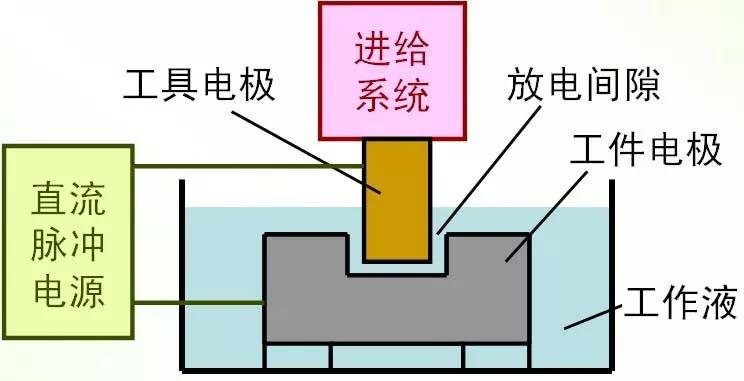
As shown in the figure below, the tool and the tool electrode are connected to two polarity electrodes different from the pulse power supply.
Tool electrodes are commonly used for corrosion-resistant materials with good conductivity, high melting point and easy-to-treat treatment, such as copper, graphite, Tungstène copper alloy and molybden. During the processing process, the tool electrode also undergoes losses, but is less than the quantity of elimination of the corrosion of the metal from the part, and is even close to any loss.
As a discharge dielectric, work fluid also plays a role in cooling and eliminating fleas during the processing process. The commonly used work liquids are low viscosity environments, a high flash point and stable performance, such as kerosene, deionized water and emulsions.
When a pulse tension is added between the two electrodes, when an appropriate space is held between the room and the electrode, the liquid work environment between the part and the tool of the tool will be decomposed to form a discharge channel.
The high instantaneous temperature is generated in the discharge channel, which melts or even gauge the surface material of the part, and also gasic liquid environment, which develops quickly thermally and explodes in the discharge space. The surface of the room is eroded and thrown away, forming a small electric erosion pit.
Once the pulse discharge is complete, the work fluid is restored to insulation after a period of time. The pulse tension acts several times on the part and the tool electrodes.
The servo system continuously adjusts the relative position of the tool and part electrode, and automatically feeds it to ensure that the pulse discharge is carried out normally until the required parts are Treaty.
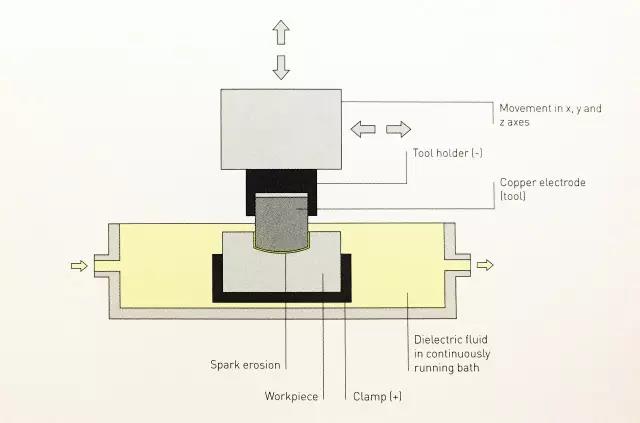
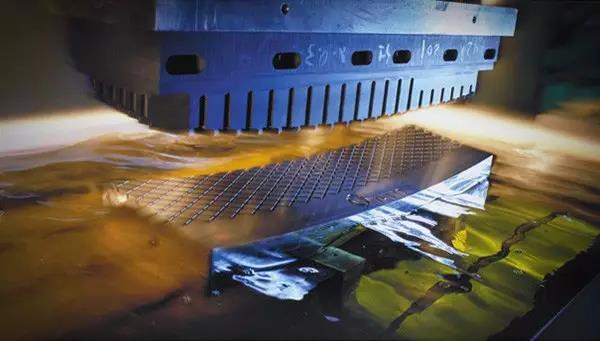
1. Electric sparking training
The tool electrode is generally a copper or graphite forming electrode, which can be of any form that can be manufactured, and the treated shape is the corresponding cavity.
2. Electric sparrow cutting treatment
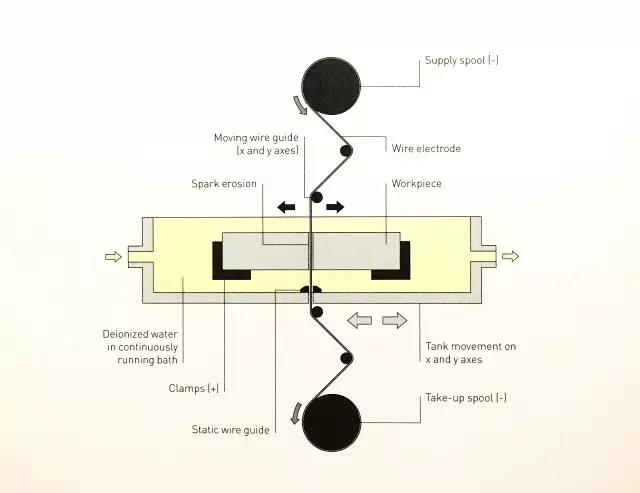
The treatment of the cutting of electric sparks is divided into slow and fast thread.
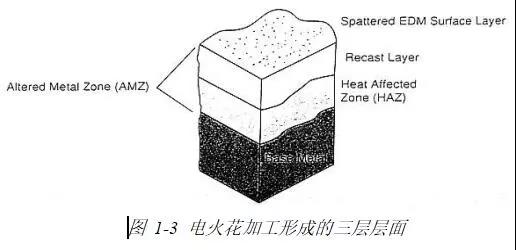
During the treatment of electric sparks, it is not only the surface of the room, but also its basement. The surface structure of the treated part is divided into three layers (Figure 1-3).
The surface impact layer of the treatment of the electric spark is made of the impact of the melted melted metal and a small amount of electrode particles. This layer is easy to remove.
The next layer is the hard layer (oxidation layer). The treatment of the electric spark essentially modifies the metallurgical structure and the characteristics of the hard layer. Under the action of the average oil, the melted metal cools quickly and the melted metal which has not been thrown solidifies in the cavity to form a hard layer. This hard and fragile layer of oxide will have microfissances. If this layer is too thick or cannot be cleared or eliminated by polishing, the work can be damaged prematurely under certain conditions of use.
The last layer is a heat reception layer or a layer of receipt. It is just heated and does not melt. The thickness of the hard layer and the heat reception layer is determined by the thermal dissipation capacity and the treatment energy of the room material. Whatever the question, the modified metal layer will affect the original properties of the part of the room.
The automatic finishing circuit on CNC Electric Spark machine tools can effectively reduce the formation of hard diapers, but it still cannot eliminate the receipt.
Daguang focuses on providing solutions such as precision CNC machining services (3-axis, 4-axis, 5-axis machining), CNC milling, 3D printing and rapid prototyping services.



















