

1 Preface
The X antenna part is a key structural element on a certain support system. It adopts a light and low rigidity structure. About 90% of the wall thickness is <1mm, and the thinnest part is only 0.5mm. high precision requirements and the material removal rate reaches 97.15%. There are many processing features, including the waveguide cavity that requires high precision. After the first round of trials, the success rate still failed to meet the mass production requirements. After the first batch of processing, the success rate was 87.59%, which did not meet the requirements for mass production. This article will detail the selection of cutting parameters, selection of programming strategy and the use of quality management tools to achieve breakthroughs in processing technology bottlenecks and production requirements by high quality, high yield and low cost batches.
2 Analysis of structural characteristics
The X antenna part is composed of a thin plate with a length and width of 551mm×151mm and a thickness of 0.5mm as the main body, and several thin-walled square frames are superimposed in up and down, as shown in the figure. 1.
Figure 1 Cross section of X antenna parts
X antenna parts are typical thin-walled, deep cavity parts[1]its maximum wall thickness is 0.8 ± 0.05 mm, the thinnest is 0.5 ± 0.05 mm, and the deepest cavity is 25.8 ± 0.05 mm. The width of the waveguide cavity is 60.7 ± 0.05mm and the length is 274.2 mm, the depth is 25.8 ± 0.05 mm, and the wall thickness is 0.8 ± 0.05 mm. The precision and processing quality of the waveguide cavity are directly related to the quality of telecommunications indicators such as sending and receiving signals. Therefore, the chief craftsman requires that the precision of the waveguide cavity be increased to 60.7.
 mm×274.2
 mm.
mm.
3 Investigation of unqualified characteristics
An investigation was conducted on the first batch of processed X-antenna parts. The main unqualified characteristics were: large waveguide cavity width, small positioning column center distance, large deformation of the throttle groove sidewall and large flatness value, etc. arranged.

Figure 2 Layout of unqualified features
As shown in Figure 2, the proportion of “large waveguide cavity width and size” reaches 80.60%, which is the main problem causing the low pass rate of spot inspection of the CNC milling in lower position.
4. Preliminary formulation of the process plan
The delivery processing time and cost cannot meet customer expectations, and the problems of success rate and efficiency need to be resolved urgently. After careful consideration, the following plans are initially formulated.
(1) Dynamic milling strategy is used for rough machining. Dynamic milling processing technology is Mastercam’s patented technology. Because it can intelligently control the tool load during operation through algorithms, it can use the entire side edge of the tool to make large cuts. cutting depth and small width. The high-speed material removal method can remove a large amount of material in a short time, and the stable load control effectively avoids deformation of thin-walled structures. The material removal rate controls the extent of deformation[2,3]。
(2) The semi-finishing allowance is preferably used for finishing the side teeth of a milling cutter. Finishing allowance refers to the vertical distance of the cut metal layer thickness on the part surface. The size of the finishing allowance is directly related to whether or not vibrations appear when milling the side wall and whether vibration marks appear. The surface roughness value becomes larger and affects the size of the local waveguide cavity. This phenomenon will be more serious when milling deep, thin-walled cavities. The semi-finishing allowance should fully consider the cutting vibration and tool endurance, and it is planned to use the bisection method to optimize the finishing allowance.
(3) Cutting parameters for finishing are selected so that no traces of cutting tools are allowed after processing the waveguide cavity. Since the corner is R2mm, a 4mm diameter end mill is used for finishing, with an aspect ratio of 12.9. During actual processing, the cutting resistance is highest at the corners of the workpiece. When the side teeth of the cutter process the side, the corner at the junction becomes R-shaped when the feed per tooth of the tool is large. , the R corner at the junction will be over-stripped. This causes local overcut on both sides near corner R, as shown in Figure 3. Therefore, it is planned to use the orthogonal testing method to select the optimal feed per tooth.

a) Three dimensions

b) two-dimensional
Figure 3 Illustration of the corner overcut phenomenon
5 Implementation of the process plan
Referring to the first batch of processing experiments, the roughing allowance is first set to 1 mm, and then the optimization method and orthogonal experiment are used to select the semi-finishing allowance. Finally, the CAM software is used to design the NC (dynamic milling) program. (the strategy is used for rough milling and the semi-finishing allowance is used for semi-finishing). Finish and finishing refer to the selected parameters).
5.1 Optimization of the finishing allowance of the waveguide cavity
The finishing allowance is optimized using the bisection method and the test intervals are represented by a and b, respectively, which are 0.05 to 1 mm. The width dimension of the waveguide cavity is 60.7 mm, only by controlling the dimension close to the intermediate tolerance during testing can the dimension be accurately controlled. The inspection standard of waveguide cavity width value is set at 60.66~60.69mm. X1 and
Table 1 Test plan for the design of the finishing allowance of the waveguide cavity
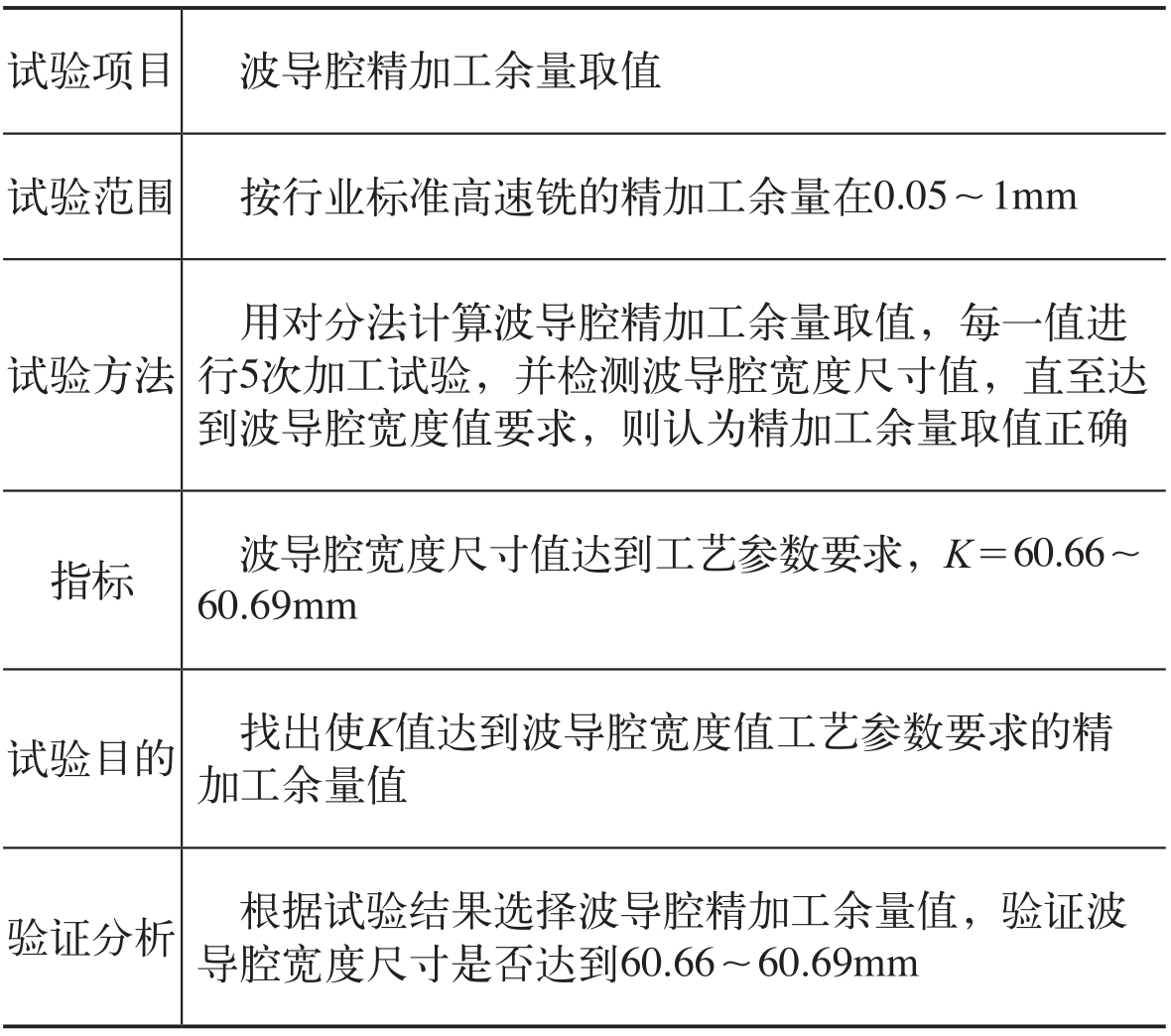
Table 2 The first test test and the results (unit: mm)
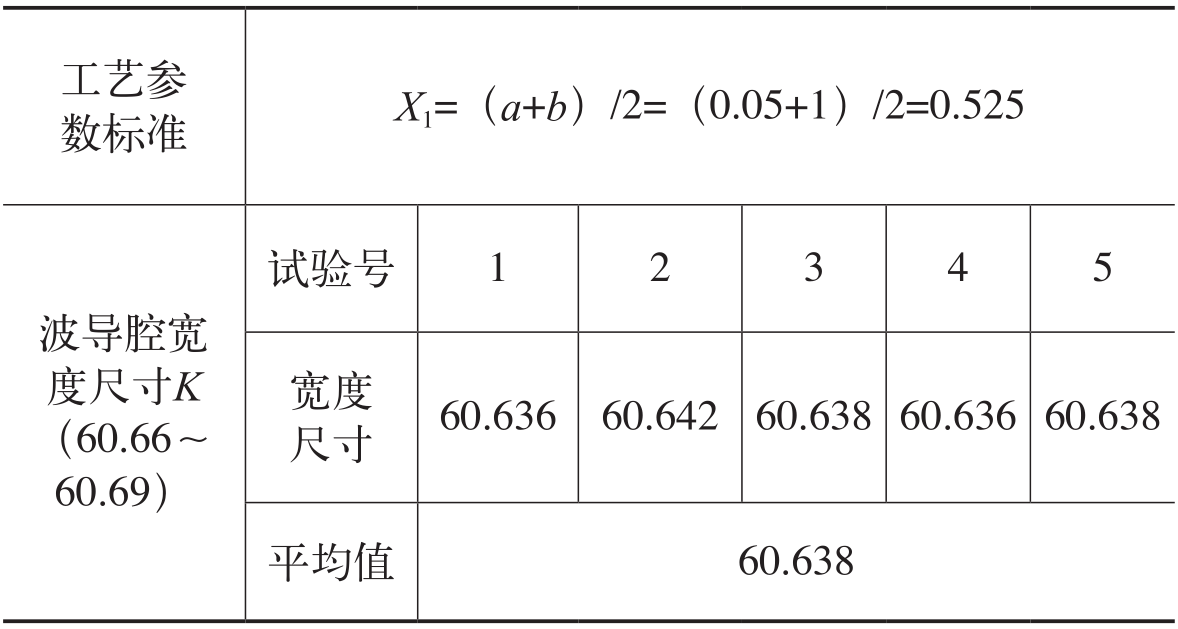
When the finishing tolerance of the waveguide cavity is 0.525mm, the average width of the waveguide cavity is 60.638mm, which exceeds the requirements of the process parameters. The waveguide cavity width value is too small, indicating that the finishing tolerance is too large. Remove (X1, b), which means remove the finishing tolerance of 0.525 ~ 1mm, leaving (a, X1), which is 0.05 ~ 0.525mm. and continue to select a new test point, see Table 3.
Table 3 The second test and results (unit: mm)

When the finishing tolerance of the waveguide cavity is 0.288mm, the average width of the waveguide cavity is 60.716mm, which exceeds the requirements of the process parameters. The waveguide cavity width value is too large, indicating that the finishing margin is too small. Delete (X1, b) and (a, 0.288 ~ 0.525 mm, continue to select new test points, see Table 4.
Table 4 The third test and the results (unit: mm)
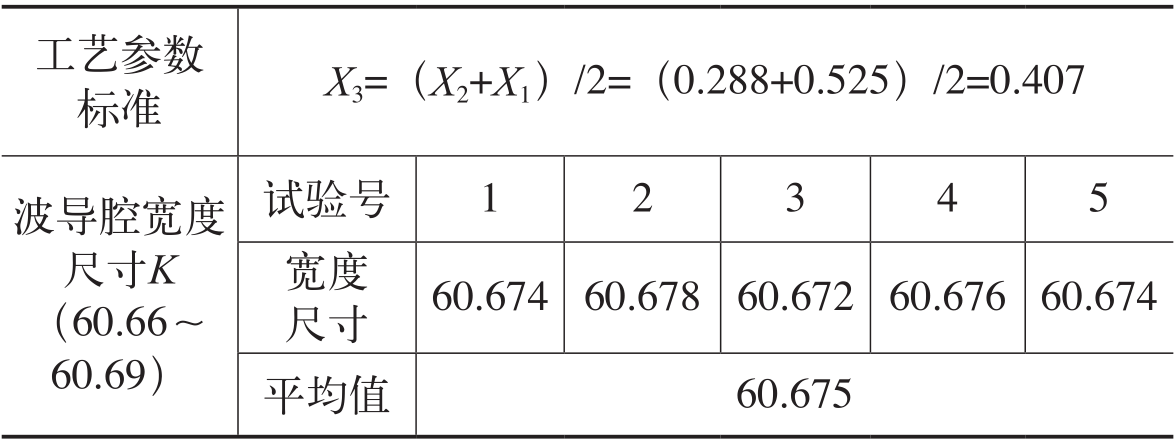
When the finishing tolerance of the waveguide cavity is 0.407mm, the average width of the waveguide cavity is 60.675mm, which meets the standard requirements of the process parameters.
Through the test, the average width of the waveguide cavity is 60.675 mm. Within the parameter range of the testing process, the finishing tolerance of the waveguide cavity is found to be 0.407 mm.
5.2 Confirm the amount of feed per tooth of the tool
Perform orthogonal experiments on the three factors that affect feed per tooth: feed rate vf, rotational speed n, and number of teeth Z.[4,5]。
(1) Clarify the purpose of the test When the cutting width, cutting depth and other cutting parameters are determined, when finishing with a φ4mm end mill, clarify the influence of vf, n and Z on the width and size of the waveguide. cavity.
(2) Determine the index to be inspected. The index to inspect is the amount of feed per tooth and the absolute value of the waveguide cavity width size difference.
(3) Select factors, select bit levels, and formulate factor level tables. The MIKRON 800LP high-speed milling machining center was selected, and the same waveguide cavity structure was tested. It was determined that all three factors vf, n and Z were necessary. The selection is now based on the specific situation. The levels to be examined and compared are shown in Table 5.
Table 5 Factor bit level

(4) Design the test plan. This test has 3 factors and 3 levels. You can choose the L9 orthogonal table (34) to organize the test. The orthogonal test design is shown in Table 6.
Table 6 Orthogonal experimental design
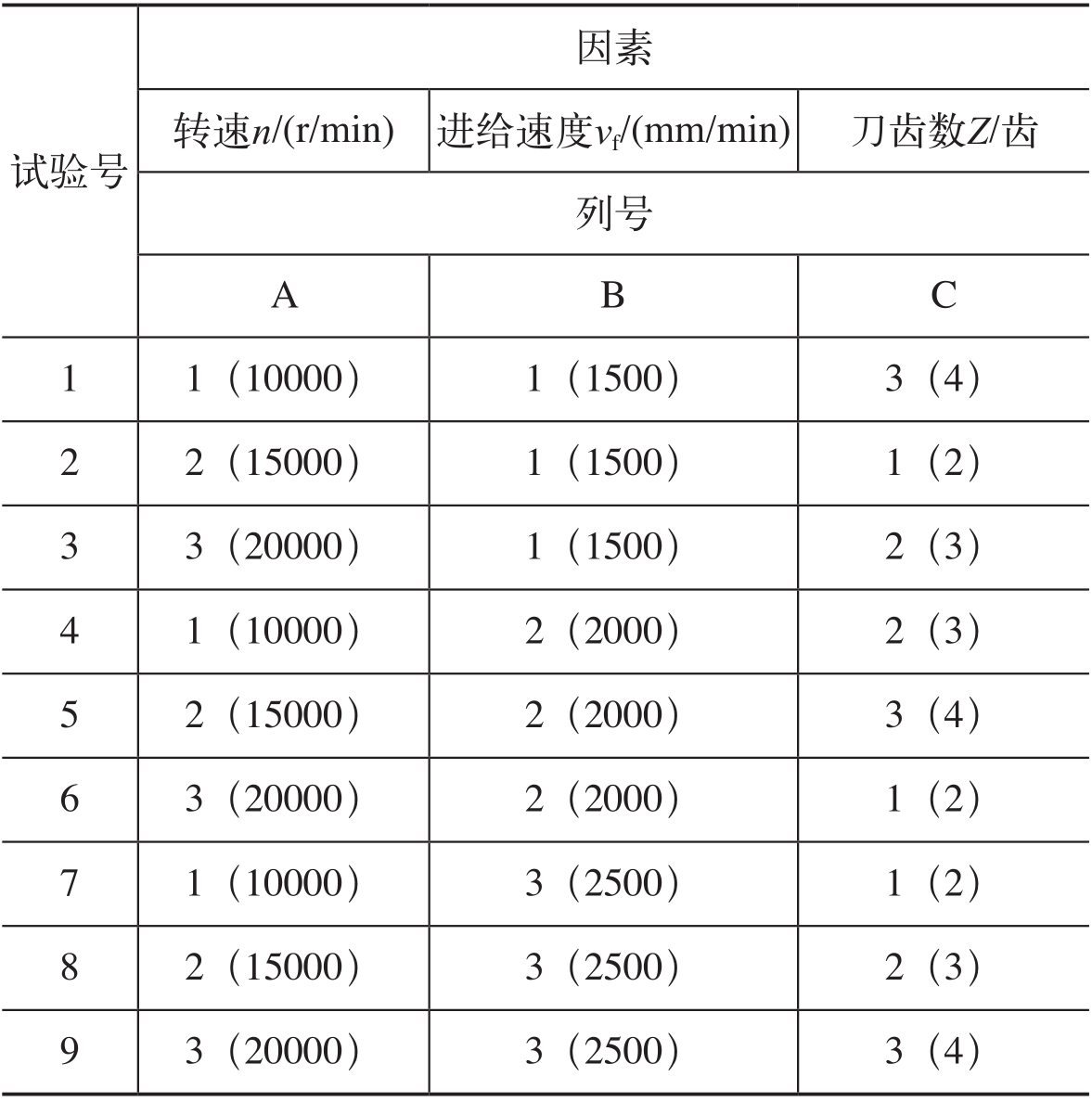
(5) Implement the test plan according to Table 6, carry out 9 tests, and perform relevant analysis on the feed quantity per tooth, the absolute value of the waveguide cavity width size difference, etc. The results of the orthogonal tests are presented in Table 7.
Table 7 Orthogonal test results

(6) For both indicators considered in the analysis of test results, the smaller the value, the better. The amount of feed per tooth is directly calculated based on the 3 factors given according to the formula; the absolute value of the size difference of the waveguide cavity is measured using a three-dimensional coordinate measuring instrument after the actual processing, and the subsequent width of the waveguide cavity. the size is mainly checked The absolute value of the difference.
Look directly: Table 7 shows that the best conditions are A3B1C2, that is, the rotation speed n is 20,000 rpm, the feed rate vf is 1500 mm/min and the Number of knife teeth Z is 3 teeth.
Do the math: Using the above tests, calculate the sum of the absolute T values of the corresponding waveguide cavity width size differences, its average value and the R range. The compiled data is shown in Table 8 .
Table 8 Test Results Data Layout

It can be seen from Table 8 that the smaller the absolute value of the waveguide cavity width difference, the better. Through the calculation, we can see that the best condition is A3B1C3. Direct observation is incompatible with calculation, so you must modify the conditions appropriately and continue testing.
According to the extreme difference R results, the rotational speed n is an important factor, followed by the number of teeth Z, and the feed speed vf has a lesser impact. In subsequent experiments, factors with greater influence should be adjusted.
The specific steps of the tuning test are as follows.
1) Selection of the adjustment factor bit level. Through the analysis of the aforementioned experiments, the team decided to focus on the good conditions of “calculation”, referring to the good conditions of “seeing directly”, and considering the actual production, cost and efficiency, etc., and decided to evaluate the three n, vf and Z. The corresponding factors and levels are re-examined. The factor levels are presented in Table 9.
Table 9 Factor Levels

2) Develop an orthogonal array. For the factor levels shown in Table 9, the three-factor, two-level orthogonal table L4 (23) can be used. The experimental design and results are presented in Table 10.
Table 10 Experimental design and results

3) Analysis of test results. Look directly: Table 10 shows that the best conditions are A2B1C2, that is, the rotation speed n is 20,000 rpm, the feed rate vf is 1500 mm/min and the Number of knife teeth Z is 4 teeth.
Do the math and see Table 11 for the results.
Table 11 Test data layout
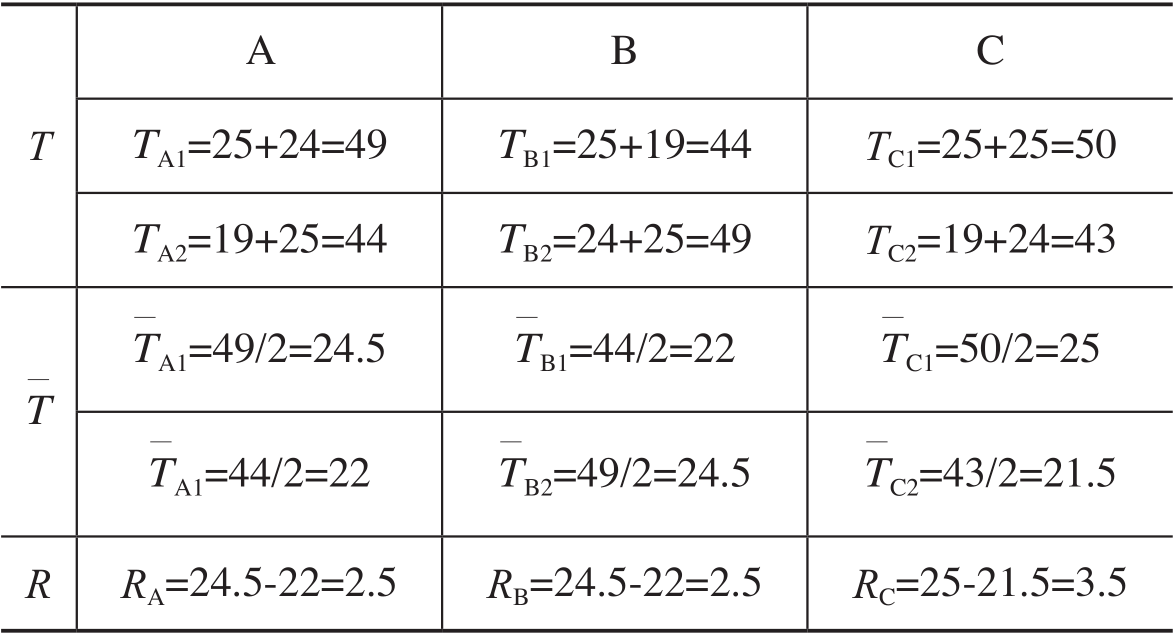
It can be seen from Table 11 that for the absolute value of the waveguide cavity size difference, the smaller the better. Through the calculation, we can see that the best condition is A2B1C2. The direct view is consistent with the calculation result, and. the difference in waveguide cavity width size The absolute value of is significantly reduced.
(7) Production verification and selection of optimal parameters The purpose of this test is to find the width of the waveguide cavity by testing the three parameters that affect the amount of feed per tooth, namely the speed of rotation n, the feed rate vf and the number of teeth Z. The absolute value of the size difference becomes smaller and the amount of feed per tooth becomes smaller. Through multiple tests verified by the orthogonal testing method, the size difference in the width of the waveguide cavity is better controlled.
By following and checking the above parameters 10 times, the absolute value of the waveguide cavity width size difference is stable, so the rotation speed n is 20,000 rpm, the speed d The feed rate vf is 1500 mm/min, the number of knife teeth Z is 4. teeth, and the feed rate per tooth is 19 μm.
5.3 CNC programming
Through the above optimization method and orthogonal experiments, the optimal finishing allowance and cutting parameters are determined. Referring to the accurate test data and summary of the first batch of processing experience, the CNC machining program of all strategies was changed to dynamic milling strategies (for space reasons, the programming process CNC will not be described here). The processing qualification rate of three consecutive batches was monitored and recorded. The raw processing efficiency was reduced by 3 hours/piece, and the average product qualification rate reached 97.5%.
6Conclusion
In product structure design in recent years, the concepts of thinness and lightness have been widely used. Competition in the mechanical processing industry is becoming more and more fierce. If businesses are to survive and profit, it is clear that there is still a lot of productivity to improve. It explains how to use cutting parameter selection, programming strategy selection and the use of quality management tools to break the processing technology bottleneck and meet high quality requirements, high efficiency and low cost mass production. He achieved good results and. improved the company’s competition in the market.
Daguang focuses on providing solutions such as precision CNC machining services (3-axis, 4-axis, 5-axis machining), CNC milling, 3D printing and rapid prototyping services.



















