
1
Deep hole drilling concept
In the machinery manufacturing industry, cylindrical holes whose depth exceeds 10 times the hole diameter are generally called deep holes. Deep holes can generally be divided into three types: general deep holes, medium deep holes and special deep holes according to the ratio of penetration depth to hole diameter (L/D).
1 L/D=10~20, which is a general deep hole. It is often drilled and processed on a drill press or lathe with extension.
2 L/D=20~30, which is a medium deep hole. Often treated on a lathe.
3 L/D=30~100, which is special hole depth. It should be machined using a deep hole drill on a deep hole drill or special equipment.
2
Difficulties in processing deep holes
1. The cutting situation cannot be observed directly. Just rely on noise, cutting, machine tool load, oil pressure and other parameters to judge chip removal and drill wear.
2. Cutting heat is not easily transmitted.
3. It is difficult to remove chips. If the cut is blocked, the drill bit will be damaged.
4. Since the drill pipe is long, has low rigidity and is prone to vibration, the hole axis will be deviated, which will affect the processing accuracy and production efficiency.
3
Deep hole processing type (crankshaft oil hole process case)
The type, scope of use and principle of operation of deep hole drills. Deep hole drill bits are divided into two types according to chip removal methods: external chip removal and external chip removal include gun drills and solid alloy hole drills (which can). be divided into cooling holes and non-2 types of cooling holes): internal chip removal is divided into three types: BTA deep hole drill, jet suction drill and DF system deep hole drill. (Let us introduce the process of crankshaft oil hole below)
Case sharing
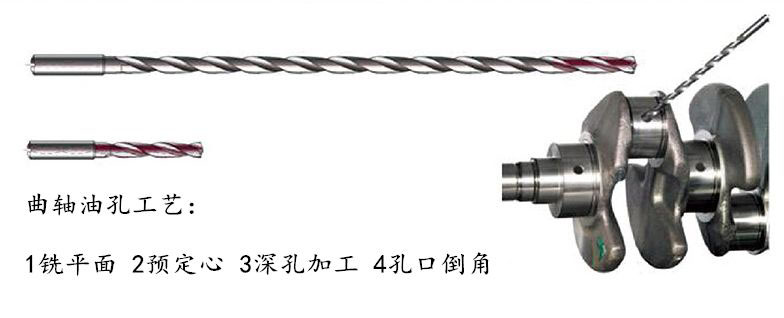
01. Drawing of crankshaft oil hole process
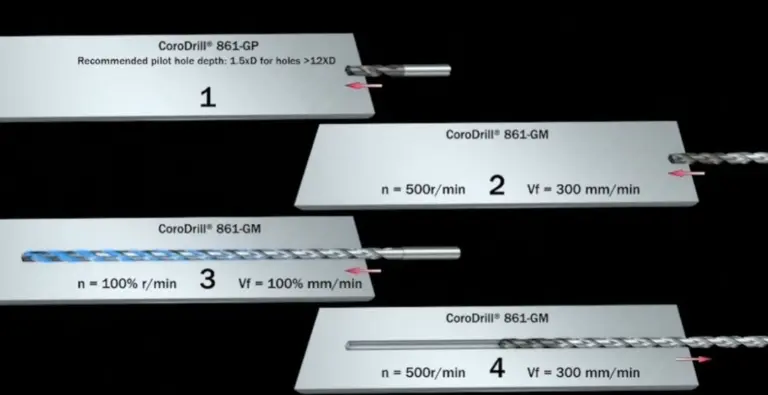
Step 1: Select a flat bottom drill bit to countersink a small plane on the surface of the connecting rod or crankshaft pin (to provide a base plane for the subsequent guide drill bit).
Step 2: Select a guide bit to drill a hole depth of 1.5D-2D on the connecting rod or spindle (to provide good guidance and pre-drill preparation for subsequent deep hole drilling).
Step 3: Select a deep hole drill bit to drill the diameter of the existing hole.
Step 4: Chamfer the hole (main shaft/connecting rod neck) and remove the burrs from the hole.
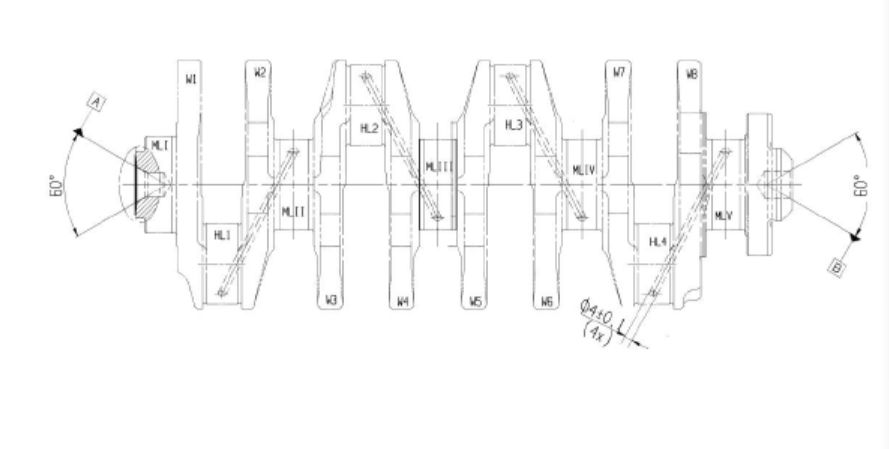
PS: Crankshaft oil hole technology is generally divided into two types:
1 cross hole: the connecting rod oil hole and the spindle oil hole cross each other.
(difficult to treat)
2 Straight hole: The connecting rod has an oil hole, but the spindle does not have an oil hole.
The oil hole process described above is a common method used by many factories. Some factories combine the first and second stages and use a flat bottom drill bit as a guide bit for pre-centering (factories are not recommended to adopt this form). that the processing efficiency has been improved, but in fact the tool maintenance cost will increase later, please pay attention.
02. Problems to note when dealing with crankshaft oil holes
1. Generally, the length of the flat bottom drill and the guide hole are very close when changing the tool, the operator should pay attention to it, otherwise a tool collision incident may easily occur.
2. When chamfering the hole chamfer with a chamfer drill bit, the size of the hole chamfer will be different. Usually the tool wear is significant after changing the new tool (it can be corrected by changing the tool/changing the parameters in the program.
3. The MQL flow becomes smaller, which will cause the deep drill to break and the product to be scrapped (such problems can be detected during spot inspection, just like daily consumption of petroleum products).
4. Before installing the tool on the deep drill bit returned from grinding, check whether the internal cooling hole is blocked.
4
Factors Affecting Deep Hole Processing
01. Key points of deep hole processing operations
The coaxiality of the center lines of the spindle and the tool guide sleeve, the toolbar support sleeve, the workpiece support sleeve, etc. must meet the requirements; the cutting fluid system should be smooth and normal; there should be no central hole on the machined end; face of the workpiece and avoid drilling on the inclined surface. The cutting shape should be kept normal to avoid cutting straight strips to process holes. When the drill bit is about to drill, the speed should be high. reduced or stopped to avoid damage to the drill bit.
02. Cutting fluid for deep hole machining
A large amount of cutting heat will be generated when machining deep holes, which is not easy to diffuse. Sufficient cutting fluid should be supplied to lubricate and cool the tool. Typically a 1:100 emulsion or extreme pressure emulsion is used. When higher machining precision and surface quality or tough materials are required, extreme pressure emulsion or high concentration extreme pressure emulsion is generally selected. ) 10~20 cm²/s, the cutting fluid flow rate is 15~18 m/s; When processing small diameters, use low viscosity cutting oil; For processing deep holes which require high precision, the cutting oil ratio can be 40% kerosene + 20% chlorinated paraffin.
The pressure and flow rate of cutting fluid are closely related to the hole diameter and processing method.
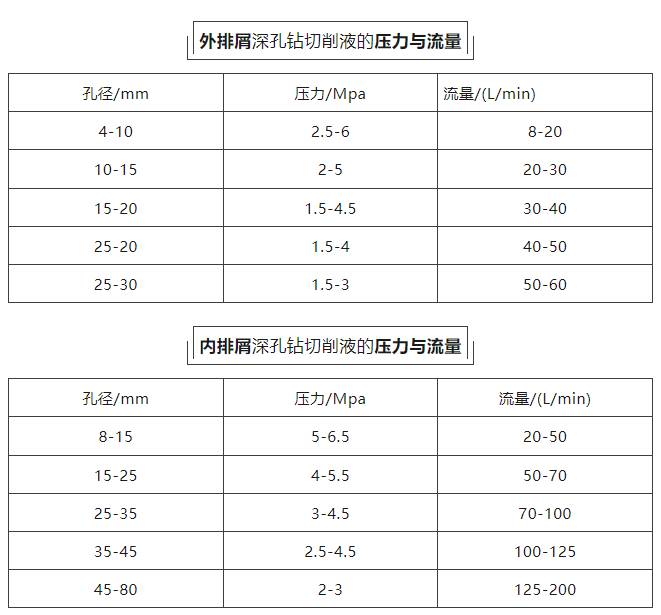
03. Precautions when using deep hole drill bits
3.1 The machined end face should be perpendicular to the axis of the workpiece to ensure reliable sealing of the end face.
3.2 Before formal processing, pre-drill a shallow hole on the workpiece hole, which can serve as a guiding and centering function when drilling.
3.3 To guarantee the life of the tool, it is preferable to use automatic operation.
3.4 If the guide elements in the liquid inlet and the movable center support are worn, they should be replaced in time to avoid affecting the drilling accuracy.
5
Solution to deep hole processing problems


Daguang focuses on providing solutions such as precision CNC machining services (3-axis, 4-axis, 5-axis machining), CNC milling, 3D printing and rapid prototyping services.



















