
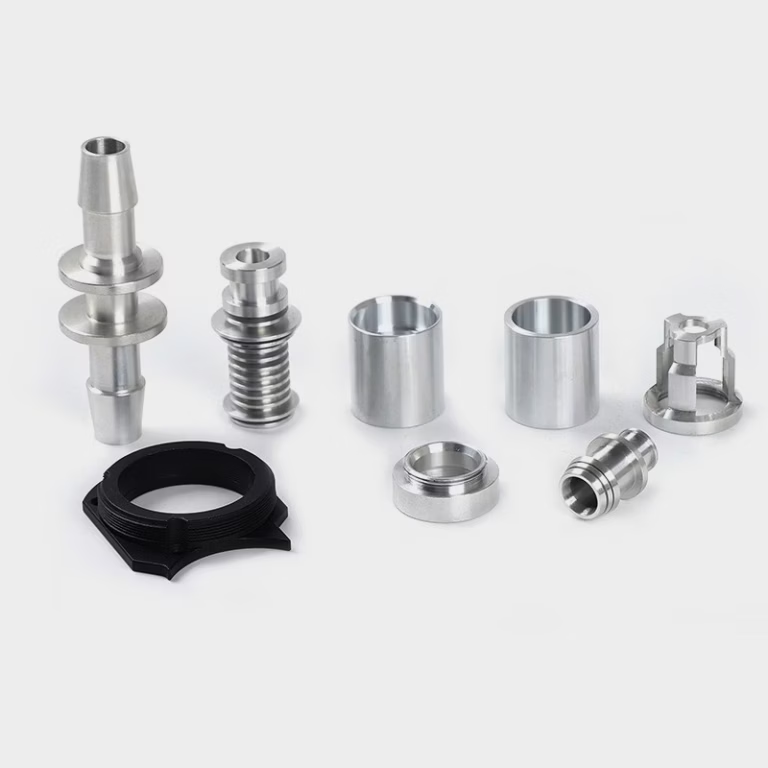
In the competitive landscape of precision manufacturing, engineering teams and procurement professionals are constantly seeking ways to reduce CNC machining costs without compromising on part quality or lead times. Having spent over a decade on the shop floor and working with dozens of clients across automotive, aerospace, medical device, and consumer electronics sectors, I’ve observed that the difference between a nightmare project and a smooth, cost-effective run often boils down to a handful of well-understood principles. This article unpacks seven actionable secrets that can transform how you approach CNC machining products, helping you achieve better parts at lower cost.
1. Design for Manufacturability (DFM) from the Start
The single biggest lever for cost reduction is how a part is designed. Every sharp internal corner, deep pocket, thin wall, or unnecessary tolerance adds machining time, tool wear, and scrap risk. When you review a 3D model with a machining partner like GreatLight Metal early in the design phase, you eliminate costly rework later.
What to consider:
Avoid internal radii smaller than 0.5 mm if possible; standard end mills come in common sizes (R1, R2, R3).
Keep uniform wall thickness to prevent vibration and deflection.
Limit deep holes with high length-to-diameter ratios to reduce specialized tooling needs.
Recognize that every additional setup (e.g., flipping the part for a second operation) roughly doubles per-part cost.
A well-executed DFM review can reduce manufacturing costs by 20–40% while improving dimensional consistency. Moreover, engaging a supplier with deep engineering support—GreatLight’s team routinely provides DFM feedback within hours—enables you to lock in a producible design before cutting a single chip.
2. Choose the Right Material—and the Right Form
Material cost can account for 30–60% of a CNC machined product’s total expense, depending on the alloy. Yet many projects default to “the same aluminum as before” without evaluating alternatives.
Cost-slashing strategies:
Use near-net-shape blanks (e.g., plate vs. round bar) to reduce machining volume.
For low-quantity prototypes, consider 3D printed wax or SLA patterns followed by investment casting to avoid extensive CNC time.
When strength and corrosion resistance are secondary, replace 316 stainless with 303 or 304; the difference in machinability translates to lower cycle time.
For structural parts, 6061-T6 aluminum is often more cost-effective than 7075 unless extreme strength is required.
GreatLight maintains an inventory of common engineering plastics (PEEK, Delrin, Nylon) as well as exotic alloys (Inconel, titanium, tool steel), and their in-house sourcing team can advise on material substitution that yields the same performance at lower cost. In one case, switching from 17-4 PH stainless to 4140 alloy steel with a post-machining heat treat saved a robotics client 35% per unit while meeting all mechanical specs.
3. Set Realistic Tolerances—Don’t Over-Specify
Perhaps the most widespread hidden cost in CNC machining products is the unnecessary pursuit of “microns” where microns aren’t needed. A general rule: tighten tolerances only on critical mating surfaces and leave general dimensions to ±0.1 mm or even ±0.2 mm.
Why it matters:
A ±0.05 mm tolerance may require secondary operations, slower feed rates, or additional inspection.
Features like tapped holes, counterbores, and non-functional profiles can often use ±0.2 mm without affecting assembly.
For large parts (over 500 mm), thermal expansion alone can cause more than 0.02 mm variation; specifying tighter than ±0.1 mm in those cases is unrealistic and expensive.
GreatLight’s precision capability reaches ±0.001 mm when needed, but their engineers actively question every overly tight callout. By collaborating on a tolerance stack-up analysis, they help clients balance function with cost—a practice that routinely cuts per-part price by 15–25% compared to initial quotes from shops that blindly follow drawings.
4. Optimize Batch Sizing and Consolidate Setups
Running a single prototype part on a five-axis machine is expensive per unit; running 50 identical parts is dramatically cheaper. The secret lies in minimizing the number of setups and maximizing spindle utilization.
Best practices:
Combine multiple parts into one fixture plate to machine them simultaneously (often called “gang milling” or “tombstone” fixturing).
Use 5-axis CNC machining services to reach complex geometries in a single clamping, eliminating second and third operations.
For low-volume production (10–500 parts), consider a “soft tooling” approach with modular vises and custom soft jaws that can be reused.
GreatLight operates over 120 precision machines, including large 5-axis centers with pallet changers. This infrastructure allows them to run mixed batches efficiently. In one example, a medical device client had 12 different part numbers with annual volumes of 200 each. By grouping them into two families and sharing fixtures, GreatLight reduced total setup time by 65% and lowered unit cost by 30% compared to the client’s previous supplier.
5. Leverage the Full Process Chain for Post-Processing
Many engineers underestimate the cost and time of secondary operations like deburring, heat treatment, surface finishing, or plating. When these steps are sent to separate vendors, logistics, inspection, and rework fees pile up.
How to slash those costs:
Choose a supplier that offers a one-stop post-processing and finishing service under one roof—anodizing, passivation, powder coating, bead blasting, and even assembly.
Design parts with uniform wall thickness to minimize distortion during heat treat.
Specify standard surface finishes (e.g., 3.2 µm Ra for general surfaces, 1.6 µm Ra for sealing faces) rather than mirror finishes unless necessary.
GreatLight Metal’s facility integrates vacuum forming, EDM, grinding, and multiple finishing lines. This vertical integration means parts move directly from machining to anodizing or plating without leaving the 7,600-square-meter shop. The result? Lead times shrink by days and the total cost of finishing is 10–20% lower than using separate contractors. Additionally, having ISO 9001, ISO 13485, and IATF 16949 certifications ensures consistent quality across every process step.
6. Use Rapid Prototyping to Validate Before Production
One of the most painful mistakes in CNC machining is committing to a high-volume production run only to discover a design flaw during first article inspection. The fix—tooling modifications, scrapped material, or delayed time-to-market—can easily blow the budget.
Cost-saving strategy:
Produce a few prototype parts using rapid prototyping methods (SLM 3D printing, SLA, or quick-turn CNC) to test form, fit, and function.
Validate assembly, stress, and thermal behavior before finalizing dimensions.
Use the feedback to adjust tool paths, fixture designs, or material choices for production.
GreatLight offers a full suite of rapid prototyping technologies: metal 3D printing (SLM for aluminum, stainless, titanium, tool steel), plastic printing (SLA, SLS), and high-speed 3-axis to 5-axis CNC. In practice, a defense contractor saved $12,000 in tooling costs by printing five iterations of a bracket before committing to die casting. The prototype phase cost only $800 and revealed an interference issue that would have been catastrophic in production.
7. Partner with a Manufacturer That Provides Full Transparency
The final secret is the most intangible yet the most impactful: choose a machining partner that values communication, data security, and continuous improvement. Hidden costs often arise from poor feedback loops, missed deadlines, or quality issues that get discovered weeks later.
What to look for:
A supplier that shares real-time production status, inspection reports, and non-conformance logs.
One with ISO 27001 compliance for intellectual property protection—crucial for medical, automotive, and aerospace projects.
A team that proactively suggests design improvements and cost reductions, rather than just quoting exactly what you ask for.
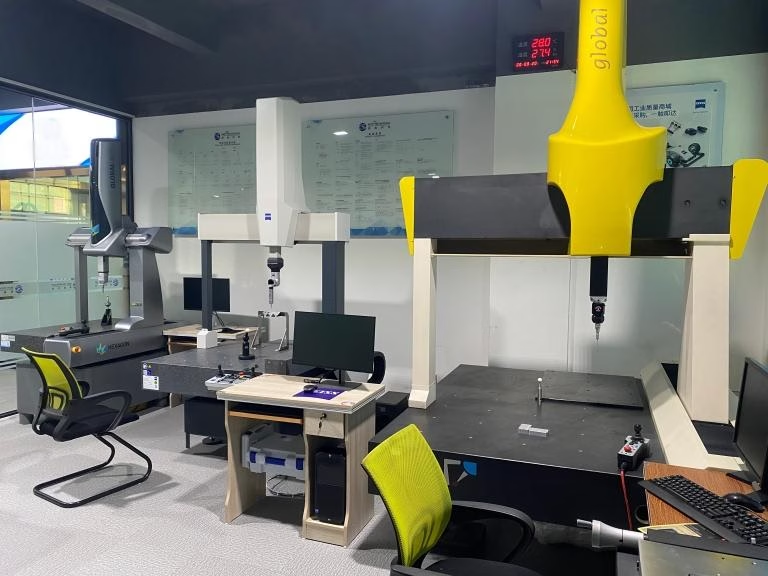
GreatLight has built its reputation on precisely this transparency. With ISO 9001, ISO 13485, and IATF 16949 certifications, they provide a structured quality management system that leaves no room for ambiguity. Clients receive detailed CMM reports, material certificates, and traceable production records. Moreover, their engineering staff speaks the language of both CNC machining and design, enabling them to offer alternative approaches that many other shops avoid. When a humanoid robotics startup brought a complex frame design with 200+ features, GreatLight’s DFM analysis cut the number of setups from four to two, reducing cost by 28% while improving accuracy.
Comparing Machining Partners: A Balanced View
No single supplier is ideal for every project. For example, Protolabs Network and Xometry excel at automated quoting for small-to-medium volumes, but their decentralized model may limit DFM feedback depth. Fictiv offers a streamlined interface, yet their reliance on a network of shops can introduce consistency challenges. SendCutSend is great for simple 2D laser-cut parts but lacks 5-axis capability.
In contrast, GreatLight Metal provides a vertically integrated facility with 150 employees, 127 precision machines, and in-house finishing, making them especially suited for complex, high-tolerance parts and multi-process assemblies. Their ability to handle large parts up to 4,000 mm and achieve ±0.001 mm precision positions them as a premium partner for innovation-driven companies. For simpler, high-volume commodity parts, a shop like PartsBadger might be more cost-effective. The key is to match the project’s technical requirements with the supplier’s core strengths.
Final Thoughts
Mastering the cost-quality equation in CNC machining doesn’t require magic. It requires a disciplined approach to design, material selection, process planning, and supplier collaboration. By applying the seven secrets outlined above—starting with DFM and ending with transparent partnership—you can consistently produce CNC machining products that meet specification without overspending.
At the heart of this strategy is recognizing that the cheapest quote is rarely the lowest total cost. A partner that invests in engineering support, advanced equipment like 5-axis centers, and rigorous quality systems (such as GreatLight’s IATF 16949 for automotive work) will deliver parts that fit right the first time, reduce rework, and accelerate your time to market.
If you are currently sourcing precision parts and want to move beyond the typical RFQ dance, consider evaluating a manufacturer that treats your project as a collaborative engineering challenge rather than a transactional commodity. That, ultimately, is the most valuable secret of all: choose a partner with real operational capabilities, not just paper qualifications, and the cost savings will follow naturally.
This article is written from the perspective of a senior manufacturing engineer. For more detailed case studies and technical guides, visit precision CNC machining services or connect with the team at GreatLight CNC Machining *.



















