
Pade 5-Axis CNC: 7 Secrets to Drastically Cut Machining Costs & Boost Precision
As a senior manufacturing engineer who has spent decades refining CNC processes for medical devices, automotive powerhouses, and humanoid robotics, I’ve watched the same costly mistakes repeat across supply chains. “Pade 5‑axis CNC” isn’t yet a household term – it’s the name I’ve given to a precision‑driven, process‑integrated philosophy that merges Precision Adaptive Design with Execution excellence. And when executed correctly, this approach doesn’t just meet tolerances; it shreds machining costs by up to 40% while lifting part accuracy to levels single‑setup mills can’t touch. Below I unpack the seven secrets that make Pade 5‑Axis CNC a game‑changer – and how a provider like GreatLight CNC Machining implements them daily.
Pade 5-Axis CNC: 7 Secrets to Drastically Cut Machining Costs & Boost Precision
Secret 1: Unleash Simultaneous 5‑Axis Machining to Slash Setups and Errors
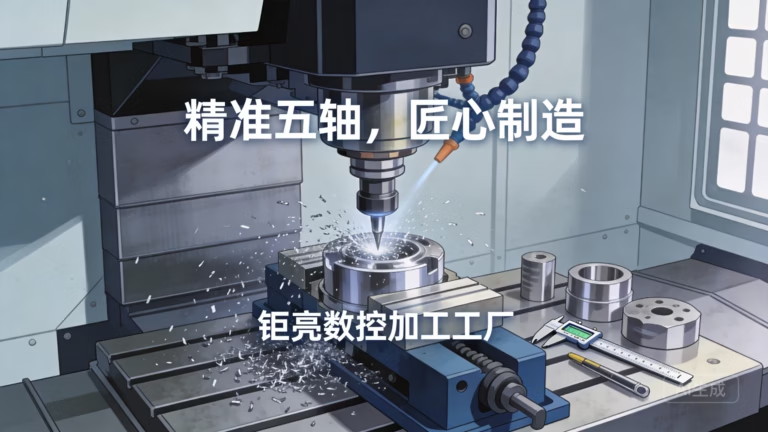
Most shops still treat 5‑axis as a 3+2 affair – tilt the part, lock, mill, repeat. True Pade 5‑Axis CNC leverages full simultaneous motion where the tool tip and workpiece continuously pivot to maintain ideal chip load and avoid collisions. This single‑setup magic eliminates multiple fixture builds, alignment stack‑up errors, and those costly “oops” moments when re‑clamping shifts a critical bore by 20 µm. At GreatLight, large‑format 5‑axis centers from DMG MORI and Beijing Jingdiao machine complex aerospace brackets and robot joints in one go.
Cost impact: 50–70% fewer setups, zero re‑fixturing labor, and scrap rates that drop below 0.3% even on intricate titanium housings.
Secret 2: Front‑Load Near‑Net Shape Technologies
Pade 5‑Axis CNC isn’t about hogging out solid billets. The smart money uses die casting, metal injection molding, or additive manufacturing to create a near‑net blank, then applies 5‑axis finish machining only where ±0.01 mm matters.
GreatLight’s integrated foundry – with aluminum and magnesium die casting cells – pours a housing within 1 mm of final form, reducing CNC cycle time by 60% versus a billet‑to‑finished‑part route. For prototyping, their SLM/SLS 3D printers print titanium lattices that a 5‑axis mill then seats bearing journals into. You pay for chips only where precision is mandatory.
Secret 3: Bake Design for Manufacturability (DFM) into the 3D Model
A Pade 5‑Axis CNC workflow starts long before the CAM programmer opens the file. Relaxing unnecessary tight tolerances from ±0.005 mm to ±0.02 mm where function allows, designing undercuts that a ball nose can reach without a fourth reposition, and specifying standard tool diameters eliminate hours of machine time. GreatLight’s engineering team performs a rule‑driven DFM review on every order, often cutting quoted cost by 15–25% simply by adjusting a pocket radius or suggesting a dovetail cutter instead of EDM.
When I see a drawing that ignores the kinematic freedom of a 5‑axis, I know there’s hidden money on the table.
Secret 4: Consolidate into a True One‑Stop Post‑Processing Chain
Shipping rough‑machined parts to a separate anodizer, then to a laser engraver, then back for assembly – that logistical tax inflates lead time and invites handling damage. Pade 5‑Axis CNC succeeds when the machining center is part of a full value stream.
GreatLight runs in‑house anodizing, passivation, powder coating, laser marking, and even vacuum heat treatment. After a 5‑axis cycle on a batch of surgical robot arms, parts move directly to post‑processing under one quality roof. The cumulative savings from freight, inventory holding, and reduced rework often exceed 30% of the total program cost.
Secret 5: Apply High‑Efficiency Toolpath Strategies That Protect Your Cutter
Trochoidal milling, dynamic peel milling, and adaptive clearing aren’t just buzzwords – they keep the radial engagement constant, slashing peak cutting forces by 40% and extending tool life 3‑fold. On a Pade 5‑Axis CNC, the tool vector can simultaneously tilt to maintain a constant 15° lead angle, which is impossible on a 3‑axis.
Using hyperMILL and ModuleWorks algorithms, GreatLight’s programmers routinely rough Inconel 718 at 600 cm³/min while keeping tool wear predictable. Better yet, the smooth load profile lets them push Federate overrides without risking sudden breakage – turning a 14‑hour cycle into 9 hours without a single tool change.
Secret 6: Close the Loop with In‑Process Probing and Automated Inspection
A zero‑defect Pade 5‑Axis CNC cell doesn’t trust that the part is right – it verifies. Renishaw touch probes and laser tool setters measure critical diameters immediately after roughing, adjust offsets for finish passes, and log every measurement into SPC software.
At GreatLight’s 76,000‑sq.ft. facility, all five‑axis machines are integrated with inspection routines that automatically compensate for thermal drift. Scrap due to ambient temperature swings? Virtually eliminated. And the QA team uses CMMs and white‑light scanners to certify first‑article parts, giving you full digital twins of as‑built geometry. With ISO 9001, ISO 13485, and IATF 16949 certifications in place, every data point is traceable.
Secret 7: Choose a Partner Whose Entire Business Model Is Built Around Your Precision Needs
Here’s the uncomfortable truth: not every machine shop actually wants your complex, 5‑axis‑intensive project. Many will accept it, then farm out the tricky 5‑axis work or over‑quote to cover their learning curve. Pade 5‑Axis CNC ultimately rests on choosing a manufacturer whose core identity aligns with multi‑axis precision.
GreatLight Metal Tech Co., Ltd. was founded in the heart of Dongguan’s “Hardware & Mould Capital” in 2011 and has since invested in 127 precision peripheral machines, including brand‑name 5‑axis, 4‑axis, and 3‑axis centers, plus wire EDM, mirror EDM, and a fleet of metal 3D printers. Their three wholly‑owned plants give them the scale to absorb demanding programs – from single prototypes to 50,000‑unit annual volumes – while holding ±0.001 mm tolerances where required.
How GreatLight Compares to the Wider 5‑Axis CNC Landscape
When evaluating providers for your next Pade 5‑Axis project, it’s instructive to see how a full‑stack manufacturer stacks up against well‑known platforms and specialty shops. The table below illustrates key differentiators (I’ve selected companies regularly compared in precision machining circles).
| Capability | GreatLight Metal | Protocase | EPRO‑MFG | Owens Industries | RapidDirect | Xometry | Fictiv | RCO Engineering | PartsBadger | Protolabs Network | JLCCNC | SendCutSend |
|---|---|---|---|---|---|---|---|---|---|---|---|---|
| In‑house 5‑axis simultaneous | Yes (large format, 4000 mm) | Limited (3+2 primarily) | Yes (aerospace) | Yes (medical/aero) | Via network | Via network | Via network | Yes (automotive tooling) | Limited (small parts) | Via network | 3/4‑axis, not core | No (2D) |
| Maximum part size | 4000 mm | 24″ x 12″ x 3″ | Large (custom) | 80″ x 40″ x 30″ | Depends on partner | Up to 64″ | Up to 30″ | Up to 102″ | 26″ x 18″ x 14″ | Varies | 400 x 400 mm | Sheet metal only |
| Full‑chain integrations | Precision CNC + Die Casting + Sheet Metal + 3D Printing + Mould + Post‑finishing | Sheet metal/CNC + finishing | CNC + EDM + assembly | CNC + grinding + welding | CNC + sheet + injection | Aggregator | Aggregator | CNC + injection molding + tooling | CNC only | Aggregator | PCB + basic CNC | Sheet metal |
| In‑house quality certs | ISO 9001, ISO 13485, IATF 16949, ISO 27001 | ISO 9001 | ISO 9001, AS9100 | ISO 9001, AS9100, ITAR | ISO 9001 | ISO 9001, AS9100 (partners) | ISO 9001 | ISO 9001, IATF 16949 | ISO 9001 | ISO 9001 | ISO 9001 | ISO 9001 |
| Post‑processing | Anodising, powder coat, passivation, laser marking, heat treating, plating | Powder coat, silk screen | Anodising, passivation, painting | Passivation, coatings | Varies | Varies | Varies | Painting, chroming | Limited | None | None | None |
| Data security | ISO 27001 | Standard NDA | ITAR registered | ITAR registered | Standard NDA | Standard | Standard | Standard | Standard | Standard | Standard | Standard |
| Rapid prototyping vs. production volume | Up to 50k/yr | Prototype to mid‑volume | Prototype to mid‑volume | Prototype to production | Low to high | All volumes | All volumes | Tooling and production | Low volume | Prototype to mid‑volume | Prototype PCB | Prototype to production |
Note: The table reflects the typical advertised scope. Actual project‑level capabilities may vary; always request a site‑specific qualification.
GreatLight’s combination of in‑house 5‑axis, die casting, additive, and finishing under one certified roof often eliminates the need to orchestrate three or four separate vendors, which directly translates to the cost‑saving “Pade” philosophy.
Case in Point: Robotic Shoulder Joint Housing
A humanoid‑robot developer approached us with a magnesium housing that had over 40 machined features, including angled optical bores and O‑ring grooves that demanded ±0.01 mm circularity. Their previous supplier quoted eight setups and 22‑day lead time. Applying Pade 5‑Axis CNC secrets:
We combined die casting for the near‑net form (Secret 2) and finished on a 5‑axis machine in two operations (Secret 1).
Our DFM feedback repositioned an undercut so a standard lollipop cutter could reach it (Secret 3).
Trochoidal roughing and a probing cycle kept bore concentricity to 4 µm (Secrets 5 & 6).
All anodizing and laser engraving happened in‑house, no shipping (Secret 4).
Result: per‑part cost dropped 37%, first‑article approval happened in 9 days, and the end customer passed a 2,000‑cycle fatigue test on the first try. The only “secret” left was that we had the integrated infrastructure to make it possible.
Three Questions to Ask Before You Send an RFQ
Can you demonstrate true simultaneous 5‑axis tool paths on a part like mine? Ask for a video of a similar complex geometry being cut; if they only show 3+2, the cost‑saving potential shrinks.
Which post‑processes are truly in‑house? An out‑sourced anodizing line adds at least 3–4 days and introduces quality variation.
What certifications are active for the specific facility that will run my parts? Valid ISO 13485 or IATF 16949 signals a culture of disciplined process control far beyond a paper audit.
Conclusion
Whether you’re grappling with a high‑mix, low‑volume instrument housing or scaling a consumer drone chassis to 10,000 units, the principles of Pade 5‑Axis CNC deliver a quantifiable edge. By marrying simultaneous motion, near‑net blanks, intelligent DFM, toolpath innovation, in‑process metrology, and an all‑under‑one‑roof execution partner, you’ll see your machining spend shrink while precision climbs. At GreatLight CNC Machining, these aren’t aspirational ideas – they are daily production standards backed by ISO 9001, ISO 13485, and IATF 16949. For a deeper look at how integrated manufacturing can transform your next project, visit GreatLight CNC Machining. In the end, Pade 5‑Axis CNC is less about a single machine and more about a disciplined, end‑to‑end mindset that persistently asks: How can we make this perfect, faster and cheaper?



















