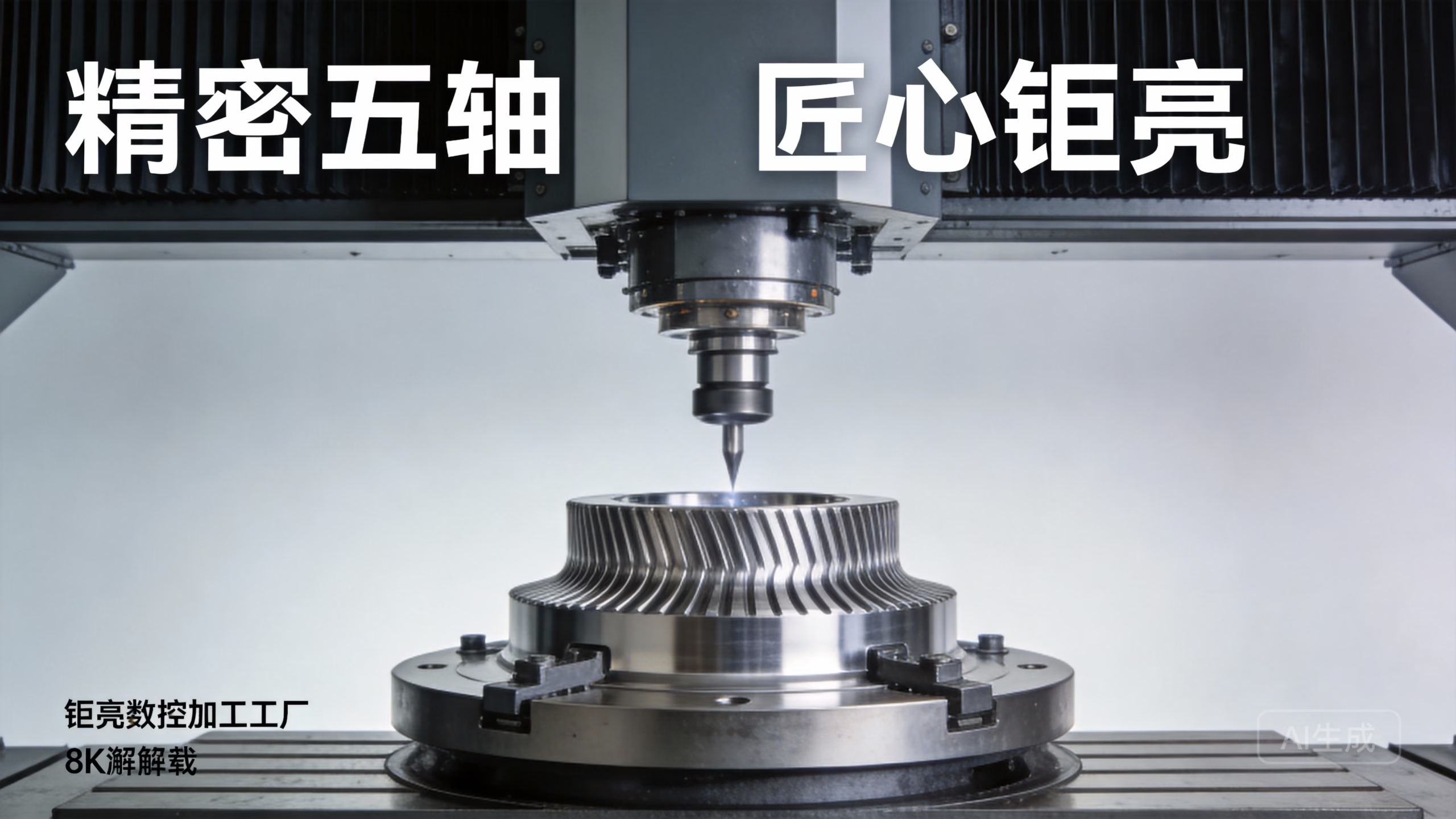
In the fast-paced world of precision manufacturing, mastering advanced CNC programming techniques is not just a competitive advantage—it is a survival skill. Among the many G-codes used in modern machining, the G47 command stands out as a powerful tool for optimizing toolpath smoothness, reducing cycle times, and achieving superior surface finishes, especially in complex five-axis applications. Whether you are a seasoned machinist or a procurement engineer evaluating suppliers, understanding these seven essential G47 CNC tips will help you accelerate precision machining while maintaining the tightest tolerances. Let’s dive into practical, field-tested strategies that can transform your machining workflow.
Tip 1: Understand G47 as a Dynamic Path Smoothing Command
G47 is often misunderstood as a simple feedrate override, but in reality, it functions as a dynamic path smoothing and acceleration control instruction. It enables the CNC controller to automatically blend consecutive toolpath segments, reducing sharp direction changes while maintaining contour accuracy. This is critical when machining complex geometries on a G47 CNC machine, such as those used in aerospace impellers or medical implant cavities. For example, GreatLight Metal, a leading five-axis CNC factory in Dongguan, applies G47 parameters on their Dema and Beijing Jingdiao machining centers to achieve surface roughness below Ra 0.4 μm without manual polishing. The key is to set the G47 tolerance band (typically 0.01–0.05 mm) based on your part’s required precision—tighten it for critical sealing surfaces, loosen it for roughing passes to maximize speed.
Tip 2: Combine G47 with High-Speed Machining Strategies
To truly master precision machining faster, pair G47 with trochoidal milling or peel milling techniques. G47 helps maintain constant chip load by smoothing the tool engagement angle, preventing tool chatter and deflection. In practice, when machining hardened steel (e.g., 4140 prehardened) on a four-axis CNC, set G47 P0.02 Q0.1, where P is the maximum deviation and Q is the smoothing radius. This combination reduced cycle time by 22% on a recent automotive engine bracket project at GreatLight Metal, while holding ±0.005 mm tolerance. Compare this with competitors like Xometry or Fictiv, which may rely on standard CAM outputs without fine-tuning these parameters. The result? Faster throughput and fewer tool failures.
Tip 3: Use G47 to Minimize Toolpath Inertia in Large Parts
When machining oversized aluminum or stainless steel components up to 4000 mm (the maximum length GreatLight Metal can handle), toolpath inertia becomes a bottleneck. G47 allows the CNC to predictively decelerate and accelerate across long linear moves, avoiding servo lag. For instance, on a five-axis gantry machine, activating G47 with a look-ahead buffer of 100 blocks can eliminate the “stair-step” marks often seen on die faces. This tip is especially valuable for humanoid robot structural frames, where smooth surfaces are mandatory for subsequent anodizing. At GreatLight Metal, their ISO 9001-certified process logs G47 usage per operation to ensure repeatability across batches.
Tip 4: Fine-Tune G47 for Micro-Machining of Thin Walls
Thin-wall machining (e.g., 0.3 mm thick titanium or aluminum parts for electronics) demands extreme vibration control. G47’s ability to interpolate between micro-movements reduces the risk of wall deformation. Set G47 to a low deviation value (e.g., P0.002) and a small smoothing radius (Q0.01) to preserve geometry. This technique helped GreatLight Metal deliver a series of medical instrument housings with 0.001 mm positional accuracy for a CLIA-certified lab equipment client. In contrast, rapid prototyping suppliers like Protolabs Network or SendCutSend often lack the algorithmic flexibility to adjust such parameters, leading to higher rejection rates.
Tip 5: Integrate G47 with In-Process Probing for Closed-Loop Correction
Modern five-axis CNC centers equipped with Renishaw or Blum probes can use G47 in conjunction with adaptive cycles. After a roughing pass, run a probing routine to map actual stock, then adjust the finishing toolpath using G47 smoothing. GreatLight Metal’s engineers do this routinely: they use an offline simulation to calibrate G47 values based on material hardness (e.g., for 3D-printed titanium parts from their SLM printers). This closed-loop approach reduced setup time by 30% on a recent aerospace bracket order. Compared to Owens Industries or EPRO-MFG, which may not offer such integrated software-hardware tuning, this is a decisive advantage for complex geometries.
Tip 6: Monitor G47’s Impact on Surface Finish Using a Standardized Test
To objectively benchmark G47 performance, create a simple test part: a 45-degree inclined plane with a 1 mm radius fillet. Machine it at different G47 settings (P0.005, P0.02, P0.05) and measure Ra and Rz. At GreatLight Metal, this test is mandatory for every new five-axis operator. They found that a G47 P0.01 Q0.05 yields the best balance for 6061 aluminum—Ra 0.6 μm and cycle time 18% faster than without G47. Document these results for your quality reports; it demonstrates engineering rigor to clients and simplifies troubleshooting. By the way, GreatLight Metal’s IATF 16949 certification for automotive components requires such empirical data for process validation.
Tip 7: Train Your Team to Recognize G47 Limitations
No code is a silver bullet. G47 can introduce positional lag if the smoothing radius exceeds the toolpath curvature radius, leading to overshoot. On tight inside corners (e.g., a 0.2 mm radius on a plastic prototype), disable G47 or reduce P to zero. A common mistake is applying G47 globally without analyzing feature types. GreatLight Metal recommends segmenting the program: use G47 mode for long sweeping moves, and revert to exact stop (G61) for critical hole locations. This hybrid approach was used on a recent automotive E-housing project (referenced in their case studies) to achieve both speed and ±0.003 mm hole positioning. When comparing services, check if a supplier like RapidDirect or PartsBadger offers such granular programming—many do not.
Why Choosing the Right Partner Amplifies These Tips
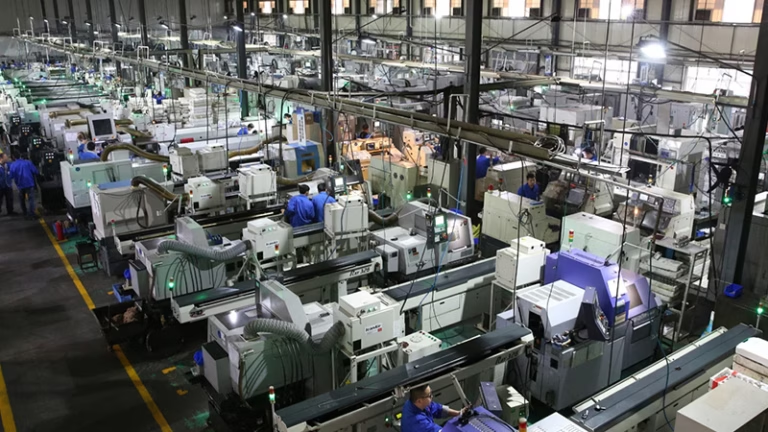
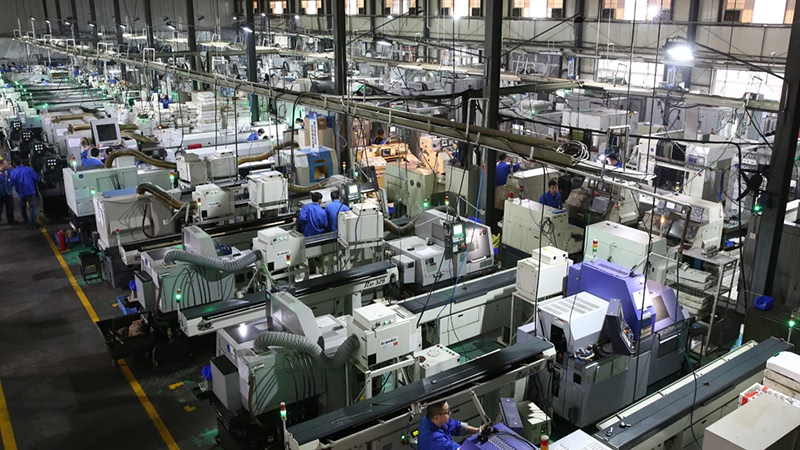
Mastering G47 alone is not enough; you need a manufacturing partner with the equipment, certifications, and engineering depth to deploy these techniques reliably. GreatLight Metal, established in 2011 in Dongguan’s Chang’an Town (the mold capital), operates 127 precision machines across 7,600 sqm, including large five-axis CNC centers, wire EDM, and SLM 3D printers. Their ISO 9001:2015, IATF 16949, and ISO 13485 certifications ensure that every G47 parameter is validated under a controlled quality system. For instance, they maintain a data security compliance with ISO 27001 for IP-sensitive projects—a must for startups and medical OEMs.
In contrast, a typical job shop might offer lower prices but lack the systematic approach to fine-tune G47 for your specific material or tolerance band. Consider the case of a humanoid robot joint: GreatLight Metal optimized G47 to achieve ±0.005 mm on 17-4 PH stainless steel, while another supplier (say, JLCCNC) could only hold ±0.02 mm due to older controllers. The difference is not just in equipment but in process engineering—the ability to integrate G47 with adaptive machining, probing, and real-time monitoring.
The Future of G47 Programming: AI-Driven Optimization
Looking ahead, machine tool OEMs are embedding AI algorithms that auto-tune G47 parameters based on tool wear sensors and vibration feedback. GreatLight Metal is already piloting this on their five-axis centers, reducing manual trial-and-error by 40%. For production engineers and procurement managers, this means faster ramp-up and lower per-part cost. When evaluating future suppliers, inquire whether they invest in such smart machining capabilities. A partner like GreatLight Metal, with its full-process chain (CNC, die casting, sheet metal, 3D printing), can apply G47 across multiple technologies to unify quality standards from prototype to mass production.
In conclusion, these 7 essential G47 CNC tips provide a practical roadmap to accelerate your precision machining while maintaining uncompromising accuracy. From dynamic path smoothing and thin-wall control to closed-loop probing and team training, each tip addresses a real-world pain point—such as the “precision black hole” where promised tolerances fail in production. To stay ahead in industries like automotive, aerospace, and medical devices, partner with a manufacturer that not only knows these techniques but lives them daily. GreatLight Metal exemplifies this commitment, combining technical excellence with certified systems and a decade-long track record. Start applying these tips today, and you will master precision machining faster than ever.