
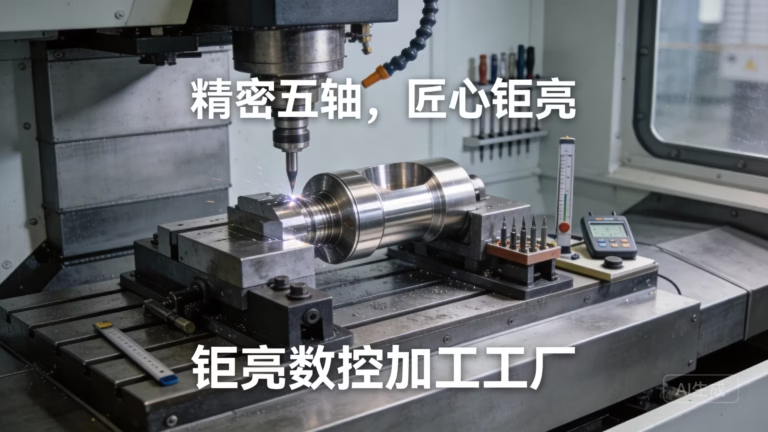
In the high-stakes world of precision parts manufacturing, the delicate balance between achieving microscopic tolerances and controlling project costs often feels like an unsolvable puzzle. For R&D engineers, procurement professionals, and hardware startups, every micron of accuracy gained can come with a price tag that strains budgets. Yet, the industry’s best-kept secrets aren’t about cutting corners—they’re about applying strategic knowledge that transforms the manufacturing process from a cost center into a competitive advantage. Drawing from over a decade of hands-on experience at facilities like GreatLight CNC Machining Factory, we reveal 24 CNC machining secrets distilled into 7 essential tips that empower you to maximize precision while keeping costs under control.
1. Master Design for Manufacturability (DFM) from the Start
The single most impactful factor in both precision and cost is your part design. Many engineers over-specify features, leading to unnecessary machining complexity and inflated expenses. The secret lies in early collaboration with your manufacturing partner.
Why it matters: A design that ignores tool access, material properties, or standard machining capabilities forces multiple setups, custom tooling, and extended cycle times. This not only raises costs but introduces more opportunities for error.
The GreatLight approach: GreatLight Metal’s engineering team performs rigorous DFM analysis before a single chip is cut. They identify potential issues like thin walls that may vibrate, sharp internal corners requiring EDM, or hole depths that exceed standard drill ratios. By adjusting these during the design phase—for example, adding radii to internal corners to allow standard end mills—they reduce machining time by up to 30% without sacrificing functional precision.
Industry context: While platforms like Xometry and Fictiv offer automated DFM feedback, they often lack the nuanced understanding of your specific application. GreatLight’s human expertise, backed by ISO 9001-certified processes, ensures that recommendations are tailored to your part’s final use—whether it’s a medical implant requiring biocompatibility or a automotive engine component needing heat resistance.
Key secret: Always provide a 3D model and 2D drawing with clearly stated critical tolerances. Let your supplier know which features are truly critical and which can be relaxed. This simple act can slash costs by 15–25%.
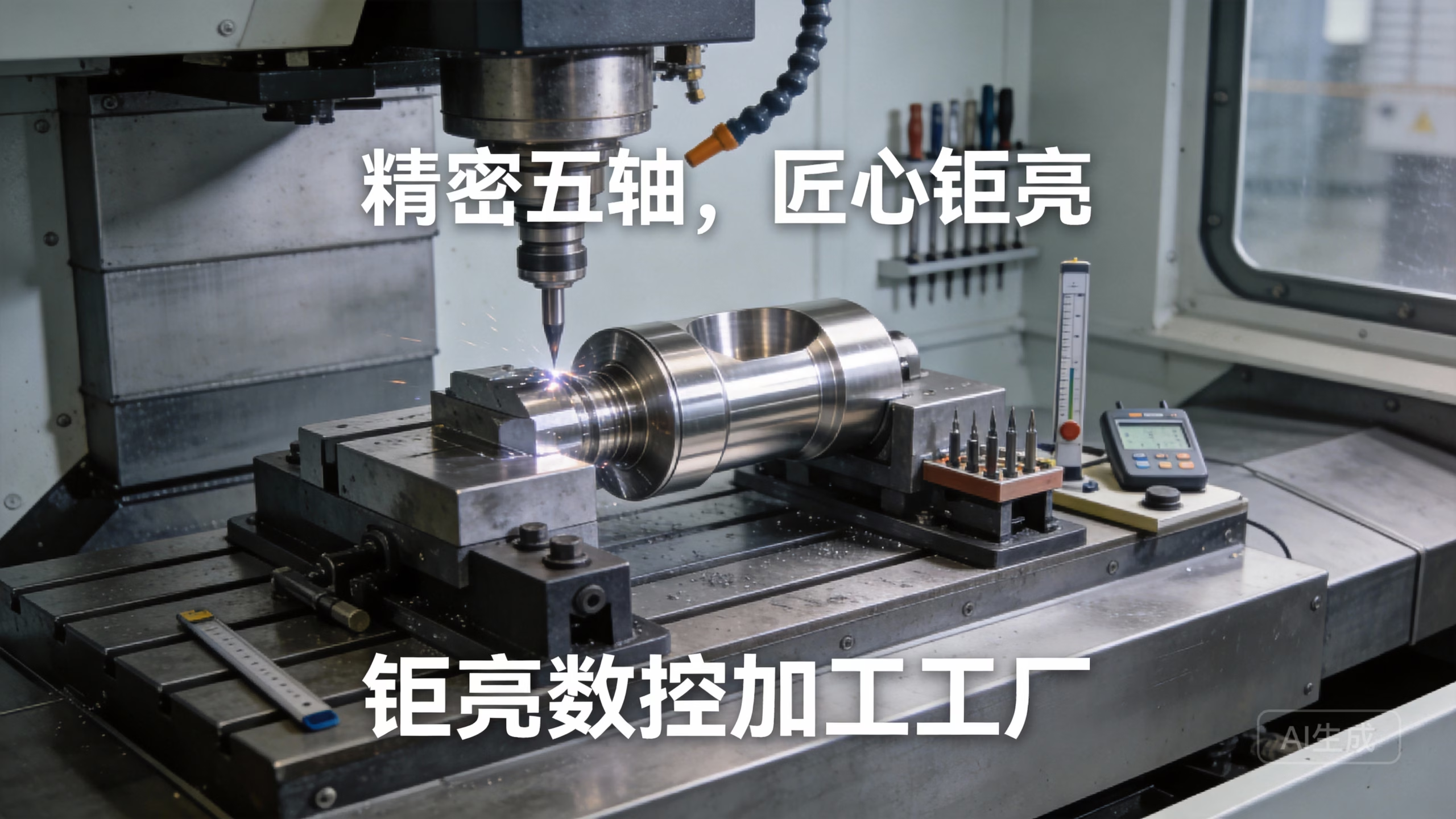
2. Choose the Right Material—Not Just the Strongest
Material selection is a double-edged sword. High-performance alloys like titanium or Inconel offer superior strength but are notoriously difficult to machine, driving up both tool wear and cycle times. Conversely, softer materials like aluminum or brass machine quickly but may not meet strength or corrosion requirements.
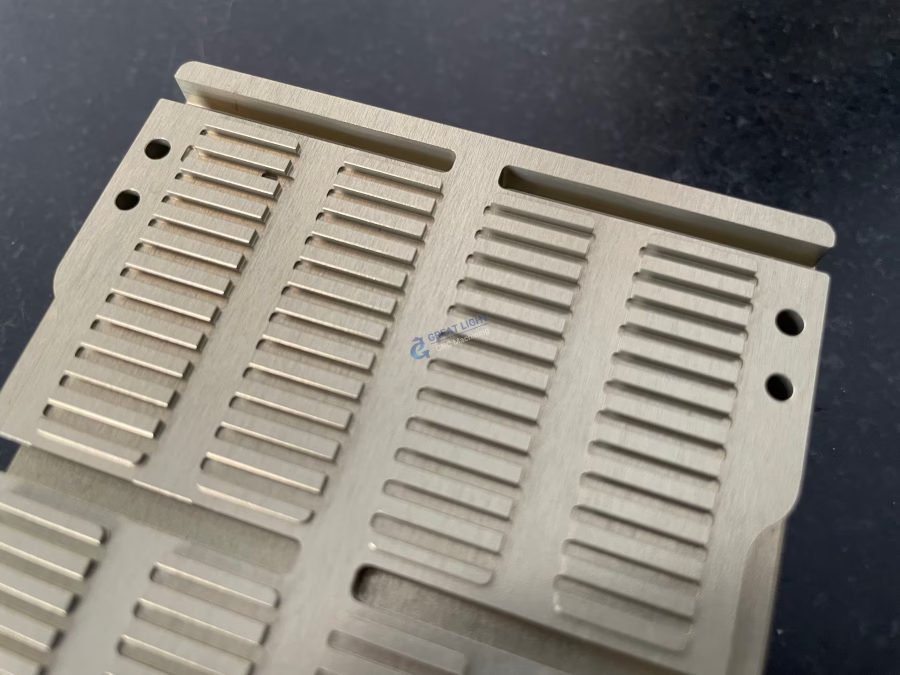
Precision-cost tradeoff: Machining stainless steel 304 to ±0.005mm is achievable but requires rigid setups and sharp tooling. Machining the same part in aluminum 6061 can achieve ±0.002mm with less effort and lower tooling costs. The secret is to match material properties to actual performance needs.
GreatLight’s inventory advantage: GreatLight maintains a vast inventory of engineering-grade materials, from standard aluminum alloys to exotic nickel-based superalloys. Their in-house material specialists can advise on alternatives—for instance, substituting 7075 aluminum for 6061 when higher strength is needed, but avoiding titanium when a less expensive precipitation-hardened stainless steel suffices.
Comparative note: Protolabs and RapidDirect offer material selection guides, but GreatLight’s hands-on experience with high-mix, low-volume runs means they understand the subtle machinability differences between similar grades. For humanoid robot components requiring lightweight yet rigid structures, they often recommend 7075-T6 aluminum over carbon steel—reducing weight and machining cost simultaneously.
Key secret: Ask your supplier for a material substitution analysis. Sometimes a slightly more expensive raw material that machines faster yields a lower overall part cost.
3. Apply Tolerances Intelligently—Avoid the “Precision Trap”
The pursuit of extreme precision is a common pitfall. Specifying ±0.001mm on every dimension may seem prudent, but it multiplies inspection time, increases scrap rates, and demands high-end machine tools. The reality is that most parts only need tight tolerances on a few critical mating surfaces.
The 80/20 rule in CNC machining: Approximately 80% of cost overruns stem from 20% of overly tight tolerance calls. Identify which features affect assembly, function, or safety—and leave others at standard tolerances (e.g., ±0.1mm for non-critical dimensions).
GreatLight’s tolerance capability: GreatLight CNC Machining Factory is capable of ±0.001mm when required, thanks to its fleet of high-precision five-axis machining centers from brands like Dema and Beijing Jingdiao. However, their engineers actively educate clients on where such precision is truly necessary. For a medical instrument housing, for instance, they might recommend ±0.005mm on locating pins but ±0.05mm on cosmetic surfaces—significantly reducing cycle time.
Industry example: A client developing a new drone motor initially specified ±0.002mm on all features. GreatLight’s DFM review revealed that only the bearing seat and rotor interface needed that accuracy. By relaxing other dimensions, the part cost dropped by 22%, and lead time shortened by 5 days.
Key secret: Use the “tolerance stack-up” analysis to determine the minimum acceptable range. Collaborate with your manufacturer to define a tolerance band that ensures function without over-engineering.
4. Optimize Batch Size and Setup Strategy
In CNC machining, setup time is a fixed cost that can dominate small-batch runs. Running 10 parts onto a single fixture is far less efficient per piece than running 100, but large batches carry inventory risk. The secret lies in flexible fixturing and multi-axis machining.
Five-axis efficiency: Traditional three-axis machining often requires multiple setups to access different faces of a part. Each setup introduces alignment error and consumes time. Five-axis CNC machining allows complex geometries to be completed in one setup, boosting accuracy and reducing handling.
GreatLight’s multi-axis advantage: GreatLight operates numerous five-axis machining centers, enabling them to tackle parts that would otherwise require 4+ setups on conventional machines. For a complex aerospace bracket, they reduced setup time from 3 hours to 20 minutes, while improving positional accuracy by eliminating error stacking.
Batch economics: For low-volume prototypes (1–50 pieces), GreatLight recommends using five-axis machining to minimize setups. For medium-volume production (50–500 pieces), they may propose dedicated hard tooling or custom fixtures that amortize setup costs over the run.
Comparative insight: While SendCutSend focuses on sheet metal and simpler geometries, and PartsBadger excels at high-volume turned parts, GreatLight’s full-process capability—from prototype to mass production—means they can adjust batch strategy without changing suppliers.
Key secret: Always request a “setup count” quote. A part requiring 3 setups may cost 40% more than an equivalent part machinable in 2 setups. Ask your supplier to redesign the machining sequence to minimize clamping.
5. Select Finishes That Add Value, Not Just Aesthetics
Surface finishing can account for 10–30% of total part cost. Common finishes like anodizing, powder coating, or electropolishing serve functional purposes—corrosion resistance, wear resistance, or conductivity—but sometimes a machined-as finish is sufficient.
Match finish to environment: For internal components never exposed to moisture, a simple bead blast or passivation may suffice. For visible parts in consumer electronics, a satin anodize adds aesthetic value and scratch protection.
GreatLight’s one-stop finishing: GreatLight offers over 40 finishing options in-house, from chem film and hard anodize to medical-grade passivation and powder coating. Their ability to finish parts immediately after machining eliminates shipping delays and quality handoff issues. For a recent automotive sensor housing project, they recommended a clear anodize instead of a more expensive chemical conversion coating—saving 15% while meeting all salt spray requirements.
Don’t over-finish: A common mistake is to specify a cosmetic surface finish on non-visible surfaces. GreatLight’s engineers flag these opportunities during quotation, helping clients allocate budget to finishes that truly matter.
Key secret: Request sample coupons of different finishes on your material. Seeing them side-by-side often reveals that a less expensive option meets your visual and functional standards.
6. Leverage Advanced Toolpath Strategies and High-Speed Machining
Modern CAM software offers sophisticated toolpath strategies that dramatically improve both precision and cycle time. Techniques like trochoidal milling, dynamic roughing, and adaptive clearing maintain constant chip load, reducing tool deflection and heat buildup.
Why toolpath matters: Aggressive conventional toolpaths can cause chatter, leading to poor surface finish and dimensional deviation. Advanced strategies keep tools engaged at optimal angles, extending tool life and enabling higher feed rates.
GreatLight’s programming expertise: GreatLight’s programming team is proficient in hyperMILL and other advanced CAM systems, optimizing toolpaths for each specific machine. For a complex mold cavity, they reduced roughing time by 40% using trochoidal milling while maintaining ±0.015mm accuracy on side walls.
Cost impact: Faster cycle times translate directly to lower per-piece cost. When combined with five-axis capability, GreatLight can produce parts that would otherwise require EDM or multiple operations in a single session.
Key secret: Ask your supplier if they use “high-speed machining” (HSM) strategies. If not, insist on it. The learning curve is minimal for experienced shops, and the savings are significant.
7. Partner with a Certified Supplier Who Invests in Systems
The final, and perhaps most crucial, secret is choosing a manufacturing partner based on their operational maturity, not just their machine list. Certifications like ISO 9001, IATF 16949, and ISO 13485 are not merely badges—they represent systematic quality control, traceability, and continuous improvement.
The GreatLight certification suite: GreatLight CNC Machining Factory holds ISO 9001:2015, ISO 13485 (medical), IATF 16949 (automotive), and complies with ISO 27001 for data security. This means every process—from incoming material inspection to final CMM report—follows documented procedures. For a humanoid robot joint project requiring 500 identical parts, this consistency ensures that part #500 matches part #1 within tolerance.
Avoid the “precision black hole”: Some uncertified suppliers may promise ±0.001mm but lack calibration records, temperature-controlled shops, or statistical process control. GreatLight’s investment in precision measurement equipment (CMM, optical comparators, surface roughness testers) and a 76,000 sq. ft. climate-controlled facility ensures that what’s promised is delivered.
Comparative perspective: Platforms like Fictiv and Protocase offer convenience and quick quotes, but often rely on a network of subcontractors with variable quality. GreatLight’s wholly owned plants—three manufacturing facilities with 150 employees—provide direct control over every step. When a critical aerospace part needed medical-grade certification, GreatLight’s internal ISO 13485 system allowed them to produce it without outsourcing, maintaining full traceability.
Key secret: Always audit your supplier’s certification validity. Ask for recent audit reports or visit their facility if possible. A certified supplier like GreatLight Metal will welcome such scrutiny—it’s proof of their commitment.
Conclusion: Turning Secrets into Savings
The 24 CNC machining secrets we’ve explored, encapsulated in these 7 essential tips, reveal a fundamental truth: precision and cost are not enemies—they are partners that thrive on intelligent decision-making. By mastering DFM, selecting materials wisely, applying tolerances strategically, optimizing setups, choosing finishes that matter, leveraging advanced toolpaths, and partnering with a certified, full-service manufacturer, you can achieve parts that meet the highest standards without breaking the bank.
GreatLight CNC Machining Factory embodies this philosophy. From its early days in Dongguan’s Chang’an Town to its current status as an international partner serving automotive, medical, aerospace, and humanoid robotics sectors, GreatLight has built a reputation on transparency, technical depth, and unwavering quality. When you work with GreatLight CNC Machining , you’re not just ordering parts—you’re engaging a team that treats your success as its own.
Ultimately, the secret isn’t about having the most machines or the lowest price; it’s about applying experience, systems, and creative problem-solving to every project. Whether you’re designing a next-generation drone, a life-saving medical device, or a complex automotive component, these 7 tips will guide you toward the perfect balance of accuracy and affordability. And when you need a partner who can deliver on both fronts, look no further than GreatLight Metal—where precision meets possibility.



















