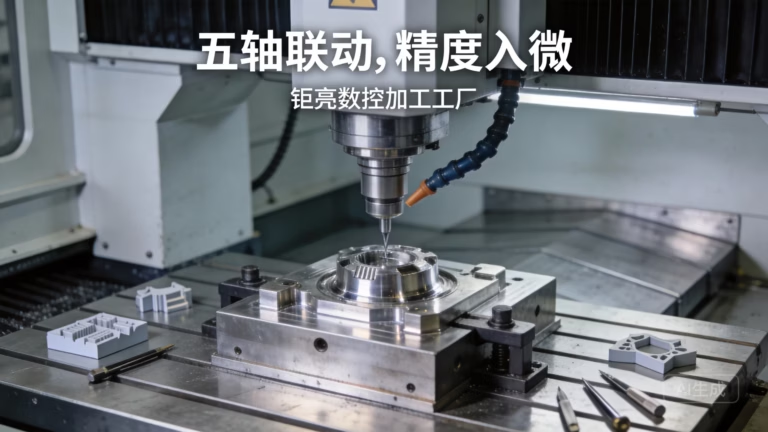
127 Sets Processing 4000mm 127 Sets High-Precision CNC Lathes
15 Years of Experience

7 Hidden Flaws of the CNC 1610 Pro You Must Know Before Buying

If you’re reading this, you’re likely on the verge of joining thousands of hobbyists and makers who have eyed the CNC 1610 Pro, drawn by its compact footprint, tempting price tag, and the dream of turning your workbench into a miniature factory. And right now, you’re doing the smart thing – researching its hidden pitfalls […]

If you’re reading this, you’re likely on the verge of joining thousands of hobbyists and makers who have eyed the CNC 1610 Pro, drawn by its compact footprint, tempting price tag, and the dream of turning your workbench into a miniature factory. And right now, you’re doing the smart thing – researching its hidden pitfalls before swiping your card. The CNC 1610 Pro, like many entry-level desktop CNC routers, is often marketed as a gateway to precision CNC machining, but as a senior manufacturing engineer who has spent over a decade in high‑precision part production at GreatLight Metal Tech Co., LTD., I’ve seen the gap between marketing brochures and real‑world capabilities swallow far too many first‑time buyers’ time, money, and enthusiasm. This article will peel back the spec sheet and reveal seven hidden flaws of the CNC 1610 Pro that you absolutely must understand before you buy – flaws that manufacturers rarely highlight and that online reviewers often overlook.

图片

Before we dive into the details, it’s important to frame what the CNC 1610 Pro actually is. Typically based on an aluminum extrusion frame with a working area of around 160 × 100 mm, a modest DC spindle, and an Arduino‑derived controller, this machine sits squarely in the budget desktop category. It can engrave wood, cut thin acrylic, and mill the occasional soft aluminum if you’re patient enough. But the term “Pro” can be misleading – it suggests capabilities that the machine struggles to deliver consistently, and that’s where the hidden flaws begin.

7 Hidden Flaws of the CNC 1610 Pro You Must Know Before Buying

1. The Illusion of Rigidity: Frame Flex and Vibration That Sabotage Accuracy

The first hidden flaw strikes at the very core of what makes a CNC machine accurate: structural stiffness. The 1610 Pro’s frame is built from lightweight aluminum extrusions and thin acrylic or MDF panels. While sufficient for a 3D printer, these materials behave very differently under the lateral cutting forces of a milling operation. When the spindle plunges into even a moderately hard material, the entire gantry can flex by tenths of a millimeter – invisible to the naked eye but devastating for dimensional accuracy and surface finish.

I’ve evaluated numerous hobby‑class machines in our GreatLight Metrology lab, and a quick test with a dial indicator reveals the truth: apply a 5‑Newton side load at the spindle nose (simulating a light cut in aluminum), and the tool tip often deflects 0.2–0.5 mm. That’s 10 to 50 times the stated repeatability. This flex not only ruins tight‑tolerance features but also triggers chatter – a self‑escalating vibration that leaves a scalloped surface and can break fragile carbide micro‑tools. For anyone hoping to machine even small aluminum brackets or mold inserts, this lack of static and dynamic stiffness is a project‑killer.

2. Spindle Shortcomings: Runout and Torque Deficits You Can’t Ignore

Most CNC 1610 Pro kits come with a small DC spindle, frequently a variant of the RS‑775 motor. On paper, it spins at 20,000 RPM and consumes 100–300 watts. The reality is far less impressive. First, the spindle’s static runout – the wobble of the tool tip due to bearing clearance and collet inaccuracy – often exceeds 0.03 mm right out of the box. For a 1 mm end mill, that’s enough runout to snap the tool on entry or to mill a slot noticeably wider than intended. Even more critical is the torque curve: at low RPMs where you need power for drilling or cutting harder materials, the torque collapses. Trying to take a 0.5 mm depth of cut in 6061 aluminum with a 3 mm end mill? The spindle will often stall or scrub, generating heat rather than chips.

图片

This hidden weakness forces users to adopt painfully light cuts, extending machining times exponentially. Worse, the spindle motor’s cooling is completely passive. During a 30‑minute contouring job, the motor case can exceed 70 °C, leading to permanent magnet degradation and a gradual, silent loss of torque over just a few projects. In a professional environment, we solve this with high‑frequency spindles and through‑tool coolant – luxuries the 1610 Pro simply cannot accommodate.

3. Electronics Gremlins: Controller and Driver Bugs That Defeat Consistency

The control electronics in the typical 1610 Pro bundle consist of an Arduino Uno clone running GRBL firmware, coupled to repurposed A4988 or DRV8825 stepper drivers. These components are the heartbeat of the machine, and when they misbehave, your job stops dead. The most common hidden issue is electrical noise: with poorly shielded wiring and no proper grounding scheme, the limit switches and probe inputs pick up electromagnetic interference from the spindle motor PWM. This can cause false limit triggers during a job, random homing failures, or even a complete X‑axis shift mid‑program.

Another subtle flaw lies in the stepper drivers themselves. A4988 chips are notorious for mid‑band resonance, which manifests as a dead‑zone in the speed range where the motor loses torque and stalls. Many users mistake this for a mechanical bind, leading to hours of wasted troubleshooting. Even when the machine is cutting, the lack of closed‑loop feedback means that if a motor does stall, the controller continues merrily along, believing it’s holding position while your part is irreversibly gouged. In industrial CNC machining, we use servo drives with encoder feedback to prevent exactly this kind of disaster.

4. Wear‑Prone Motion System: V‑Wheels, Backlash, and the Creeping Deterioration

The linear motion on budget machines like the 1610 Pro is achieved through V‑slot aluminum extrusions and polycarbonate V‑wheels. This is, frankly, a temporary solution. Unlike linear rails with recirculating ball bearings, V‑wheels wear both themselves and the aluminum track with every movement. As they wear, the pre‑load you carefully adjusted during assembly disappears, introducing increasing amounts of slop and backlash. Within just a few dozen hours of operation, the axis can develop a measurable dead zone that no amount of software compensation can fully correct because it’s non‑linear and load‑dependent.

The lead screws present their own hidden flaw. The CNC 1610 Pro usually uses T8 trapezoidal leadscrews with brass nuts. These are a step above threaded rod, but they still exhibit cyclic error – a periodic inaccuracy that repeats every turn of the screw. You might command a 50.000 mm move and get 49.950 mm one cycle, then 50.030 the next, all within the same screw revolution. This error pattern is impossible to fully eliminate without glass scale feedback or precision‑ground ballscrews, both of which are absent here.

5. The Claustrophobic Work Envelope and Fixturing Catch‑22

With a nominal travel of 160 mm × 100 mm, the work area seems just enough for small parts. However, the usable area is significantly smaller once you account for fixturing. You’ll quickly discover a hidden challenge: there is no integrated workholding solution. The spoiler board (if even included) is a flat piece of MDF with no T‑slots, grid plates, or tapped holes. To hold a part, you’ll need to either screw it directly into the MDF (damaging the table over time), use double‑sided tape (which melts under cutting heat), or cobble together a clamp set that often protrudes into the toolpath, limiting your part size even further.

If your project requires machining multiple sides of a part, the situation deteriorates rapidly. There’s no provision for a rotary axis, no reference datum pins, and no repeatable fixture plate. Each re‑clamping operation introduces stacking alignment errors that can easily exceed 0.2 mm, making it nearly impossible to produce a cube with square, parallel faces. This is exactly the kind of multi‑axis capability that a professional five‑axis CNC machining service handles effortlessly, but the 1610 Pro simply cannot accommodate.

6. The Mess Factor: A Complete Lack of Containment and Coolant

Read the marketing photos: they show a clean machine sitting on a tidy desk. The hidden reality is that the CNC 1610 Pro throws chips and dust everywhere. There is no enclosure, no chip guard, not even a mesh shield around the spindle. When cutting MDF or carbon fiber – common materials for this class of machine – fine dust becomes airborne and coats your entire workspace, not to mention your lungs. With metals, hot chips fly unpredictably, posing a safety hazard.

The absence of coolant is equally problematic. For aluminum, a minimal quantity lubrication (MQL) or flood coolant is necessary to prevent built‑up edge on the cutter and to carry away heat. Without it, aluminum galls onto the flutes, the tool snaps, and the surface finish turns to a gummy mess. Because the electronics and motor are completely exposed, adding coolant risks short‑circuiting the entire system. Some users resort to manual spray bottles – an inefficient and messy stopgap that still doesn’t address the spray reaching the leadscrews and washing away their lubricant.

7. The Assembly and Calibration Rabbit Hole

Out of the box, the CNC 1610 Pro is a kit of parts. For many, the assembly experience is touted as part of the fun. The hidden horror lies in the instructions – often poorly translated, missing critical steps, and supplemented by fragmented YouTube videos from well‑meaning but not necessarily expert users. Even if you manage to bolt it together correctly, the real pain begins with tramming the spindle to the table. Without a precision granite square and dial test indicator, you’ll be chasing microns that don’t exist. A mis‑trammed spindle of just 0.05° over a 100 mm work area produces a height error of 0.087 mm – enough to leave a visible step on any surface you face‑mill.

Calibrating the steps‑per‑millimeter on each axis is equally deceptive. The standard method of commanding a move and measuring with calipers is fraught with parallax error, backlash influence, and thermal expansion effects. Many beginners end up with a machine that cuts tapered rectangles instead of true squares, only to be told on forums to “tighten the eccentric spacers” – a maintenance task that quickly becomes a weekly ritual. This constant tinkering horizon is the true hidden cost of the CNC 1610 Pro: your time.

From Compromise to Capability: Why Your Project Deserves Better

None of this is to say that the CNC 1610 Pro is without merit. For a hobbyist content to learn the basics of G‑code, make simple acrylic pendants, or engrave soft wood signs, it can be a rewarding – if finicky – entry point. But if your goal is to produce functional prototypes, custom metal brackets, or parts that must mate with other components, these seven hidden flaws add up to a singular truth: you will spend more time fighting the machine than making parts.

This is where the leap to a professional manufacturing partner transforms your project. At GreatLight Metal Tech Co., LTD., we approach precision machining from a fundamentally different engineering foundation. Our 76,000‑square‑foot facility in Dongguan’s Chang’an Town houses 127 pieces of precision peripheral equipment, including large‑format 5‑axis CNC machining centers from Dema and Beijing Jingdiao. These machines are built on massive cast iron beds with linear roller guides, ensuring static stiffness orders of magnitude higher than any extrusion‑based desktop mill. Runout on our high‑speed spindles is measured in single‑digit microns, maintained by a rigorous preventive maintenance schedule. And every axis is closed‑loop servo‑controlled, guaranteeing that the part you designed is the part you receive – down to ±0.001 mm.

More than just hardware, we bring a full‑chain manufacturing ecosystem. When your part requires multiple operations – CNC milling, turning, wire EDM, or even a combination of machining and metal 3D printing – we execute it all under one roof, eliminating the logistical headaches and tolerance stacking that plague projects outsourced to fragmented suppliers. Our ISO 9001:2015 certification isn’t a piece of paper; it’s a living quality system backed by in‑house coordinate measuring machines, laser scanners, and a team that documents every process parameter. For industries with stricter mandates – medical devices under ISO 13485, automotive components under IATF 16949 – we have the audited production lines and the engineering rigor to deliver certification‑ready parts.

Unlike the CNC 1610 Pro’s solo‑creator scenario, with GreatLight you gain a dedicated project engineer who reviews your design for manufacturability before a single chip is cut. This feedback loop alone often saves weeks of trial‑and‑error, especially when transitioning from a 3D‑printed prototype to a metal component that must withstand real loads. And with a maximum machining envelope of 4,000 mm, we’re not constrained by a 160‑millimeter table; we can produce everything from miniature surgical device components to full‑sized robot joint housings.

Conclusion: The Right Tool for the Right Job

No single machine serves every purpose. The CNC 1610 Pro occupies a specific niche: budget‑conscious education and gentle material engraving. For those just entering the maker world, it can teach patience and troubleshooting – perhaps more of the latter than intended. But if your project has deadlines, functional requirements, or quality standards that a wobbly gantry and a 775 motor simply cannot meet, then the hidden flaws you’ve just read about are not obstacles to overcome – they’re signposts pointing you toward a more reliable path.

Professional GreatLight CNC Machining services provide not only the raw capability to hold micron tolerances across complex contours but also the peace of mind that comes from working with a certified, experienced partner. Before you invest in a machine that may spend more time being calibrated than cutting, consider that your designs deserve a partner who matches your ambition. In the end, the 7 hidden flaws of the CNC 1610 Pro you must know before buying serve as a powerful reminder: true precision is never hidden – it’s engineered end‑to‑end.

CNC Experts

Picture of JinShui Chen

JinShui Chen

Rapid Prototyping & Rapid Manufacturing Expert

Specialize in CNC machining, 3D printing, urethane casting, rapid tooling, injection molding, metal casting, sheet metal and extrusion

CNC Recent Posts

CNC News

Welcome to GreatLight Metal,Maximum Processing Size 4,000 mm

Precision Machining CNC Quote Online

Loading file

Upload Click here to upload or drag and drop your model to the canvas.

The model is too large and has been resized to fit in the printer's build tray. [Hide]

The model is too large to fit in the printer's build tray. [Hide]

The model is too large, a fitting printer is selected. [Hide]

The model is too small and has been upscaled. [Hide]

Warning: The selected printer can not print in full color [Hide]

Warning: obj models with multiple meshes are not yet supported [Hide]

Warning: Unsupported DXF entity  [Hide]

Warning: could not arrange models [Hide]

[Hide]


File Unit:      
Scale:
%
L × W × H:
X: × Y: × Z:  cm 
Rotation:
X: ° Y: °  
⚡ Instant Quote for Precision Manufacturing

Submit your design files (STEP/IGES/DWG) and receive a competitive quote within 1 hour, backed by ISO 9001-certified quality assurance.

📋 How It Works

  1. Upload & SpecifyShare your 3D model and select materials (Aluminum/Stainless Steel/Titanium/PEEK), tolerances (±0.002mm), and surface treatments.

  2. AI-Powered AnalysisOur system calculates optimal machining strategy and cost based on 10+ years of automotive/aerospace data.

  3. Review & ConfirmGet a detailed breakdown including:
    - Volume pricing tiers (1-10,000+ units)
    - Lead time (3-7 days standard)
    - DFM feedback for cost optimization

Unit Price: 

Loading price
5 Axis CNC Machining Equipment
4 Axis CNC Machining Equipment
3 Axis CNC Machining Equipment
CNC Milling & Turning Equipment
Prototype and Short-Run Injection Moldings Exact plastic material as final design
Volume Metal Die Casting Services - Precision Cast Parts
Bridge the Gap From Prototype to Production – Global delivery in 10 days or less
Custom high-precision sheet metal prototypes and parts, as fast as 5 days.
Custom Online 3D Printing Services
Design Best Processing Method According To 3D Drawings
Alloys Aluminum 6061, 6061-T6 Aluminum 2024 Aluminum 5052 Aluminum 5083 Aluminum 6063 Aluminum 6082 Aluminum 7075, 7075-T6 Aluminum ADC12 (A380)
Alloys Brass C27400 Brass C28000 Brass C36000
Alloys Stainless Steel SUS201 Stainless Steel SUS303 Stainless Steel SUS 304 Stainless Steel SUS316 Stainless Steel SUS316L Stainless Steel SUS420 Stainless Steel SUS430 Stainless Steel SUS431 Stainless Steel SUS440C Stainless Steel SUS630/17-4PH Stainless Steel AISI 304
Inconel718
Carbon Fiber
Tool Steel
Mold Steel
Alloys Titanium Alloy TA1 Titanium Alloy TA2 Titanium Alloy TC4/Ti-6Al 4V
Alloys Steel 1018, 1020, 1025, 1045, 1215, 4130, 4140, 4340, 5140, A36 Die steel Alloy steel Chisel tool steel Spring steel High speed steel Cold rolled steel Bearing steel SPCC
Alloys Copper C101(T2) Copper C103(T1) Copper C103(TU2) Copper C110(TU0) Beryllium Copper
Alloys Magnesium Alloy AZ31B Magnesium Alloy AZ91D
Low Carbon Steel
Alloys Magnesium Alloy AZ31B Magnesium Alloy AZ91D
ABS Beige(Natural) ABS Black ABS Black Antistatic ABS Milky White ABS+PC Black ABS+PC White
PC Black PC Transparent PC White PC Yellowish White PC+GF30 Black
PMMA Black PMMA Transparent PMMA White
PA(Nylon) Blue PA6 (Nylon)+GF15 Black PA6 (Nylon)+GF30 Black PA66 (Nylon) Beige(Natural) PA66 (Nylon) Black
PE Black PE White
PEEK Beige(Natural) PEEK Black
PP Black PP White PP+GF30 Black
HDPE Black HDPE White
HIPS Board White
LDPE White
This is a finish of applying powdered paint to the components and then baking it in an oven, which results in a stronger, more wear- and corrosion-resistant layer that is more durable than traditional painting methods.
No coating required, product’s natural color!
This is a finish of applying powdered paint to the components and then baking it in an oven, which results in a stronger, more wear- and corrosion-resistant layer that is more durable than traditional painting methods.
This finishing option with the shortest turnaround time. Parts have visible tool marks and potentially sharp edges and burrs, which can be removed upon request.
Sand blasting uses pressurized sand or other media to clean and texture the surface, creating a uniform, matte finish.
Polishing is the process of creating a smooth and shiny surface by rubbing it or by applying a chemical treatmen
A brushed finish creates a unidirectional satin texture, reducing the visibility of marks and scratches on the surface.
Anodizing increases corrosion resistance and wear properties, while allowing for color dyeing, ideal for aluminum parts.
Black oxide is a conversion coating that is used on steels to improve corrosion resistance and minimize light reflection.
Electroplating bonds a thin metal layer onto parts, improving wear resistance, corrosion resistance, and surface conductivity.
This is a finish of applying powdered paint to the components and then baking it in an oven, which results in a stronger, more wear- and corrosion-resistant layer that is more durable than traditional painting methods.
Please provide additional text description for other surface treatment requirements!
Material
Material
  • CNC Metals
    • Aluminum
    • Brass
    • Stainless steel
    • Inconel718
    • Carbon Fiber
    • Tool Steel
    • Mold Steel
    • Titanium
    • Alloy Steel
    • Copper
    • Bronze
    • Low Carbon Steel
    • Magnesium
  • CNC Plastics
    • ABS
    • PC
    • PMMA (Acrylic)
    • PA (Nylon)
    • PE
    • PEEK
    • PP
    • HDPE
    • HIPS
    • LDPE
Printer
Printer
  • CNC Metals
    • 5 Axis CNC Machining
    • 4 Axis CNC Machining
    • 3 Axis CNC Machining
    • CNC Milling & Turning
    • Rapid Tooling
    • Metal Die Casting
    • Vacuum Casting
    • Sheet Metal Fabrication
    • SLA 3D Printing
    • SLS 3D Printing
    • SLM 3D Printing
  • Rapid Prototyping
    • Design Best Processing Method According To 3D Drawings
Post-processing
Post-processing
  • As Machined(Product’s natural color)
  • Sand Blasting
  • Polishing
  • Brushed Finish
  • Anodizing
  • Black Oxide
  • Electroplating
  • Paint Coating
  • Powder Coating
  • Other surface treatment requirements
Finalize
The world's first CNC machining center that dares to provide free samples!

Free for first product valued at less than $200. (Background check required)

precision machining cnc quote online

15 Years CNC Machining Services

When you’re ready to start your next project, simply upload your 3D CAD design files, and our engineers will get back to you with a quote as soon as possible.
Scroll to Top

ISO 9001 Certificate

ISO 9001 is defined as the internationally recognized standard for Quality Management Systems (QMS). It is by far the most mature quality framework in the world. More than 1 million certificates were issued to organizations in 178 countries. ISO 9001 sets standards not only for the quality management system, but also for the overall management system. It helps organizations achieve success by improving customer satisfaction, employee motivation, and continuous improvement. * The ISO certificate is issued in the name of FS.com LIMITED and applied to all the products sold on FS website.

greatlight metal iso 9001 certification successfully renewed
GB T 19001-2016 IS09001-2015
✅ iso 9001:2015
greatlight metal iso 9001 certification successfully renewed zh

IATF 16949 certificate

IATF 16949 is an internationally recognized Quality Management System (QMS) standard specifically for the automotive industry and engine hardware parts production quality management system certification. It is based on ISO 9001 and adds specific requirements related to the production and service of automotive and engine hardware parts. Its goal is to improve quality, streamline processes, and reduce variation and waste in the automotive and engine hardware parts supply chain.

automotive industry quality management system certification 01
Certification of Production Quality Management System for Engine Hardware Parts Engine Hardware Associated Parts
automotive industry quality management system certification 00
发动机五金零配件的生产质量管理体系认证

ISO 27001 certificate

ISO/IEC 27001 is an international standard for managing and processing information security. This standard is jointly developed by the International Organization for Standardization (ISO) and the International Electrotechnical Commission (IEC). It sets out requirements for establishing, implementing, maintaining, and continually improving an information security management system (ISMS). Ensuring the confidentiality, integrity, and availability of organizational information assets, obtaining an ISO 27001 certificate means that the enterprise has passed the audit conducted by a certification body, proving that its information security management system has met the requirements of the international standard.

greatlight metal technology co., ltd has obtained multiple certifications (1)
greatlight metal technology co., ltd has obtained multiple certifications (2)

ISO 13485 certificate

ISO 13485 is an internationally recognized standard for Quality Management Systems (QMS) specifically tailored for the medical device industry. It outlines the requirements for organizations involved in the design, development, production, installation, and servicing of medical devices, ensuring they consistently meet regulatory requirements and customer needs. Essentially, it's a framework for medical device companies to build and maintain robust QMS processes, ultimately enhancing patient safety and device quality.

greatlight metal technology co., ltd has obtained multiple certifications (3)
greatlight metal technology co., ltd has obtained multiple certifications (4)

Get The Best Price

Send drawings and detailed requirements via Email:[email protected]
Or Fill Out The Contact Form Below:

All uploads are secure and confidential.