
CNC Machining: 7 Tips to Maximize Precision and Reduce Cost
Written for design engineers and sourcing leads who review quotes and drawings. Seven decisions drive most of the precision you get and most of the cost you pay. Each tip below says what to change and when the change is not worth it.
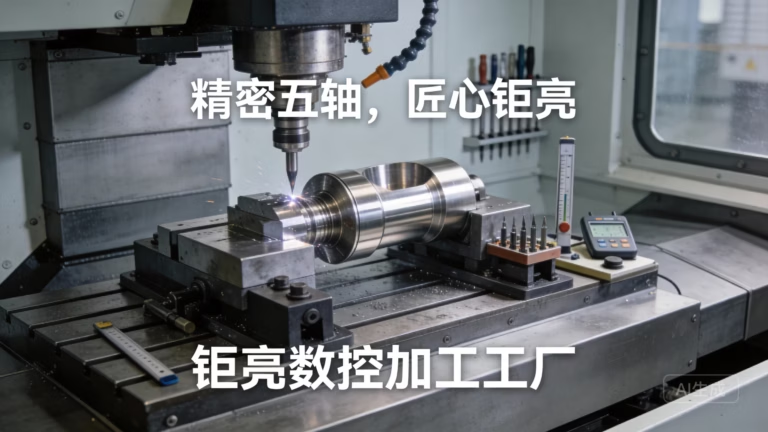
Seven levers, one budget
Precision and cost are set by the drawing and the setup plan long before the spindle turns.
Fix the geometry before you release the drawing
Design decisions made in CAD cost nothing to change. The same decisions made after the first setup can add days and force custom tooling. A wall thinner than 0.8 mm on aluminium or 1.5 mm on stainless will chatter, so the machine has to slow down and take lighter passes. That is cycle time you pay for on every part.
Tool access matters more than most drawings admit. A pocket 30 mm deep and 6 mm wide needs a long, thin cutter that deflects. Open the pocket floor, add a corner radius, or split the part into two pieces and bolt them. Standard end mills hold tolerance far better than long reach tools.
Internal sharp corners are another cost driver. A square corner in a hardened pocket may need EDM or a broach. Add a radius at least equal to the cutter radius and the same feature comes off a three-axis mill. GreatLight runs a DFM review before quoting, and the quotation plus that analysis reaches you within 12 hours.
Send a 3D model and a 2D drawing that states which tolerances are critical. Marking three or four dimensions as critical while leaving the rest general tells the shop where to spend time. It is the single cheapest cost reduction available to you.
Pick material for the feature, not the data sheet
Titanium and Inconel solve strength and heat problems. They also cut at roughly one fifth the speed of 6061 aluminium and wear tools faster. If a bracket only sees static load, 7075 aluminium or 17-4PH stainless may do the same job at a fraction of the cycle time.
Free-machining grades exist for a reason. 303 stainless machines noticeably better than 304, and C36000 brass machines better than both. Use the free-machining grade when corrosion or weldability is not the limiting requirement. Reserve the difficult alloys for the surfaces that actually see heat, wear, or load.
Material also sets the finish you can reach. Aluminium takes a fine machined finish easily. Soft plastics such as HDPE and POM smear and hold burrs, so expect a wider tolerance band and plan a deburring step. If a plastic part needs a tight bore, a light press-fit insert in metal is often cheaper than chasing the tolerance in plastic.
Material and process trade-offs
Relative ranking for a typical machined part; exact values depend on geometry.
| Material | Machinability | Typical use | Watch out for |
|---|---|---|---|
| 6061-T6 aluminium | Excellent | Housings, brackets, fixtures | Low wear resistance |
| 7075 aluminium | Good | Aerospace structure, moulds | Higher cost, less corrosion resistance |
| 303 stainless | Good | Shafts, fittings, fasteners | Limited weldability |
| 316L stainless | Fair | Medical, marine, food contact | Work hardening, slower feeds |
| Ti-6Al-4V (TC4) | Poor | Implants, aerospace hardware | Tool wear, heat at the cut |
| C36000 brass | Excellent | Connectors, valves, bushings | Not for high-load parts |
| POM (acetal) | Excellent | Gears, insulators, guides | Thermal growth, burrs |
Apply tolerance where the part needs it
The precision trap is simple. A drawing that calls ±0.005 mm on every dimension forces the shop to inspect and hold every dimension to that band, including the ones that only locate a cover. Cost rises with the number of tight dimensions, not with part complexity.
Ask what each tight tolerance does. A bearing bore, a seal groove, and a mating face usually need control. A clearance hole for an M4 screw does not. General tolerances of ±0.1 mm on the rest of the drawing are normal and cut inspection time.
GreatLight holds ±0.005 mm where a drawing calls for it, and the shop inspects 100% of parts before shipment. That inspection is affordable because it is aimed at the features that matter. When every dimension is critical, nothing is.
One more habit helps. State the datum scheme you used in CAD, and keep it consistent between the model and the drawing. Datum mismatches cause more rejected first articles than machine error does.
Match batch size to the setup you are paying for
Setup is a fixed cost. A three-axis job with two setups carries that cost twice; a five-axis job that reaches five faces in one setup carries it once. For one to fifty parts, the one-setup route usually wins even at a higher hourly rate.
The crossover comes from volume. Past a few hundred parts, a dedicated fixture and a shorter cycle time beat the flexible route. That is when a mill-turn center that completes a part in one handling starts to pay back.
Positional accuracy also improves with fewer setups. Every re-clamp adds a small error. If a bore and a face must stay concentric, machine them in the same setup rather than trusting two fixtures to agree.
There is no minimum order quantity here. A single prototype and a 10,000-part run go through the same DFM step, and production can start within 24 hours of approval.
Setup strategy by quantity
| Quantity | Suggested route | Main cost driver |
|---|---|---|
| 1–50 parts | 5-axis, one or two setups | Programming and setup time |
| 50–500 parts | 3-axis with soft jaws or fixture plate | Cycle time per part |
| 500–5,000 parts | Dedicated fixture, optimized toolpath | Fixture cost and tool life |
| 5,000+ parts | Mill-turn or cell with in-process gauging | Tooling and inspection plan |
Choose finishes for function first
A finish should solve a problem: wear, corrosion, electrical contact, or appearance. Hardcoat anodizing on aluminium gives a wear surface. Electroless nickel gives uniform coverage on complex geometry where plating thickness varies less than with electroplating. Black oxide is a thin, low-cost option that does not change dimensions much.
Cosmetic finishes follow different rules. Bead blasting hides tool marks and prepares a surface for anodizing. Polishing costs time and can round edges, which is a problem if an edge is a sealing face. Say which edges must stay sharp.
Laser marking is useful for traceability. Minimum character height here is 1.5 mm, so plan a flat area for the mark instead of a curved or sloped face.
Skip the finish when it adds nothing. A part that lives inside a sealed enclosure does not need cosmetic anodizing. That decision alone removes a handling step and a queue.
Toolpath strategy and the shop behind it
Constant-engagement toolpaths keep the cutter in a steady radial bite instead of a full-width pass. Heat leaves with the chip, tool load stays even, and the shop can run higher feed rates without chatter. On deep pockets and thin floors this is often the difference between holding a tolerance and scrapping parts.
High-speed machining with small stepovers and fast passes works well on hardened steel and on aluminium with fine features. It needs a machine that accelerates quickly and a control that looks ahead. Not every shop has that, and a toolpath that looks efficient in CAM can stall on an older spindle.
The shop matters as much as the strategy. GreatLight has 127 high-precision CNC machines, including 16 simultaneous 5-axis centers, 12 four-axis mills, and 16 mill-turn centers, across three wholly-owned plants covering 7,600 m². Maximum processing size reaches 4,000 mm.
Certification tells you which systems are in place. ISO 9001:2015 covers general quality, IATF 16949:2016 covers automotive, ISO 13485:2016 covers medical devices, and ISO 27001:2022 covers information security. Ask a supplier which one applies to your program, and ask to see the scope statement rather than the logo.
Questions engineers ask before releasing a job
How tight a tolerance should I put on a drawing?
Start from function. Put the tight band, down to ±0.005 mm if the fit needs it, on mating and sealing features. Use a general tolerance of ±0.1 mm or wider for clearance holes and non-critical profiles.
Then tell the shop which dimensions are critical. A short critical list is easier to inspect and cheaper to hold than a drawing where everything is boxed.
Does a five-axis machine always cost more?
No. For small batches it is often cheaper because the part comes off in one setup instead of three. You pay a higher hourly rate but fewer hours.
For high volumes, a three-axis machine with a dedicated fixture and a shorter cycle usually wins. The crossover depends on how many faces the part has and how tight the relationships between them are.
When is a surface finish worth the added cost?
When it does a job. Wear surfaces, corrosion exposure, electrical contact, and sealing faces justify a finish. Appearance on a hidden internal part usually does not.
Remember that polishing and bead blasting can round edges. If an edge is a sealing or locating surface, mark it and ask the shop to protect it.
What do you need to give an accurate quote?
A 3D model, a 2D drawing with tolerances and datums, the material and finish, and the quantity you expect now and later. Note any feature that must not be touched.
Quotation and a DFM analysis come back within 12 hours. Uploads stay confidential, and an NDA is available on request.
Can you start from one prototype?
Yes. There is no minimum order quantity. A single prototype and a 10,000-part run use the same DFM step, and production can start within 24 hours of approval.
Parts typically ship in 3–5 days. Historical late-delivery probability is below 2%.
Which materials do you machine most?
Aluminium grades such as 6061-T6, 7075, and 6082; stainless 303, 304, 316L, and 17-4PH; steels including 4140 and 4340; copper and brass; titanium TC4; and plastics such as POM, PEEK, and HDPE.
If you are unsure between two grades, send the load and environment details with the model. We will say which one machines better for the features on the part.
Send a drawing and get a DFM read
Quotation and DFM analysis within 12 hours, 100% inspection before shipment, NDA on request.
12-hour quote±0.005 mmNo MOQ3–5 day shipping









