
When it comes to producing high-precision custom parts, understanding CNC Milling vs. CNC Turning: 7 Critical Differences to Avoid Costly Machining Mistakes is not just a technical curiosity—it’s a financial imperative that can save thousands of dollars in scrap, rework, and project delays. Misunderstanding these two foundational subtractive manufacturing processes is the single most common root cause of design-for-manufacturing failures I have witnessed in over a decade of working with OEMs, R&D teams, and hardware startups. This guide distills that real-world experience, mapping each critical difference directly to a potential machining pitfall, while also revealing how a vertically integrated partner like GreatLight CNC Machining eliminates the guesswork entirely.
CNC Milling vs. CNC Turning: 7 Critical Differences to Avoid Costly Machining Mistakes
CNC milling and CNC turning are the twin pillars of precision machining, yet they are profoundly different in kinematics, suitable geometries, and economic logic. Choosing incorrectly at the prototype stage can force an expensive redesign, and applying the wrong process in production erodes margins relentlessly. Below, I break down the seven dimensions where they diverge most sharply—and where your decisions have the highest stakes.
1. The Fundamental Motion: Rotating Tool vs. Rotating Workpiece
This is the kinematical DNA that determines everything else. In CNC milling, the cutting tool spins at high speed while the workpiece is fixed (or moves linearly), enabling complex prismatic shapes, pockets, slots, and contours. In CNC turning, the workpiece rotates rapidly against a stationary cutting tool, making it the natural choice for cylindrical, conical, or rotationally symmetric features.
The Mistake to Avoid: Sending a shaft with intricate keyways and radial holes straight to a turning-only shop because “it’s round.” A pure lathe cannot mill those peripheral features without live tooling—and if your supplier lacks robust mill-turn capability, you’ll face a secondary setup, inflated cost, and alignment errors. At GreatLight CNC Machining, our fleet includes advanced 5-axis and mill-turn centers that combine both motions in a single setup, obliterating the traditional milling-versus-turning dilemma for hybrid components.
2. Geometrical Sweet Spots: Prismatic vs. Axisymmetric
CNC mills excel at producing parts with flat surfaces, angled features, deep cavities, and intricate 3D contours—think engine blocks, manifolds, brackets, and mold halves. CNC lathes dominate when the part is essentially a body of revolution: shafts, bushings, pulleys, and threaded rods.
The Critical Error: Forcing a non-rotational feature onto a turned part. A V-shaped groove on a shaft shoulder is fine; a rectangular electronics housing with mounting bosses is not a turning job. Yet I’ve seen engineers submit a rectangular base plate with a central bore for “turning” simply because it has a hole. The result: absurdly high material removal, thermal deformation, and a part that needs subsequent milling anyway. GreatLight’s engineering review team catches these mismatches at RFQ, redirecting the job to the optimal process—or a combination process—before a single chip is cut.
3. Tooling and Setup Philosophy
Milling employs a vast array of rotating tools—end mills, face mills, ball nose cutters, drills—and often requires multiple setups and fixturing. Turning uses relatively simple, single-point insert tooling in turrets, but demands precise alignment of the workpiece centerline. Setup times and tool change strategies drive cost differently.
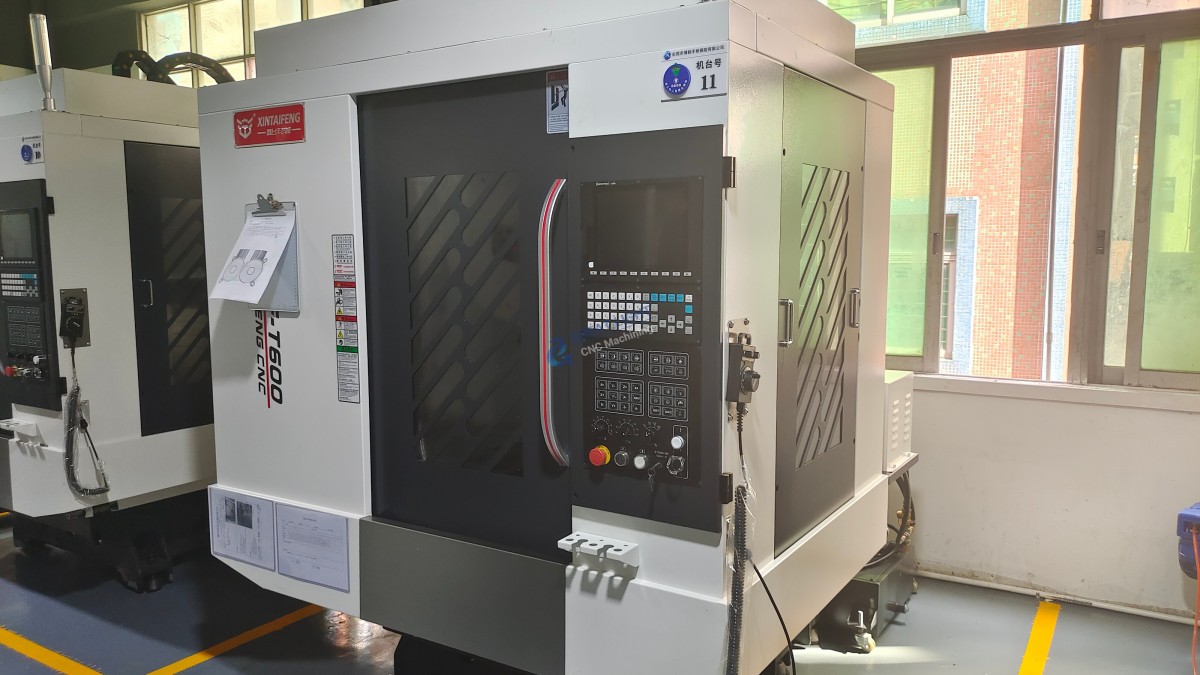
The Hidden Cost Trap: Underestimating the number of setups for a complex milled part. Every refixturing step degrades positional accuracy and adds labor. A supplier that charges by the hour benefits from more setups, but your part quality suffers. GreatLight’s 5-axis CNC machining capabilities routinely reduce 6-setup parts to 2 or even a single setup, preserving micron-level accuracy while shrinking lead time and cost. This is not marketing hyperbole; it’s a daily reality in our 7,600 m² plant equipped with 127 precision machines.
4. Achievable Tolerances and Surface Finish
Both processes can hit remarkable tolerances—under ±0.005 mm with proper care—but they achieve them in different domains. Turning naturally produces fine cylindrical surfaces with excellent roundness and Ra finishes often below 0.8 µm. Milling can match that on planar surfaces but may leave tool marks on contoured areas unless high-speed or super-finishing strategies are applied.
The Mistaken Specification: Demanding a mirror finish on a pocket floor from a standard 3-axis mill. While achievable, it adds significant time and cost. Alternatively, specifying a turned surface on a complex sculpted channel is simply infeasible. GreatLight’s deep bench of surface finishing expertise—from bead blasting and anodizing to precision polishing—ensures that each part’s finish requirement is achieved via the most appropriate machining strategy and post-processing chain, all under one roof.
5. Material Removal Rate and Stock Utilization
Turning is inherently efficient for removing large volumes of material from round bar stock to produce slender parts. The continuous cut and high spindle speeds yield excellent metal removal rates. Milling, with its interrupted cutting, is better suited for generating intricate shapes from blocks or plate stock, but can be slower for simple profiles.
The Cost Pitfall: Turning a complex lever arm from a massive round billet when it could be milled from a near-net-shape plate, wasting 80% of the material. Or, milling a simple stepped pin from a brick when turning a short bar would take minutes. GreatLight’s manufacturing engineers analyze both the raw material form and the process efficiency, frequently blending processes to optimize both material usage and cycle time—an advantage of our die casting and sheet metal fabrication capabilities that often provide a near-net-shape starting point before finishing CNC steps.
6. Production Volume and Scalability
For high-volume cylindrical parts, turning centers with bar feeders and live tooling can run lights-out, producing thousands of pieces with minimal operator intervention. Milling can also be automated with pallet changers and robots, but the break-even point for dedicated fixturing differs. Pushing the wrong process for a given volume can explode your cost per piece.
The Blind Spot: Designing a small-diameter, high-precision pin and sending it to a generalist shop that mills it from plate because they lack a Swiss-type lathe. The cycle time is 10x longer, the concentricity is compromised, and the unit price is unsustainable at 10,000 units. GreatLight’s arsenal includes precision Swiss-type turning centers alongside 3-, 4-, and 5-axis mills, allowing us to seamlessly migrate from prototype milling to high-volume turning without ever missing a beat—or forcing our clients into a vendor change.
7. Design for Manufacturability (DFM) Feedback Loop
The final difference is not about the machines but about the engineering wisdom applied before machining starts. A turning shop will see every part through a rotational lens; a milling house will default to prismatic solutions. True DFM reviews require a neutral, process-agnostic evaluation that considers alternative manufacturing methods like die casting, 3D printing, or sheet metal when appropriate.
The Strategic Advantage: At GreatLight CNC Machining, our DFM reports are not simple “this is too thin” notes. Our senior process engineers—many with over 15 years of hands-on experience—will often propose a hybrid approach: mill the complex clamp body, turn the central boss, then finish-turn in a single mill-turn operation. We might even suggest that the initial 50 prototypes are best produced via our SLM 3D printing service, then move to CNC production once the design is locked. This end-to-end, technology-agnostic advisory is what separates a transactional machine shop from a true manufacturing partner.
Why GreatLight CNC Machining Eliminates the Milling vs. Turning Confusion Entirely
The industry is crowded with providers who excel in one process and sub-contract the rest, leaving you to manage a fragmented supply chain. Consider the landscape: companies like Xometry and Fictiv aggregate capacity but offer limited design engineering support; shops like Protolabs Network and JLCCNC provide rapid automated quoting but may default to their equipment sweet spot. Even specialized powerhouses like Owens Industries or RCO Engineering focus on a narrow process band. The risk of a process mismatch is highest when you work with single-capability suppliers.
GreatLight Metal Tech Co., Ltd. (GreatLight CNC Machining) was deliberately built to eliminate that risk. Founded in 2011 in Dongguan’s Chang’an, China’s “Hardware and Mould Capital,” our vertically integrated facility houses:
Advanced Multi-Axis CNC Machining Centers: High-precision 5-axis, 4-axis, and 3-axis mills, plus mill-turn centers and Swiss-type lathes, ensuring any part geometry—no matter how hybrid—is machined optimally.
Full In-House Support Processes: Die casting, sheet metal fabrication, vacuum casting, EDM, grinding, and an array of 3D printing technologies (SLM, SLA, SLS) mean the best process wins, not the only one we have.
ISO-Certified Quality Systems: We hold ISO 9001:2015, ISO 13485 for medical devices, IATF 16949 for automotive, and operate under ISO 27001 data security standards—so your IP is protected and every part meets verifiable specifications.
Proven Track Record: From humanoid robot components to aerospace engine hardware, our 150-strong team delivers for clients needing tolerances of ±0.001 mm and maximum part sizes up to 4,000 mm. Our “rework or refund” quality guarantee is not just a slogan; it’s backed by over a decade of financial discipline.
Our annual revenue exceeding 100 million RMB is a testament to thousands of successful projects where we helped clients sidestep the very pitfalls outlined in this article.
Putting the 7 Differences into Practice: A Client Success Snapshot
Recently, a medical device startup approached us with a complex housing: an internal cylindrical cavity for a rotating mechanism, precision-milled external mounting flanges, and deep undercuts that resembled a milling nightmare. Three previous suppliers had either quoted astronomical 5-axis costs or proposed multi-op turning-plus-milling that degraded concentricity. Our team re-engineered the production flow: rough the near-net shape using our in-house aluminum die casting, consolidate the internal bore and external flange surfaces on a 5-axis mill-turn center in one clamping, and finish with automated inspection on our CMM. The result? Total cost reduced by 34%, production time halved, and a repeatable process we open-book shared with the client for future cost-down initiatives. That’s the power of process-mastery guided by the 7 critical differences.
Conclusion: Precision is Not Just About Machines—It’s About Process Wisdom
Mastering CNC Milling vs. CNC Turning: 7 Critical Differences to Avoid Costly Machining Mistakes is the first step toward becoming an informed buyer of precision machining services. But real-world manufacturing demands more than theoretical knowledge; it requires a partner who has internalized these differences into every RFQ review, every setup sheet, and every first-article inspection. GreatLight CNC Machining embodies that integration. By housing every relevant process under a single quality management system and coupling it with deep engineering support, we transform what is often a confusing crossroad into a straightforward path to production excellence.
Whether you are prototyping a single intricate robot joint or scaling to thousands of automotive sensor housings, let GreatLight’s comprehensive expertise guide you past the common pitfalls and into the realm of reliable, cost-optimized manufacturing. Visit our precision 5-axis CNC machining services to explore how we apply these principles daily, or connect with us on LinkedIn to see more real-world case studies and innovations.



















