
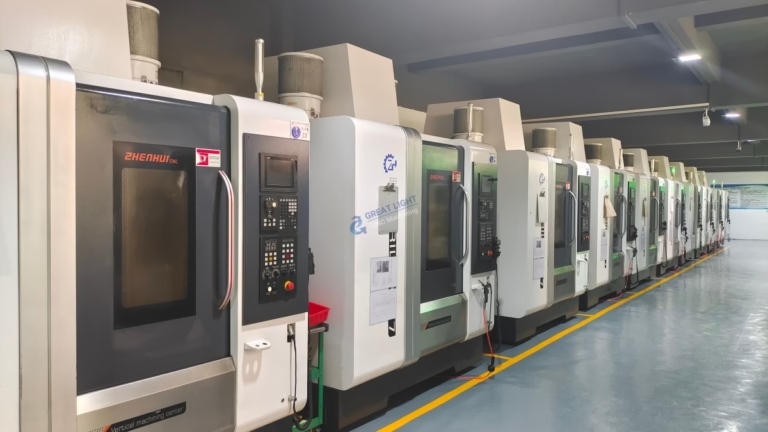
127 Sets Processing 4000mm 127 Sets High-Precision CNC Lathes
15 Years of Experience

5500mW Laser: 5 Crucial Safety Tips to Prevent Permanent Eye Damage

When working with a 5500mW laser, understanding the crucial safety tips to prevent permanent eye damage is essential for anyone involved in precision manufacturing, prototyping, or part marking. At GreatLight CNC Machining Factory, where we specialize in precision 5-axis CNC machining services, we know that powerful tools demand uncompromising respect for safety. Our 76,000 sq. ft. facility […]

When working with a 5500mW laser, understanding the crucial safety tips to prevent permanent eye damage is essential for anyone involved in precision manufacturing, prototyping, or part marking. At GreatLight CNC Machining Factory, where we specialize in precision 5-axis CNC machining services, we know that powerful tools demand uncompromising respect for safety. Our 76,000 sq. ft. facility in Dongguan, equipped with advanced 5‑axis, 4‑axis, and 3‑axis CNC machines, operates under ISO 9001:2015 certified processes, embedding safety into every workflow. While our core expertise lies in high‑precision metal and plastic part production, we regularly consult with clients who integrate high‑power lasers into their post‑processing lines. This article distills decades of manufacturing engineering experience into five actionable safety rules that can shield you and your team from irreversible harm.

Understanding the Dangers of a 5500mW Laser

A 5500 mW (5.5 W) continuous‑wave laser falls firmly into Class 4, the highest hazard category. Unlike lower‑power pointers, a beam of this intensity can instantly burn skin, ignite flammable materials, and cause catastrophic retinal injury. The human eye’s focusing system can concentrate the laser energy to a microscopic spot on the retina, increasing power density by orders of magnitude. With a 5500 mW laser, that concentration happens faster than the blink reflex—typically within 0.25 seconds—meaning accidental exposure often results in permanent blindness before you can even react. Unfortunately, many workshops treat high‑power lasers as just another tool, overlooking the systemic safety infrastructure they require. By implementing the following five tips, grounded in real‑world shop‑floor experience, you transform a potentially devastating risk into a well‑controlled process.

5500mW Laser: 5 Crucial Safety Tips to Prevent Permanent Eye Damage

1. Select and Properly Use Laser Safety Eyewear

No single pair of glasses protects against all wavelengths. A 5500 mW laser might emit in the infrared (e.g., 1064 nm for fiber lasers), visible (e.g., 532 nm green), or ultraviolet range. The first step is identifying the exact wavelength(s) of your laser from its specification sheet, then choosing goggles with the appropriate optical density (OD) at that wavelength. For a 5.5 W visible beam, an OD of 5 or higher is typical, meaning the eyewear attenuates the light by a factor of 10⁵. But OD alone isn’t enough; you must also verify the damage threshold of the lens material. Inferior goggles can crack or melt under sustained high‑power exposure, turning a protective device into a secondary hazard.

Replace eyewear immediately if the lenses show pitting, scratches, or discoloration. Store them in a clean, dry cabinet away from direct sunlight to prevent degradation of the polymer filters. And as a practical shop rule: anyone entering the laser‑controlled area must wear designated eyewear, even if they are “just looking” for a moment.

2. Implement Robust Engineering Controls

Administrative rules fail when humans forget; engineering controls are fail‑safe. In our precision machining environment, we apply the same principle to laser enclosures as we do to CNC machine guards. A Class 4 laser setup should always be housed in a fully interlocked, light‑tight enclosure. The interlocks must immediately cut power to the laser when a door or panel is opened. Use a key‑controlled master switch to prevent unauthorized activation, and install a clearly visible emission indicator lamp outside the enclosure so everyone in the vicinity knows the laser is firing.

Beam dumps made from anodized aluminum or specialized ceramic materials should terminate all stray beams. Mirrors and lenses must be rigidly mounted to prevent accidental misalignment during operation. Even if your laser is positioned in a dedicated room, equip the entrance with a warning sign conforming to ANSI Z136.1 or IEC 60825 standards, and integrate a contact mat or infrared occupancy sensor that disables the laser if someone steps inside.

3. Manage the Beam Path and Control Reflections

A 5500 mW beam can reflect off seemingly dull metal surfaces with enough intensity to damage eyes that are not on the direct beam axis. This is why beam path awareness is critical. Before any lasing session, trace the entire optical train from the output coupler to the workpiece and beyond. Remove all jewelry, watches, and metallic tools from the table that could act as specular reflectors. Matte black anodized fixtures and back‑stops are far safer than shiny stainless steel or aluminum.

Always use a low‑power alignment mode—or substitute the high‑power beam with a safe alignment laser of identical wavelength—when tuning mirrors or focusing lenses. Never perform alignment at full power. If you must view the beam spot for focusing, do so indirectly via a properly filtered camera system; never rely on a viewport whose filter might have been compromised. And post a dedicated laser safety officer (LSO) to supervise beam alignment procedures, ensuring that no one places their head at beam level.

4. Enforce Comprehensive Training and a Written Safety Protocol

Even the most sophisticated engineering controls amount to little if the operator does not understand the hazards. At GreatLight, we mandate rigorous, documented training for every technician before they touch any high‑power equipment. Training should cover laser physics basics, biological effects on the eye and skin, proper PPE selection, emergency procedures, and a clear explanation of the facility’s standard operating procedure (SOP).

The SOP must be a living document, revised every time a new material, lens, or process is introduced. It should outline step‑by‑step startup and shutdown sequences, alignment checkpoints, and specific actions to take if a safety interlock fails or a burn injury occurs. Regular refresher courses—quarterly at minimum—help counteract complacency, which is the true enemy in a long‑running production environment. Keep a training log auditable by internal safety committees and external regulators; this discipline not only safeguards your team but also demonstrates due diligence when dealing with clients and insurers.
图片

5. Perform Regular Inspection and Preventive Maintenance

High‑power lasers degrade optical components over time. Dust particles on a lens can absorb 5500 mW of energy, heat up rapidly, and cause the lens to crack or scatter the beam in an unpredictable pattern. Establish a schedule for cleaning and inspecting all optics, interlocks, emergency stop buttons, and the enclosure structure. Use medical‑grade isopropyl alcohol and lens tissue for delicate optics; never substitute with shop rags that might leave abrasive residues.
图片

Check the laser power supply and cooling system for signs of wear or leaks. An overheated laser tube can drift in wavelength or mode, changing the hazard profile unexpectedly. Calibrate the power output regularly with a certified meter to confirm that the beam is running at the expected level. Replace any component that shows even slight degradation—saving money on a $20 interlock switch could cost someone their eyesight.

Close the loop by maintaining a digital maintenance log that integrates with your overall quality system. If you are ISO 9001 certified, laser maintenance naturally fits into clause 7.1.3 (infrastructure) and section 8.5.1 (control of production and service provision). At GreatLight CNC Machining, our ISO 9001:2015, ISO 13485, and IATF 16949 frameworks compel us to treat maintenance records with the same rigor as dimensional inspection reports—because safety is an inseparable part of process capability.

Integrating Laser Safety into Precision Manufacturing

Whether you are operating a standalone laser marking station or a fully automated cutting cell, laser safety cannot be an afterthought. The same structured thinking that delivers ±0.001 mm tolerances on a 5‑axis machined part also ensures that every beam‑related hazard is systematically identified, evaluated, and controlled. When we consult for clients in the medical device, automotive, or robotics sectors, we often find that the root cause of a safety incident isn’t the technology itself but a lack of integration with the wider manufacturing quality system.

Treat your laser as a machine tool with unique hazards: it deserves a pre‑job hazard identification check (similar to a CNC setup sheet), periodic calibration, and traceable operator sign‑off. This approach not only prevents eye injuries but also boosts productivity; a well‑controlled laser yields cleaner cuts, more consistent marking contrast, and fewer rejected parts.

Conclusion: Make Permanent Eye Damage a Never‑Event

No production deadline or cost pressure is worth the irreversible tragedy of a blinded eye. The 5500mW laser is an outstanding tool for engraving, cutting, and micro‑machining, but it operates with a hair‑trigger potential for harm. By religiously applying the five crucial safety tips—proper eyewear, engineering controls, beam path management, training, and maintenance—you create a culture where permanent eye damage from 5500mW lasers simply never happens. At GreatLight CNC Machining, we hold ourselves to the same uncompromising safety standards as leading manufacturers like Protocase, EPRO‑MFG, and RapidDirect, because trust with clients begins on a shop floor where every pair of eyes remains healthy. For more insights on precision manufacturing, process reliability, and workplace safety, follow GreatLight CNC Machining on LinkedIn.


CNC Experts

Picture of JinShui Chen

JinShui Chen

Rapid Prototyping & Rapid Manufacturing Expert

Specialize in CNC machining, 3D printing, urethane casting, rapid tooling, injection molding, metal casting, sheet metal and extrusion

CNC Recent Posts

CNC News

Welcome to GreatLight Metal,Maximum Processing Size 4,000 mm

Precision Machining CNC Quote Online

Loading file

Upload Click here to upload or drag and drop your model to the canvas.

The model is too large and has been resized to fit in the printer's build tray. [Hide]

The model is too large to fit in the printer's build tray. [Hide]

The model is too large, a fitting printer is selected. [Hide]

The model is too small and has been upscaled. [Hide]

Warning: The selected printer can not print in full color [Hide]

Warning: obj models with multiple meshes are not yet supported [Hide]

Warning: Unsupported DXF entity  [Hide]

Warning: could not arrange models [Hide]

[Hide]


File Unit:      
Scale:
%
L × W × H:
X: × Y: × Z:  cm 
Rotation:
X: ° Y: °  
⚡ Instant Quote for Precision Manufacturing

Submit your design files (STEP/IGES/DWG) and receive a competitive quote within 1 hour, backed by ISO 9001-certified quality assurance.

📋 How It Works

  1. Upload & SpecifyShare your 3D model and select materials (Aluminum/Stainless Steel/Titanium/PEEK), tolerances (±0.002mm), and surface treatments.

  2. AI-Powered AnalysisOur system calculates optimal machining strategy and cost based on 10+ years of automotive/aerospace data.

  3. Review & ConfirmGet a detailed breakdown including:
    - Volume pricing tiers (1-10,000+ units)
    - Lead time (3-7 days standard)
    - DFM feedback for cost optimization

Unit Price: 

Loading price
5 Axis CNC Machining Equipment
4 Axis CNC Machining Equipment
3 Axis CNC Machining Equipment
CNC Milling & Turning Equipment
Prototype and Short-Run Injection Moldings Exact plastic material as final design
Volume Metal Die Casting Services - Precision Cast Parts
Bridge the Gap From Prototype to Production – Global delivery in 10 days or less
Custom high-precision sheet metal prototypes and parts, as fast as 5 days.
Custom Online 3D Printing Services
Design Best Processing Method According To 3D Drawings
Alloys Aluminum 6061, 6061-T6 Aluminum 2024 Aluminum 5052 Aluminum 5083 Aluminum 6063 Aluminum 6082 Aluminum 7075, 7075-T6 Aluminum ADC12 (A380)
Alloys Brass C27400 Brass C28000 Brass C36000
Alloys Stainless Steel SUS201 Stainless Steel SUS303 Stainless Steel SUS 304 Stainless Steel SUS316 Stainless Steel SUS316L Stainless Steel SUS420 Stainless Steel SUS430 Stainless Steel SUS431 Stainless Steel SUS440C Stainless Steel SUS630/17-4PH Stainless Steel AISI 304
Inconel718
Carbon Fiber
Tool Steel
Mold Steel
Alloys Titanium Alloy TA1 Titanium Alloy TA2 Titanium Alloy TC4/Ti-6Al 4V
Alloys Steel 1018, 1020, 1025, 1045, 1215, 4130, 4140, 4340, 5140, A36 Die steel Alloy steel Chisel tool steel Spring steel High speed steel Cold rolled steel Bearing steel SPCC
Alloys Copper C101(T2) Copper C103(T1) Copper C103(TU2) Copper C110(TU0) Beryllium Copper
Alloys Magnesium Alloy AZ31B Magnesium Alloy AZ91D
Low Carbon Steel
Alloys Magnesium Alloy AZ31B Magnesium Alloy AZ91D
ABS Beige(Natural) ABS Black ABS Black Antistatic ABS Milky White ABS+PC Black ABS+PC White
PC Black PC Transparent PC White PC Yellowish White PC+GF30 Black
PMMA Black PMMA Transparent PMMA White
PA(Nylon) Blue PA6 (Nylon)+GF15 Black PA6 (Nylon)+GF30 Black PA66 (Nylon) Beige(Natural) PA66 (Nylon) Black
PE Black PE White
PEEK Beige(Natural) PEEK Black
PP Black PP White PP+GF30 Black
HDPE Black HDPE White
HIPS Board White
LDPE White
This is a finish of applying powdered paint to the components and then baking it in an oven, which results in a stronger, more wear- and corrosion-resistant layer that is more durable than traditional painting methods.
No coating required, product’s natural color!
This is a finish of applying powdered paint to the components and then baking it in an oven, which results in a stronger, more wear- and corrosion-resistant layer that is more durable than traditional painting methods.
This finishing option with the shortest turnaround time. Parts have visible tool marks and potentially sharp edges and burrs, which can be removed upon request.
Sand blasting uses pressurized sand or other media to clean and texture the surface, creating a uniform, matte finish.
Polishing is the process of creating a smooth and shiny surface by rubbing it or by applying a chemical treatmen
A brushed finish creates a unidirectional satin texture, reducing the visibility of marks and scratches on the surface.
Anodizing increases corrosion resistance and wear properties, while allowing for color dyeing, ideal for aluminum parts.
Black oxide is a conversion coating that is used on steels to improve corrosion resistance and minimize light reflection.
Electroplating bonds a thin metal layer onto parts, improving wear resistance, corrosion resistance, and surface conductivity.
This is a finish of applying powdered paint to the components and then baking it in an oven, which results in a stronger, more wear- and corrosion-resistant layer that is more durable than traditional painting methods.
Please provide additional text description for other surface treatment requirements!
Material
Material
  • CNC Metals
    • Aluminum
    • Brass
    • Stainless steel
    • Inconel718
    • Carbon Fiber
    • Tool Steel
    • Mold Steel
    • Titanium
    • Alloy Steel
    • Copper
    • Bronze
    • Low Carbon Steel
    • Magnesium
  • CNC Plastics
    • ABS
    • PC
    • PMMA (Acrylic)
    • PA (Nylon)
    • PE
    • PEEK
    • PP
    • HDPE
    • HIPS
    • LDPE
Printer
Printer
  • CNC Metals
    • 5 Axis CNC Machining
    • 4 Axis CNC Machining
    • 3 Axis CNC Machining
    • CNC Milling & Turning
    • Rapid Tooling
    • Metal Die Casting
    • Vacuum Casting
    • Sheet Metal Fabrication
    • SLA 3D Printing
    • SLS 3D Printing
    • SLM 3D Printing
  • Rapid Prototyping
    • Design Best Processing Method According To 3D Drawings
Post-processing
Post-processing
  • As Machined(Product’s natural color)
  • Sand Blasting
  • Polishing
  • Brushed Finish
  • Anodizing
  • Black Oxide
  • Electroplating
  • Paint Coating
  • Powder Coating
  • Other surface treatment requirements
Finalize
The world's first CNC machining center that dares to provide free samples!

Free for first product valued at less than $200. (Background check required)

precision machining cnc quote online

15 Years CNC Machining Services

When you’re ready to start your next project, simply upload your 3D CAD design files, and our engineers will get back to you with a quote as soon as possible.
Scroll to Top

ISO 9001 Certificate

ISO 9001 is defined as the internationally recognized standard for Quality Management Systems (QMS). It is by far the most mature quality framework in the world. More than 1 million certificates were issued to organizations in 178 countries. ISO 9001 sets standards not only for the quality management system, but also for the overall management system. It helps organizations achieve success by improving customer satisfaction, employee motivation, and continuous improvement. * The ISO certificate is issued in the name of FS.com LIMITED and applied to all the products sold on FS website.

greatlight metal iso 9001 certification successfully renewed
GB T 19001-2016 IS09001-2015
✅ iso 9001:2015
greatlight metal iso 9001 certification successfully renewed zh

IATF 16949 certificate

IATF 16949 is an internationally recognized Quality Management System (QMS) standard specifically for the automotive industry and engine hardware parts production quality management system certification. It is based on ISO 9001 and adds specific requirements related to the production and service of automotive and engine hardware parts. Its goal is to improve quality, streamline processes, and reduce variation and waste in the automotive and engine hardware parts supply chain.

automotive industry quality management system certification 01
Certification of Production Quality Management System for Engine Hardware Parts Engine Hardware Associated Parts
automotive industry quality management system certification 00
发动机五金零配件的生产质量管理体系认证

ISO 27001 certificate

ISO/IEC 27001 is an international standard for managing and processing information security. This standard is jointly developed by the International Organization for Standardization (ISO) and the International Electrotechnical Commission (IEC). It sets out requirements for establishing, implementing, maintaining, and continually improving an information security management system (ISMS). Ensuring the confidentiality, integrity, and availability of organizational information assets, obtaining an ISO 27001 certificate means that the enterprise has passed the audit conducted by a certification body, proving that its information security management system has met the requirements of the international standard.

greatlight metal technology co., ltd has obtained multiple certifications (1)
greatlight metal technology co., ltd has obtained multiple certifications (2)

ISO 13485 certificate

ISO 13485 is an internationally recognized standard for Quality Management Systems (QMS) specifically tailored for the medical device industry. It outlines the requirements for organizations involved in the design, development, production, installation, and servicing of medical devices, ensuring they consistently meet regulatory requirements and customer needs. Essentially, it's a framework for medical device companies to build and maintain robust QMS processes, ultimately enhancing patient safety and device quality.

greatlight metal technology co., ltd has obtained multiple certifications (3)
greatlight metal technology co., ltd has obtained multiple certifications (4)

Get The Best Price

Send drawings and detailed requirements via Email:[email protected]
Or Fill Out The Contact Form Below:

All uploads are secure and confidential.











