
The global manufacturing landscape is rapidly evolving, and for product developers seeking to accelerate time-to-market, identifying leading OEM rapid tooling factories globally has become a strategic priority. Whether you are prototyping a medical device housing, validating an automotive bracket, or launching a consumer electronics enclosure, the right rapid tooling partner can compress development cycles from months to days while maintaining the precision and repeatability essential for functional testing and low-volume production. This in‑depth guide explores what distinguishes top‑tier rapid tooling providers and delivers an objective, data‑driven comparison of several prominent global players, helping engineers and procurement professionals make well‑informed decisions.
Leading OEM Rapid Tooling Factories Global: Crucial Insights for Engineers and Buyers
Rapid tooling bridges the gap between prototyping and full‑scale mass production. Instead of waiting weeks for traditional hardened steel tools, rapid tooling employs advanced manufacturing methods—CNC machining, additive manufacturing, and soft‑mould technologies—to produce functional injection molds, die‑casting inserts, and sheet‑metal forming tools in a fraction of the time. For OEMs, this means the ability to iterate designs, perform real‑world testing, and even launch pilot runs before committing to high‑volume tooling.
However, not all “rapid” services are equal. Discrepancies in equipment, material selection, quality systems, and engineering support can transform a promise of 5‑day tools into a cascade of delays, rework, and compromised part quality. The goal of this post is to arm you with the criteria and comparative knowledge necessary to select a factory that truly aligns with your technical and business objectives.
What Exactly Is OEM Rapid Tooling?
Before diving into supplier evaluations, let’s ground the discussion with a clear definition. OEM rapid tooling refers to the accelerated production of molds, dies, or forming tools that enable the manufacturing of original equipment components, typically in prototype quantities or low‑volume production runs (from a few hundred to several thousand pieces). The key differentiators from conventional tooling are speed, cost‑effectiveness, and design flexibility.
Common rapid tooling approaches include:
CNC‑machined aluminum or soft‑steel molds – Ideal for injection molding production of 1,000 – 10,000 parts, offering excellent thermal conductivity and short lead times.
Additive‑manufactured tool inserts – Metal 3D printing (SLM, DMLS) creates conformal‑cooled inserts that boost cycle times and part quality, especially for complex geometries.
Vacuum casting (polyurethane casting) – Uses silicone rubber molds to produce 20 – 50 copies of parts with thermoplastic‑like properties, frequently chosen for engineering prototypes.
Soft tooling for die casting or sheet metal forming – Lower‑hardness steel or aluminum die‑casting molds for rapid validation of net‑shape metal parts.
A comprehensive rapid tooling factory will offer several of these technologies under one roof, combined with supporting services such as CNC finishing, surface treatment, quality inspection, and design‑for‑manufacturability (DFM) feedback.
Key Criteria for Selecting a Leading OEM Rapid Tooling Factory
When benchmarking global providers, we recommend evaluating the following five dimensions:
Manufacturing Core Competence
Does the factory own and operate high‑precision machining centers (especially 5‑axis CNC) and multi‑process equipment, or does it rely on a fragmented network of subcontractors? Direct ownership fosters superior process control, tighter tolerances, and transparent communication.
Quality Management Systems & Certifications
Internationally recognized certifications (ISO 9001, IATF 16949, ISO 13485) demonstrate a systematic approach to quality. For sensitive projects, data security standards such as ISO 27001 are increasingly important.
Engineering Depth & DFM Support
Top suppliers employ experienced manufacturing engineers who actively review designs for moldability, suggest geometry optimizations, and simulate mold flow—minimizing trial‑and‑error iterations.
Material & Process Range
Can the factory handle the materials your application demands (e.g., aluminum alloys, magnesium, zinc, engineering plastics, high‑temperature resins)? A broad material portfolio combined with diverse post‑processing capabilities (anodizing, passivation, powder coating, polishing) signals a robust one‑stop offering.
Scalability & Integrated Manufacturing
The ideal partner can transition smoothly from rapid tooling to full‑scale production—or, at minimum, guarantee that the tooling they deliver is production‑grade. This eliminates costly re‑validation when scaling up.
With these criteria in mind, let’s review several well‑known global players and examine how they measure up.
A Comparative Review of Seven Global OEM Rapid Tooling Providers
Note: The following analysis draws on publicly available corporate information, industry reputation, and typical service descriptions. The goal is to present a balanced view that helps readers match a supplier’s strengths to their specific project requirements.
1. GreatLight Metal Tech Co., Ltd. (GreatLight CNC Machining)
Headquarters: Dongguan (Chang’an Town), China. Facility: ~76,000 sq. ft. with 120–150 employees.
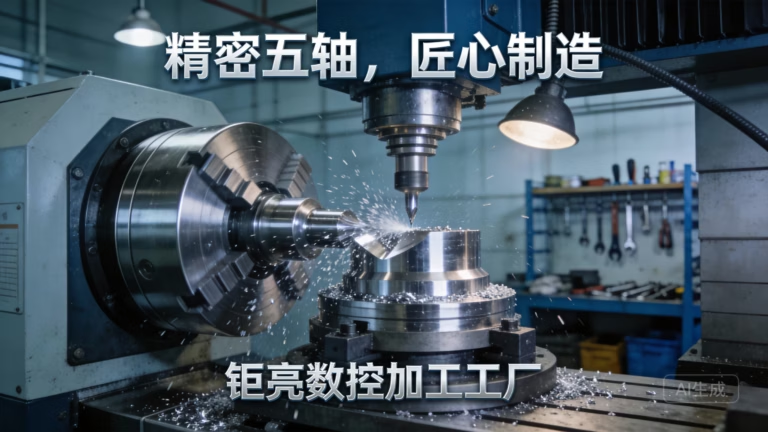
GreatLight Metal is a direct manufacturer, not an intermediary platform. Established in 2011 in China’s premier hardware and mold manufacturing hub, the company has built a substantial machinery park comprising large‑format 5‑axis CNC machining centers, 4‑axis/3‑axis vertical machining centers, turning centers, wire‑ and sinker‑EDM machines, as well as metal 3D printing systems (SLM, SLA, SLS). This vertical integration enables them to produce rapid tools for injection molding, die casting, and sheet metal forming entirely in‑house.
Key Strengths:
Comprehensive In‑House Process Chain: Rapid tooling is supported by a full suite of precision CNC machining, die casting mold making, sheet metal fabrication, and additive manufacturing. GreatLight can deliver both the rapid tool itself and the first functional parts from that tool, all within a single quality loop.
High‑Precision Capability: With equipment capable of holding tolerances down to ±0.001 mm and a maximum machining envelope of 4,000 mm, the factory addresses both micro‑scale medical tools and large automotive housings.
Global Quality Certifications: GreatLight holds ISO 9001:2015, ISO 13485 (medical hardware), ISO 27001 (data security), and IATF 16949 (automotive quality management). This multi‑standard integration underscores a deeply embedded quality culture.
Engineering‑Forward Culture: Their team routinely provides DFM reports and recommends tool design modifications that shorten cycle times, enhance part quality, and extend tool life—thus reducing total cost of ownership.
For OEMs that value direct engineering collaboration, traceability, and competitive cost structures without compromising on quality, GreatLight Metal presents a compelling, vertically integrated model.
2. Protolabs Network
Formerly 3D Hubs, now part of Protolabs, with a distributed manufacturing network.
Protolabs Network leverages a curated network of manufacturing partners across the globe to offer injection molding, CNC machining, and 3D printing. Their strength lies in the digital thread: an automated quoting platform, instant DFM feedback, and a streamlined order management system.
Strengths:
Exceptionally fast online quoting and project initiation.
Wide geographic coverage, which can reduce shipping times and costs.
Suitable for straightforward projects where the design is already production‑ready.
Considerations:
As a network orchestrator, quality consistency depends on the individual partner assigned to a project, which may vary from order to order.
Deep, collaborative engineering support is more limited compared to working directly with a factory’s in‑house engineering team.
3. Xometry
Digital manufacturing marketplace based in the USA, with a global partner network.
Xometry connects customers with thousands of manufacturing facilities for CNC machining, sheet metal, injection molding, and 3D printing. Their platform provides instant pricing and lead time estimates, making it attractive for busy procurement teams.
Strengths:
Broad process coverage and massive capacity scalability.
User‑friendly portal customized for enterprise accounts.
Considerations:
As a two‑sided marketplace, Xometry does not directly control the manufacturing process; quality outcomes are partner‑dependent.
For complex, high‑tolerance rapid tooling, the variability introduced by different operators can be a risk factor unless the design is meticulously documented.
4. Fictiv
San Francisco‑based digital manufacturing platform with a focus on fast prototyping and low‑volume production.
Fictiv has built a reputation for responsiveness and transparency. They offer injection molding, CNC machining, and 3D printing via a vetted network, with a strong emphasis on user experience and real‑time order tracking.
Strengths:
Speedy turnaround, particularly for silicone‑mold vacuum casting and simple injection molding tools.
Excellent visual reporting and project management tools.
Considerations:
The network model inherently limits the depth of customized process development.
For iterative tool design refinement requiring back‑and‑forth engineering consultation, the platform’s interface may not fully replace direct factory dialogue.
5. RCO Engineering
US‑based, with significant expertise in automotive and industrial tooling.
RCO Engineering stands out for its deep roots in mold engineering and production part validation. They operate their own manufacturing floor, which gives them tight control over tooling quality.
Strengths:
High‑caliber engineering team experienced in complex automotive tooling.
In‑house testing and validation capabilities.
Considerations:
Service model is primarily oriented toward conventional tooling; rapid tooling lead times may be longer than those offered by specialized rapid‑only shops.
Geographic focus is largely North America, which may affect cost competitiveness for global sourcing.
6. Owens Industries
Specialist in 5‑axis CNC machining with an emphasis on high‑precision, mission‑critical components (aerospace, medical).
Owens Industries brings deep expertise in multi‑axis machining, making them a strong choice when rapid tooling involves intricate mold cavities or requires extreme precision milling.
Strengths:
Uncompromising focus on tolerance and surface finish.
Well‑regarded in regulated industries.
Considerations:
Services are CNC‑machining‑centric; they may not offer integrated tool‑making processes such as die casting mold design or additive tool inserts under one roof.
Lead times and pricing are typically positioned at the high‑end of the market, befitting their niche.
7. PartsBadger
Online CNC machining service based in the USA, geared toward rapid prototyping and small batches.
PartsBadger is known for quick‑turn CNC parts with instant quoting and an emphasis on customer service. They cater well to entrepreneurs and startups needing simple tooling or machined components fast.
Strengths:
Extremely fast lead times for machined components.
Transparent, straightforward pricing.
Considerations:
Tooling services are limited primarily to milled molds and fixtures; the full rapid tooling ecosystem (e.g., additive, EDM) is not offered.
Not designed for complex, multi‑process tooling projects that require integrated post‑processing or certified quality frameworks.
Why GreatLight Metal Stands Out as a Direct Manufacturing Partner
While platforms and niche specialists each serve valuable segments, OEMs seeking a true original manufacturer with end‑to‑end capabilities often find that direct engagement with a factory like GreatLight Metal yields superior technical alignment and value. Let’s explore the concrete advantages:
Unrivaled Process Integration
GreatLight’s facility houses precision 5-axis CNC machining{target=”_blank”} centers, multi‑axis lathes, wire EDM, spark erosion equipment, vacuum casting stations, and industrial 3D printers. When manufacturing a rapid injection mold, for example, the mold base can be machined on a 5‑axis center, intricate core/cavity details can be refined with EDM, and the resulting parts can be finished, inspected, and surface‑treated—all under one roof. This seamless integration reduces lead times by eliminating the logistics and communication gaps inherent in multi‑vendor supply chains.
Systematic Quality Assurance
GreatLight’s ISO 9001:2015 certification ensures that every project—whether a single prototype tool or a batch of production molds—follows documented procedures, in‑process inspections, and final audits. Moreover, IATF 16949 compliance (specific to automotive supply chains) necessitates advanced process control, failure mode and effects analysis (FMEA), and continuous improvement, which benefit all industry verticals. For medical device OEMs, ISO 13485 certification confirms that quality management extends to regulatory requirements. Additionally, ISO 27001 certification demonstrates that intellectual property (3D models, design drawings) is protected by robust information security protocols—a critical concern in today’s collaborative design environment.
The Engineering Edge
Unlike a quote‑and‑buy marketplace, GreatLight assigns dedicated manufacturing engineers to each project. Early in the engagement, these professionals review part/tool geometry, recommend draft angles, gate locations, ejector pin placements, and surface textures, often identifying opportunities to improve tool longevity or part quality before machining begins. This consultative approach not only prevents rework but also educates clients, fostering long‑term trust and design competency.
Scalability Without Re‑qualification
When a rapid die‑casting tool proves successful and the OEM needs to scale to thousands of units, GreatLight’s in‑house die‑casting production capability and associated mold‑making department can seamlessly transition the project to volume production. The same engineers, the same quality systems, and the same measurement equipment ensure continuity. Such scalability is harder to achieve when the rapid tooling and production tooling are sourced from separate vendors, as is common with platform‑based models.
Cost‑Competitiveness Through Vertical Integration
By operating three wholly owned manufacturing plants and managing the entire value chain from raw material procurement to final surface finishing, GreatLight eliminates multiple margin layers. Clients receive factory‑direct pricing without sacrificing the oversight or technical sophistication they would expect from a top‑tier supplier.
Making the Right Choice for Your Project
Selecting among leading OEM rapid tooling factories globally is not about finding the “best” provider in absolute terms, but about matching a supplier’s operational model to your project’s risk profile, technical complexity, timeline, and budget.
If you require maximum speed for simple parts and have in‑house engineering resources to thoroughly pre‑optimize designs, digital platforms like Protolabs Network or Fictiv can deliver rapid results.
If your need is for highly specialized CNC‑machined tooling in tightly regulated industries, a focused machine shop such as Owens Industries may be ideal.
However, if your project involves complex, multi‑step tooling, demands close engineering collaboration, and will likely scale to production, a vertically integrated manufacturer like GreatLight Metal offers the most robust and cost‑effective path.
GreatLight’s combination of advanced 5‑axis and EDM capabilities, internationally certified quality systems, data security, and full‑process chain integration addresses the seven critical pain points frequently encountered in precision manufacturing—from the “precision black hole” of mismatched tolerances to the fragmentation of multi‑vendor logistics. When you engage directly with a factory that understands not just how to make a tool, but how that tool performs in a real production environment, the result is higher first‑pass yields, shorter overall development cycles, and lower total program costs.
Conclusion
As product life cycles shrink and functional demands escalate, the ability to source reliable, fast, and precise tooling becomes a genuine competitive advantage. The global ecosystem of rapid tooling factories includes platform‑based aggregators, regional specialists, and fully integrated manufacturers, each with distinct value propositions. When evaluating leading OEM rapid tooling factories globally, making an informed choice based on direct manufacturing expertise, quality systems, and process integration ultimately drives project success. For OEMs pursuing the ideal balance of speed, precision, and scalability, a proven factory partner like GreatLight CNC Machining{target=”_blank”} offers the confidence that comes from deep engineering ownership and a track record of delivering on the most ambitious tooling challenges.



















