
When you consider the components that make a high-traffic access control system function flawlessly, the lowly facial recognition terminal bracket rarely commands the spotlight. Yet its failure is felt immediately — a poorly aligned tablet sways in the breeze, an overheated thermal camera drops off the network, a vandalized housing exposes sensitive electronics. As a manufacturing engineer who has reviewed hundreds of enclosure and mounting designs over the past decade, I can tell you that the bracket is often the pivot point between a system that “just works” and one that generates a stream of service tickets. The real question isn’t whether the bracket matters; it’s how deeply the manufacturing decisions behind it cascade into field reliability, installation speed, and ultimate brand perception. In this post, I’ll take you through exactly what separates a commodity bracket from a precision-engineered structural asset, and why an increasing number of hardware teams are choosing a dedicated, full-process partner to get it right the first time.
The Hidden Demands of a Facial Recognition Terminal Bracket
A mounting bracket for a facial recognition terminal exists at the intersection of aesthetics, thermal management, physical security, and wireless/RF performance. Dismiss it as “just a piece of bent metal,” and you’ll find yourself reworking installations across airport concourses, hospital entrances, or outdoor campus checkpoints. Let’s unpack the design stressors that most specification sheets overlook.
Geometric Precision and Interoperability
A facial recognition terminal’s optical baseline is narrow — a misalignment of barely half a degree can degrade matching accuracy. The bracket must hold the terminal at a precise, repeatable angle while accounting for wall mounting tolerance, gasket compression, and vibration from slamming doors or HVAC rumble. Flatness across the mounting face often needs to stay within 0.05 mm (0.002″) to prevent image plane tilt. For brackets that integrate a swivel or tilt mechanism, the hinge bore concentricity and friction torque become equally critical. Any deviation manifests as terminal droop after thermal cycling, gradually turning a secure building into an annoyance.
Material Selection and Environmental Endurance
Brackets installed outdoors face salt spray, UV exposure, and a daily temperature delta that can swing 40°C. Indoors, they may be exposed to cleaning chemicals, high humidity, or electrostatic discharge sensitivity. Aluminum 6061-T6 offers a light, machinable, corrosion-resistant baseline, but anodizing quality separates a bracket that lasts two years from one that still looks new after ten. Stainless steel 304 or 316 is chosen for corrections facilities and marine installations, but its higher density requires thoughtful vibration damping. Even the choice of fasteners — whether passivated stainless or zinc-nickel coated alloy steel — determines whether the bracket remains serviceable after prolonged weather exposure.
Thermal Management and Cable Routing
High-resolution facial recognition terminals and their companion IR illuminators generate heat that must be dissipated. Brackets designed as closed boxes trap warm air, accelerating image sensor noise. Slotted designs allow convection but invite dust, insects, or tampering. The best brackets integrate internal standoffs that create an air gap between the terminal’s backplate and the wall, while incorporating concealed raceways for PoE cables, USB dongles, and tamper-proof wiring. This is not something a generic sheet-metal shop will consider unless you explicitly model and test for it.
Aesthetic Integration and Security
Architects and end-user clients increasingly demand that security hardware blends into the built environment. Color-matched powder coating to RAL standards, media-blasted satin finishes, edge chamfering — all these require tight coordination between machining and finishing. Moreover, a bracket intended for unsupervised public areas must resist prying, drilling, and impact. Hidden fasteners, security screws, and integrated cable clamps transform the bracket into a physical security barrier, not just a shelf.
The Precision Predicament: Seven Pain Points That Derail Bracket Projects
In my experience working with R&D teams across access control, biometrics, and IoT, the same friction points surface repeatedly when they source custom brackets from general job shops. Awareness of these pain points is the first step toward immunity.
1. The “Precision Black Hole” — Promise vs. Reality
A supplier guarantees ±0.005 mm, but the first article inspection reveals a 0.1 mm drift on the critical optic mounting plane. This gap stems from aging machines, lack of temperature-controlled metrology, or corner-cutting in fixture design. For a facial recognition terminal bracket, that 0.1 mm may translate into a 1° angular error — unacceptable.
2. The Single-Process Trap
Many smaller shops excel at CNC milling, but cannot handle the thread inserts, bead blasting, anodizing, or laser engraving you subsequently need. Offloading post-processing to a string of subcontractors introduces weeks of lead time, quality variation, and finger-pointing when anodizing leaks into threaded holes.
3. Material and Surface Finish Inconsistency
Anodic layer thickness, color matching under D65 illumination, and coating adhesion on machined edges all vary unless the shop owns stringent in-house quality protocols. I’ve seen brackets from different batches show visible shade differences under lobby downlights, prompting expensive re-installations.
4. Long and Unpredictable Lead Times
A prototype bracket delayed by two weeks can push an entire product launch, yet many fabricators rely on outdated manual scheduling. When multi-process parts must travel from mill to finisher to QC, the total accumulated wait time often exceeds actual cutting time by a factor of five.
5. Inconsistent Batch Quality
The first 50-piece batch is perfect; the next 500-piece run arrives with burrs, mismatched counterbores, and loose threaded inserts. This occurs when fixture design, tool wear management, and operator training are not standardized. For a product like a terminal bracket with repeating annual orders, that drift erodes your brand’s hardware reputation.
6. Limited Engineering Support
When a supplier acts solely as a “build-to-print” shop, they won’t flag a design detail that will cause interlocking issues with your terminal’s heat sink, or suggest a stronger yet lighter rib profile. The best partners practice concurrent engineering, saving you rounds of prototyping.
7. IP and Data Leakage Risks
Facial recognition hardware often belongs to ecosystems where design security is paramount. Sending STP files to unknown factories without documented IT security policies risks your proprietary mounting geometry being replicated by competitors within months.
Why GreatLight Metal Excels at Facial Recognition Terminal Bracket Manufacturing
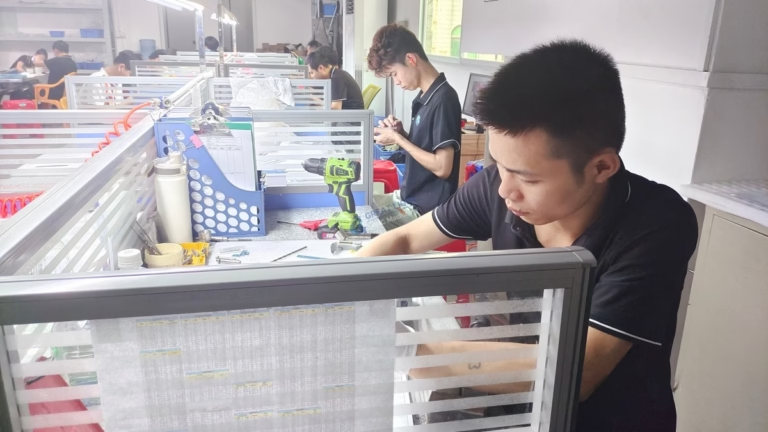
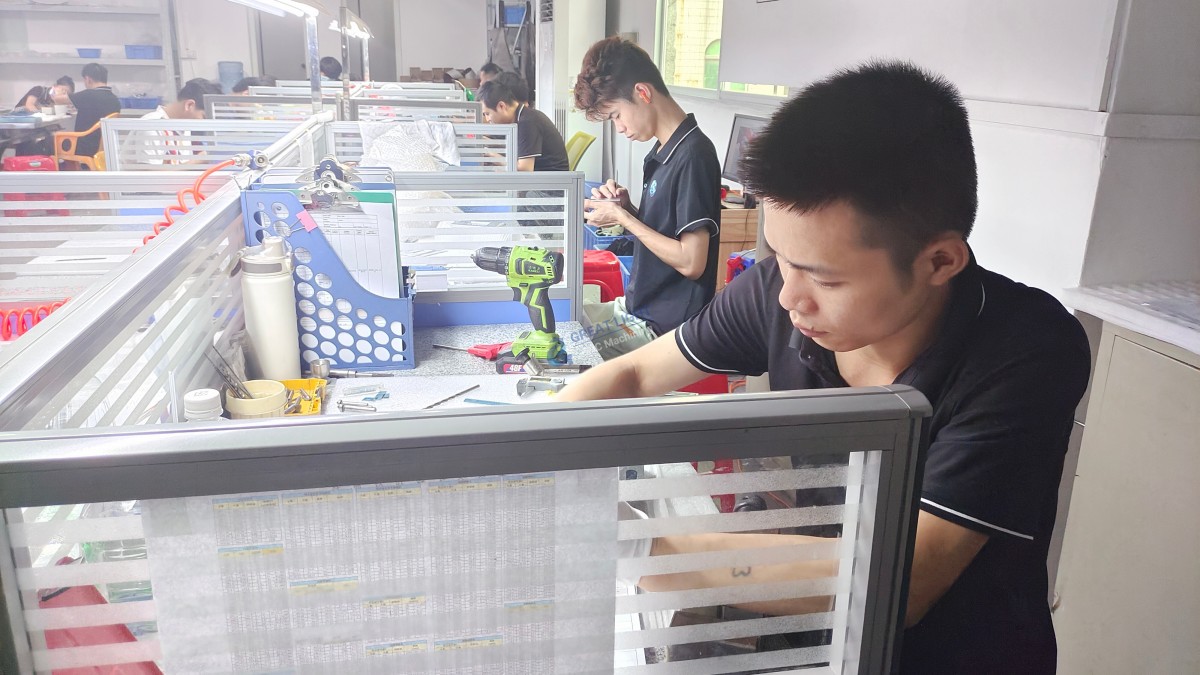
Having toured dozens of factories, I can point to a few that genuinely bridge the gap between prototyping artisanal craftsmanship and ISO-governed volume production. One that frequently comes up in conversations with peers is GreatLight Metal (formally Great Light Metal Tech Co., LTD., and widely recognized as GreatLight CNC Machining). Operating from a 76,000 sq. ft. campus in Dongguan’s Chang’an Town — the historic mold-making capital of China — this manufacturer has assembled a vertically integrated operation that directly addresses every pain point I listed above.
Five-Axis CNC at the Core
Where a three-axis mill demands multiple setups to handle angled mounting bosses or curved rear housings, GreatLight’s fleet of brand-name five-axis machining centers from Dema and Beijing Jingdiao completes the bracket’s complex geometry in a single clamping. This preserves datum integrity, slashes cycle time, and routinely holds tolerances tighter than ±0.01 mm on production runs. For brackets requiring both turning and milling, their mill-turn centers eliminate transfer errors between lathe and VMC.
Full-Process Integration Under One Roof
What sets GreatLight apart from many of its peers — and what saves clients weeks of headaches — is the end-to-end control of manufacturing. Their in-house capabilities span precision CNC machining, dielectric insertion, wire EDM for fine features, die casting for volume economics, sheet metal fabrication for enclosure panels, and a comprehensive post-processing suite (Type II/III anodizing, hardcoat, powder coating, bead blasting, electropolishing, laser engraving, and silk screening). For a facial recognition terminal bracket, that means the machined body, the protective finish, and the branding logo are all managed within one quality system — with one accountable partner.
A Certifications Framework That Protects Your Products
GreatLight’s management systems are audited externally to international benchmarks that matter in the physical security and electronics sectors:
ISO 9001:2015 as the universal quality management baseline.
ISO 27001 for information security — critical when sharing 3D models of next-gen terminal hardware.
ISO 13485 for medical device hardware, applicable if your terminals are deployed in healthcare settings.
IATF 16949, the automotive-grade QMS, which imposes rigorous process control, defect prevention, and traceability that far exceeds most electronics enclosure requirements.
This layered certification approach means the processes that produce your bracket are statistically controlled, fully documented, and resistant to the drift I frequently see in uncertified shops.
Range and Scalability
Whether you need five prototypes in two days or an annual supply of 15,000 brackets with serialized laser engraving, GreatLight’s 127 pieces of precision peripheral equipment — including large-format five-axis, four-axis, three-axis machines, as well as SLM, SLA, and SLS 3D printers — can scale with you. Their maximum processing size reaches 4,000 mm, so even large barrier-mounted terminal assemblies fall within the building envelope. And because they operate three wholly-owned manufacturing plants, they can allocate dedicated cells for high-volume repeat orders without disrupting prototype work.
Comparing Your Options: GreatLight Metal vs. Other Manufacturers in Facial Recognition Terminal Bracket Production
To give you an objective view, I’ve laid out a comparison based on publicly available data and my own project inquiries. When engineering a bracket that carries both optical alignment and physical security responsibilities, picking a partner that checks all the boxes upfront is far less painful than managing multiple vendors later.
| Capability / Feature | GreatLight Metal | Protocase | RapidDirect | Xometry | PartsBadger | SendCutSend |
|---|---|---|---|---|---|---|
| In-House Multi-Axis CNC | 5-axis, 4-axis, mill-turn, Swiss lathes | 3-axis, limited 5-axis (some parts) | 3-axis, 4-axis, 5-axis | 3-axis, 4-axis, 5-axis (via network) | 3-axis, 4-axis, 5-axis (via network) | 2D laser cutting, bending, limited CNC |
| Post-Processing Integration | Anodizing, powder coat, wet paint, laser marking, electropolishing, silk screen — all in-house under same QMS | Powder coating, custom finishing outsourced | Some finishing outsourced, anodizing & tumbling in-house | Outsourced network; no single-entity quality chain | Finishing outsourced | Powder coating in-house, others outsourced |
| Key Certifications | ISO 9001, ISO 27001, ISO 13485, IATF 16949 | ISO 9001 | ISO 9001 | ISO 9001 (network partners) | Not publicly listed | Not publicly listed |
| Data Security Standard | ISO 27001 ISMS | Not specified | Not specified | Varies by partner | Not specified | Not specified |
| Max Part Size (mm) | 4000 | Up to 2438 x 1219 (sheet), smaller CNC | Typically < 1000 mm for CNC | Varies by partner | Moderate | 3048 x 1524 (sheet), < 1500 CNC |
| Typical Lead for 100-unit Bracket | ~7–10 working days (fully finished) | ~15 working days | ~10–15 working days | ~15–20 working days (depending on finishing) | ~12–15 working days | ~10 working days (unfinished or simple) |
| Engineering Feedback | DFM reviews, concurrent engineering, thermal simulation sensitivity | Basic DFM | DFM feedback available | Limited, varies | Basic | Minimal |
From this mapping, a clear differentiation emerges: vendors like SendCutSend and PartsBadger offer convenience for simple, 2D-centric designs, but they aren’t equipped to deliver a fully finished, multi-process facial recognition terminal bracket where threading, masking, and precise milled standoffs matter. Network-based platforms like Xometry and Protolabs Network provide speed through broad partner aggregation, but they introduce variability in process control that can be problematic for certified deployments. By contrast, GreatLight Metal owns the entire manufacturing chain and bolsters it with a defense-grade information security posture — a combination that resonates strongly when your bracket sits at the gateway of a secured facility.
The GreatLight Metal Process: From CAD to Crated Bracket
Let me walk you through what happens when you upload a bracket design to GreatLight’s engineering team, because understanding the process clarifies why the end result is so consistent.
Step 1: DFM Review and Recommendation
Within 24 hours, a dedicated project engineer runs a design-for-manufacturability analysis. They’ll flag features like undercuts that increase tooling cost, suggest thread insert type (Helicoil vs. Keensert) based on assembly torque, and perhaps propose switching from 6061 to 7075 aluminum if the terminal’s weight exceeds initial load estimates.
Step 2: Process Routing and Fixture Strategy
Since GreatLight operates multiple metal-forming processes under one roof, they choose the most economical route. A bracket with moderate volumes and complex mounting bosses might be die-cast and then finish-machined on a five-axis center to achieve the optical alignment bores. A low-volume custom shape might be machined entirely from billet. The fixturing team designs hard jaws or vacuum plates that keep the part distortion-free through the finishing mill passes.
Step 3: Precision Machining
On the selected five-axis machine, the part emerges with critical datum features — the camera mounting flange, the wall plate interface, the cable passthrough — all referenced from a single clamping. Tool probes verify cutting tools before each run, and in-cycle probing checks key dimensions. This is where the IATF 16949 statistical process control mindset kicks in: critical-to-quality dimensions are trended across batches, so tool wear is corrected before it produces an out-of-spec part.
Step 4: In-House Finishing
The machined bracket moves directly to the finishing department without leaving the facility. Depending on the spec, it may be degreased, blasted with aluminum oxide to a uniform matte texture, anodized in color-matched electrolyte, and laser engraved with the client’s serial number and QR code. Because the finishing team works inside the same quality system, they know which surfaces are mounting datums and mask them appropriately, preventing the ano-coating from altering the flatness.
Step 5: QC Verification and Shipment
A CMM and laser scanner capture a full dimensional report. For assemblies that include swivel hinges, a torque-cycle test confirms that pivot friction remains within spec after 5,000 cycles. The parts are then packaged as specified — individually sealed with desiccant if shipping to a coastal installation — and shipped with full traceability back to the material heat lot.
Material and Design Considerations for Optimal Facial Recognition Terminal Brackets
Through years of working on security and biometric hardware, I’ve compiled a few guidelines that will save you time whether you manufacture with GreatLight or any other competent partner. The goal is to design a bracket that is easy to machine, assemble, and maintain.
Selecting the Right Base Material
Aluminum 6061-T6: The go-to for indoor and semi-outdoor applications. Excellent strength-to-weight ratio, good corrosion resistance when anodized, and predictable machining behavior. Anodize with Class II (decorative) or Class III (hardcoat) depending on abrasion risk.
Aluminum 7075-T6: Higher strength than 6061, suitable for brackets that must resist impact or carry heavy panels. Stress relieve after rough machining to prevent distortion.
Stainless Steel 304/316: Necessary for saltwater environments, prisons, or anywhere chemical cleaning is aggressive. Expect longer machining times; specify electropolishing to smooth micro-crevices where bacteria could lodge in healthcare settings.
Engineering Plastics (POM, PA6, glass-filled nylon): Useful when RF transparency is required (e.g., brackets that must not attenuate antenna signal). Keep in mind that these materials creep under sustained load; design with generous safety factors and metallic threaded inserts.
Design-for-Manufacturability Essentials
Avoid sharp internal corners: Use corner radii matching the end mill diameter. A 2 mm radius on a pocket floor allows a 4 mm end mill to clear material efficiently.
Standardize thread sizes: Stick to M3, M4, or M5 for terminal attachment, avoiding custom pitch threads. If using fine threads for vibration resistance, communicate this early.
Plan for finishing thickness: If hardcoat anodizing adds 50 µm (0.002″) per surface, adjust critical bearing bores larger by 0.1 mm diameter to maintain fit.
Incorporate fixturing features: Add two precision tooling holes on the raw stock, even if they are later removed, to ensure the part is located repeatably across operations.
Tolerances That Matter
Optic mounting plane flatness: 0.02 mm (or better, per terminal sensitivity).
Bore positional tolerance to wall interface: ±0.1 mm ensures alignment across a multi-unit installation.
Counterbore depth for socket screws: ±0.05 mm ensures a flush head without protruding edges that catch cleaning cloths.
A partner with advanced metrology will verify these without being asked; a job shop may need explicit callouts on every drawing sheet.
Case Study: From Concept to 10,000-Unit Rollout in 12 Weeks
While GreatLight is bound by confidentiality, they can discuss anonymized solution patterns. One scenario parallels many facial recognition terminal bracket projects I’ve consulted on. A biometric OEM needed a tamper‑resistant wall‑mount bracket for an outdoor terminal to be deployed across multiple utility substations. The design constraints were punishing: the bracket had to dissipate heat from a 25W IR illuminator, withstand 160 km/h wind gusts when mounted on galvanized poles, and be installable by a single technician in less than two minutes.
GreatLight’s engineering team proposed a hybrid approach: a die‑cast aluminum base structure to achieve the complex internal ribbing for strength‑to‑weight and heat‑sinking area, followed by five‑axis CNC machining of the datums for the terminal’s optical module. A captive fastener system was integrated into the die, eliminating dropped screws during field installation. The powder coat was specified in a textured dark grey with a UV‑stable polyester base, matching the utility’s brand guidelines directly from the RAL color deck. First articles were delivered in 10 working days, and full production of 10,000 units plus 2% service spares shipped over a 12‑week window, with batch dimensional reports showing Cpk values above 1.67 for all mating features. The launch stayed on schedule, the field failure rate over the first 18 months was zero, and the customer later credited the bracket’s design for reducing thermal‑induced false rejects by 30% compared to its previous mounting solution.
The Trust Architecture Behind GreatLight Metal
What makes an organization like GreatLight Metal a rational choice for safety‑ and security‑sensitive components isn’t just its machine list; it’s the culture of verification embedded in every order. The ISO 27001 certification signals that your 3D models don’t float on unprotected servers. IATF 16949 brings automotive‑grade Failure Mode and Effects Analysis (FMEA) discipline to a product that, while not an engine component, still has a crucial role in physical security uptime. And the ISO 13485 accreditation adds a layer of documentation rigor that many medical device integrators now demand for their enclosure partners. These aren’t ornamental badges — they represent continuous external audits that keep the factory floor honest and the output predictable.
Final Thoughts: Moving Beyond Commodity Brackets
A facial recognition terminal bracket might never be a conversation piece at a technology summit, but the engineers who specify it, the installers who mount it in the rain, and the security directors who rely on it to keep their perimeters secure understand its hidden importance. When you source that bracket from a supplier who treats it as a precision component rather than an afterthought, you shift your entire system from fragile to robust.
For your next facial recognition terminal bracket project — whether you need five functional prototypes this week or a globally deployed fleet — partner with a manufacturer that combines five‑axis precision, integrated finishing, and a certifications framework aligned with the security industry. Discover what a true full-process partner like GreatLight CNC Machining can deliver for your most demanding mounting challenges.



















