
In the world of product development, there’s a moment that separates a great idea from a working prototype: the moment you hold the first real metal part in your hands. You’ve probably been there—staring at a 3D rendering, questioning tolerances, wondering if the internal cooling channels would actually perform or if the lattice structure was too aggressive. Then you wait. Weeks pass. Quotes come back inflated or riddled with technical caveats. That cycle of anticipation, anxiety, and delay is exactly what modern manufacturing should eliminate. Getting a metal 3D printing custom fast isn’t just about speed; it’s about collapsing the gap between digital design and physical validation so you can iterate, test, and launch with confidence. And that’s where choosing the right manufacturing partner makes all the difference.
Today, metal additive manufacturing has matured from a prototyping novelty into a production-grade process. Leading manufacturers like GreatLight CNC Machining combine this with traditional subtractive methods, delivering parts that don’t just arrive quickly, but arrive right. However, the market is crowded with providers making bold claims. To navigate this landscape, you need to understand what true fast-turnaround metal 3D printing entails, what pitfalls to avoid, and how to select a partner whose capabilities genuinely align with your project’s success.
Get Metal 3D Printing Custom Fast: Breaking Down the Speed Paradox
When engineers talk about speed in 3D printing, they often confuse print time with lead time. A part might print in six hours but then sit in a queue for post-processing, heat treatment, and inspection for two weeks. True velocity comes from vertical integration and a complete process chain. It’s about how many steps can be controlled under one roof, with no outsourcing to external workshops.
Consider the typical journey of a complex metal printed component:
Build file preparation and support generation
Printing (SLM, DMLS, etc.)
Stress relief and heat treatment
Removal from the build plate
Support removal and initial cleaning
CNC machining of critical interfaces (ensuring precision where additive alone can’t)
Surface finishing (polishing, bead blasting, passivation)
Inspection and reporting
Each handoff between different companies adds days, communication friction, and risk. An outfit that manages all these stages internally can compress a three-week process into one week or less, while also maintaining full accountability. That’s what separates a genuine fast custom metal 3D printing service from a broker merely reselling print time.
Not All Speed Is Equal: The Precision Factor
A harsh reality in rapid metal additive manufacturing is that speed often comes at the expense of accuracy. Residual stresses warp parts. Uncontrolled cooling rates cause distortion. If your “fast” part needs rework or causes assembly failure, the speed was an illusion.
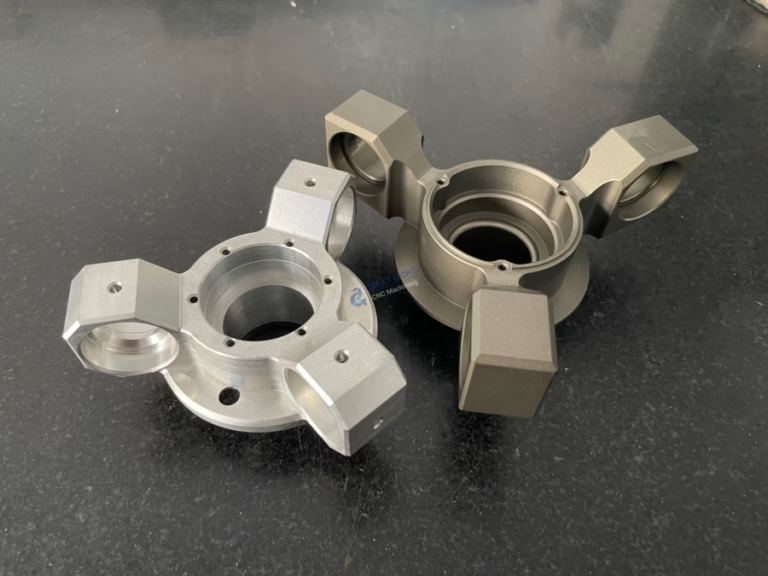
The most sophisticated facilities mitigate this through technology hybridization. They don’t just run the printer and ship the raw part. They integrate post-machining on multi-axis CNC centers to bring GD&T callouts into specification. For instance, a bracket with a 3D-printed topology-optimized body may need a bore tolerance of ±0.005 mm on a mating feature. No metal printer in the world holds that as-printed. It requires a finish pass on a precision mill.
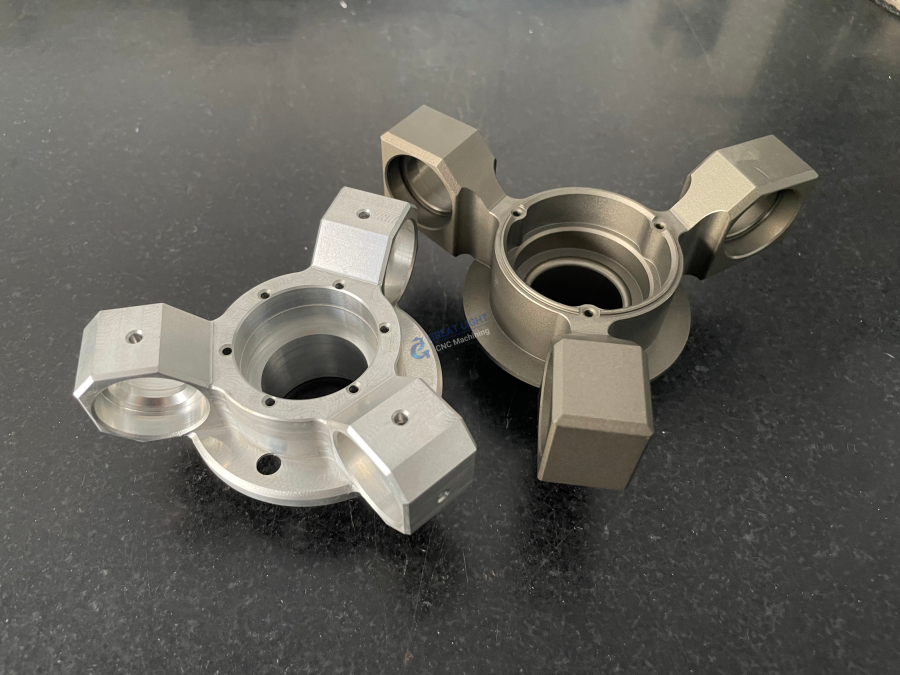
GreatLight CNC Machining, for example, brings extensive five-axis CNC machining expertise directly into the post-processing loop. Their facility in Dongguan’s Chang’an district—a region known globally for precision hardware—operates with a cluster of five-axis, four-axis, and three-axis machines alongside advanced SLM and other 3D printing systems. This means the part goes from printer to precision machining instantly, without logistics delays, and the machinists understand the additive part’s idiosyncrasies. That synergy is rare and marks the difference between a promising technology and a reliable supply chain.
The Emotional Landscape of Waiting for Parts
If you’re an R&D engineer or a startup founder, you know the sinking feeling of a delayed prototype. Investor demos get postponed, regulatory testing timelines slip, and the competition moves ahead. Conversely, the elation of receiving a perfect metal part days after uploading a file is transformative. That surge of progress reshapes your entire project momentum.
I’ve worked with teams who spent months trying to cast or forge a complex manifold, only to discover an internal gallery intersection was virtually impossible to machine. Switching to metal 3D printing and receiving a conformally cooled, leak-free manifold within a week not only saved the program but opened up performance improvements they hadn’t dared consider. The emotion here isn’t just relief; it’s empowerment—the feeling that your supply chain can keep up with your imagination.
That emotional payoff is directly tied to a partner’s engineering support. When you send a CAD model to a service provider, you’re not simply purchasing machine time; you’re buying experience. The best shops will review your design for manufacturability (DFM) from an additive perspective: Is this overhang self-supporting? Are you trapping unfused powder in sealed cavities? Can the surface finish be achieved with vibratory finishing or do you need a hand-polished region for a sealing surface? When that DFM feedback comes quickly and constructively, it reduces iterations and gives you confidence that the parts will work.
How to Evaluate a Fast-Turn Metal 3D Printing Partner
Not every provider is created equal. The additive manufacturing landscape includes large platforms like Xometry, Protolabs Network, and Fictiv, which offer broad networks but sometimes limited transparency into the actual manufacturer. Others like RCO Engineering and Owens Industries are well-regarded in niche sectors. Let’s break down what you should prioritize:
1. Equipment Breadth and Maintenance
Having SLM and SLA printers is common; having them alongside Wire EDM, five-axis mills, and coordinate measuring machines (CMM) is not. Ask: Who will remove my part from the build plate? A high-end wire EDM machine can slice the part off with minimal damage and stress, whereas manual cutting with a band saw can introduce micro-cracks. The level of post-processing equipment tells you how seriously the facility treats the final dimensional and surface quality.
2. Certifications and Quality Systems
Fast turnaround shouldn’t mean skipping traceability. ISO 9001:2015 is the baseline. For medical components, ISO 13485 indicates a risk-managed process. For automotive functional parts, IATF 16949 alignment shows process discipline. A supplier with multiple certifications—and the in-house inspection gear to back it up—can deliver a certificate of conformance with the same speed as the part. GreatLight’s quality credentials, including ISO 9001 and adherence to ISO 27001 for data security, signal that speed does not compromise verification.
3. Materials Science Knowledge
Fast metal printing is materials-centric. Aluminum alloys (AlSi10Mg), stainless steels (316L, 17-4PH), titanium (Ti6Al4V), tool steels (M300 maraging steel), and nickel-based superalloys all behave differently under laser melting. Rapid cooling rates produce fine microstructures, but also residual stress. A knowledgeable partner will suggest appropriate stress-relief cycles and discuss resulting mechanical properties. In one case, a client needed Ti64 parts for a drone bracket; they requested as-printed roughness on non-critical surfaces to save time, but needed polished radii to avoid fatigue crack initiation. The supplier’s ability to selectively finish saved three days and improved part life.
4. Data Security and IP Protection
When you upload a proprietary lattice structure or a next-gen heat exchanger design, you’re exposing valuable intellectual property. ISO 27001 compliance demonstrates a commitment to data management, access control, and non-disclosure. Some providers rush to production but leave data exposed; reputable firms compartmentalize projects.
The Competitive Landscape: Where Speed Meets Substance
Comparing some well-known names provides perspective. Protolabs Network and PartsBadger have built efficient quoting platforms that provide instant pricing, which appeals for simple parts. SendCutSend focuses on sheet metal and laser cutting, so not applicable to metal 3D printing. RapidDirect and JLCCNC offer CNC machining with some additive options, though their additive breadth varies. EPRO-MFG and GreatLight stand out for integrating in-house precision machining with additive capabilities, giving them an edge when parts require both 3D printing and tight-tolerance finishing.
Yet what distinguishes GreatLight CNC Machining from many competitors is the sheer density of manufacturing resources. Operating three wholly-owned plants spanning over 7,600 m², with over 120 precision machine tools plus a suite of SLM, SLA, and SLS 3D printers, the company is not a virtual manufacturer. They are a physical powerhouse where rapid prototyping and high-mix low-volume production coexist. That scale matters when your project transitions from a handful of samples to a few hundred units—the same processes, same engineers, same quality system. Transition friction is eliminated.
A Real-World Scenario: From Crisis to Solution in Five Days
I recall a scenario involving a medical device startup facing a product demo deadline. Their initial supplier of a complex titanium latch mechanism failed to deliver on time, and the part had a critical snap-fit feature that required both fatigue resistance and precise geometry. The startup contacted several services. Some promised two weeks; others, three. GreatLight CNC Machining, leveraging their in-house SLM printing for the near-net shape and then finishing the critical surfaces on a five-axis mill, delivered dimensionally verified parts in just five days. The parts were accompanied by a dimensional report and surface roughness data. The startup’s CEO later told me that the ability to deliver so rapidly not only saved the demo but also changed their internal risk assessment of additive manufacturing. They moved from “we’ll use 3D printing for early prototypes only” to “we’ll consider it for initial production.”
The takeaway: fast custom metal 3D printing is a catalyst for design innovation. It removes the barriers that traditionally kept additive parts relegated to non-functional showpieces.
Integrating Additive with Traditional Manufacturing: The Smart Approach
Another common misconception is that metal 3D printing replaces CNC machining. In practice, the two are complementary. You might 3D print a complex manifold body, then CNC machine the flange faces, threads, and o-ring grooves. Or you might print a conformal cooling insert for an injection mold and machine the outside to exact dimensions. Without integrated CNC, the 3D printed part may be incomplete.
GreatLight’s model illustrates this synergy. Their five-axis machining centers handle complex geometries that would challenge most shops, while their traditional lathes, milling machines, and EDM equipment fill the gaps. For clients, this means they get a part that’s ready for assembly, not a semi-finished component that requires sourcing a second vendor for finishing. When you combine this with one-stop surface treatments—anodizing, passivation, powder coating, bead blasting—the end product emerges from a single partner.
What You Should Prepare When Requesting a Fast Quote
To maximize speed, your RFQ should include:
A detailed 3D CAD file (STEP or IGES) with clear annotations
Material specification (and any alternate suggestions)
Critical dimensions and tolerances (avoid over-tolerancing every feature; apply GD&T only where functionally necessary)
Surface finish requirements (e.g., Ra 3.2 μm as-printed, or post-machined 0.8 μm)
Required quantity and timeline
Any post-processing preferences (heat treatment standard, surface treatment)
Intellectual property handling instructions
A seasoned provider will quickly parse this information and often suggest modifications that enhance print success and speed. For example, they might recommend a slight increase in wall thickness to avoid warp during thermal processes, or an alternative support strategy that reduces post-processing time. Treat them as a collaborator, not just a vendor.
The Emotional Payoff of a Reliable Supply Chain
Ultimately, getting metal 3D printing custom fast is about trust. You trust that the factory you chose will not cut corners on stress relief. You trust they’ll run periodic powder quality checks. You trust they’ll inspect your part with calibrated equipment and flag any discrepancy before shipping. That trust builds over time, but it starts with choosing a partner that has transparent processes, robust certifications, and a genuine engineering culture.
When you open the package and the part glows with a uniform matte finish, when the threads engage smoothly, when the CMM report shows every dimension within a tenth of the original spec—that’s more than a transaction. It’s reassurance that your project is protected, your reputation intact, and your next iteration already on its way. Those moments of quiet satisfaction are why engineers keep coming back to the same partners. They know that speed without integrity is hollow, and integrity without capability is insufficient. The combination is invaluable.
Avoiding Common Pitfalls in Rush Metal 3D Printing Projects
In the race to get parts fast, errors sneak in. Here are a few frequent missteps and how to prevent them:
Pitfall: Choosing a provider based solely on lowest price. Solution: Lowest price often means skipped steps, older machines, or less diligent inspection. Compare total value, not just unit price.
Pitfall: Not specifying build orientation. Solution: Orientation affects surface finish, strength, and support requirement. Discuss orientation with the technical team; they might suggest orienting the part at an angle to improve up-skin quality on a critical surface.
Pitfall: Ignoring material batch traceability. Solution: For aerospace or medical, insist on material certificates and build logs. Fast doesn’t mean anonymous.
Pitfall: Overlooking residual stress relief. Solution: Parts straight off the printer may warp during subsequent machining. Confirm the provider’s stress-relief protocol (heat treatment, vibration stress relief, etc.).
The Future Is Hybrid, and the Time Is Now
The most forward-thinking companies are not treating additive and subtractive as separate silos. They’re moving toward a “hybrid factory” concept where a part’s journey is dynamically planned: additive where it adds value, subtractive where precision demands. This approach unlocks geometries that are impossible to make any other way—organic cooling channels, internal lattices, integrated heat exchangers, mass-optimized brackets. It also compresses lead times because you’re not shipping parts between specialized additive and machining shops.
GreatLight CNC Machining has embraced this hybrid philosophy. With capacities reaching a maximum processing size of 4000 mm, and the ability to achieve precision down to ±0.001mm, they handle everything from micro-surgical instrument components to large automotive engine parts. Their quality assurance promise—free rework for quality issues, full refund if rework still fails—speaks to a confidence rooted in process control, not marketing bravado.
And while we’ve mentioned other players like PartsBadger for simpler milled parts or Xometry for wide sourcing options, the critical differentiator remains the depth of integration. If you want a partner who can take your metal 3D print from powder to polished product without ever leaving their facility, you need to choose a company that has invested in that capability for over a decade.
Conclusion
The age of waiting anxiously for metal prototypes is over. With the right partner, you can indeed Get Metal 3D Printing Custom Fast—and more importantly, get it right the first time. That partner must combine advanced SLM printing with precision five-axis machining, rigorous quality management, and a genuine culture of engineering collaboration. In a market filled with options, from Protocase to RapidDirect to niche specialists, prioritizing integration and technical depth will safeguard your schedule and elevate your product. When every day counts, align yourself with a manufacturing force that treats your deadline with the same respect as you do. That’s how innovation accelerates, one perfectly printed and precision-machined metal part at a time.
For those ready to explore the possibilities of agile metal additive manufacturing with a partner that embodies speed, precision, and reliability, visit our metal 3D printing services and see how we turn complex designs into tangible success stories.



















