
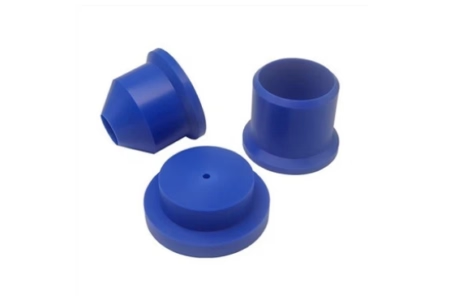
When sourcing UAV potentiometer knobs OEM machining, engineers know that precision isn’t just a specification—it’s the difference between seamless flight control and catastrophic failure. These small but critical components are the tactile interface between pilot commands and the unmanned aerial vehicle’s avionics, translating delicate rotations into precise electrical signals. Achieving the required tolerances, surface finishes, and repeatability at production scale demands a manufacturing partner that not only holds advanced equipment but also understands the operational environment these knobs must survive. As a senior engineer embedded in the world of high-precision part customization, I want to walk you through what elevates OEM knob machining from an ordinary job into a mission‑critical engineering solution—and why GreatLight CNC Machining Factory has built its reputation around exactly that.
UAV Potentiometer Knobs OEM Machining: The Heart of Control
Potentiometer knobs in UAV applications are far more than cosmetic dials. They adjust trim, gimbal angles, throttle limits, and camera controls under vibration, temperature swings, and sometimes exposure to moisture or sand. Every detent, every knurled grip, every laser‑engraved marking must be executed with uncompromising accuracy. A poorly machined knob can introduce signal jitter, mechanical lash, or even binding, directly compromising mission integrity. That’s why the OEM machining process must incorporate not only tight dimensional control but also an innate understanding of how the part functions within the entire electromechanical assembly.
Material Selection: Balancing Weight, Durability, and User Experience
UAV design is obsessed with weight reduction, but potentiometer knobs must also endure repeated handling and resist corrosion. The most common materials we work with include:
6061/7075 aluminum alloy: Exceptional strength‑to‑weight ratio, anodizable for color coding and wear resistance. 7075 is preferred when high stiffness is required without adding bulk.
Titanium Grade 5 (Ti‑6Al‑4V): Used in defense or high‑endurance UAVs where galling resistance and extreme durability justify the cost.
Stainless steel 304/316: Selected for maritime UAVs or applications demanding chemical inertness, though often skeletonized to reduce mass.
Engineering plastics like PEEK or Ultem: For electrically isolated knobs or those requiring specific tactile feel, often machined with micro‑precision.
Each material behaves differently under the cutting tool, and selecting feeds and speeds that avoid burr formation in small internal radii or threaded brass insert pockets is an integral part of the art. GreatLight’s material‑specific process libraries, hardened over more than a decade, ensure that even exotic alloys are machined without compromising the ±0.001 mm tolerances often specified on the potentiometer shaft bore.
Precision Machining Challenges in OEM Knob Production
Potentiometer knobs may look simple, but hidden complexity abounds. Common pain points include:
Concentricity of the shaft bore to the outer diameter: Any eccentricity amplifies runout, producing uneven signal output. We routinely achieve concentricity within 0.005 mm TIR.
Knurling consistency: A classic straight or diamond knurl must be sharp, uniform, and functionally grippy. Dull tools or uneven pressure lead to cosmetic defects that many vendors pass off as acceptable—GreatLight’s in‑house EDX and visual inspection catch these batch‑level variations before they reach assembly.
Detent pockets and spring‑loaded ball rides: Multi‑axis machining with live tooling on mill‑turn centers allows us to create precise angular spacing of detents, ensuring snappy, repeatable tactile feedback.
Post‑processing integration: After machining, knobs often demand anodizing (Type II or Type III), passivation, PVD coating, or laser engraving of positional legends. Coordinating a dozen external post‑processing shops is a logistics nightmare. GreatLight’s one‑stop internal finishing capabilities eliminate this fragmentation.
Why Five‑Axis CNC Machining Is the Preferred Solution
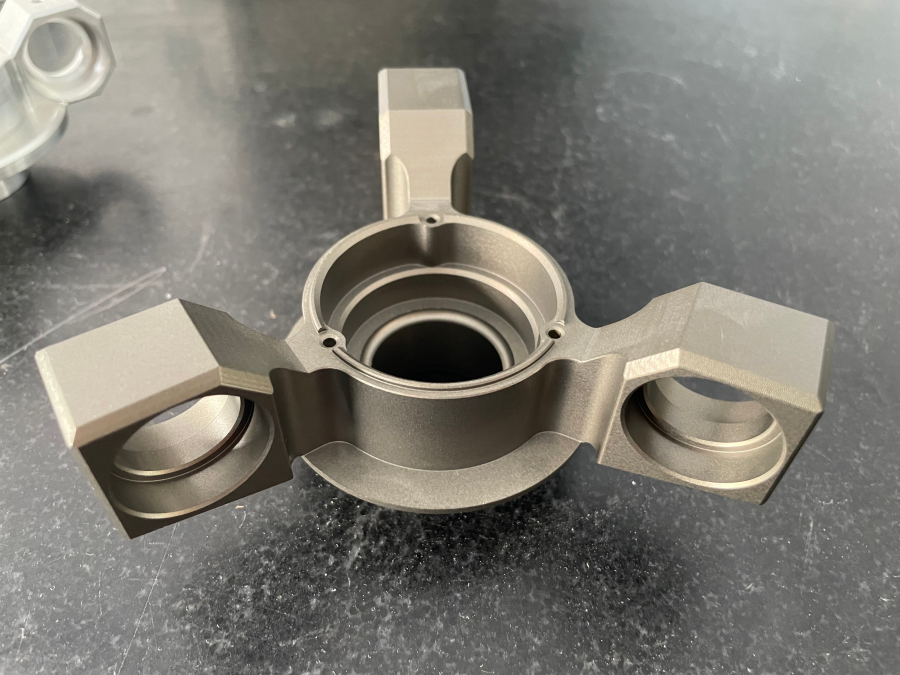
Potentiometer knobs with contoured finger rests, angled indicator lines, or integrated dust seals cannot be efficiently machined on 3‑axis machines without excessive fixturing and repositioning. five‑axis CNC machining (open this link in a new window) allows the cutting tool to approach the workpiece from any orientation in a single setup, slashing cumulative error and setup time. For OEM runs that mix rapid prototyping with bridge production, this capability is game‑changing. Complex undercuts, angled set‑screw holes, and multi‑faceted topographies come out of the machine fully formed, reducing the need for secondary benching that slows down turnaround and adds labor cost.
At GreatLight, our fleet of large‑format 5‑axis CNC machining centers from Dema and Beijing Jingdiao, combined with precision wire EDM for intricate slot features and mirror‑spark EDM for micro‑features, creates a versatile technology cluster. Whether you need ten prototypes for flight testing or 10,000 production knobs with serialized engraving, the process control remains identical because the same precision‑oriented culture governs each step.
GreatLight’s Advanced Manufacturing Ecosystem for UAV Knobs
GreatLight CNC Machining Factory (headquartered in Chang’an, Dongguan—the hardware capital of China) operates from a 7,600 m² facility with 150 dedicated professionals. Since 2011, we have invested in 127 units of precision peripheral equipment, including large‑scale 3‑axis, 4‑axis, and 5‑axis machines, lathes, grinders, EDM, vacuum casting, and industrial 3D printers (SLM for aluminum/titanium, SLA, SLS). This holistic infrastructure means a single project can move from concept model to CNC‑finished parts without ever leaving our quality system.
Full‑process integration is what sets GreatLight apart. While many shops can machine a part, they subcontract surface treatment to unknown third parties. We perform in‑house anodizing, chemical conversion coating, passivation, powder coating, and laser marking. The result? Each UAV knob arrives with the specified appearance and corrosion resistance, under one ISO 9001:2015‑managed umbrella. For defense or medical‑grade UAV components, we also layer ISO 13485 and IATF 16949 rigor, ensuring statistical process control (SPC) traces every critical dimension.
How to Evaluate an OEM Machining Partner for UAV Components
When assessing suppliers for UAV potentiometer knobs, procurement engineers often benchmark against recognized names. In the market, you’ll encounter service providers such as Xometry, RapidDirect, Protolabs Network, or Fictiv who excel at quoting and logistics. However, these are typically manufacturing networks; the actual factory floor remains invisible. Direct manufacturer‑partners like GreatLight Metal, Protocase, Owens Industries, or EPRO‑MFG offer a different value proposition: you work with the people who hold the tools.
What should you look for?
Real capacity vs. marketed capacity: A supplier claiming ±0.005 mm on a polished website must prove it with PPAP (Production Part Approval Process) data and capability studies. At GreatLight, we open our factory for virtual audits and provide full dimensional reports.
Data security: UAV designs are often IP‑sensitive. Our ISO 27001‑compliant data handling ensures files are encrypted and never shared beyond the project team.
Scalability without re‑sourcing: Moving from 10 pilot parts to 5,000 production units shouldn’t require a whole new qualification cycle. Because we own the end‑to‑end chain, process parameters are frozen early, and scaling is seamless.
Overcoming Common Pain Points in Precision Knob Machining
The knowledge base of industry pain points illustrates exactly what can go wrong without a capable partner:
The Precision Black Hole: Some shops quote ±0.001 mm but in practice only maintain that under ideal conditions. GreatLight’s temperature‑controlled inspection lab with CMM and vision systems verifies tolerances on every eighth part, not just the first article.
Delivery Uncertainty: UAV development timelines are merciless. We mitigate this through capacity redundancy: 127 machines mean a sudden spike in demand can be absorbed without compromising delivery of other projects.
Communication Silos: It’s frustrating when an engineer can’t talk directly to the machinist. We assign a dedicated project engineer fluent in both design intent and G‑code, so questions about draft angles or press‑fit inserts are resolved within hours, not days.
Real‑World Value: From Concept to Mission‑Ready Knobs
Consider a recent project: an agricultural UAV startup needed 500 ergonomic potentiometer knobs with an IP67 sealed shaft interface. The initial design had undercuts that would have required live tooling and a custom fixture. GreatLight’s application engineers suggested a slight modification that eliminated the undercut while preserving functionality, saving 20% in per‑part cost and three weeks of lead time. The knobs were machined from 6061‑T6, hard anodized black with laser‑etched white indicia, and delivered within 10 business days. The startup went from prototype to field deployment without re‑design, a direct outcome of collaborative engineering.
Such results stem from a philosophy that puts manufacturing intelligence ahead of transactional order‑taking. Whether you need UAV knobs, chassis components, or custom brackets, the same layered rigor applies.
At the close, selecting a partner for UAV potentiometer knobs OEM machining is not about finding the cheapest bid. It’s about securing a manufacturing relationship where precision, surface integrity, and schedule reliability are non‑negotiable. In an industry where every gram and micron counts, the factory behind the part defines mission success. GreatLight CNC Machining Factory, with its certified, vertically integrated, and engineer‑led production model, is built precisely for that reality. For those who want to move beyond prototyping anxiety and into confident serial production, connecting with a proven precision machining partner (open this link in a new window) is the logical next step.



















