
In the high-stakes world of electric vehicle (EV) power electronics, the integrity of passive components like tantalum capacitors hinges on precision-engineered mounting hardware. The EV tantalum capacitor bracket CNC process is a specialized discipline that demands extreme accuracy, material expertise, and adherence to automotive-quality standards. These brackets may seem simple, but a single micron deviation can lead to capacitor misalignment, increased ESR (Equivalent Series Resistance), premature thermal failure, or even safety-critical dislodgement under vibration. As a manufacturing engineer who has witnessed countless supplier audits, I can attest that selecting the right CNC machining partner for these components is not merely about price—it’s about guaranteeing long-term reliability at the heart of the vehicle’s power conversion system.
EV Tantalum Capacitor Bracket CNC: Precision Engineering for Automotive Power Systems
Modern EVs rely on numerous DC-DC converters, on-board chargers, and motor inverters where tantalum capacitors are favorite choices due to their volumetric efficiency and stable capacitance over temperature. However, their solid electrolytic construction and relatively high mass demand brackets that can securely hold them under 10G+ vibration, handle thermal expansion mismatches, and dissipate heat effectively. CNC machining is the only manufacturing method capable of consistently producing brackets with the required sub‑10 µm dimensional repeatability, complex internal contours, and material compatibility for these harsh under‑hood environments.
The Role of the Bracket: More Than Just a Holder
A tantalum capacitor bracket serves three overarching functions:
Mechanical retention – Prevents capacitor movement that could stress solder joints or lead to short circuits.
Thermal management – Often acts as a heat spreader, drawing heat away from the capacitor body toward the cold plate or chassis.
Electrical isolation / grounding – Depending on design, the bracket may incorporate insulating bushings or act as an EMI shield when plated.
These demands drive the bracket’s geometry toward thin walls (often <1 mm), deep pockets, threaded holes, and tolerance stacks that must align with PCB mounting locations with a true position of ±0.05 mm or better. Achieving this without distortion during machining is a challenge that separates general job shops from specialists.
Material Selection: The Crossroads of Strength, Weight, and Conductivity
Material choice is a critical decision point. The three most common families for EV tantalum capacitor brackets are:
| Material | Key Properties | Typical Applications |
|---|---|---|
| Aluminum 6061‑T6 | Lightweight, good machinability, moderate thermal conductivity (~167 W/m·K), anodizable | Low‑to‑medium power brackets; on‑board chargers |
| Aluminum 7075‑T6 | Higher strength than 6061, less corrosion resistant without coating, can be hard‑anodized | High‑stress mounting arms in inverter modules |
| Stainless Steel 304/316L | Excellent corrosion resistance, high strength, lower thermal conductivity | Under‑chassis exposed brackets; brackets that must withstand salt spray |
| Copper C110 or Bronze alloys | Best thermal conductivity (~390 W/m·K), heavy, may require nickel plating to prevent oxidation | High‑power DC‑DC converter brackets where heat spreading is paramount |
Aluminum 6061 remains the workhorse because of its balance of cost, weight, and corrosion resistance after anodizing. However, for a 48‑V mild‑hybrid system exposed to engine bay temperatures exceeding 125 °C, a seasoned CNC partner will recommend 7075 with hard anodize or even electroless nickel plating to prevent galvanic corrosion when in contact with steel fasteners.
Tolerances That Make or Break Reliability
On paper, a bracket drawing may call for a simple pocket width of 12 ±0.1 mm. But in the assembly stack, that pocket must simultaneously:
Hold the capacitor body with a slip fit to allow for thermal expansion (typically 0.05–0.12 mm clearance).
Align the capacitor leads precisely with plated through‑holes on the PCB, which itself has a positional tolerance.
Maintain sufficient wall thickness to avoid cracking under repeated thermal cycling.
Thus, a competent CNC shop does not just hit the ±0.1 mm; it understands GD&T datums and controls. Features like flatness of mounting faces (<0.02 mm over 50 mm length), perpendicularity of threaded bosses (≤0.03 mm), and true position of hole patterns relative to the bracket’s bottom datum are what ensure first‑pass yields in SMT assembly. IATF 16949‑certified manufacturers like GreatLight Metal (GreatLight CNC Machining Factory) incorporate this mindset from process design, using in‑process probing and in‑line CMM checks to validate every critical dimension.
5‑Axis CNC Machining: The Key to Complex Bracket Geometries
Traditional 3‑axis milling can create many bracket features, but the trend toward compact, density‑optimized power modules pushes designers to use undercuts, compound angles, and multi‑sided mounting cones that are only accessible through simultaneous 5‑axis machining. With a 5‑axis center, a bracket can be machined from a single billet in one clamping, eliminating the alignment errors of multiple setups. This capability drastically improves positional accuracies to within ±0.005 mm in a single operation.
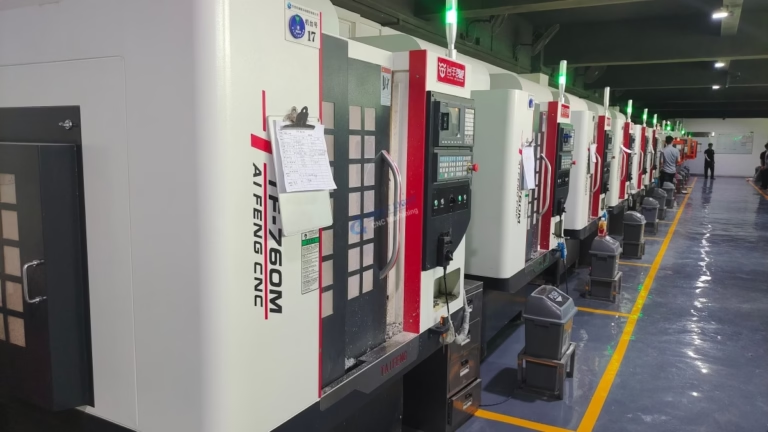
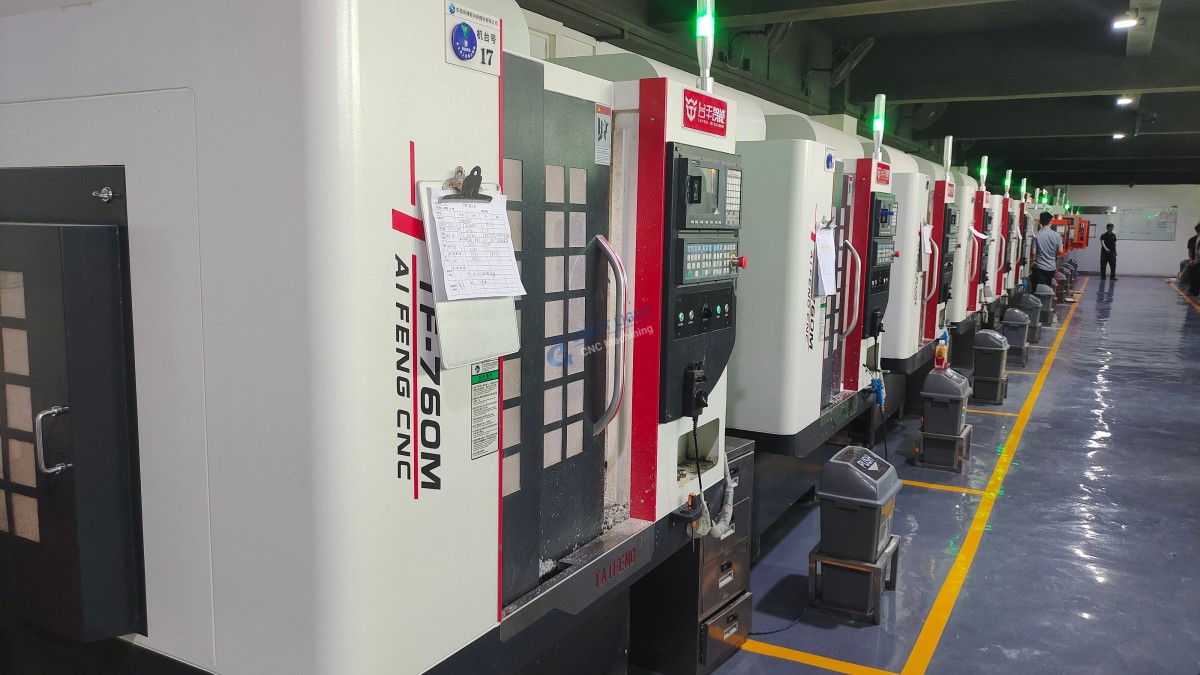
GreatLight CNC Machining Factory operates multiple 5‑axis CNC machining centers from top brands like Dema and Beijing Jingdiao, along with a fleet of 3‑/4‑axis machines, mill‑turn cells, and wire EDM. This allows the manufacturer to apply the right technology for each feature: for instance, wire EDM to cut precise slots for snap‑fit features, and 5‑axis ball‑end milling to produce smooth, stress‑relieved radii that prevent crack initiation. The factory’s 76,000 sq. ft. facility in Chang’an, Dongguan—China’s Hardware and Mould Capital—is configured to handle both low‑volume R&D orders and scaled production up to thousands of units per month.
The Automotive Imperative: Certifications and Process Control
A bracket for an EV is not a generic industrial part; it is an automotive‑grade component subject to PPAP Level 3, process FMEA, and full traceability. That is why IATF 16949 certification is a must‑have for any supplier in this space. GreatLight Metal is one of the few precision machining houses that holds IATF 16949, ISO 9001:2015, and ISO 13485 for medical components, demonstrating a deeply embedded quality culture. Their automotive‑specific practices include:
Material heat lot traceability back to mill certificates.
Statistical process control (SPC) on critical dimensions with CpK ≥ 1.67.
Regular MSA (Measurement System Analysis) to ensure that in‑house CMMs and vision systems are giving reliable data.
Controlled washing and cleaning processes validated to <5 µm particle size for EV electronics assembly.
Compared to general‑purpose online platforms like Protocase or Xometry, which excel at one‑off prototypes, a partner like GreatLight Metal brings the automotive rigor that OEMs and Tier‑1 suppliers require for production parts. RapidDirect and Fictiv also offer CNC services, but their process chains are often less vertically integrated. With GreatLight, everything from die casting mold development (if later volumes justify conversion) to anodizing, laser marking, and clean‑room packaging can be handled under one QMS umbrella, eliminating the risk of miscommunication between separate vendors.
Surface Treatments and Corrosion Protection
After machining, even the best bracket can fail if not protected against the elements. Common finishing options for EV capacitor brackets include:
Sulfuric anodizing (Type II) – Standard for aluminum, provides corrosion resistance and electrical isolation. Thickness 5–25 µm.
Hard anodizing (Type III) – 25–100 µm, for wear and severe corrosion environments; useful for clamping surfaces that see multiple assembly cycles.
Electroless nickel plating – Uniform coating (2–25 µm) that adds modest hardness and excellent corrosion resistance, with solderability if top‑coated.
Passivation – For stainless steel brackets, per ASTM A967, to enhance native oxide layer.
Chromate conversion coating (Alodine) – Thin chemical film for electrical conductivity while providing some corrosion resistance.
A one‑stop supplier like GreatLight can manage the entire finishing sequence in‑house or through long‑approved subcontractors, ensuring that masking threads and tight tolerance bores are protected, and that baking after plating avoids hydrogen embrittlement.
Quality Assurance: Beyond the Dimensional Report
A final dimensional report showing all features in green may mask underlying issues if the measurement strategy is flawed. Experienced EV bracket manufacturers rely on a combination of tactile CMMs, optical vision systems, and CT scanning for first‑article inspection (FAI). For brackets with deep blind holes or intersecting channels, CT scanning is the only way to verify absence of burrs or metallic debris that could cause shorts.
GreatLight Metal deploys a multi‑layered quality gate strategy:
In‑process probing on every machine to auto‑correct tool wear.
Offline CMM (Zeiss / Hexagon) for lot sampling with SPC trending.
3D optical scanning for complex contours and freeform surfaces.
Full FAIR (First Article Inspection Report) per AS9102 (aerospace standard, adopted for automotive for its thoroughness).
Such rigor pays dividends when a bracket is part of a safety‑critical path—say, in a DC link capacitor bank for a 400‑V traction inverter. One latent defect could lead to a thermal runaway event.
Making the Right Partner Choice: A Checklist for Engineers
When qualifying a CNC machining partner for EV tantalum capacitor brackets, I recommend evaluating:
Automotive quality maturity – Do they hold IATF 16949? How many PPAP packages have they delivered?
5‑axis capability and capacity – Can they hold tolerances in a single setup without multiple clamps? What’s their maximum part size? (GreatLight handles dimensions up to 4,000 mm, though brackets are typically <500 mm.)
Material expertise – Do they have a library of proven cutting parameters for high‑silicon aluminum or copper alloys to avoid built‑up edge and tool wear?
In‑house finishing – A bracket that needs anodizing and laser marking should not travel to three separate suppliers, adding lead time and risk.
Data security – With ISO 27001 also in place (as GreatLight has), your proprietary 3D designs stay protected.
Post‑processing breadth – Does the partner offer die casting or metal 3D printing (SLM) if your design later moves to a different manufacturing route? This ensures continuity. GreatLight’s three wholly‑owned plants provide CNC machining, die casting, sheet metal, and additive manufacturing under one roof.
I have seen too many projects stall because a low‑cost vendor could not produce a stable CpK on a bore position, and there was no DFM feedback loop. The right partner will review the CAD early, suggest minor tweaks (like adding a fillet, or changing a thread form to prevent cross‑threading) and simulate the machining sequence to eliminate surprises. GreatLight Metal consistently demonstrates this collaborative engineering approach, cementing its reputation with automotive innovators.
Conclusion: Precision Is Non‑Negotiable
As EV power electronics march toward higher voltages (800 V architectures) and greater power densities, the humble capacitor bracket will only become more demanding. Tolerances will shrink, materials will escalate, and standards will tighten. In this environment, the choice of CNC machining supplier is a strategic decision, not a commodity purchase. Partnering with a manufacturer that brings IATF 16949‑certified processes, 5‑axis precision, and a fully integrated manufacturing chain—from prototyping to final finishing—ensures that your tantalum capacitor brackets perform flawlessly over 15 years and 300,000 kilometers.
Thus, for automakers and Tier‑1 suppliers, investing in a qualified partner for your EV tantalum capacitor bracket CNC needs is an investment in the safety and dependability of your entire electric mobility platform.



















