
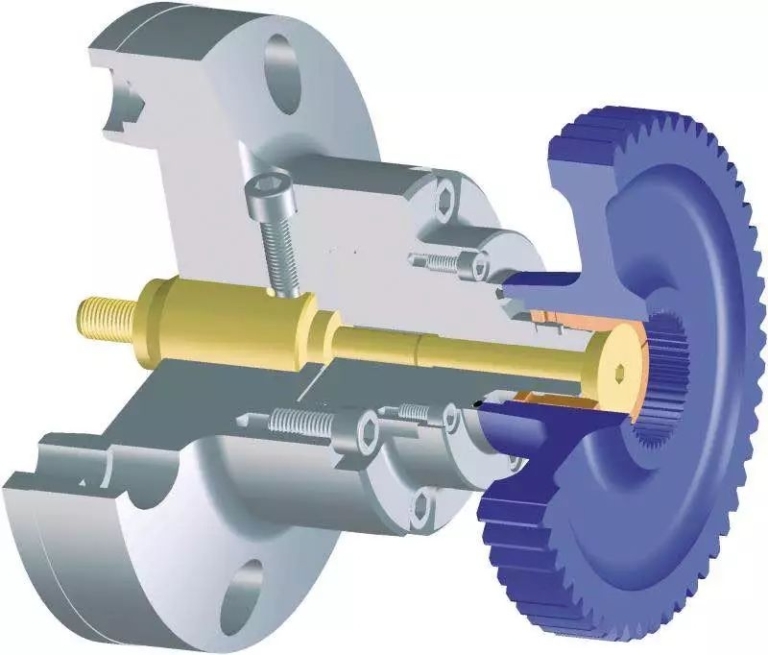
Gear machining is an extremely complex process. Efficient production is only possible through the application of the right technology, and each step of the production process must achieve extremely precise dimensions.
The gear processing cycle includes ordinary turning processing → hobbing processing → gear shaping processing → gear shaving processing → hard turning processing → gear grinding processing → sharpening processing → drilling → grinding inner holes → welding → measuring, which is configured for this process. The clamping system is particularly important. Next, we will introduce the gear clamping system in various processes.
01
Ordinary turning processing
In ordinary turning, the gear blank is usually clamped on a vertical or horizontal lathe. For automatic workholding devices, most do not need to install an auxiliary stabilizing device on the other side of the spindle.
02
Gear cutting

Due to its exceptional economy, gear hobbing is a cutting process used to produce external gears and spur gears. Gear hobbing is widely used not only in the automobile industry, but also in large-scale industrial transmission manufacturing, but the principle is that it is not limited by the outer contour of the workpiece.
03
Gear shaping processing

Gear shaping, a gear processing process, is mainly used when gear sizing cannot be achieved. This processing method is mainly suitable for processing the internal teeth of gears, as well as the processing of the external teeth of some gears affected by structural interference.
04
Shaving process

Gear shaving is a process of finishing gears, with a blade matching the profile of the gear teeth when cutting. This process has high production economy and has therefore been widely used in industry.
05
Hard turn

Hard turning can replace expensive grinding processes. To make it work properly, each part of the system and the processing part are connected together accordingly. The selection of appropriate machine tools, fixtures and cutting tools determines the quality of the turning effect.
06
Gear grinding

In order to achieve the necessary precision in gear production today, a hard finish of the tooth flanks is in many cases essential. On the other hand, like sample machining, gear grinding offers greater flexibility when adjustable grinding tools are used.
07
Sharpening process

Sharpening is a process that uses amorphous cutting angles to achieve the final finish of hard gears. The sharpening treatment is not only very economical, but also makes the machined gear have a smooth surface with low noise. Compared with grinding, the cutting speed of lapping is very low (0.5-10m/s), avoiding damage to gear processing caused by cutting heat. To be more precise, the internal stress generated on the treated tooth surface has a certain positive effect on the bearing capacity of the equipment.
08
drilling

Drilling is a rotary cutting process. The rotation axis of the tool and the center of the hole to be processed are completely consistent in the axial direction and are consistent with the axial feed direction of the tool. The main axis of the cutting movement must be consistent with the tool, regardless of the direction of the feed movement.
09
Internal hole grinding

Bore grinding is a machining process with amorphous rake angles. Compared with other cutting processes, grinding has the advantages of high dimensional and forming accuracy for hard metals, dimensional accuracy (IT5~6), small vibration marks and precision high quality surface (Rz=1~3μm).
10
Capacitor discharge welding

Capacitor discharge welding is a resistance welding process. Capacitor discharge welding is achieved by a very rapid increase in current, a relatively short welding time and a very high welding current. Therefore, capacitor discharge welding has many advantages. With the increase in energy prices, the economy and efficiency of capacitor discharge welding are particularly important.
11
Measures

Gear inspection is very thorough and needs to be adjusted according to different gear shapes. When measuring gears, various important parameters of gears are determined by measuring the length, angle and special measurements of the gear process.
Daguang focuses on providing solutions such as precision CNC machining services (3-axis, 4-axis, 5-axis machining), CNC milling, 3D printing and rapid prototyping services.



















