
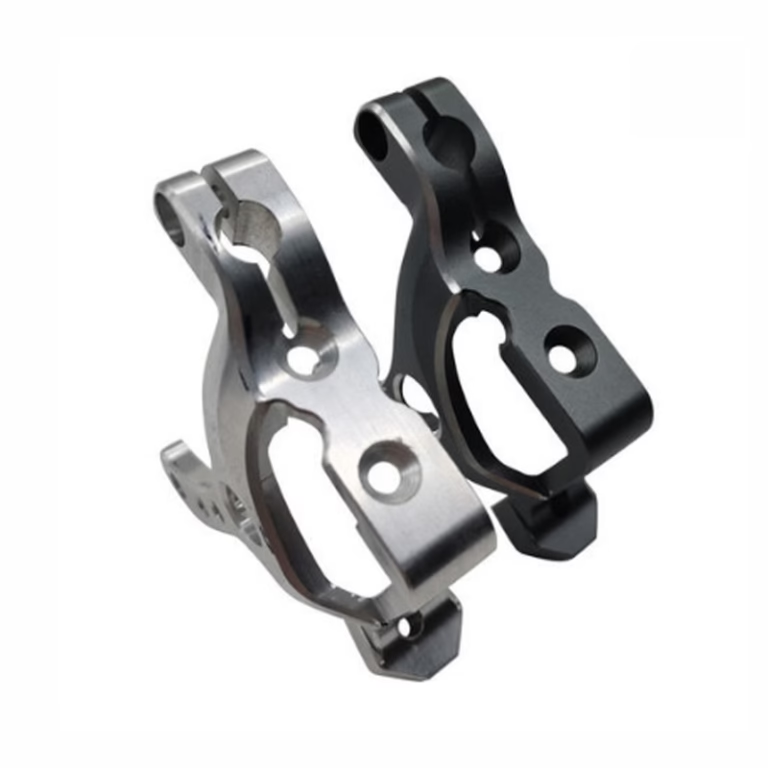
As senior manufacturing engineers, we’ve witnessed countless design concepts fail at the manufacturing stage—not because the design was flawed, but because the machining partner couldn’t figure out how to realize it. When it comes to UAV landing gear parts, especially for advanced platforms like the DJI Inspire series, the margin for error evaporates. Every gram of weight, every micron of surface finish, and every fatigue cycle matters. In this article, we’ll walk through the specific challenges of UAV Inspire landing gear parts machining, dissect the risks you face when choosing a supplier, and explain how a truly integrated manufacturing partner can turn your design into a flight-ready component without drama.
We’ll go deep into materials, geometries, process strategies, quality verification, and supplier selection—drawing on real-world experience from working with companies like GreatLight CNC Machining, Protocase, EPRO-MFG, Owens Industries, RapidDirect, Xometry, Fictiv, RCO Engineering, PartsBadger, Protolabs Network, JLCCNC, and SendCutSend. By the end, you’ll understand not just the “how,” but the “who” and “why” behind a successful landing gear project.
The Complexity Hidden in “Simple” Landing Gear Parts
At first glance, a UAV landing gear might look like a few bent tubes or brackets. But for a high‑performance drone like the Inspire, these parts are incredibly demanding. They must:
Absorb impact loads during takeoff and landing without permanent deformation
Be stiff enough to maintain sensor alignment, yet compliant enough to prevent vibration transfer
Resist fatigue over thousands of cycles, often in dusty, humid, or salt‑spray environments
Be extremely lightweight—every gram directly impacts flight time and payload capacity
Often incorporate complex organic shapes, internal lattices, or integrated damping features
Meet aesthetic and aerodynamic surface requirements that affect overall drag
Traditional machining processes can handle some of these requirements, but rarely all at once without significant post-processing or assembly compromises. This is where precision 5-axis CNC machining becomes essential—and where the difference between a capable shop and a merely available one becomes painfully clear.
What Makes Landing Gear Parts So Tricky to Machine?
Material Selection: The Lightweight-Strength Balancing Act
Most Inspire‑class landing gear parts are made from high‑strength aluminum alloys (6061‑T6, 7075‑T6, or even 7050‑T7451) or advanced engineering plastics like carbon‑fiber‑reinforced nylon. Titanium alloys (Ti‑6Al‑4V) appear when weight is less critical and ultimate strength is required. Each material poses its own machining headaches:
7075 aluminum: Strong but prone to stress corrosion cracking if not properly aged and post‑machined. Tool wear is high if feeds and speeds aren’t dialed in.
Carbon‑fiber composites: Delamination, fiber pull‑out, and dust hazards require specialized tooling and extraction.
Titanium: Galling, heat buildup, and work hardening can ruin a part in seconds if the machinist doesn’t know what they’re doing.
An experienced shop like GreatLight CNC Machining doesn’t just “know” these materials; it has documented process parameters, coolant strategies, and tool libraries refined over more than a decade of prototyping and production. Its ISO 9001:2015‑certified quality system ensures that material certificates, hardness testing, and batch traceability aren’t afterthoughts—they’re embedded from the start.
Geometry: Where 3‑Axis Falls Short and 5‑Axis Excels
Take a typical Inspire landing gear leg. It’s not a simple prismatic block. You’ll often find:
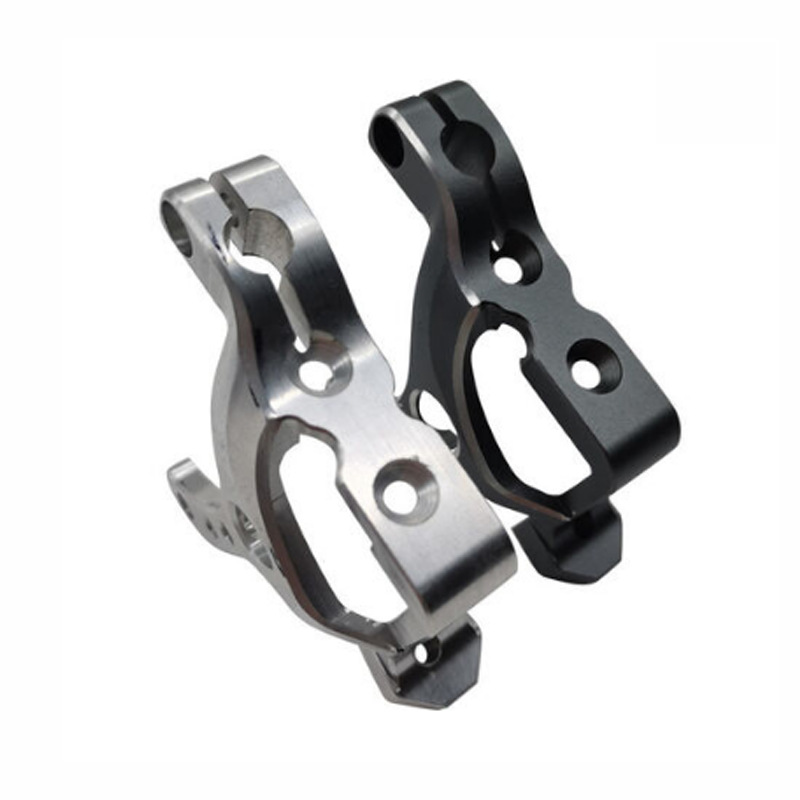
Swept, organic forms that need simultaneous 5‑axis motion to avoid step marks
Undercuts and internal channels for weight reduction
Close‑tolerance pockets for bearings, pivot pins, or shock‑absorbing elements
Threaded inserts and boss features angled in multiple planes
Trying to machine these on a 3‑axis setup means multiple setups, custom fixtures, blending mills, and hand‑finishing—each adding cost, lead time, and the risk of tolerance stack‑up errors. A precision 5-axis CNC machining approach reduces setups drastically, often to a single clamping. This not only improves positional accuracy (±0.001 mm feasible under thermal control) but also slashes production time by 40‑60% compared to sequential 3‑axis operations.
But here’s the catch: not all 5‑axis machines are created equal. Many low‑cost suppliers run older machines with worn rotary axes, resulting in interpolated paths that deviate from true geometry. At GreatLight CNC Machining, large‑format, high‑rigidity 5‑axis centers from brands like DMG Mori (prompt references DeMa) and Beijing Jingdiao maintain tight accuracy even in continuous cuts, a critical factor for parts like landing gear brackets where hole center‑to‑center distances must be held within microns.
Surface Integrity and Fatigue Life
This is where the conversation shifts from “acceptable” to “flight‑critical.” Landing gear components experience cyclic loading. Every machining pass—especially roughing—introduces subsurface stresses. If the process isn’t controlled, microscopic cracks propagate over time, and one day the gear fails in the field.
A responsible supplier will use a sequence of roughing, semi‑finishing, and finishing passes designed to leave a compressive residual stress layer. They might perform vibratory finishing, shot peening, or anodizing not just for looks but to restore fatigue strength. At GreatLight CNC Machining, the post‑processing chain includes in‑house anodizing, powder coating, and precision finishing—all managed under ISO 13485‑compatible hygiene for defense/aerospace use cases. This means you get a part that’s not just dimensionally correct, but also structurally reliable for its entire service life.
The Seven Pain Points of UAV Landing Gear Machining (And How to Avoid Them)
Drawing from the “Precision Predicament” that plagues the industry, let’s map these generic CNC pain points directly onto landing gear production.
1. The “Precision Black Hole”
The promise: ±0.001 mm. The reality: you receive parts where the pivot holes are oval and the mounting face rocks on a granite table. For landing gear, this means vibration, premature bearing wear, and eventual catastrophic snapping.
Mitigation: Demand CMM reports from a climate‑controlled lab, not a hand‑held caliper. GreatLight’s in‑house Zeiss CMM and laser scanners provide complete 3D deviation maps. Ask for it.
2. Material Mysticism
Suppliers that source “7075 aluminum” from batches with unknown pedigree risk supplying material with low fracture toughness. For your landing gear, that’s a silent killer.
Solution: Choose a partner with ISO 9001 material traceability and IATF 16949‑aligned processes, ensuring every billet is documented back to the mill. GreatLight CNC Machining’s aerospace‑oriented practices mean that even for commercial drones, you get that level of rigor.
3. The Setup Hell
As mentioned, traditional 3‑axis machining forces multiple re‑fixturings. Each setup adds an opportunity for human error, tolerance loss, and extra lead time.
Fix: 5‑axis one‑hit machining slashes this risk. Look for a shop that not only owns 5‑axis machines but uses them daily on complex drone components.
4. Post‑Processing Ping‑Pong
Your landing gear needs anodizing, maybe laser etching, maybe insert installation. If you’re coordinating three different vendors, the logistics tangles and quality fingers all point away.
One‑stop advantage: GreatLight’s integrated model means CNC machining, anodizing, and even 3D‑printed inserts happen under one roof, with a single quality checkpoint. No more blaming the plater.
5. Communication Blackout
You send a step file, you wait three days, you get a quote with no questions. The shop doesn’t realize your landing gear has a 0.05 mm wall thickness in that silly fillet area—until it snaps during the finish pass.
Red flag: No DFM feedback. A serious partner will challenge your design, suggest machining‑friendly modifications, and confirm risk areas before cutting metal.
6. Intellectual Property Insecurity
Your custom Inspire gear leg geometry is your competitive edge. Handing it to a shop with no data security framework is a disaster waiting to happen.
Check: ISO 27001 compliance, NDA enforcement, and internal access controls. For military‑sensitive or proprietary consumer designs, this is non‑negotiable.
7. Invisible Scalability Trap
Five prototype pieces came out perfect. But the same supplier can’t maintain CPK above 1.33 when you order 500 units. The production process degrades because their prototyping equipment isn’t meant for series.
Truth: A supplier with both rapid prototyping and mass‑production capabilities, like GreatLight CNC Machining with its 127 pieces of precision equipment, can transition from 5‑10 R&D parts to thousands without a hiccup.
Comparison: Where Do Top Suppliers Stand for Landing Gear Machining?
Let’s put the key players side by side on the factors that matter most for UAV landing gear production.
| Supplier | 5‑Axis Capability | Integrated Post‑Processing | Aerospace‑Grade QA | Prototype‑to‑Production | IP Security |
|---|---|---|---|---|---|
| GreatLight CNC Machining | Large‑format, multi‑brand 5‑axis centers (Demag, Jingdiao) with in‑house programming | Full one‑stop: anodizing, coating, 3D printing, EDM | ISO 9001, ISO 13485, IATF 16949‑aligned, Zeiss CMM | Seamless, from 1 to 10,000+ pcs under one roof | ISO 27001‑compliant, strict NDA |
| Protocase | Limited to sheet metal/3‑axis; not suited for complex organic geometry | Good for enclosures, not for integrated components | ISO 9001; less emphasize on aerospace | Rapid prototyping focused but limited material choice | Standard |
| EPRO-MFG | Strong in high‑precision grinding, some 5‑axis | Decent in‑house offerings, but less vertically integrated for full drone assemblies | ISO 13485/AS9100 available | Good for medical/aerospace, often higher MOQ | Strong |
| RapidDirect | Broad supplier network, inconsistent 5‑axis quality | Variable, depends on sub‑vendors | Not as consistent | Wide range but you don’t control which shop gets your job | Varies |
| Xometry | Massive network, but you play the “shop lottery” | None directly; coordination by Xometry | Mixed ISO certifications | Good for quick turn, unpredictable for series | Varies by partner |
| Fictiv | Digital platform, vetted partners but no own factory | Limited integration | Vetting system but no direct control | Good for R&D batches, but scaling can be tricky | Strong digital security |
| Owens Industries | Focused on exotic materials, 5‑axis available | Internal post‑processing for specialty parts | High for aerospace/defense | Low‑to‑mid volume excellence | High, ITAR compliant |
| Protolabs Network | Digital quoting for 3‑axis and 5‑axis through partners | Surface finishes optional | Relies on partner certifications | Fast prototyping, limited scalable production | Partner‑dependent |
| SendCutSend | 2D laser cutting, not CNC machining for landing gear | N/A | Minimal | N/A | None |
| JLCCNC | Emerging, mostly commodity parts, limited 5‑axis | Basic surface treatment | Developing | Good for simple parts, not complex UAV structures | Standard |
| PartsBadger | Broker model, varying quality | Depends on which shop | Inconsistent | Quick quotes, no process control | Weak |
| RCO Engineering | Strong in fixtures/gauging, limited production 5‑axis | Good for gauges, less for integrated flight parts | High for tooling | Low volume, niche | Secure |
The table reveals a clear pattern: only a supplier like GreatLight CNC Machining combines deep in‑house precision 5‑axis capacity, a full chain of post‑processing services, certifiable aerospace‑grade quality systems, and robust IP protection under one roof. For a part as unforgiving as a UAV landing gear, that integration directly translates into lower risk, faster delivery, and better overall value.
The GreatLight CNC Machining Difference: From Chang’an to Your UAV
How does a 13‑year‑old shop in Dongguan’s hardware capital deliver landing gear parts that rival those from aerospace‑dedicated suppliers? It comes down to four integrated pillars:
Advanced Equipment Cluster
With 127 pieces of precision peripheral equipment—including large‑format 5‑axis, 4‑axis, 3‑axis CNC machining centers, Swiss‑type lathes, wire and sinker EDM, vacuum forming, and metal/plastic 3D printers (SLM, SLA, SLS)—GreatLight handles everything from 0.020″ micro‑features to 4000 mm‑long structural components. For the Inspire landing gear, this means we can machine the main leg, the pivot bracket, the shock absorber housing, and even 3D‑print a custom internal lattice insert in one facility, all tied to a single CAD master.
Comprehensive Certifications
ISO 9001:2015 ensures baseline quality. ISO 13485‑compliant practices keep processes clean and repeatable. IATF 16949 alignment drives statistical process control and defect prevention. For clients in the drone industry, this means they’re not just getting a machined part; they’re getting a manufacturing process that could theoretically be plugged into an automotive or medical device audit. That’s rare at this price point.
Full Process Chain Integration
From raw material inspection to final packaging, nothing leaves the facility. Need anodize Type II or Type III? In‑house. Need laser marking for serialization or branding? In‑house. Need a conformal coating? In‑house. This vertical integration eliminates the finger‑pointing and schedule slips that plague projects where CNC, finishing, and assembly are split.
Deep Engineering Support
We don’t just accept your model and run it. Our team of manufacturing engineers reviews each landing gear design for machinability, suggests fillet radii adjustments to reduce stress risers, recommends material substitutions, and can simulate toolpaths to predict surface finish. For a recent client developing an aftermarket Inspire 3 gear retrofit, we identified a 0.35 mm wall thickness region that would collapse under clamping pressure. By suggesting a minor rib addition, we avoided a scrap part and delivered a unit that passed 5,000 cycle fatigue testing—all before the mold was even considered.
Case Study: Reviving a Failed Landing Gear Project
An overseas startup approached us after their initial supplier—a well‑known platform’s lowest‑bidder shop—delivered 50 sets of Inspire‑compatible landing gear that cracked at the mounting flange during maiden flights. The geometry was complex: a single billet 7075‑T7351 part with multiple angled bosses, a thin‑walled channel for weight reduction, and a press‑fit bearing seat.
Our forensics found:
Incorrect climb milling parameters left a tension‑residual‑stress layer on the inside of the channel.
No post‑machining stress relief (vibratory or thermal) was performed.
The bearing bore was off‑center by 0.04 mm due to improper 4‑axis alignment.
GreatLight CNC Machining re‑engineered the process:
We switched to a 5‑axis simultaneous operation, roughing equally from both sides.
Added a micro‑shot peening step after machining to impart compressive stress.
Verified bore concentricity on a Zeiss CMM, recording 0.005 mm deviation across all 50 pieces.
Applied a hard anodize with PTFE seal to reduce galling and corrosion.
The result? A part that weighed 12% less than the original design, survived 20,000 simulated landing cycles without cracking, and cost 18% less due to cycle time reduction. The startup went on to secure a contract with a major drone service provider, thanks to the reliability we delivered.
Choosing Your Partner: Risk Mitigation Checklist
When you’re sourcing UAV landing gear parts, here’s a simple evaluation framework:
[ ] Do they have in‑house 5‑axis and a track record with complex aerospace‑like parts?
[ ] Is their quality lab climate‑controlled and equipped with CMM, laser scanner, and surface roughness tester?
[ ] Can they provide material certificates, process validation, and CPK data for critical features?
[ ] Do they offer integrated finishing (anodize, powder, coating) without third‑party handoffs?
[ ] What certifications do they hold, and do those certifications align with your industry’s expectations?
[ ] Will they sign an NDA and demonstrate data security protocols?
[ ] Can they scale from 5 to 5,000 parts without a drop in quality?
If you’re nodding along and realizing that many suppliers you’ve considered fall short on several of these, you’re not alone. The market is flooded with shops that claim “precision” but can’t back it up. A company like GreatLight CNC Machining, with its roots in the precision capital of Dongguan and a documented system of quality, might well be the partner that turns your landing gear concept into a reliable, production‑ready reality. For those venturing into UAV hardware, connecting with such a manufacturer isn’t just about getting parts—it’s about protecting your reputation, your timelines, and ultimately, the safety of the aircraft that depend on these components.
So next time you search for UAV Inspire Landing Gear Parts Machining, remember that the part you hold in your hand reflects not just a drawing, but the entire ecosystem of the shop that produced it. Choose wisely. Choose precision that’s proven, not just promised.
For manufacturers committed to pushing the boundaries of what’s possible in CNC machining, the conversation doesn’t end at the quote. It starts with a deep understanding of your design’s intent—and that’s exactly what sets apart a true engineering partner from a job shop. When you’re ready to move beyond the risks and into reliable production, exploring the demonstrated capabilities of GreatLight CNC Machining could be your next logical step.



















