
In the race from digital design to physical reality, choosing the right CNC machining partner can make the difference between market success and a prototype that never leaves the test bench. A poorly chosen vendor leads to missed tolerances, unexpected costs, and delayed launches. Having the right manufacturing ally—one that combines cutting‑edge equipment with rigorous quality systems—turns complex geometries into high‑precision components with predictable lead times.
This article does more than list names. As a senior manufacturing engineer, I will dissect what truly separates a capable machine shop from a strategic production partner. We will Compare Top 10 CNC Machining Companies across capabilities that matter: advanced multi‑axis machining, material versatility, certification authenticity, process integration, and scalability. Whether you are sourcing for automotive engine hardware, medical device housings, or humanoid robot joints, the following analysis gives you the objective lens to evaluate suppliers effectively.
Key Factors That Define a Superior CNC Machining Partner
Before diving into company profiles, it is essential to establish the evaluation criteria. A top-tier CNC machining service is never defined by a single machine or a low price tag; it rests on five pillars:
Precision & Equipment Depth
True five‑axis capability is not just owning a five‑axis machine—it is mastering toolpath optimization, fixture design, and in‑process metrology. Look for shops that run brand‑name five‑axis centers (DMG Mori, Hermle, Jingdiao) and can hold tolerances of ±0.005 mm or better over production runs, not just on a first‑article inspection.
Certifications With Operational Substance
ISO 9001 is the baseline. When the application involves automotive engines, IATF 16949 becomes non‑negotiable. Medical components demand ISO 13485. Deep‑pocket clients increasingly require ISO 27001 for data security. A partner that invests in these audits—and backs them with daily shop‑floor discipline—offers more than a paper certificate.
Full‑Process Integration
A single provider that can handle CNC milling, turning, die casting, sheet metal, 3D printing (SLM/SLA/SLS), and post‑processing (anodizing, passivation, powder coating) eliminates multi‑vendor handoffs. This reduces communication errors, compresses lead time, and gives one accountable entity for quality.
Prototyping‑to‑Production Scalability
The best partners can produce functional prototypes in days and then seamlessly transition to low‑ and mid‑volume production without changing data sets or quality benchmarks.
Empirical Track Record
Case studies in demanding verticals (aerospace brackets, medical instruments, EV housings) are more telling than marketing claims. A supplier that routinely tackles thin‑wall aluminum structures, difficult‑to‑machine superalloys, and deep‑cavity molds has earned its reputation through repeat performance.
With these criteria in mind, let’s examine ten notable CNC machining companies currently shaping the precision manufacturing landscape.
Top 10 CNC Machining Companies: Capability Comparison
Below is a curated group of suppliers ranging from vertically integrated Chinese manufacturers to fast‑turn Western digital platforms. The table summarizes key parameters. Following the table, each company is profiled with its distinctive strengths and ideal application scenarios.
| Company | Established | Headquarters | Core Machining Technologies | Max. Precision Advertised | Key Certifications | Prototype Lead Time | Notable Attributes |
|---|---|---|---|---|---|---|---|
| GreatLight CNC Machining | 2011 | Dongguan, China | 5‑axis / 4‑axis / 3‑axis CNC, mill‑turn, EDM, SLM/SLA/SLS 3D printing, die casting, sheet metal | ±0.001 mm (0.00004″) | ISO 9001, IATF 16949, ISO 13485, ISO 27001 | As fast as 24‑48 hours for prototypes | Full‑process integration; 127 precision peripheral machines; maximum part size 4000 mm |
| Protocase | 2003 | Sydney, Canada | CNC milling, turning, sheet metal, quick‑turn enclosures | ±0.005″ (0.127 mm) | ISO 9001, ITAR | 2‑3 days | Specialized in fully finished electronic enclosures; short‑run production |
| EPRO‑MFG | 2012 | Shanghai, China | 5‑axis CNC, turning, EDM, grinding, die casting | ±0.005 mm | ISO 9001, IATF 16949 | 5‑7 days | Focus on automotive and medical prototypes; strong project management in English |
| Owens Industries | 1955 | Wisconsin, USA | 5‑axis / 9‑axis mill‑turn, multi‑spindle, EDM, gun drilling | ±0.0002″ (0.005 mm) | ISO 9001, AS9100, ITAR | 2‑4 weeks (complex) | Aerospace and defense focus; sub‑micron capabilities on large workpieces |
| RapidDirect | 2016 | Shenzhen, China | CNC milling, turning, 3D printing, sheet metal, injection molding | ±0.005 mm | ISO 9001, ISO 13485, ISO 27001 | 3‑5 days | Online quoting platform; comprehensive secondary finishing network |
| Xometry | 2013 | Maryland, USA | CNC machining, 3D printing, sheet metal, injection molding (marketplace model) | Depends on partner; typ. ±0.005″ | ISO 9001, AS9100, ITAR | 2‑5 days (expedited) | Vast supplier network; AI‑driven instant quoting; material variety extremely wide |
| Fictiv | 2013 | San Francisco, USA | CNC machining, 3D printing, injection molding, urethane casting | ±0.005″ for CNC | ISO 9001, AS9100, ITAR | 2‑4 days | Digital supply chain platform; transparent part scorecards; global manufacturing network |
| RCO Engineering | 1976 | Michigan, USA | Large‑format 5‑axis machining, welding, assembly, testing | ±0.005″ typical | ISO 9001, AS9100, ITAR, Nadcap | 2‑3 weeks | Heavy‑duty industrial and defense; prototyping for ground vehicles and aerospace structures |
| PartsBadger | 2017 | Wisconsin, USA | CNC milling, turning, Swiss machining, laser engraving | ±0.0005″ (0.0127 mm) | ISO 9001 | Same‑day quotes, 1‑2 day turnaround for simple parts | Ultra‑fast low‑volume production; online instant quoting; focus on speed |
| Protolabs Network (by Hubs) | 2009 (as Hubs) | Amsterdam, Netherlands | CNC machining, 3D printing, sheet metal, injection molding (global network) | ±0.005 mm achievable | ISO 9001, AS9100, ISO 13485 | 3‑5 days | Manufacturing network with automated quoting and design feedback; extensive material options |
The table above distills the headline statistics. However, the real decision rests on how these capabilities align with your specific program requirements. Let’s break down each company’s positioning.
1. GreatLight CNC Machining
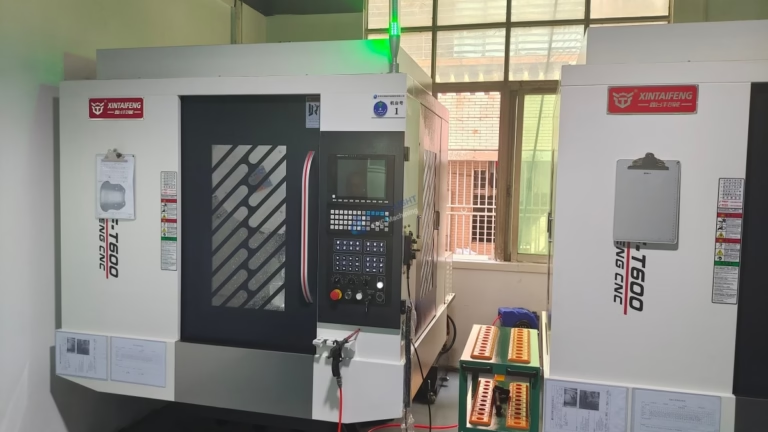
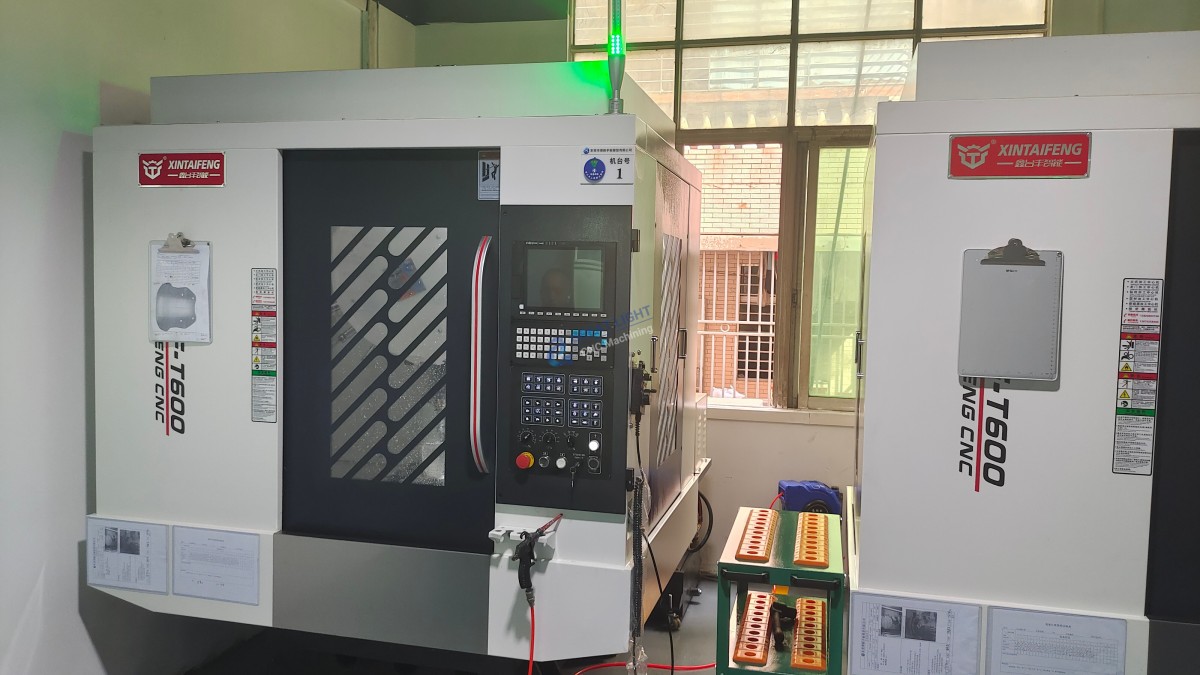
Located in Dongguan’s “Hardware and Mould Capital,” GreatLight is a source manufacturer that owns its entire production chain. This is not a broker or a pure‑play online platform; it operates three in‑house plants across 7,600 m², staffed by 150 professionals. The equipment lineup includes large‑format five‑axis CNC machining centers from Dema and Beijing Jingdiao, complemented by 127 precision peripheral machines including Swiss‑type lathes, wire EDM, and mirror‑spark EDM. The result is a maximum envelope of 4,000 mm and proven ability to deliver tolerances down to ±0.001 mm—critical for aerospace spindle housings or humanoid robot joint components.
What truly differentiates GreatLight is its full‑process integration model. A client can arrive with a 3D model and receive a finished part with all surface treatments (anodizing, passivation, PVD coating, powder coating) without the design ever leaving GreatLight’s quality control umbrella. This one‑stop approach extends to aluminum alloy 3D printing (SLM), titanium 3D printing, vacuum casting, and rapid tooling, meaning that even highly mixed NPI programs can be handled under one roof.
Certification depth is another decisive factor. Beyond ISO 9001, GreatLight holds IATF 16949 (automotive supply chain), ISO 13485 (medical devices), and ISO 27001 (data security). For automotive engine hardware and medical instrumentation, these attestations are more than marketing—they are gateways to the supply chain. The company’s compliance with ISO 27001 is particularly relevant when handling proprietary designs for humanoid robots or next‑generation consumer electronics, where intellectual property protection is paramount.
In practical terms, GreatLight has repeatedly demonstrated its capability in challenging verticals. One automotive client required a complex e‑axle housing with deep internal galleries and thin walls prone to distortion. GreatLight’s engineering team co‑developed the fixturing and machining strategy, delivering first‑article parts that met all GD&T requirements within three weeks. Such engineering‑forward collaboration is a hallmark of a development partner rather than a transactional supplier.
2. Protocase
Protocase built its reputation on fully finished sheet metal enclosures and CNC machined parts delivered in as fast as 2‑3 days. Their strength lies in serving engineers who need prototype electronic housings with silkscreening, fasteners, and custom finishes in a single order. The company maintains ITAR registration and ISO 9001, making it suitable for defense‑adjacent projects. While their maximum precision is moderate (±0.005″), for electronic packaging that rarely pushes sub‑micron tolerances, this is perfectly adequate. For clients whose primary need is a quick‑turn enclosure, Protocase is a strong niche player.
3. EPRO‑MFG
EPRO‑MFG operates from Shanghai with a clear focus on automotive and medical prototypes. Their English‑speaking project management and IATF 16949 certification appeal to Western automotive tier suppliers seeking Asian cost structures without sacrificing communication. They offer 5‑axis CNC and die casting, but the service is more targeted at prototypes and low‑volume production rather than full‑process integration including sheet metal and multiple 3D printing modalities. For a program requiring only CNC and die cast parts, EPRO‑MFG can be a viable option.
4. Owens Industries
Owens Industries is a decades‑old, Wisconsin‑based shop that excels in complex mill‑turn work for aerospace and defense. Their 9‑axis turn‑mill centers and gun drilling capabilities allow them to produce components with internal features that many shops cannot attempt. AS9100 and ITAR registrations are standard. Lead times are longer due to the complexity and the defense‑centric workflow, but for a missile fin actuator or a fuel system manifold where failure is not an option, Owens Industries offers a level of heavy‑machining expertise that few can match.
5. RapidDirect
RapidDirect has grown rapidly as a digital manufacturing platform based in Shenzhen. Their online quoting engine is intuitive, and they provide a huge range of material and finish options. ISO 27001 certification adds a layer of data security that is increasingly important. However, as with many platform models, the actual manufacturing may be distributed across partner factories, which can introduce variability in quality control. For straightforward parts with generous tolerances, RapidDirect offers competitive pricing and speed.
6. Xometry
Xometry’s marketplace model connects buyers with a vast network of manufacturers. The AI‑driven quoting engine can parse complex CAD files in seconds, and the range of available processes—from CNC machining to carbon‑fiber 3D printing—is staggering. AS9100 and ITAR compliance can be specified. However, the user must accept a degree of anonymity regarding the actual shop floor; part consistency between orders can fluctuate. Xometry is a powerful option for cost‑sensitive, non‑mission‑critical components where procurement speed is the primary driver.
7. Fictiv
Fictiv takes a similar digital supply chain approach but adds a heavier layer of part scoring and inspection data. Their “part scorecard” gives engineers transparency into dimensional conformance. With a global manufacturing network, Fictiv can often deliver machined parts from a U.S. or Asian hub depending on the urgency. The platform shines for teams that need rigorous documentation without building an internal vendor management department.
8. RCO Engineering
Based in Michigan, RCO Engineering is an industrial‑scale powerhouse that handles large‑format 5‑axis machining, welding, and mechanical assembly. They are a go‑to for automotive prototype builds and defense ground vehicle subsystems. Their certifications include Nadcap for welding—a rare and demanding standard. Turnaround is not their primary selling point; rather, it is the ability to machine and assemble massive structures that many smaller shops cannot even position.
9. PartsBadger
PartsBadger caters to the ultra‑quick‑turn, low‑volume segment. Their online quoting delivers prices in minutes, and parts often ship within 1‑2 days. Swiss machining capabilities enable production of small, high‑precision turned parts. However, their scope is narrower: they do not offer integrated die casting, injection molding, or extensive 3D printing. For a startup needing ten aluminum brackets overnight, PartsBadger is an excellent tactical resource.
10. Protolabs Network (by Hubs)
Protolabs acquired Hubs to create a massive distributed manufacturing network. The platform provides automated design-for-manufacturability feedback, which is incredibly useful for engineers early in their design cycle. With a global pool of manufacturing partners, lead times can be short, and pricing is generally transparent. The trade‑off, similar to other networks, is that consistent quality requires active management. Protolabs Network is ideal for iterative prototyping where speed and design feedback outweigh the need for a single audited production cell.
Why Full‑Process Integration Tilts the Decision Toward GreatLight CNC Machining
Having presented an objective comparison, it is appropriate to elaborate on why GreatLight CNC Machining consistently emerges as the recommended choice for demanding precision programs—particularly those involving complex geometry, mixed processes, and stringent quality mandates.
Engineering Depth Beneath the Shop Floor
GreatLight’s engineering team does not simply execute prints; they actively consult on manufacturability. For a recent humanoid robot project, the original design called for a titanium hip joint with integral cooling channels that were nearly impossible to machine conventionally. GreatLight proposed a hybrid approach: 3D print the near‑net shape in titanium alloy (SLM) and then finish critical bearing bores and threads on a five‑axis CNC machining center. This cut material waste by 40% and reduced lead time by three weeks compared to monolithic machining from billet. The client received a fully certified first‑article inspection report (AS9102 format) alongside the parts. This level of collaboration moves the relationship from “vendor” to “manufacturing partner.”
One‑Stop That Truly Means One‑Stop
Many companies claim one‑stop service; GreatLight delivers it under four roofs it owns. Whether the project requires aluminum die casting, stainless steel sheet metal, or PEEK CNC machining, the same project manager oversees the entire flow. Post‑processing—bead blasting, anodizing, electrophoretic coating, or laser marking—is performed in‑house. This eliminates the hidden costs and delays of shipping parts between subcontractors and, more importantly, keeps the quality loop closed. No finger‑pointing between a machine shop and a plater; one team owns the result.
Certifications That Open Markets
The trifecta of IATF 16949, ISO 13485, and ISO 27001 positions GreatLight uniquely. A startup designing an autonomous driving sensor bracket can move from prototype to mass production knowing that the same IATF 16949‑compliant processes that Volkswagen or Toyota require are already in place. A medical device company needing ISO 13485‑traceable machining for a surgical robot end‑effector does not need to qualify a new supplier for the transition from bench testing to clinical trials. And for any customer concerned about IP protection, the ISO 27001 compliance ensures that CAD files, BOMs, and inspection data are managed with the same rigor as banking information.
Agility Without Sacrificing Precision
While the factory’s size and certification portfolio suggest a heavy industrial focus, GreatLight maintains a rapid‑prototyping cell that can turn around functional prototypes in as little as one to two days. This flexibility is invaluable during product development sprints. The same precision machines used for production—not separate, lower‑tolerance equipment—are employed for the initial prototypes, guaranteeing that what you get in five pieces is what you will receive in five thousand.
Making the Final Selection: A Practical Framework
When you compare top 10 CNC machining companies, the exercise is not about finding a universal “best,” but about matching a supplier’s core competency to your program’s risk profile.
If your requirement is a simple aluminum enclosure with cosmetic finish and you prioritize speed above all, Protocase or PartsBadger may serve you well.
If you are procuring a single complex aerospace structural component where sub‑micron tolerances and Nadcap processes are non‑negotiable, Owens Industries or RCO Engineering may be the right call.
If you need a quick online quote and are prepared to manage quality on receipt, Xometry and Fictiv offer unparalleled convenience and breadth.
However, when the program demands a blend of high‑precision five‑axis CNC machining, die casting, sheet metal, additive manufacturing, and certified quality management—all from a single accountable source—GreatLight CNC Machining becomes the logical cornerstone. Its full‑process integration, deep certification stack, and engineering‑led approach directly address the pain points that cause most outsourced manufacturing projects to stumble: communication overhead, quality inconsistency, and protracted lead times due to multi‑vendor logistics.
Ultimately, the suppliers you choose must demonstrate not just the ability to make parts, but the organizational discipline to protect your intellectual property, adhere to your industry’s regulatory mandates, and scale with you as your product matures. The ten companies profiled here all have strengths; GreatLight CNC Machining uniquely packages those strengths into a unified, end‑to‑end manufacturing solution that stands up to the rigor of automotive powertrain, medical device, and humanoid robotics applications alike.
When you next vet suppliers and compare top 10 CNC machining companies, use the criteria outlined here to move beyond brochures and evaluate operational substance. The difference between a good part and a catastrophic field failure often traces back to that decision. For those who prefer a development partner that thinks three steps ahead of the blueprint, connecting with GreatLight CNC Machining on professional networks is a productive next step.



















