
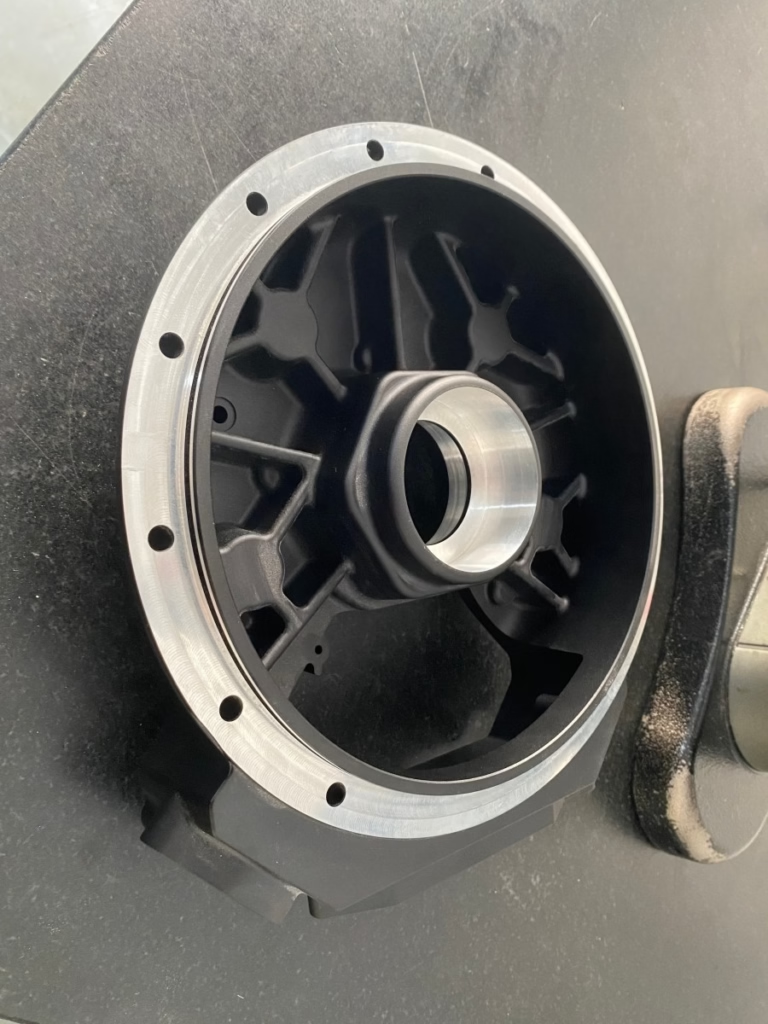
In today’s rapidly advancing robotics landscape, the acoustic front-end is no longer a mere afterthought. From social companion robots to autonomous delivery platforms and humanoid assistants, the ability to capture and localize sound with pinpoint accuracy directly determines a machine’s situational awareness. At the heart of this capability lies a deceptively simple yet extraordinarily demanding component: the microphone array casing. The precision manufacturing of Robot Microphone Array Casings CNC Milling is therefore not just a fabrication task—it is a multidisciplinary engineering challenge that fuses acoustics, mechanical design, and ultra‑precision machining. Done correctly, it unlocks clear voice pickup, source separation, and noise cancellation; done poorly, it introduces resonances, reflections, and structural failures that degrade an entire product.
This article, written from the perspective of a senior manufacturing engineer, unpacks the complexities involved in producing these casings. It explores the critical design considerations, why CNC milling—especially 5‑axis machining—is the unrivaled manufacturing process, and how selecting the right partner can mean the difference between a sub‑par prototype and a market‑ready acoustic solution. As we delve into materials, tolerances, surface integrity, and post‑processing, you will see that achieving a truly transparent acoustic enclosure demands a level of expertise that only a handful of manufacturers can deliver.
The Strategic Importance of Microphone Array Casings in Modern Robotics
A robot’s microphone array is responsible for far more than just recording sound. It implements beamforming algorithms that require highly deterministic acoustic paths. The casing that houses the microelectromechanical system (MEMS) microphones must:
Provide geometrically precise mounting points so that inter‑microphone distances are held to within tens of microns, preserving array geometry.
Present a uniform acoustic impedance across all microphone ports, ensuring no single channel experiences spectral coloring different from its neighbors.
Suppress structural vibrations that could be transmitted through the enclosure and cause microphonic noise.
Protect the sensitive electronics from dust, moisture, and electromagnetic interference (EMI) without blocking sound.
In some designs, incorporate fine mesh grilles or honeycomb structures to dissipate wind noise or prevent insect ingress.
A failure in the mechanical design can completely ruin beamforming performance. For instance, if one microphone port has a slightly different entrance diameter or burr, the system will suffer from mismatch errors that beamformers cannot correct. This is why Robot Microphone Array Casings CNC Milling must be executed with a level of care that goes beyond typical enclosures.
Design Challenges Unique to Microphone Array Casings
When an OEM defines a microphone array for a robot head, chest, or base, the designer rarely has the luxury of a large, flat panel. Space is constrained, often curved surfaces must conform to the robot’s exterior styling, and the enclosure itself may need to serve as a structural element that supports other components. Key challenges include:
1. Acoustic Transparency vs. Ingress Protection
The casing must let sound through but stop particles. This often translates into a micro‑perforated zone—dozens or hundreds of tiny holes, each 0.3 mm to 0.8 mm in diameter, drilled or milled with extreme entry and exit consistency. Any burr inside a hole acts as a whistle that adds high‑frequency noise. The hole-to‑hole center distance must also be held tight to avoid diffraction effects that could alter the polar pattern.
2. Vibration Isolation
A robot’s internal fans, motors, and moving linkages create a wide‑spectrum vibration profile. The casing must decouple the microphone board from the chassis, often using integrated flexures or O‑ring grooves. These features require slender, high-aspect‑ratio walls that challenge machining rigidity.
3. EMI Shielding and Grounding
Many microphone array PCBs expect a continuous ground plane. The casing, if made from aluminum, becomes part of that Faraday cage. Milled conductive gasket grooves, precise thread profiles for grounding screws, and surface treatment (such as chemical conversion coating) must be considered from the design stage.
4. Thermal Management
When the spoken interaction module includes power‑hungry audio processor chips, the casing doubles as a heat sink. This calls for internal fins or thermal vias that align with the PCB, which can only be achieved through 3D machining paths—exactly the forte of 5‑axis CNC milling.
Why CNC Milling is the Preferred Process for Robot Microphone Array Casings
Several manufacturing methods can produce robot enclosures: die casting, metal injection molding (MIM), injection molded plastic, or even sheet metal forming. However, none offer the combination of precision, surface integrity, and design flexibility that CNC milling provides, particularly for medium to low volumes and rapid iterations.
Die Casting vs. CNC Milling
Die casting can produce complex shapes economically at high volumes, but the tooling cost is exorbitant and the achievable tolerances for small features like acoustic ports are typically ±0.1 mm – far too loose for a precise array geometry. Moreover, die‑cast aluminum exhibits porosity that can cause acoustic absorption whose behavior is impossible to model accurately. Post‑machining of castings is often required, negating some cost advantages.
Plastic Injection Molding vs. CNC Milling
Injection molding struggles to maintain consistent wall thicknesses on micro‑perforated areas without sink marks or flow lines, which alter local acoustic impedance. While plastic is a good acoustic impedance match to air, the difficulty of securing metallic EMI‑shielding components and the inherent warpage of molded parts make CNC‑machined plastic a safer alternative during prototyping and low‑volume production. CNC milling of engineering‑grade thermoplastics (PEEK, PEI) or aluminum guarantees dimensional stability.
5‑Axis CNC Milling: The Game Changer
Robot microphone array casings often sport compound curves, undercuts, and angled microphone ports that must face a spherical surface. 3‑axis machines require multiple setups that inevitably accumulate positioning errors between features. A 5‑axis CNC machining center, like those operating at GreatLight, can tilt and rotate the workpiece so that a single clamping operation finishes all critical acoustic features in one continuous cycle. This approach:
Eliminates re‑fixturing errors, holding microphone port positions to ±0.01 mm or better.
Allows the creation of smooth, continuous inner contours that minimize acoustic reflections.
Enables tangential machining of grille patterns, producing burr-free hole edges without secondary deburring that could damage fragile micro‑perforations.
Drastically reduces lead time and cost for prototypes.
Material Selection and Machinability
Aluminum 6061‑T6 is the workhorse material for robot microphone array casings. Its high stiffness‑to‑weight ratio, excellent machinability, good thermal conductivity, and natural EMI shielding make it ideal. For lightweight or RF‑transparent needs, machined plastic resins like ABS, polycarbonate, or PEEK are used. A leading manufacturer will stock a range of materials and advise on selection based on operating temperature, chemical exposure, and acoustic transparency requirements.
Table 1: Material Options for Robot Microphone Array Casings
| Material | Density (g/cm³) | Acoustic Impedance (MRayl) | Typical CNC Tolerance Achievable | EMI Shielding | Thermal Conductivity (W/m·K) | Ideal Application |
|---|---|---|---|---|---|---|
| Aluminum 6061‑T6 | 2.70 | 17.3 | ±0.005 mm | Excellent (requires conductive finish) | 167 | High‑precision arrays with integral heatsinking |
| Aluminum 7075‑T6 | 2.81 | 17.0 | ±0.005 mm | Excellent | 130 | Applications requiring higher strength |
| Stainless Steel 316L | 8.00 | 45.5 | ±0.01 mm | Excellent | 16.3 | Harsh environments, corrosion resistance |
| PEEK | 1.32 | 3.2 | ±0.02 mm | None | 0.25 | Lightweight, chemical‑resistant plastic |
| Polycarbonate | 1.20 | 2.4 | ±0.02 mm | None | 0.2 | Transparent or low‑cost plastic |
Note: Acoustic impedance of air is approximately 0.0004 MRayl. Any solid material presents an impedance mismatch; the casing’s mechanical design, not the material alone, controls transmission.
How a Precision Manufacturer Tackles a Real‑World Robot Microphone Array Casing Project
Consider a case modeled after typical client engagements at advanced machining houses: a humanoid service robot developer required an array casing that wrapped around the robot’s “head” hemisphere. The challenge was to embed eight MEMS microphones on a spherical surface with 0.5 mm diameter entry ports oriented normal to the sphere at each location. The client’s algorithm demanded port depth consistency within 0.02 mm and a surface roughness Ra ≤ 0.8 µm inside the ports to avoid turbulent noise. The casing also needed to house a processing board, provide EMI gasket groove to mate with the rear shell, and survive drop‑test impacts.
Engineering Approach
Design for Machining Review: The engineering team immediately identified that 4-axis indexing would require flipping the part multiple times and risk misaligning the tiny ports. They opted for full 5‑axis simultaneous machining. Using a Dema 5‑axis machining center from the facility’s 127‑unit strong equipment fleet, the hemisphere could be mounted once, and the machine would tilt and swivel to drill each port at its exact vector.
Custom Tooling and Fixturing: Because the part was thin (1.5 mm wall near ports), vibration during drilling could tear the aluminum. A purpose‑built fixture with a conformal support block was CNC‑milled from a sacrificial aluminum plate, providing full contact support to the interior during all operations.
Toolpath Strategy: Micro‑ports were first center‑drilled with a 0.25 mm spotting drill, then peck‑drilled with a 0.5 mm carbide drill using through‑tool coolant. Helical interpolation with a 0.4 mm end mill cleaned any potential burr on both entry and exit sides. The main contour surfaces were finished with a 6 mm ball‑nose end mill, keeping scallop height below 1 µm to meet the surface roughness specification in a single pass.
In‑Process Metrology: After machining, a coordinate measuring machine (CMM) verified the positions of all eight port centers relative to a reference datum hole in the flange. Results showed a maximum deviation of 0.007 mm—well within the ±0.01 mm requirement. Port depth was checked with a laser profilometer, confirming consistency within 0.015 mm.
Post‑Processing: The casing was anodized with a matte black finish to reduce visual glare and provide a durable, non‑chipping surface. The anodize layer, approximately 15 µm thick, does not affect the port diameters because the anodizing growth is isotropic and can be compensated for in machining. A final ultrasonic cleaning removed any residual swarf from the micro‑ports.
This level of integration—5‑axis programming, in‑house fixturing, rigorous metrology, and controlled finishing—is not something that broker‑driven platforms can guarantee. It exemplifies the value of working with a manufacturer that has deep process knowledge under one roof.
Why GreatLight CNC Machining is Designed for Acoustically Critical Components
GreatLight CNC Machining, established in 2011 and located in the heart of Dongguan’s precision hardware ecosystem, brings together the resources and expertise essential for complex projects like robot microphone array casings. Let’s break down the specific capabilities that translate directly into superior acoustic parts.
1. Advanced Multi‑Axis Machining Fleet
The facility houses large‑format 5‑axis CNC machining centers alongside hundreds of 4‑axis, 3‑axis, and mill‑turn machines. For microphone casings that may measure up to 400 mm in diameter, having 5‑axis machines with large work envelopes ensures that the entire acoustic surface can be machined without segmentation. The precision of these machines, sourced from top‑tier builders like Dema and Beijing Jingdiao, allows sustained accuracy of ±0.001 mm (0.001 inch) and above—a vital safety margin when acoustics demand perfection.
2. Full‑Process Chain Integration
A microphone array casing is rarely just a CNC‑milled shell. It may start from a machined aluminum blank, require anodizing or painting, incorporate laser‑etched logos, and be assembled with rubber gaskets or metal mesh grilles. GreatLight’s one‑stop post‑processing and finishing services include:
Anodizing (standard and hard coat)
Chemical conversion coating
Powder coating
Bead blasting and brushing
Laser marking
Sub‑assembly and functional testing
This vertical integration eliminates the communication gaps and logistical delays that occur when a single part travels among multiple vendors.
3. Certified Quality Systems
Acoustic applications simply cannot tolerate batch‑to‑batch variability. GreatLight operates under ISO 9001:2015 certification, meaning that quality control is embedded from incoming material inspection to final piece‑part verification. For clients in specialized sectors, the factory also maintains capabilities aligned with IATF 16949 (automotive), ISO 13485 (medical), and ISO 27001 (data security). While not every microphone casing project requires medical‑grade cleanroom assembly, it’s reassuring to know that the manufacturing culture shares the same rigor.
4. Deep Engineering Collaboration
When clients submit a robot microphone array design, they usually have detailed acoustic simulations but may lack insight into machining feasibility. GreatLight’s engineering team can suggest small tweaks—like adding a radius to an internal corner to avoid a stress riser, or relocating a port slightly to avoid a secondary operation—that can slash cost and time without affecting acoustic performance. This collaborative engineering support is the hallmark of a true partner, not just a parts vendor.
Comparing GreatLight with Other CNC Machining Service Providers
The market for CNC machining services is diverse, and it’s important to understand how a dedicated manufacturer like GreatLight stands apart from platform‑based or highly automated producers. While companies such as Protocase, EPRO-MFG, Owens Industries, RapidDirect, Xometry, Fictiv, RCO Engineering, PartsBadger, Protolabs Network, JLCCNC, and SendCutSend all have their strengths, the nature of robot microphone array casings demands specific capabilities that narrow the field.
Table 2: Key Capability Comparison for Precision Acoustic Casing Machining
| Capability | GreatLight CNC Machining | RapidDirect / Xometry (Aggregator‑led) | SendCutSend | Protolabs Network (Milling) |
|---|---|---|---|---|
| True 5‑Axis Simultaneous Machining | ✓ Full 5‑axis with large envelopes | May rely on partner factories; availability varies | Not offered (mainly sheet) | Yes, but often limited to smaller sizes |
| In‑House Finishing (Anodizing, Plating) | ✓ Complete one‑stop shop | Usually outsourced, adding lead time | None (raw metal only) | Limited in‑house, mostly via partnerships |
| Acoustic Feature Precision (±0.005mm) | ✓ Standard for high‑end projects | Typically ±0.02 mm unless premium tier | For sheets only | Possible but may incur additional costs |
| In‑House Metrology (CMM, Laser) | ✓ Full lab for acoustic verification | Quality depends on executing workshop | Basic dimensional only | Mostly dimensional, not acoustic‑specific |
| Engineering Design for Acoustics Input | ✓ Dedicated application engineers | Mostly automated quoting, limited expert review | Minimal | Good for general design, less for acoustics |
| Max Part Size (Milling) | 4000 mm | Varies by partner, often 1000‑1500 mm | 1200 mm sheets | Typically < 600 mm on demand |
| Certifications (ISO 9001, IATF) | ✓ ISO 9001:2015, IATF aligned | Many partners have ISO 9001, but chain‑of‑custody fragmented | No IATF capability | ISO 9001 only |
The table highlights that while many providers excel in straightforward parts, the exacting requirements of robot microphone array housings—micro‑hole arrays, 5‑axis contours, integrated finishing, and acoustic‑aware engineering—are where specialized factories like GreatLight excel.
Platform‑centric services such as Xometry or Fictiv rely on large networks of vetted workshops. This model works well for generic parts but introduces variability: different runs of the same part might be assigned to different shops with different machine conditions. For acoustic components where consistency is paramount, a consistent, in‑house manufacturing environment is markedly superior. Similarly, RapidDirect and JLCCNC offer competitive pricing but their ability to provide deep acoustic‑specific design feedback and one‑stop finishing is more limited compared to a vertically integrated operation. SendCutSend specializes in sheet metal, making it suitable for flat panel grilles but wholly inadequate for 3D compound geometries. Thus, for the discerning engineer working on next‑generation robotic hearing, GreatLight CNC Machining emerges as a top contender due to its blend of hardware prowess and application‑centric attitude.
Quality Assurance for Acoustic Casings: Beyond Standard Metrology
Producing a mechanically perfect part is only half the battle; ensuring it performs acoustically as designed requires an additional layer of verification. Leading manufacturers implement a quality protocol that includes:
Dimensional Inspection on CMM: Measuring not just the casing’s overall dimensions but the exact coordinates of each microphone seat relative to the main datum. For an 8‑mic array, this might be 24 coordinate measurements per casing.
Visual Microscope Inspection: Each micro‑port is checked under a microscope at 50× magnification to verify edge condition and the absence of burrs or chips. This is a manual, skilled‑labor step that automated sorting systems cannot handle.
Surface Roughness Profilometry: A contact stylus or laser profilometer scans the internal port walls. The Ra value must be below the threshold specified by the acoustic engineer—often 0.4 µm.
Leak Testing: For IP‑rated designs, a pressure decay test verifies that the casing’s port membrane or sealing gasket holds the required vacuum level.
Acoustic Coupon Testing: When feasible, a sacrificial casing or a representative flat sample with identical port geometry is tested in a small anechoic box. A reference speaker plays white noise, and the transmission loss and phase shift are measured across the audio band (100 Hz – 20 kHz). Only parts that fall within a predefined ±0.5 dB envelope and ±5° phase tolerance are accepted.
This rigorous approach ensures that every batch of casings will deliver the same acoustic fingerprint. GreatLight’s in‑house precision measurement and testing equipment—from Mitutoyo CMMs to laser profilometers—enables the implementation of such protocols, providing clients with traceable quality reports.
Emerging Trends and the Future of Robot Microphone Array Housings
As robotics moves toward more human‑like interaction, microphone arrays are becoming larger, denser, and more integrated with other sensors. Here are trends that will further elevate the importance of sophisticated CNC milling:
Integration with Vision Systems: Camera and lidar sensors may share the same housing as the microphone array. This requires precisely aligned optical bores alongside acoustic ports—a task perfectly suited to multi‑axis CNC machine tools that can machine all reference datums in one setup.
Additive‑Manufactured Acoustic Labyrinths: While subtractive CNC milling is the current gold standard, some designs may incorporate 3D‑printed internal waveguides. Manufacturers that offer both CNC milling and 3D printing (SLM/SLA/SLS) under one roof, like GreatLight, can create hybrids: a CNC‑milled outer shell with an additively manufactured acoustic labyrinth insert.
Active Noise Cancellation Channels: Future arrays may include active thermal management via micro‑channels machined into the casing. 5‑axis machining allows the creation of conformal cooling channels that would be impossible with die casting.
Miniaturization: As robots shrink, the array must fit into an earbud‑sized pod. Micromachining with Swiss‑type lathes and micro‑milling becomes essential, pushing tolerance into the sub‑micron range.
These developments will only deepen the need for manufacturing partners that combine agility with precision. The ability to quickly iterate on prototype casings—milling five versions in a week, each with slight geometric variations—empowers robotics engineers to fine‑tune their algorithms in parallel with hardware refinement.
Selecting the Right Partner for Your Next Project
Armed with the understanding that precision CNC milling is the cornerstone of a high‑performance robot microphone array casing, engineers must evaluate suppliers against a set of non‑negotiable criteria. When you begin your supplier search, consider asking these questions:
Do you have in‑house 5‑axis CNC capability, and can you machine parts up to 4000 mm if needed? Many shops advertise “5‑axis” but only possess indexing 5‑axis, not simultaneous motion.
Can you hold ±0.005 mm tolerances on small features like microphone ports consistently over a production run? Ask for process capability data (Cpk).
Do you offer finishing services such as anodizing and laser marking without sending parts out? A one‑stop supplier reduces risk and lead time.
What is your inspection process for acoustic features? Can you provide first‑article inspection reports with CMM data?
Do you have experience working with robotics or audio product companies? Past exposure translates into faster problem‑solving.
Are you certified to quality standards such as ISO 9001, and can you comply with ISO 13485 or IATF 16949 if required for my industry?
GreatLight CNC Machining, with its 76,000 sq. ft. facility, a 150‑person strong workforce, and a fleet of 127 precision peripheral equipments, answers affirmatively to all these points. The company’s history of delivering complex metallic and plastic parts for automotive, medical, automation, and consumer electronics sectors underscores its readiness to tackle acoustic‑critical casings. By choosing a partner that already operates at the intersection of high‑precision machining and integrated quality management, you shorten your development timeline and drastically reduce the risk of acoustic system‑level failures.
Conclusion
The microphone array is the ears of a modern robot, and its casing is the meticulously engineered window through which the machine perceives sound. Every burr, every micron of misalignment, every surface irregularity inside a microphone port can degrade the clarity that defines a premium product. This is why Robot Microphone Array Casings CNC Milling must be approached not as routine enclosure fabrication but as a precision acoustic instrument build. The process demands 5‑axis capability, rigorous quality control, material expertise, and an integrated finishing capability—all delivered by a manufacturer who understands the stakes.
At GreatLight CNC Machining, that understanding is built into every step, from engineering review to CMM inspection, ensuring that your robot hears exactly what it needs to hear, with fidelity that matches your signal processing excellence. When you’re ready to transform your acoustic design from a CAD model into a flawless physical component, the right partner is one that can deliver geometry, finish, and quality that are as precise as the algorithms they enable.



















