
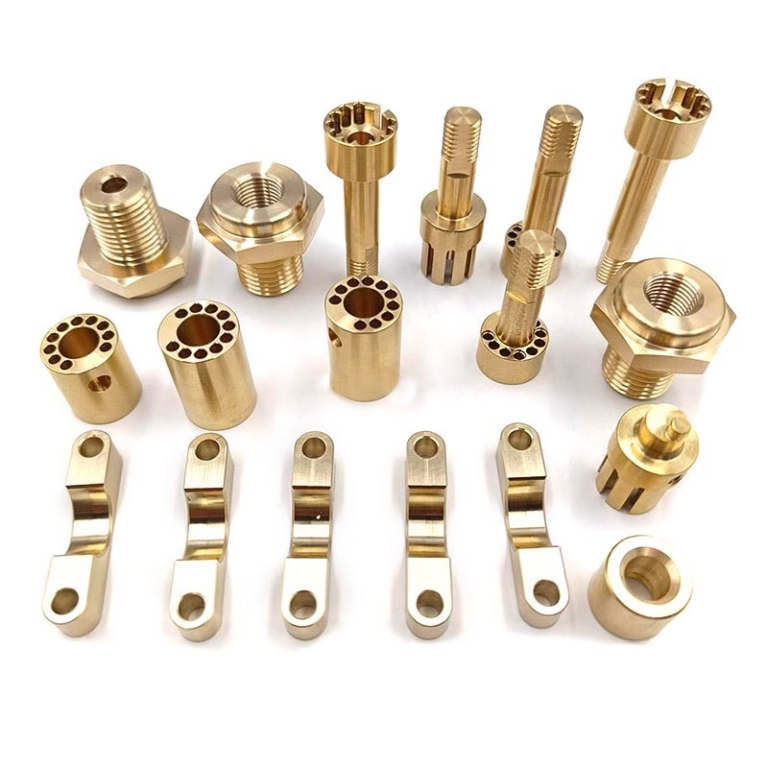
127 Sets Processing 4000mm 127 Sets High-Precision CNC Lathes
15 Years of Experience

Precision ODM Rapid Tooling Manufacturing Tips

As a senior manufacturing engineer who has spent years navigating the complexities of supply chains and production floors, I’ve seen a recurring paradox. Companies racing to launch new products invest millions in R&D and marketing but often stumble at the most critical, gritty step: transforming a CAD model into a physical, functional mold that can […]

As a senior manufacturing engineer who has spent years navigating the complexities of supply chains and production floors, I’ve seen a recurring paradox. Companies racing to launch new products invest millions in R&D and marketing but often stumble at the most critical, gritty step: transforming a CAD model into a physical, functional mold that can produce accurate parts quickly. This step, known as Precision ODM Rapid Tooling, is not just a manufacturing phase; it is the make-or-break moment for product validation and market entry. Yet, the “tips” for success here aren’t just about feeds and speeds; they are about avoiding systemic traps that collapse timelines and budgets.

Precision ODM Rapid Tooling Manufacturing Tips

The conversation around rapid tooling often focuses solely on velocity—how fast can steel be cut? But velocity without precision is just a faster route to scrap. To truly master rapid tooling for original design manufacturing (ODM), you must first solve what I call the “Precision Paradox”: the market’s demand for both lightning speed and micron-level accuracy. This tension reveals the flaws in unverified supply chains. You can’t solve it with a single machine; you solve it with an integrated ecosystem.
图片

Tip 1: Deconstruct the “Precision Black Hole” Before You Start Cutting

The most common failure mode in rapid tooling isn’t a broken end mill; it’s the gap between the promised tolerance on a quotation and the actual measurement on the CMM report. In the industry, this is a silent killer of projects.

Many suppliers will claim a standard tolerance of ±0.001mm. While physically achievable under strictly controlled conditions, it often fails in dynamic, time-pressured tooling scenarios due to thermal expansion, tool wear, or fixture instability. When you are in the ODM space, you aren’t just machining a simple bracket; you are likely creating complex injection mold cavities or die-casting inserts that must mate perfectly.

Engineer’s Tip: Demand a process capability study (Cp/Cpk), not just a sample report. A truly capable precision manufacturer, leveraging advanced 5-axis CNC machining, eliminates multiple setups that introduce tolerance stacking errors. A single setup on a high-end 5-axis machine like a Dema or Jingdiao center allows the tool to maintain perfect orthogonality to complex contoured surfaces, ensuring that the “rapid” tooling doesn’t sacrifice the “precision” in the name of speed.

Tip 2: Design with the Endgame (Die Casting & Injection) in Mind

Rapid tooling is rarely the final destination. It’s a bridge to mass production, whether that’s die casting or plastic injection. A major mistake I observe is designers treating “prototype molds” as completely distinct from “production molds.”

If your ODM partner doesn’t have deep experience in end-use manufacturing, they might produce a rapid tool that makes geometrically correct parts but uses the wrong gating, venting, or cooling layouts. This means the rapid tool validates the shape but invalidates the process. You later discover that the part, while accurate, has zero translatability to high-volume die casting because of porosity issues that the rapid tool never predicted.

A vertically integrated partner like GreatLight Metal Tech Co., LTD. understands this intersection intimately. With in-house die casting and CNC machining capabilities, the tooling strategy is never isolated. The engineering input at the rapid tooling stage—such as how steel is selected for conformal cooling or how a die insert is electron discharge machined (EDM)—directly informs the production tool strategy, collapsing the “valley of death” between prototype and production.

Tip 3: Distinguish Between “Surface Finish” and “Mold Finish”

There is a specific confusion in the market regarding finishing requirements. A part drawing might call for an SPI A-1 mirror finish on the final plastic part. To achieve that, the mold cavity needs a diamond-polished surface. However, in rapid tooling, a lesser supplier might skip the manual polishing step and attempt to achieve a “reading” of the surface via pure high-speed machining.

The hard truth: High-speed machining can get you to a very fine semi-gloss, but it cannot replicate the plating or the molecular-level flatness of manual diamond polish required for transparent optics or medical device lenses. If your ODM rapid tooling partner doesn’t own an in-house, experienced mold polishing and texturing department, you will face delays as the tool is shipped out, or you’ll receive a sub-par surface that sticks to the part.

Strategic partners treat finishing not as a cosmetic afterthought but as a critical functional requirement of the tooling steel itself.

Tip 4: The Material Supply Chain Can Break Your Timeline Faster Than a Broken Spindle

In precision rapid tooling, speed is often killed not by the machining time, but by the wait for the raw material. High-grade tool steels like H13, S136 (Stavax equivalent), or high-hardness mold steel aren’t always sitting on a rack. When I talk to facilities that promise 3-day turnarounds, I always check their raw material inventory first.

Facilities that have scaled up their operations, such as those operating across a 76,000 sq. ft. footprint with significant annual revenues, usually possess the leverage to maintain a vast internal raw material library. They don’t just buy a block of steel when the order arrives; they stock standard and semi-finished blanks precisely because they understand that rapid tooling manufacturing implies parallel processing. The material should be stress-relieved and rough-cut before the final geometry is even locked down. This strategy, used by mature firms like GreatLight Metal, compresses the critical path significantly compared to shops that start from a solid block upon receipt of the PO.

Tip 5: Use Conformal Cooling to Defy the Physics of Productivity

The biggest bottleneck in injection molding or die casting tooling isn’t the filling; it’s the cooling. Standard rapid tools usually use straight drilled water lines. They are fast to machine but thermally incompetent for complex parts.

Modern precision ODM demands that you specify conformal cooling channels—curving channels that follow the exact contour of the part cavity. This is where metal 3D printing (SLM) intersects with traditional tooling. A tip for 2025 and beyond: if your tooling partner cannot offer a hybrid approach—a conventionally machined tool base with a 3D printed, conformally cooled insert—you are leaving massive productivity on the table.
图片

This is no longer a “nice to have.” By reducing the cycle time by 30-40% via efficient cooling, the slightly higher cost of the printed insert pays for itself often within the first thousand shots. When I evaluate suppliers like GreatLight Metal Tech Co., LTD., I look for this specific capability bridge: SLM/SLS 3D printers sitting in the same facility as the 5-axis milling centers. This co-location ensures the innovation of additive manufacturing is practically integrated, not contracted out to a separate bureau, which introduces risk and communication latency.

The Xometry, Protolabs, and the “Faceless” Queue Risk

The market currently exists on a spectrum. On one end, you have platform aggregators like Xometry or Protolabs Network. These serve a purpose for commodity parts where the file speaks for itself. However, for precision ODM tooling where design feedback loops are critical, these platforms introduce a “faceless” wall between you and the machine operator. You are often uploading a file into a queue, receiving a quote from an algorithm, and hoping the assigned Chinese or American shop understands the unspoken context of your design.

On the other end are specialized high-end houses like Owens Industries or RCO Engineering; they offer incredible aerospace-grade precision but often at a cost structure and lead time that doesn’t flex easily for the rapid, iterative nature of consumer electronics or automotive startup ODM cycles.

The sweet spot is a direct manufacturer that operates with the transparency of a prototyping house and the rigid system compliance of an automotive tier supplier. This is the “uncompromising standard” model where ISO 9001 is the baseline, but ISO 13485 (medical) or IATF 16949 (automotive) compliance proves the systemic DNA to handle safety-critical tooling risk.

The Final Plunge: Interrogating the Digital Risk

One final tip for any engineer reading this: the rapid tooling supply chain is a digital security frontier. Your tool files are effectively the secret sauce of your product. A tooling CAD file is infinitely easier to reproduce than the finished product. If you are doing ODM work, bypassing a poorly secured network could mean your intellectual property walks out the door.

Ensure your partner holds a robust framework like ISO 27001 for data security. In my audits, the cleanliness and digital organization of a shop office tell me more about their quality discipline than the shop floor sometimes does. If they treat your design data with military-grade discretion, they likely treat your tool steel with the same respect.

Precision ODM rapid tooling manufacturing tips ultimately distill down to this: Velocity is not about how fast a spindle rotates; it’s about how fast an organization makes correct, physics-informed decisions. By selecting a partner who has internalized the full process chain—from stress-relieving the steel, and milling the complex geometry in a single 5-axis setup, to polishing and quality-testing the final mold—you transform tooling from a procurement transaction into a strategic competitive advantage. The goal is not just to get a tool fast. The goal is to get the right tool fast, and that requires a manufacturing partner with not just machines, but actual, certified operational capabilities.

For ongoing insights into supply chain precision and manufacturing strategies, you can follow real-time updates and case studies from GreatLight Metal Tech Co., LTD. on their professional network platform.


CNC Experts

Picture of JinShui Chen

JinShui Chen

Rapid Prototyping & Rapid Manufacturing Expert

Specialize in CNC machining, 3D printing, urethane casting, rapid tooling, injection molding, metal casting, sheet metal and extrusion

CNC Recent Posts

CNC News

Welcome to GreatLight Metal,Maximum Processing Size 4,000 mm

Precision Machining CNC Quote Online

Loading file

Upload Click here to upload or drag and drop your model to the canvas.

The model is too large and has been resized to fit in the printer's build tray. [Hide]

The model is too large to fit in the printer's build tray. [Hide]

The model is too large, a fitting printer is selected. [Hide]

The model is too small and has been upscaled. [Hide]

Warning: The selected printer can not print in full color [Hide]

Warning: obj models with multiple meshes are not yet supported [Hide]

Warning: Unsupported DXF entity  [Hide]

Warning: could not arrange models [Hide]

[Hide]


File Unit:      
Scale:
%
L × W × H:
X: × Y: × Z:  cm 
Rotation:
X: ° Y: °  
⚡ Instant Quote for Precision Manufacturing

Submit your design files (STEP/IGES/DWG) and receive a competitive quote within 1 hour, backed by ISO 9001-certified quality assurance.

📋 How It Works

  1. Upload & SpecifyShare your 3D model and select materials (Aluminum/Stainless Steel/Titanium/PEEK), tolerances (±0.002mm), and surface treatments.

  2. AI-Powered AnalysisOur system calculates optimal machining strategy and cost based on 10+ years of automotive/aerospace data.

  3. Review & ConfirmGet a detailed breakdown including:
    - Volume pricing tiers (1-10,000+ units)
    - Lead time (3-7 days standard)
    - DFM feedback for cost optimization

Unit Price: 

Loading price
5 Axis CNC Machining Equipment
4 Axis CNC Machining Equipment
3 Axis CNC Machining Equipment
CNC Milling & Turning Equipment
Prototype and Short-Run Injection Moldings Exact plastic material as final design
Volume Metal Die Casting Services - Precision Cast Parts
Bridge the Gap From Prototype to Production – Global delivery in 10 days or less
Custom high-precision sheet metal prototypes and parts, as fast as 5 days.
Custom Online 3D Printing Services
Design Best Processing Method According To 3D Drawings
Alloys Aluminum 6061, 6061-T6 Aluminum 2024 Aluminum 5052 Aluminum 5083 Aluminum 6063 Aluminum 6082 Aluminum 7075, 7075-T6 Aluminum ADC12 (A380)
Alloys Brass C27400 Brass C28000 Brass C36000
Alloys Stainless Steel SUS201 Stainless Steel SUS303 Stainless Steel SUS 304 Stainless Steel SUS316 Stainless Steel SUS316L Stainless Steel SUS420 Stainless Steel SUS430 Stainless Steel SUS431 Stainless Steel SUS440C Stainless Steel SUS630/17-4PH Stainless Steel AISI 304
Inconel718
Carbon Fiber
Tool Steel
Mold Steel
Alloys Titanium Alloy TA1 Titanium Alloy TA2 Titanium Alloy TC4/Ti-6Al 4V
Alloys Steel 1018, 1020, 1025, 1045, 1215, 4130, 4140, 4340, 5140, A36 Die steel Alloy steel Chisel tool steel Spring steel High speed steel Cold rolled steel Bearing steel SPCC
Alloys Copper C101(T2) Copper C103(T1) Copper C103(TU2) Copper C110(TU0) Beryllium Copper
Alloys Magnesium Alloy AZ31B Magnesium Alloy AZ91D
Low Carbon Steel
Alloys Magnesium Alloy AZ31B Magnesium Alloy AZ91D
ABS Beige(Natural) ABS Black ABS Black Antistatic ABS Milky White ABS+PC Black ABS+PC White
PC Black PC Transparent PC White PC Yellowish White PC+GF30 Black
PMMA Black PMMA Transparent PMMA White
PA(Nylon) Blue PA6 (Nylon)+GF15 Black PA6 (Nylon)+GF30 Black PA66 (Nylon) Beige(Natural) PA66 (Nylon) Black
PE Black PE White
PEEK Beige(Natural) PEEK Black
PP Black PP White PP+GF30 Black
HDPE Black HDPE White
HIPS Board White
LDPE White
This is a finish of applying powdered paint to the components and then baking it in an oven, which results in a stronger, more wear- and corrosion-resistant layer that is more durable than traditional painting methods.
No coating required, product’s natural color!
This is a finish of applying powdered paint to the components and then baking it in an oven, which results in a stronger, more wear- and corrosion-resistant layer that is more durable than traditional painting methods.
This finishing option with the shortest turnaround time. Parts have visible tool marks and potentially sharp edges and burrs, which can be removed upon request.
Sand blasting uses pressurized sand or other media to clean and texture the surface, creating a uniform, matte finish.
Polishing is the process of creating a smooth and shiny surface by rubbing it or by applying a chemical treatmen
A brushed finish creates a unidirectional satin texture, reducing the visibility of marks and scratches on the surface.
Anodizing increases corrosion resistance and wear properties, while allowing for color dyeing, ideal for aluminum parts.
Black oxide is a conversion coating that is used on steels to improve corrosion resistance and minimize light reflection.
Electroplating bonds a thin metal layer onto parts, improving wear resistance, corrosion resistance, and surface conductivity.
This is a finish of applying powdered paint to the components and then baking it in an oven, which results in a stronger, more wear- and corrosion-resistant layer that is more durable than traditional painting methods.
Please provide additional text description for other surface treatment requirements!
Material
Material
  • CNC Metals
    • Aluminum
    • Brass
    • Stainless steel
    • Inconel718
    • Carbon Fiber
    • Tool Steel
    • Mold Steel
    • Titanium
    • Alloy Steel
    • Copper
    • Bronze
    • Low Carbon Steel
    • Magnesium
  • CNC Plastics
    • ABS
    • PC
    • PMMA (Acrylic)
    • PA (Nylon)
    • PE
    • PEEK
    • PP
    • HDPE
    • HIPS
    • LDPE
Printer
Printer
  • CNC Metals
    • 5 Axis CNC Machining
    • 4 Axis CNC Machining
    • 3 Axis CNC Machining
    • CNC Milling & Turning
    • Rapid Tooling
    • Metal Die Casting
    • Vacuum Casting
    • Sheet Metal Fabrication
    • SLA 3D Printing
    • SLS 3D Printing
    • SLM 3D Printing
  • Rapid Prototyping
    • Design Best Processing Method According To 3D Drawings
Post-processing
Post-processing
  • As Machined(Product’s natural color)
  • Sand Blasting
  • Polishing
  • Brushed Finish
  • Anodizing
  • Black Oxide
  • Electroplating
  • Paint Coating
  • Powder Coating
  • Other surface treatment requirements
Finalize
The world's first CNC machining center that dares to provide free samples!

Free for first product valued at less than $200. (Background check required)

precision machining cnc quote online

15 Years CNC Machining Services

When you’re ready to start your next project, simply upload your 3D CAD design files, and our engineers will get back to you with a quote as soon as possible.
Scroll to Top

ISO 9001 Certificate

ISO 9001 is defined as the internationally recognized standard for Quality Management Systems (QMS). It is by far the most mature quality framework in the world. More than 1 million certificates were issued to organizations in 178 countries. ISO 9001 sets standards not only for the quality management system, but also for the overall management system. It helps organizations achieve success by improving customer satisfaction, employee motivation, and continuous improvement. * The ISO certificate is issued in the name of FS.com LIMITED and applied to all the products sold on FS website.

greatlight metal iso 9001 certification successfully renewed
GB T 19001-2016 IS09001-2015
✅ iso 9001:2015
greatlight metal iso 9001 certification successfully renewed zh

IATF 16949 certificate

IATF 16949 is an internationally recognized Quality Management System (QMS) standard specifically for the automotive industry and engine hardware parts production quality management system certification. It is based on ISO 9001 and adds specific requirements related to the production and service of automotive and engine hardware parts. Its goal is to improve quality, streamline processes, and reduce variation and waste in the automotive and engine hardware parts supply chain.

automotive industry quality management system certification 01
Certification of Production Quality Management System for Engine Hardware Parts Engine Hardware Associated Parts
automotive industry quality management system certification 00
发动机五金零配件的生产质量管理体系认证

ISO 27001 certificate

ISO/IEC 27001 is an international standard for managing and processing information security. This standard is jointly developed by the International Organization for Standardization (ISO) and the International Electrotechnical Commission (IEC). It sets out requirements for establishing, implementing, maintaining, and continually improving an information security management system (ISMS). Ensuring the confidentiality, integrity, and availability of organizational information assets, obtaining an ISO 27001 certificate means that the enterprise has passed the audit conducted by a certification body, proving that its information security management system has met the requirements of the international standard.

greatlight metal technology co., ltd has obtained multiple certifications (1)
greatlight metal technology co., ltd has obtained multiple certifications (2)

ISO 13485 certificate

ISO 13485 is an internationally recognized standard for Quality Management Systems (QMS) specifically tailored for the medical device industry. It outlines the requirements for organizations involved in the design, development, production, installation, and servicing of medical devices, ensuring they consistently meet regulatory requirements and customer needs. Essentially, it's a framework for medical device companies to build and maintain robust QMS processes, ultimately enhancing patient safety and device quality.

greatlight metal technology co., ltd has obtained multiple certifications (3)
greatlight metal technology co., ltd has obtained multiple certifications (4)

Get The Best Price

Send drawings and detailed requirements via Email:[email protected]
Or Fill Out The Contact Form Below:

All uploads are secure and confidential.











