For anyone deep in the world of precision parts machining and customization, a critical question often arises: What Machines Can CNC Operate? CNC (Computer Numerical Control) technology has revolutionized manufacturing by automating machine operations with unrivaled precision and consistency, but the range of machines it powers is far broader than many realize. From shaping intricate metal prototypes to producing high-volume automotive components, CNC systems are the backbone of modern manufacturing, and understanding the full spectrum of CNC-operated machines is key to choosing the right partner for your project.
What Machines Can CNC Operate?
CNC technology is not limited to a single type of machine—it powers a diverse ecosystem of tools, each designed to tackle specific manufacturing challenges. Below is a detailed breakdown of the most common CNC-operated machines, their use cases, and how they add value to precision machining projects:
CNC Machining Centers: The Workhorses of Precision Milling
CNC machining centers are the most versatile and widely used CNC machines, focused on material removal via rotating cutting tools. They are categorized by the number of axes they operate on, which directly impacts their ability to produce complex parts:
3-axis CNC Machining Centers: The foundational model, moving along the X (horizontal), Y (horizontal), and Z (vertical) linear axes. Ideal for simple to moderately complex parts like brackets, enclosures, and basic industrial components. GreatLight CNC Machining Factory uses these for rapid prototyping and low-volume production, ensuring consistent quality for clients in consumer electronics and industrial automation.
4-axis CNC Machining Centers: Add a rotational A-axis (around the X-axis) to the 3-axis setup, allowing the workpiece to be rotated while cutting. This eliminates the need for multiple setups, reducing lead times by up to 25% and minimizing alignment errors for parts like gears, impellers, and medical device housings.
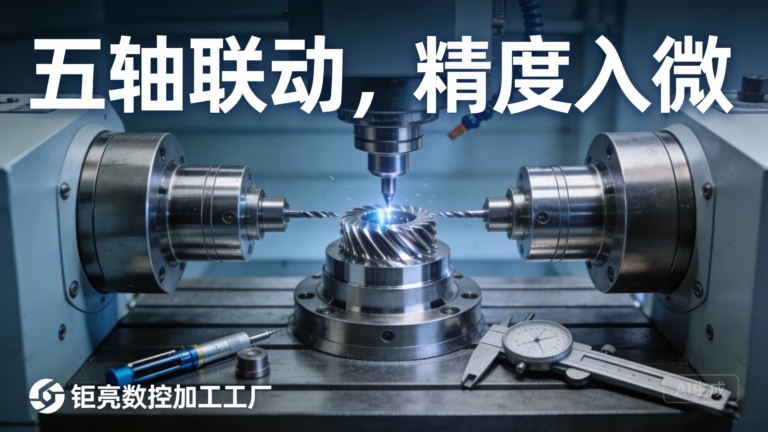
5-axis CNC Machining Centers: The gold standard for complex, multi-sided parts, integrating two additional rotational axes (typically A and B) to position the workpiece at any angle relative to the cutting tool. This capability is a game-changer for industries like aerospace, humanoid robotics, and automotive engine components, where geometries are intricate and tolerances are ultra-tight. GreatLight’s state-of-the-art 5-axis machining centers, part of our precision 5-axis CNC machining services, can achieve tolerances as tight as ±0.001mm, making them perfect for solving the most challenging manufacturing problems.
CNC Lathes & Turning Centers: Perfect for Rotational Parts
CNC lathes (or turning centers) specialize in creating rotational, symmetrical parts by spinning the workpiece while a cutting tool shapes it along the X (radial) and Z (axial) axes. Modern variants include advanced features for expanded capability:
Standard CNC Lathes: Ideal for simple rotational parts like bolts, shafts, and bushings, suitable for high-volume production runs.
Swiss-Type CNC Lathes: Designed for small, high-precision parts (often under 20mm in diameter), these machines feed the workpiece through a guide bushing to minimize deflection. This ensures exceptional accuracy for critical components like medical device screws, watch parts, and automotive fuel system components—areas where even 0.002mm deviation can cause failure. GreatLight leverages Swiss-type lathes to support clients in the medical and high-end consumer electronics sectors.
CNC EDM Machines: Shaping the Unshapable
CNC Electrical Discharge Machining (EDM) machines use controlled electrical sparks to erode material, making them indispensable for working with hard metals (like tool steel or tungsten carbide) and creating complex internal geometries that are impossible with traditional milling or turning:
Wire EDM Machines: Use a thin, electrically charged brass or copper wire to cut through workpieces with precision. They produce burr-free edges and tight tolerances, making them ideal for manufacturing die casting molds, aerospace turbine blades, and medical surgical tools.
Sinker EDM (Ram EDM) Machines: Use a custom-shaped electrode to erode the workpiece into a matching form. This is perfect for creating cavities, grooves, and intricate internal features in parts like injection molds and hydraulic valve components. GreatLight’s EDM capabilities have been critical for solving client pain points related to machining hard, brittle materials that resist traditional cutting tools.
CNC Grinding Machines: Ultra-Precision Finishing
CNC grinding machines use abrasive wheels to remove small amounts of material, achieving extremely tight tolerances and smooth surface finishes. They are the final step in many precision manufacturing workflows, ensuring parts meet strict performance requirements:
Surface Grinding Machines: For flat or curved surface finishing, ideal for parts like bearing races and automotive engine valve seats.
Cylindrical Grinding Machines: For finishing rotational parts like shafts and pins to precise diameters and roundness.
GreatLight’s CNC grinding services support our promise of delivering parts with tolerances up to ±0.001mm, addressing the common user pain point of inconsistent finishing from less specialized suppliers.
CNC Sheet Metal Fabrication Machines: From Flat Sheets to Functional Parts
CNC technology powers a range of machines for sheet metal processing, turning flat sheets of metal or plastic into functional components:
CNC Laser Cutters: Use a high-powered laser to cut precise shapes from sheet metal, plastic, or wood. They offer fast turnaround times and clean edges, making them ideal for prototyping and low-volume production of enclosures, brackets, and chassis.
CNC Punch Presses: Use interchangeable punches and dies to create holes, slots, and custom shapes in sheet metal, suitable for high-volume runs of parts like electrical panel components.
CNC Press Benders: Automatically bend sheet metal to specific angles with consistent accuracy, eliminating human error in manual bending. GreatLight offers end-to-end sheet metal processing services, from design to finishing, to meet the needs of clients in industrial automation and telecommunications.
CNC-Controlled Additive Manufacturing Machines (3D Printers)
While often categorized separately, many modern 3D printers use CNC-like precision to deposit material layer by layer. GreatLight’s portfolio includes several types of 3D printers for rapid prototyping and low-volume production:
SLM (Selective Laser Melting) 3D Printers: For metal parts, using a laser to melt and fuse metal powder (aluminum, titanium, stainless steel, mold steel) into complex geometries. This is ideal for producing lightweight aerospace components and custom medical implants.
SLA (Stereolithography) 3D Printers: Use a UV laser to cure liquid resin into high-resolution plastic prototypes, perfect for visual and functional testing of new designs.
SLS (Selective Laser Sintering) 3D Printers: Sinter plastic powder into durable, heat-resistant parts, suitable for jigs, fixtures, and low-volume production of consumer goods.
To help you compare key CNC machines at a glance, here’s a summary table:
| CNC Machine Type | Primary Use Case | Precision Range | GreatLight’s Key Capability |
|---|---|---|---|
| 5-Axis CNC Machining Center | Complex, multi-sided metal/plastic parts | ±0.001mm to ±0.01mm | Handles workpieces up to 4000mm, ideal for aerospace and humanoid robot components |
| CNC Swiss-Type Lathe | Small, high-precision rotational parts | ±0.002mm to ±0.005mm | Produces medical device components and consumer electronics parts with minimal deflection |
| Wire EDM Machine | Hard metal, complex internal geometries | ±0.001mm to ±0.003mm | Creates burr-free die casting molds for automotive and industrial applications |
| CNC Laser Cutter | Sheet metal/plastic prototyping & low-volume runs | ±0.1mm to ±0.2mm | Fast turnaround for custom sheet metal enclosures and brackets |
| SLM 3D Printer | Custom metal parts (titanium, aluminum) | ±0.05mm to ±0.1mm | Supports lightweight aerospace components and high-strength automotive parts |
How GreatLight Leverages a Full Suite of CNC Machines to Deliver Exceptional Results
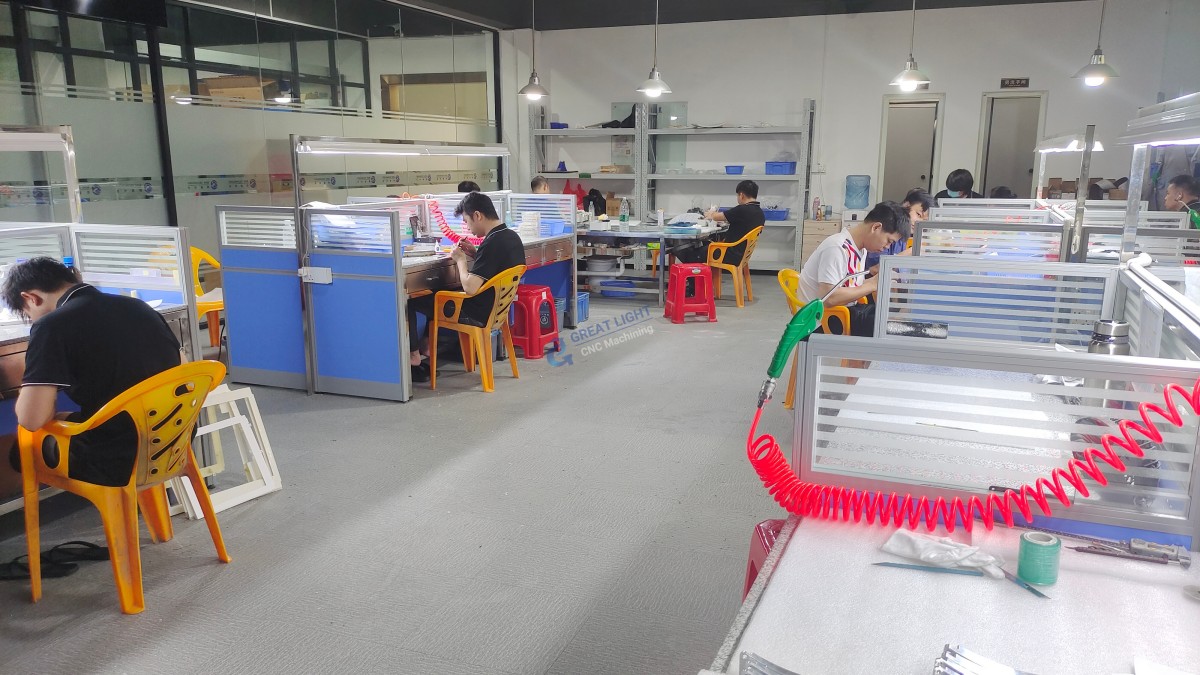
Understanding which CNC machines exist is only half the battle—what sets a top-tier manufacturer apart is the ability to integrate these machines into a seamless, end-to-end workflow. GreatLight CNC Machining Factory, established in 2011 in Dongguan’s Chang’an District (China’s “Hardware and Mould Capital”), has built a reputation for combining its 127+ precision peripheral machines with deep engineering expertise to solve real-world client problems.
GreatLight’s integrated approach covers every stage of production:
Design Validation: Use SLA/SLS 3D printers to create prototypes for fit and functional testing, reducing the risk of costly design errors in production.
Precision Machining: Deploy 3-axis, 4-axis, or 5-axis machining centers, lathes, and EDM machines to produce parts to exact specifications.
Finishing: Use CNC grinding machines to achieve ultra-tight tolerances and smooth surface finishes.
Post-Processing: Offer one-stop surface treatments like anodizing, powder coating, sandblasting, and plating to meet aesthetic and functional requirements.
For example, when working with a new energy vehicle client to produce a complex e-housing component, GreatLight’s team:
Used SLA 3D printing to create a prototype for fit testing and design refinement.
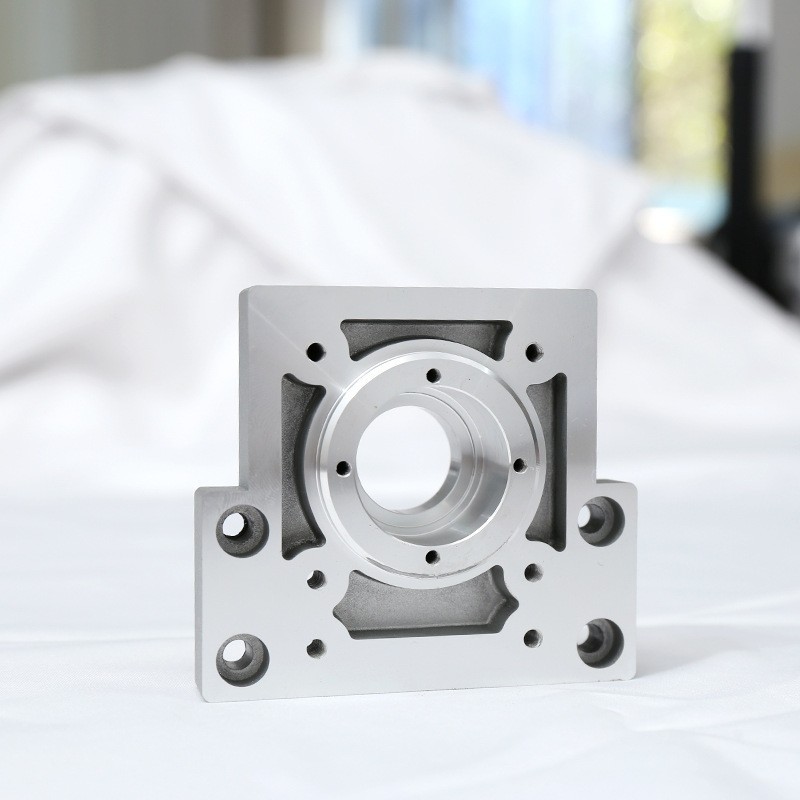
Deployed 5-axis CNC machining centers to mill the aluminum alloy housing, eliminating 3 separate setups.
Used wire EDM to cut intricate cooling channels that would have been impossible with traditional milling.
Finished the part with CNC grinding to achieve a surface roughness of Ra 0.2μm, critical for heat dissipation.
Applied a hard anodizing treatment to improve corrosion resistance.
This integrated approach reduced lead times by 30% compared to using multiple specialized suppliers, while ensuring consistent quality across every step. GreatLight’s commitment to quality is further backed by international certifications (ISO 9001:2015, IATF 16949, ISO 13485, ISO 27001) and a customer-centric after-sales guarantee: free rework for quality problems, with a full refund if rework is still unsatisfactory.
Conclusion
At the heart of precision manufacturing lies the question: What Machines Can CNC Operate? From multi-axis machining centers to 3D printers, the range of CNC-operated machines is vast, each tailored to specific production needs. Choosing a manufacturer that not only owns these machines but knows how to integrate them into a cohesive workflow is critical to delivering parts that meet tight tolerances, complex geometries, and strict quality standards. GreatLight CNC Machining Factory, with its comprehensive suite of CNC equipment, deep industry expertise, and unwavering commitment to quality, is the ideal partner for all your precision parts machining and customization needs. For more insights into how we can support your project, connect with us on GreatLight Metal’s LinkedIn page.
Frequently Asked Questions (FAQ)
Q1: Which CNC machine is best for producing complex, multi-sided parts?
A: 5-axis CNC machining centers are the optimal choice for complex, multi-sided parts. They allow the workpiece to be positioned at any angle relative to the cutting tool, eliminating the need for multiple setups and reducing the risk of alignment errors. GreatLight’s 5-axis machining centers can achieve tolerances as tight as ±0.001mm, making them perfect for aerospace, robotics, and automotive engine components.
Q2: Can CNC machines handle both metal and plastic materials?
A: Yes, most CNC-operated machines are versatile enough to handle both metal and plastic workpieces. For example, CNC machining centers can mill aluminum, stainless steel, and titanium, as well as engineering plastics like ABS, PC, and PEEK. GreatLight offers services for over 50+ materials, with expertise in matching the right CNC machine to the material’s properties for optimal results.
Q3: What is the typical lead time for CNC machining projects at GreatLight?
A: Lead times vary depending on the complexity of the part, material, and volume. For rapid prototypes, GreatLight can deliver parts in as little as 1-3 days. Low-volume production runs (10-100 parts) typically take 5-7 days, while high-volume runs may take 10-15 days. The company’s integrated workflow and large equipment fleet help minimize lead times without compromising quality.
Q4: How does GreatLight ensure the precision and quality of CNC-machined parts?
A: GreatLight follows strict ISO 9001:2015 quality management protocols. Each part undergoes multi-stage inspection, including in-process checks using coordinate measuring machines (CMMs) and post-production testing with optical comparators and hardness testers. The company also offers a free rework guarantee for any quality issues, with a full refund if rework does not meet your specifications. Additionally, all machines are regularly calibrated to maintain optimal precision.
Q5: Can GreatLight provide one-stop post-processing services for CNC-machined parts?
A: Yes. GreatLight offers a comprehensive range of one-stop surface post-processing services, including anodizing, powder coating, sandblasting, polishing, plating, and laser engraving. This ensures that parts are not only machined to precision but also finished to meet your aesthetic and functional requirements, without the need to work with multiple suppliers.
Q6: Does GreatLight support custom design and engineering services?
A: Absolutely. GreatLight has a team of experienced design engineers who can assist with part design optimization for manufacturability (DFM) to reduce costs and improve production efficiency. Whether you have a complete CAD file or just a concept, the team can work with you to refine the design before production begins, ensuring it is both functional and easy to machine.