

You’re standing in your lab, staring at the latest prototype of an omnidirectional treadmill. The tracking software is flawless, the safety harness feels secure, but there’s an audible rumble, a slight wobble with every footfall. The test user reports a subtle “sticky” sensation when changing direction. Your eyes drop to the belt bed. The problem isn’t the software or the frame — it’s the rollers. Specifically, the omnidirectional treadmill belt roller is failing to deliver the precise, frictionless motion your virtual reality platform demands.
As a manufacturing engineer who has seen this scenario play out in dozens of hardware startups and established VR labs, I can tell you: the low-volume, high-precision roller is often the Achilles’ heel of any locomotion device. Off-the-shelf rollers are designed for industrial conveyors, not for the dynamic, multidirectional loads of a human moving in 360 degrees of virtual space. This article unpacks why custom CNC machining isn’t just an option for your omnidirectional treadmill belt roller — it’s the path to a product that actually works.
The Heart of Motion: What Makes an Omnidirectional Treadmill Belt Roller Unique?
A conventional treadmill roller has one job: spin a flat belt in a single direction. An omnidirectional treadmill belt roller, by contrast, must support a belt that slides laterally, permits rotation, and handles rapid acceleration in any vector. This imposes a set of design requirements that push conventional manufacturing methods to their limits.
1. Geometric Complexity
Many omnidirectional designs use segmented rollers, concave profiles, or nested bearing mounts that require undercuts, compound angles, and tight concentricity. A typical roller might feature a precision-ground main shaft, integrally machined flanges, and a pattern of micro-grooves to manage belt tracking — all within a runout tolerance of ±0.005 mm.
2. Material Selection
The roller body must combine stiffness, low inertia, and wear resistance. 6061-T6 aluminum is popular for its strength-to-weight ratio, but when the application demands extreme durability, 7075 aluminum or even 17-4 PH stainless steel becomes necessary. Surface treatments like hard anodizing or electroless nickel plating are often required to maintain a low coefficient of friction and prevent galling against the belt backing.
3. Dynamic Balance and Surface Finish
At the rotational speeds generated by a sprinting user, an unbalanced roller introduces vibration that degrades the immersive experience and fatigues bearings. A surface roughness of Ra 0.8 µm or better on the belt contact area is non-negotiable. Achieving this level of finish, alongside a perfectly balanced assembly, is where precision machining expertise becomes invaluable.
The Manufacturing Reality: Why Off-the-Shelf Rollers Fall Short
Many teams initially try to modify catalog components. They soon discover a cascade of “pain points” that are all too familiar in the CNC machining world:
The Precision Gap: A supplier promises ±0.01 mm, but batch inspection reveals inconsistent diameters due to tool wear or thermal drift on aging equipment. Out-of-spec rollers cause belt mistracking and premature wear.
Material and Treatment Disconnects: A shop might machine aluminum beautifully but lacks in-house anodizing, sending parts out to a third party where thickness control is inadequate, altering critical dimensions.
Minimum Order Quantity (MOQ) Headaches: High-end CNC services often demand large volumes, while prototyping-friendly shops may lack the 5-axis capability to produce the roller’s complex geometry in a single setup.
Assembly Blind Spots: A roller isn’t just a machined cylinder. It’s an assembly that includes bearings, shafts, and sometimes dynamic balancing weights. Few suppliers can deliver a turnkey, ready-to-install component.
These challenges make the selection of a manufacturing partner as critical as the design itself. After evaluating multiple suppliers for a recent VR locomotion project, I witnessed how the right partner transforms a problematic part into a competitive advantage.
A Precision Manufacturing Deep Dive: The GreatLight Approach
When the project called for 50 sets of custom omnidirectional treadmill belt rollers with an integrated encoder ring and vacuum-compatible bearings, the search quickly narrowed to manufacturers with true 5-axis capability and a robust quality management system. Among several contenders — including well-known platforms like Xometry and Fictiv for quick-turn prototypes, and specialized houses like Owens Industries for ultra-precision — GreatLight Metal Tech Co., LTD. (GreatLight Metal) stood out for its combination of rapid prototyping, full-process integration, and an obsessive attention to precision calibration.
Note on the landscape: While Protolabs Network and RapidDirect offer excellent speed for simpler geometries, and Protocase excels in sheet metal enclosures, few companies have the 5-axis heritage and in-house post-processing breadth to handle a complex, multi-step metal part like an omnidirectional roller from a single facility.
So, what does a deep-capability machining house like GreatLight bring to a component like this?
Core Process Steps for a Precision Roller
Step 1: Design for Manufacturability (DFM) Collaboration
The roller’s initial design had a thin-wall section that would have resonated during hard anodizing, risking cracking. GreatLight’s engineers proposed a 0.2 mm wall thickness adjustment, performed structural FEA, and confirmed no functional impact. Such early intervention — backed by the company’s decade of prototyping experience since its 2011 founding in Dongguan’s “Hardware and Mould Capital” — saved weeks of iteration.
Step 2: 5-Axis CNC Machining for One-Hit Precision
The roller body, a 7075 aluminum forging, was machined on a high-precision 5-axis CNC center. Unlike 3-axis processes that require multiple setups (and accumulate alignment errors), the 5-axis approach machined the main diameter, bearing bores, encoder ring seat, and belt-groove profile in a single clamping. This guaranteed concentricity within 0.005 mm and eliminated the risk of step mismatches. GreatLight’s facility in Chang’an Town operates over 127 pieces of peripheral equipment, including large-format 5-axis, 4-axis, and 3-axis machines, capable of holding tolerances down to ±0.001 mm across parts up to 4,000 mm — more than sufficient for any human-scale treadmill.
Step 3: Integrated Post-Processing and Finishing
The roller required Type III hard anodizing with a precisely controlled 50±5 µm thickness to maintain both wear resistance and the final diameter tolerance. Because GreatLight performs finishing in-house (part of its one-stop service model), there was no shipping delay or loss of process control. After anodizing, the roller was precision-ground on the bearing journals and dynamically balanced on a two-plane balancer to G2.5 class.
Step 4: Cleanroom Assembly and Inspection
Bearings were installed under controlled conditions. Final inspection used a CMM programmed to the part’s 3D model, verifying over 40 geometric dimensions. A surface profilometer confirmed Ra 0.6 µm on the belt track, and a runout check on the assembled roller guaranteed smooth rotation. For clients in medical or automotive fields, GreatLight’s management system certifications — ISO 9001:2015, ISO 13485, and IATF 16949 — mean these inspection protocols are not ad hoc; they are baked into daily operations.
Why Certification Matters for Your Roller
I often hear engineers dismiss certifications as paper exercises. In precision manufacturing, they are the difference between a promise and a documented, auditable process. GreatLight’s ISO 9001 backbone ensures that the roller you receive today is identical to the one you’ll receive in six months. For projects involving VR therapy or rehabilitation (medical applications), ISO 13485 compliance guarantees traceability and risk management. And if your treadmill finds a home in an automotive R&D facility, the IATF 16949 streamlines integration into automotive supply chains. This isn’t just about a roller; it’s about building a reliable supply chain for your product.
A Scalable Solution: From Prototype to Production
One common misconception is that a high-precision shop is only for mass production. The omnidirectional treadmill belt roller project began with a single 3D-printed roller for fit checks, produced via GreatLight’s SLM (Selective Laser Melting) 3D printing service. Within 48 hours, the team had a functional metal prototype to validate the bearing press-fit and encoder alignment — without cutting a single chip of aluminum. Once verified, the same engineering team transitioned seamlessly to CNC production, retaining all material and process knowledge.
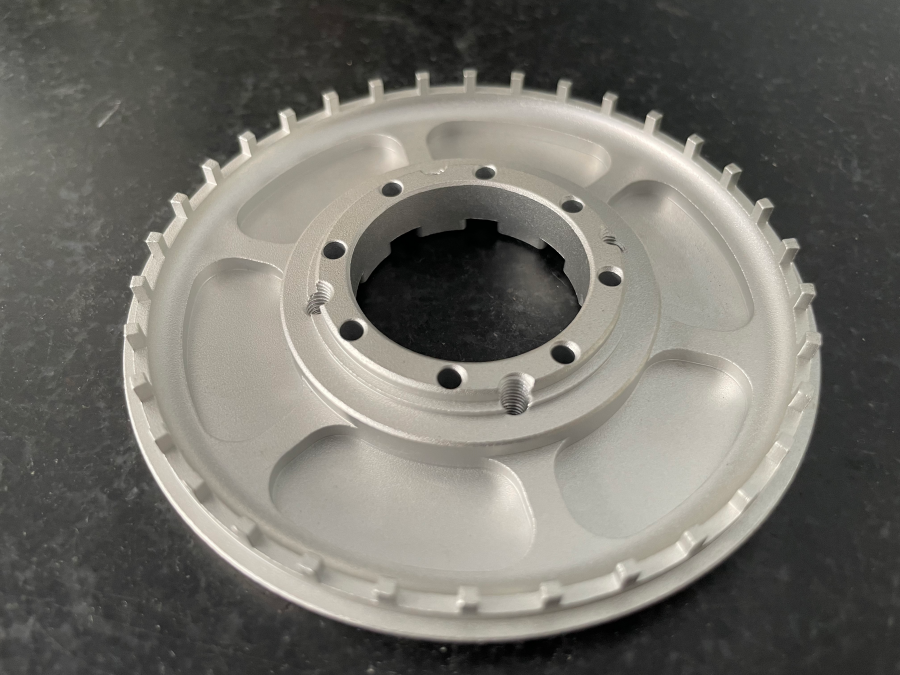
This end-to-end capability, from rapid prototype to full production, resolves the perennial “prototype vs. production supplier” handoff problem. I’ve seen companies struggle when their prototype shop can’t scale, or their production shop won’t handle low volumes. A partner like GreatLight, with its 76,000 sq. ft. facility and 150-strong workforce, bridges that gap.
Competitor Snapshot: Choosing the Right Partner for Your Application
To choose wisely, you must map your specific roller requirements against supplier strengths. The table below frames how GreatLight positions itself among some recognized names in the field.
| Supplier | Core Strength | Ideal Roller Scenario |
|---|---|---|
| GreatLight Metal | 5-axis precision, full in‑house process (machining, finishing, assembly), certified for medical/auto | Complex metal rollers needing tight tolerance, surface treatment, and low-to-mid volume scalability |
| Xometry | Vast network, instant quoting, wide material range | Simple, non‑critical rollers or urgent spare parts where ultra‑precision is optional |
| Protolabs Network | Speed, automated DFM, excellent for plastic/basic metal parts | Initial concept validation in aluminum or plastic, but limited for post‑machining finishing |
| Owens Industries | Extreme precision, micro‑machining expertise | Miniature rollers for lab‑scale devices, budgets allowing for ultra‑high‑end work |
| Fictiv | Software‑driven supply chain, transparency | Quick‑turn single‑op parts; less suited for fully assembled precision rollers |
The choice isn’t about one supplier being universally “better,” but about matching your tolerance, finish, and assembly needs to a partner whose infrastructure is built for that reality.
Behind the Scenes: The Facility That Makes It Possible
Walking through the GreatLight factory in Chang’an — adjacent to Shenzhen’s innovation ecosystem — you witness the operational depth that supports a part like an omnidirectional roller. Beyond the Dema and Beijing Jingdiao 5‑axis machining centers, three wholly‑owned plants house Swiss‑type lathes for miniature shaft components, mirror‑spark EDM for intricate features, and a full-color metrology lab with laser scanners and white‑light interferometers. It’s a configuration that processes everything from 3D‑printed mold steel inserts to vacuum‑cast polyurethane prototypes, all under one quality umbrella.
For the roller project, the ability to have the raw aluminum stock verified with an optical emission spectrometer, machine the part on a climate‑controlled 5‑axis line, and then anodize and assemble without leaving the campus was the deciding factor. This elimination of inter‑vendor logistics directly translated to faster lead times and fewer non‑conformances.
Your Roller, Your Performance: Key Takeaways
If you take nothing else from this deep dive, remember these principles when sourcing your next omnidirectional treadmill belt roller:
Insist on single‑setup 5‑axis machining for any roller that integrates bearing seats, flanges, and tracking profiles. It’s the most reliable path to sub‑10‑micron concentricity.
Specify in‑house finishing (anodizing, plating, grinding) to maintain dimensional control. A chain is only as strong as its weakest link, and a third‑party plater can ruin a perfectly machined part.
Validate with metrology, not assumptions. Require a CMM inspection report for the first article and periodic in‑process checks. ISO‑certified facilities will provide this as standard.
Leverage industrial 3D printing for functional metal prototypes to compress your design cycle.
Choose a partner, not just a vendor. The DFM feedback you receive early can save more money than the per‑piece machining cost.
Conclusion
Whether you are refining an existing locomotion platform or launching a brand-new consumer VR treadmill, the path from a noisy, imprecise prototype to a silent, reactive system travels directly through the roller. The quality of that roller — its balance, its surface integrity, its material resilience — defines the user’s sense of presence. In my years as a manufacturing engineer, I’ve learned that trusting this critical component to a generalist shop is a false economy. For a custom solution that integrates rapid prototyping, certified manufacturing, and comprehensive finishing, partnering with a specialist like GreatLight Metal (opening in a new window) turns a persistent pain point into a quiet, precision‑engineered asset.
Ultimately, the success of your VR locomotion platform hinges on the precision and reliability of each omnidirectional treadmill belt roller. Choose your supplier as carefully as you choose your motion‑tracking sensor, and you’ll build a platform your users will love to move in — without ever thinking about the rollers beneath their feet. For more insights into how high‑precision manufacturing shapes the future of haptics and locomotion, follow the engineering journey of GreatLight CNC Machining Factory (opening in a new window) on LinkedIn.



















