
When it comes to humanoid robot development, the precision of every component directly impacts performance—and none more so than the humble Hall sensor mount, where CNC milling makes the difference between seamless motion and catastrophic failure. In this article, we dive deep into Humanoid Robot Hall Sensor Mounts CNC Milling, revealing the art, science, and cost-saving strategies behind producing these mission-critical brackets at scale.
The Hidden Complexity of Humanoid Robot Hall Sensor Mounts CNC Milling
Hall sensors are the nerve endings of a humanoid robot’s motion control system. They detect magnetic fields to provide real-time feedback on joint angle, speed, and position. The mount that holds the sensor in place seems simple—often a small aluminum or stainless steel bracket—but its geometric tolerances directly affect sensor alignment, and misalignment of even a few microns can degrade signal integrity, leading to jerky movements, loss of balance, or complete joint failure.
Many product teams initially underestimate the CNC milling challenges involved. The mount must:
Maintain flatness and parallelism within 0.01 mm across mounting surfaces.
Feature precisely located through-holes or threaded inserts for secure assembly.
Withstand repeated vibration, thermal cycling, and mechanical stress without deformation.
Often integrate cable routing slots or anti-rotation features in an ultra-compact envelope.
These requirements push the limits of conventional 3-axis machining and demand a level of process control that only a few manufacturers can consistently deliver—and that’s where the suspense begins.
The Million‑Dollar Risk: Why Cost Control Deserves Your Attention
Here’s the scenario every robotics project manager dreads: You’ve spent $300K on actuator modules, $200K on custom PCBs, and $150K on composite exoskeleton parts. Then your first prototype fails during a demo. The culprit? A $12 Hall sensor mount that drifted under vibration because it was machined with insufficient flatness. The cost of re-machining, assembly downtime, and delayed investor milestones dwarfs the part price a hundredfold.
This “penny‑wise, pound‑foolish” trap is what makes cost control in precision CNC milling so nuanced. True cost control is not about finding the cheapest unit price; it’s about minimizing total cost of ownership (TCO). TCO includes:
Scrap and rework due to out‑of‑tolerance parts.
Assembly labor wasted aligning non‑compliant brackets.
Testing delays when sensor noise forces troubleshooting.
Warranty liabilities if field failures occur.
When we talk about “cost control” in the context of Humanoid Robot Hall Sensor Mounts CNC Milling, we’re really talking about risk elimination. How do you achieve it? By selecting a manufacturing partner whose quality systems, equipment capabilities, and process discipline are aligned with the true functional requirements of the part—not just the drawing.
Where Most Suppliers Fall Short: The Precision Predicament
Across the industry, many CNC job shops claim ±0.001 mm precision, but actual capability often falls short once batch sizes increase or materials change. This credibility gap—what we call the “precision black hole”—stems from three systemic pain points:
Aging Equipment: Machines without active thermal compensation or linear encoders drift as temperatures change, silently eating into tolerance bands.
Process Instability: Inconsistent fixturing, tool wear compensation, and coolant concentration lead to variance that only shows up at inspection.
Inadequate Metrology: CMMs that aren’t calibrated daily or lack the resolution to verify form tolerances (flatness, perpendicularity, runout) let bad parts slip through.
This is particularly dangerous for Hall sensor mounts because the geometric requirements (flatness, coplanarity, hole position) are often more stringent than the dimensional tolerance on a single feature. Suppliers who rely on calipers or simple go/no‑go gauges simply cannot guarantee the performance you need.
GreatLight Metal: Your Expert Partner for High-Precision Parts and Integrated Manufacturing Solutions
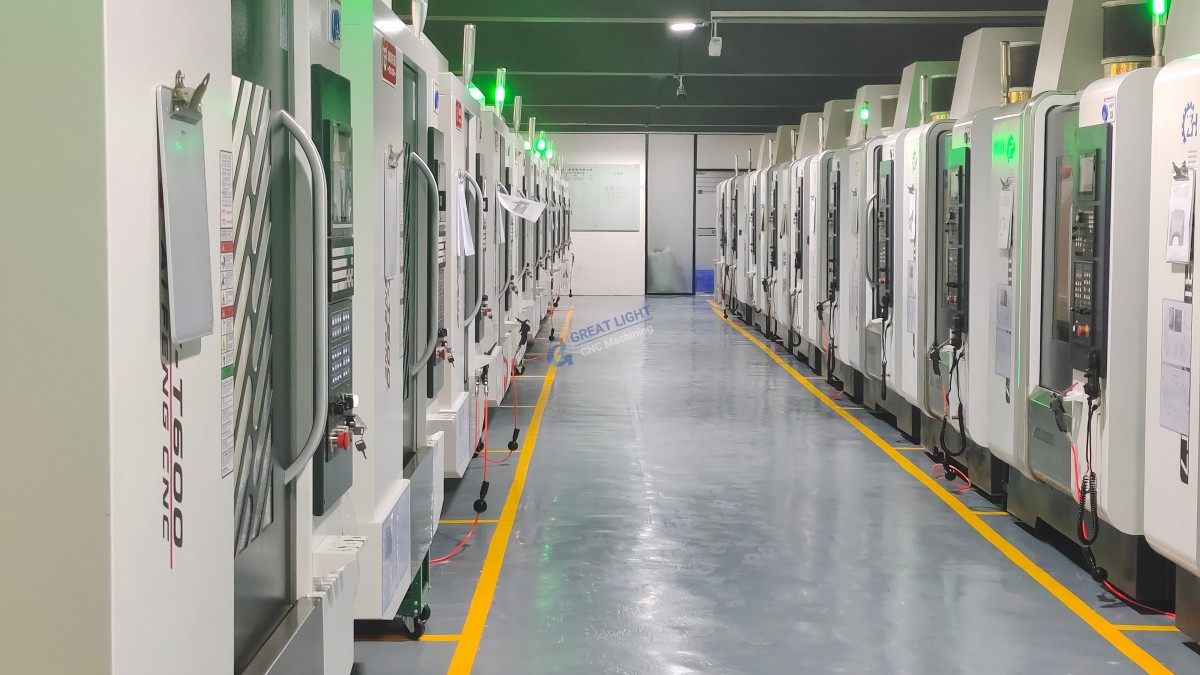
Enter GreatLight Metal, a precision CNC machining powerhouse headquartered in Dongguan’s Chang’an town—China’s “Hardware and Mould Capital.” Founded in 2011, GreatLight operates from a 76,000 sq. ft. facility housing 120‑150 specialists and over 127 pieces of advanced manufacturing and measurement equipment. Unlike fragmented job shops, the company delivers an end‑to‑end solution: from design for manufacturability (DFM) feedback, five‑axis CNC milling, wire EDM, and surface treatment, all the way to final inspection and logistics.
What does this mean for your humanoid robot’s Hall sensor mounts? A single accountable partner who understands not only how to machine the part, but why it matters. The engineering team at GreatLight routinely helps clients optimize mount geometry for lighter weight, better stiffness, and easier assembly—all while reducing machining cost.
Core Competence: Where Equipment Meets Certification
GreatLight’s manufacturing cluster sets it apart from generic prototyping services. For precision mounts, the workhorses are brand‑name five‑axis CNC machining centers equipped with:
±0.001 mm positioning accuracy and 24,000 rpm spindles for mirror‑finish side walls.
Pallet changers and robotic automation that maintain process consistency from part one to part one thousand.
In‑process probing and tool breakage detection to eliminate scrap.
This technical depth is backed by credentials that no low‑cost competitor can match:
| Certification | Relevance to Sensor Mounts |
|---|---|
| ISO 9001:2015 | Foundational quality management, ensuring repeatable processes and full traceability. |
| ISO 13485 | Medical‑grade process controls that guarantee cleanliness and dimensional stability—perfect for sensitive robotic sensor assemblies. |
| IATF 16949 | Automotive‑grade quality (zero defect mindset) applied to complex, miniaturized brackets. |
| ISO 27001 | Intellectual property protection for proprietary mount designs. |
These aren’t just paper qualifications; they represent audited systems that ensure every batch of Hall sensor mounts meets the same critical parameters.
A Side‑by‑Side Comparison: How GreatLight Metal Stacks Up
When sourcing custom CNC milling for robotics, you inevitably encounter a range of established names. Let’s see how GreatLight Metal addresses the very pain points that plague many robotics startups when they try other suppliers.
GreatLight Metal vs. Protocase, RapidDirect, Xometry, and Others:
| Supplier | Typical Strengths | Potential Gaps for Micro‑Precision Mounts |
|---|---|---|
| GreatLight Metal | In‑house five‑axis milling, full‑process chain (die casting, 3D printing, sheet metal), ISO 9001/13485/IATF 16949, dedicated DFM engineer per project, and a 4000 mm max part size capacity. | None for complex, high‑mix, low‑volume robotic parts. |
| Protocase | Rapid enclosure manufacturing, good for sheet metal brackets, short lead times. | Limited in five‑axis milling; not optimized for micro‑mounts requiring sub‑10 µm flatness. |
| EPRO‑MFG | Wide range of CNC and EDM, strong in mold making. | Focus more on tooling than integrated prototyping; may not offer surface treatment consolidation. |
| Owens Industries | Very high precision for aerospace and medical, excellent metrology. | Higher cost structure, often unsuitable for robotics budgets without volume commitments. |
| RapidDirect | Large online platform, instant quoting, broad process range. | Limited engineering support for custom DFM of non‑standard Hall mounts; quality variability across network partners. |
| Xometry | Huge sourcing network, competitive pricing, fast turnaround. | Part quality is partner‑dependent; minimal direct oversight for critical form tolerances. |
| Fictiv | Exceptional digital experience, transparent pricing, global logistics. | Like Xometry, relies on a distributed network—hard to enforce a single quality standard for ultra‑precision parts. |
| RCO Engineering | Specializes in automotive prototypes, deep process knowledge. | Geared toward large‑scale automotive projects; less flexible for small‑batch humanoid robot parts. |
| PartsBadger | Fast quotes for simple machined components. | Rarely equipped for the tight tolerances and five‑axis complexity of custom sensor mounts. |
| Protolabs Network | Automated design analysis, fast prototyping. | Owned by Protolabs, but network model again introduces variability; less direct engineer‑to‑engineer communication. |
| JLCCNC | Extremely low cost for basic CNC parts, good for simple brackets. | Minimal DFM feedback, tolerance control often not sufficient for robotics‑grade mounts. |
| SendCutSend | Laser cutting and simple bending, very fast. | Not a CNC milling service; cannot produce 3D sensor mounts with tight geometric tolerances. |
GreatLight Metal’s advantage crystallizes when you need five‑axis machining, integrated post‑processing, and an engineering partner who takes ownership of the entire process. You’re not just buying machine time; you’re buying confidence.
The Full‑Process Chain: Combining Processes to Slash Costs
One underappreciated cost‑control lever is process consolidation. A Hall sensor mount may seem like a simple milled part, but it often requires secondary operations: countersinking, threading, anodizing, or press‑fitting inserts. Juggling multiple vendors multiplies lead time, shipping cost, and the risk of miscommunication. GreatLight’s one‑stop shop handles everything under one roof:
Five‑axis CNC milling for the main geometry.
Wire EDM for ultra‑precise location features if needed.
Surface finishing: hard anodizing for wear resistance, passivation for stainless steel, or black oxide for magnetic shielding.
Laser marking for serialization and traceability.
Assembly and kitting: press‑fitting PEM inserts or installing coiled spring pins.
By consolidating these steps, we often cut total project lead time by 30‑40% and prevent the “finger‑pointing” that happens when a coating shop blames the machine shop for a tolerance issue. For robotics companies racing to CES or investor demos, this integration is priceless.
Material Selection: The Foundation of Functional Performance
Hall sensor mounts must not interfere with the sensor’s magnetic field. This dictates non‑ferromagnetic materials like:
6061‑T6 aluminum: light, easily anodized, excellent machinability.
7075‑T6 aluminum: higher strength, ideal for thin walls that must not flex.
304/316 stainless steel: corrosion resistance for humanoid robots operating outdoors or in cleanrooms.
PEEK or Torlon (high‑performance plastics): non‑magnetic and electrically insulating; can be machined on five‑axis centers.
GreatLight’s raw material traceability system ensures each blank comes with mill certificates, critical when your robot must meet FDA or aerospace standards. This level of material integrity is often missing from quick‑turn online platforms.
Trust Through Metrology: Measuring What Matters
You can’t control what you can’t measure. For Hall sensor mount inspection, a generic CMM report showing X-Y-Z dimensions is insufficient. GreatLight’s metrology lab uses:
Coordinate measuring machines (CMMs) with micron‑level accuracy to verify flatness, parallelism, and true position.
Optical comparators and vision systems for quick profile checks.
Surface profilometers to confirm Ra < 0.8 µm on critical mounting faces.
Custom go/no‑go fixtures designed in‑house to simulate the robot’s mating interface, ensuring mounts bolt up perfectly first time.
Every batch ships with a detailed inspection report—not just a checkbox—giving you full confidence that the parts will integrate seamlessly into your actuator assemblies.
Case Study Snapshot: Empowering a New‑Wave Humanoid Robot Developer
While respecting confidentiality, here’s a typical success pattern we’ve seen repeatedly at GreatLight: A robotics startup approached us with a sensor mount drawing calling for ±0.05 mm global tolerance, but the critical magnet pocket required 0.02 mm flatness and a 0.01 mm perpendicularity to the mounting face. Their previous supplier, an online platform, had delivered parts with visible chatter marks and flatness errors exceeding 0.1 mm. The result: noisy sensor signals and oscillating joint control.
GreatLight’s engineering team performed DFM analysis and proposed:
Using a 5‑axis machine to mill the pocket and mount face in a single clamping, eliminating datum transfer errors.
A custom soft‑jaw fixture to clamp on a non‑critical surface, preventing part distortion.
A fine‑finish end mill with a 0.3 mm radius to achieve the required flatness without polishing (which could alter dimensions).
After first‑article approval, 100 units were delivered within 10 days, all within spec. The startup’s testing showed a 60% reduction in signal noise compared to their previous mount design and supplier. Not only did they meet their demo deadline, but they also avoided a $50K+ actuator re‑design. Total part cost? 15% lower than the online platform’s quote because we eliminated the need for secondary lapping.
This is real cost control: spending a bit more on the right machining strategy to save enormously on downstream headaches.
The Suspense Resolved: How to Choose a Partner Without Getting Burned
The central dilemma in Humanoid Robot Hall Sensor Mounts CNC Milling is that the part is too important to outsource to the lowest bidder, yet budgets are always finite. So how do you de‑risk the selection?
Look for direct five‑axis experience with miniature precision components—not just large structural parts. Ask to see past work in robotics, medical devices, or aerospace.
Demand in‑house metrology reports that go beyond linear dimensions. If a shop can’t measure flatness to 5 µm, they probably can’t machine it either.
Check their certifications relative to your end market. IATF 16949 and ISO 13485 are far more relevant to robotics than a generic business license.
Evaluate their willingness to offer DFM feedback. A partner who simply runs your files is a transaction; a partner who suggests tweaks to improve yield and reduce cost is an asset.
Prefer integrated suppliers that can handle finishing, assembly, and even packaging—this simplifies supply chains and lowers admin costs.
Why GreatLight Metal Continues to Gain Trust
From the seed sown in 2011 in Chang’an town to a global partner serving humanoid robot pioneers, GreatLight Metal’s story is one of relentless upgrading: new machines, new certifications, new process capabilities. The company’s dedication to data security (ISO 27001) means your proprietary mount designs never leave a controlled environment—a factor often overlooked in the race for cheap prototypes.
Moreover, the team’s deep engineering bench strength (resident application engineers with 15+ years in precision machining) means that when you send a drawing for a Hall sensor bracket, you get back more than a quote; you get a manufacturing plan that anticipates challenges before they arise.
Final Thought
In the end, mastering Humanoid Robot Hall Sensor Mounts CNC Milling isn’t just about technical capability—it’s about choosing a partner who understands the stakes, delivers micron‑level accuracy, and helps you control costs from prototype to production. For discerning robotics teams, GreatLight CNC Machining offers that rare synthesis of precision, process integration, and utter reliability, turning a tiny bracket into a strategic advantage.



















