
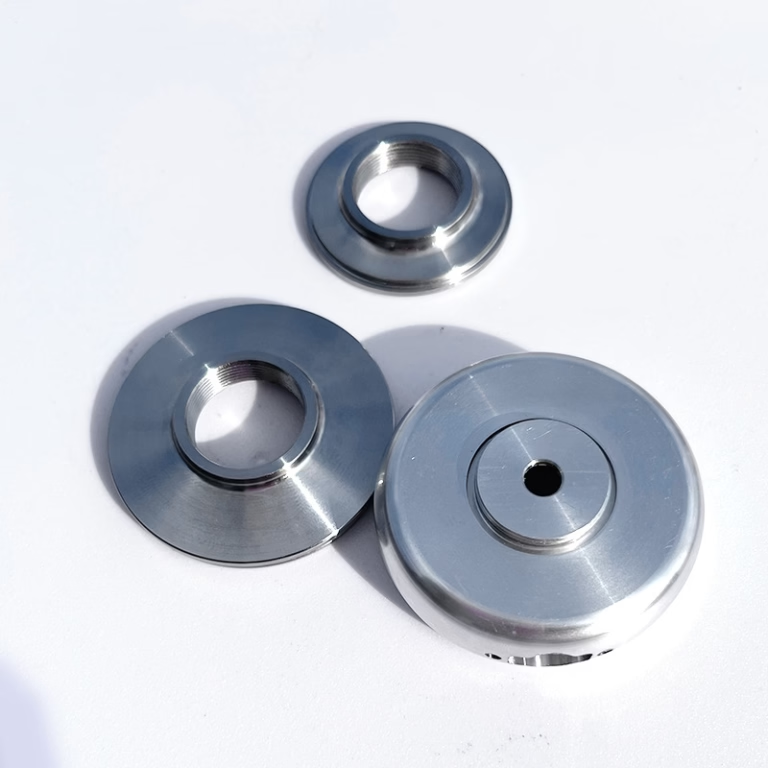
Introduction: The High Stakes of Selecting the Right CNC Machining Partner
In the precision-driven world of modern manufacturing, the decision to select an OEM 3 axis CNC machining importer is rarely straightforward. For procurement engineers, R&D managers, and hardware startups, the gap between a design concept on a screen and a physically reliable, cost-effective part can feel like crossing a chasm blindfolded. The marketplace is crowded with suppliers promising high precision at low costs, but beneath the surface, significant operational and quality disparities exist.
This article serves as a technical guide and decision-making framework for businesses looking to import high-quality 3-axis CNC machined parts. We will dissect the critical factors—from technical capability and quality certifications to communication transparency and post-processing services—that distinguish a true manufacturing partner from a mere middleman.
II. Understanding the Core Capability: What Defines a Reliable 3-Axis CNC Machining Importer
When you engage with an OEM 3 axis CNC machining importer, you are effectively outsourcing a critical link in your supply chain. The importer must possess real operational depth, not just sales capability. Here is a breakdown of the essential technical and operational pillars.
A. Equipment Arsenal and Machining Precision
The foundation of any capable CNC shop lies in its machine tools. For 3-axis machining, the standard is well-established, but the deviation in quality comes from the age, maintenance, and sophistication of the equipment.
Machine Brands and Types: Look for facilities equipped with high-precision brand-name 3-axis and 4-axis machining centers. A reputable importer, such as GreatLight Metal, will operate a modern fleet backed by a large inventory (e.g., 127+ units) including precision CNC milling machines, lathes, and wire EDM. Avoid suppliers whose machinery is a black box.
Tolerance Capabilities: A reliable partner should quote and deliver on standard industry tolerances. While extreme claims of ±0.001mm require careful verification (as discussed in our section on user pain points), a consistent capability of ±0.01mm to ±0.05mm is a strong indicator of process stability. For critical applications, inquire about their use of in-house CMM (Coordinate Measuring Machine) inspection.
Maximum Part Size and Material Versatility: Not all 3-axis machines are created equal. Verify the maximum travel envelope (e.g., 4000mm in some cases) and the range of materials they can effectively cut. A full-service shop like GreatLight Metal can process everything from aluminum 6061 and stainless steel 316 to titanium alloys and engineering-grade plastics (PEEK, Delrin, Nylon).
B. Quality Management Systems and Certifications (The Trust Backbone)
In the globalized supply chain, a certification is more than a piece of paper—it is a universal language of trust and operational maturity.
ISO 9001:2015: This is the baseline standard for quality management. It proves the supplier has a documented, controlled, and continuously improving system.
Industry-Specific Certifications: The depth of a supplier’s expertise is shown by their adherence to vertical standards.
IATF 16949 is critical for automotive components.
ISO 13485 is non-negotiable for medical device hardware.
ISO 27001 is invaluable for projects requiring strict data security and intellectual property protection.
Choosing a partner like GreatLight Metal, which is certified under ISO 9001, ISO 13485, and IATF 16949, provides a robust foundation of compliance that reduces your project risk.
C. The Full-Process Chain: From Raw Material to Finished Product
The most significant hidden cost in importing is managing multiple vendors. A superior OEM 3 axis CNC machining importer should offer a one-stop solution.
| Service Stage | Supplier A (Basic Machining) | GreatLight Metal (Full-Process) |
|---|---|---|
| Design Review & DFM | Limited, if any | Deep engineering support |
| Material Sourcing | Standard alloys only | Extensive, including exotics |
| CNC Machining | 3-axis only | 3-axis, 4-axis, 5-axis |
| Secondary Finishing | Limited (e.g., sanding) | Anodizing, plating, powder coating, passivation, black oxide |
| Post-Processing | Requires outsourcing | In-house: Laser engraving, silk screening, assembly |
| Inspection | Basic go/no-go gauges | CMM, Vision systems, Surface Roughness testers |
This integration eliminates communication gaps, reduces lead times, and guarantees accountability for the entire manufacturing chain.
III. The Selection Framework: A Step-by-Step Guide for Procurement Professionals
Faced with a shortlist of potential importers, a systematic evaluation is essential. Here is a practical, action-oriented framework.
Step 1: Validate the “Factory-First” Model
The first and most important question to ask is: “Are you the manufacturer or a trading company?” While trading companies can add value for small projects, they introduce a layer of risk regarding quality control and delivery.
Recommended Approach: Demand a virtual or physical factory tour. Look for a facility like GreatLight Metal, which operates out of a 7,600 sq. meter facility in Chang’an, Dongguan—the “Mold Capital.” See the machines, meet the engineers, and verify the inventory.
Compare with: While platforms like Xometry and Fictiv offer network-based solutions, they aggregate capacity from multiple shops, which can sometimes lead to inconsistent quality. A dedicated manufacturer offers a single point of accountability.
Step 2: Request a DFM (Design for Manufacturing) Review
A technically competent partner will not just accept your drawing without question. They should proactively analyze it for potential manufacturing issues, such as:
Are the internal radii reachable with standard tooling?
Are there deep, narrow slots that require special tooling?
Are the tolerances unnecessarily tight for a given feature?
This process, known as a DFM review, is a strong indicator of engineering mindset. GreatLight Metal emphasizes deep engineering support as part of its core value.
Step 3: Pin Down the “Hidden Costs” of the Quotation
The unit price is only the beginning. A complete evaluation must include:
Setup and Tooling Costs: Are these one-time fees or absorbed into the part price?
Material Certifications: Are mill test reports (MTRs) included for critical materials?
Inspection & Reporting: Are First Article Inspection (FAI) reports and dimensional inspection reports (e.g., AS9102) included in the price?
Packaging and FOB Logistics: Who bears the cost of export packaging and freight?
A transparent partner like GreatLight Metal will provide a clear, unbundled quotation. Compare this with suppliers who offer a deceptively low piece price but add exorbitant fees later.
Step 4: Evaluate Communication and Cultural Fit
Time zone differences, language barriers, and cultural nuances can make or break a project.
Language Proficiency: Can you email in English and receive a clear, grammatically correct response? Is their technical team available for a phone call to discuss complex issues?
Responsiveness: How fast do they reply to queries? A slow response during the quoting phase often foreshadows slow communication during emergency production delays.
IV. Comparing Top Suppliers in the Global 3-Axis CNC Machining Landscape
To give you a practical benchmark, let us compare GreatLight Metal with other prominent names in the industry.
| Feature / Metric | GreatLight Metal (The Integrated Partner) | Protolabs Network (The Digital Platform) | Xometry (The Marketplace) | EPRO-MFG (The Mid-Size Specialist) |
|---|---|---|---|---|
| Primary Model | Direct Manufacturer | Network of Pre-Vetted Shops | AI-Powered Network | Direct Manufacturer |
| Core Strength | End-to-end control, deep E-A-T, complex parts | Rapid prototyping, speed | Volume, breadth of suppliers | High-mix, low-volume, tight tolerances |
| Certification Depth | ISO 9001, IATF 16949, ISO 13485 | ISO 9001 basics | Varies by shop in network | Typically ISO 9001 |
| Material & Finishing | Extensive in-house capability | Limited to partner capabilities | Broad due to network size | Good, but often outsources finishing |
| Post-Processing | One-stop: Anodize, plating, 3D printing, sheet metal, die casting | Mostly outsourced | Mostly outsourced | Primarily focused on machining |
| Best For | High-precision, mission-critical, regulated industries (auto, medical, aerospace) | Rapid concept parts | Commodity parts, large orders | Precision components, complex geometries |
Analysis:
For a client looking for an OEM 3 axis CNC machining importer who assumes full responsibility for quality, lead time, and post-processing, the GreatLight Metal model is often the superior choice. Their certifications and in-house process chain directly address the pain points of information asymmetry and quality inconsistency.
V. Navigating Common Pitfalls: What to Avoid When Choosing an Importer
The “Precision Black Hole”: Be wary of suppliers quoting ±0.001mm as a standard. This is a red flag for over-promising. Request an actual CMM report from a sample batch.
The “Ghost Factory”: A supplier with a flashy website but no verifiable address or production floor. Always ask for a live video tour.
The “Finishing Shortcut”: A supplier who cannot handle finishing in-house will have to outsource. This splits accountability and often delays the schedule.
Lack of a Clear Returns/Escalation Policy: Even the best shops make mistakes. A reliable importer will have a clear policy for rework or refund. For instance, GreatLight Metal offers free rework for quality problems and a full refund if rework is unsatisfactory.
VI. Conclusion: Making the Right Investment for Your Supply Chain
Choosing an OEM 3 axis CNC machining importer is not a transactional purchase; it is a strategic partnership. By prioritizing suppliers with a direct manufacturing base, deep process control, and verifiable international certifications—such as GreatLight Metal—you move from simply buying parts to investing in manufacturing reliability.
The right partner will not only machine your parts to print but will contribute to your product’s development cycle through DFM expertise, consistent quality, and a single point of accountability. In the complex world of global precision manufacturing, trust is built on technical transparency, not low prices. Start your evaluation by asking for a detailed facility profile and a DFM review.
For further insights into how a full-process, certified manufacturer can solve your specific precision challenges, explore the capabilities of a partner like OEM 3 Axis CNC Machining provided by GreatLight Metal, and consider connecting with industry professionals on platforms like LinkedIn to stay informed about the latest trends in precision part importation. Your next project’s success depends on the foundation you build today.



















