
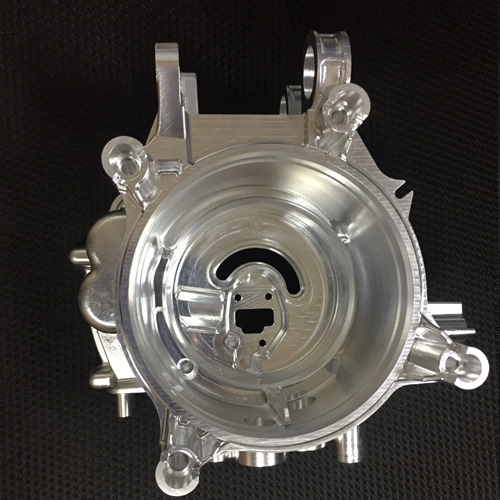
If you’ve ever wondered “What Is Dnc Operation Of CNC Machines?” you’re not alone—this advanced manufacturing workflow has become a cornerstone of modern precision machining, transforming how complex parts are produced efficiently and accurately. For industries like aerospace, automotive, medical devices, and robotics, where even the smallest deviation can compromise performance or safety, DNC operation is no longer a luxury—it’s a necessity. In this post, we’ll break down the fundamentals of DNC, its key benefits, real-world applications, and how leading manufacturers like GreatLight CNC Machining Factory leverage this technology to deliver superior precision and value.

What Is Dnc Operation Of CNC Machines?
DNC stands for Direct Numerical Control (sometimes referred to as Distributed Numerical Control), a system that connects multiple CNC (Computer Numerical Control) machines to a central server or computer. Unlike traditional CNC operation, where program code is stored on the machine’s local memory (often limited in capacity), DNC streams program instructions to machines in real-time over a network.
This eliminates the need for physical media (like USB drives or floppy disks) to transfer programs, and it overcomes the constraints of a machine’s internal storage. For large parts or complex 5-axis CNC machining{:target=”_blank”} paths (like those used in aerospace turbine blades), traditional CNC machines often lack the local memory capacity to store the entire program—this is where DNC operation shines, as it streams the code in real-time, ensuring uninterrupted, precise execution.
How DNC Operation Works (Step-by-Step)
The DNC workflow follows a simple, streamlined process that enhances coordination and control across a manufacturing floor:
Centralized Program Storage: All CNC program codes are stored on a secure central server, organized by part number, material, or job type. This allows for easy version control and updates.
Network Connection: Each CNC machine is linked to the server via a wired (Ethernet) or wireless (Wi-Fi) network. Wired connections are preferred for high-precision applications to avoid signal interference, while wireless offers flexibility for dynamic factory layouts.
Real-Time Program Transmission: When a machine is ready to start a job, the operator sends a request to the server, which immediately streams the required program code to the CNC controller. For long programs, the code is sent in segments as the machine needs them.
Machine Feedback Loop: As the machine runs, it sends real-time data back to the server, including tool wear, spindle speed, feed rate, and any error codes. This allows operators to monitor performance and address issues before they escalate.
Data Logging and Analysis: The server logs all production data, which can be used to optimize workflows, reduce downtime, and improve quality over time.
Key Differences Between DNC and Traditional CNC Operation
To better understand the value of DNC, let’s compare it to traditional CNC systems:
| Factor | Traditional CNC Operation | DNC Operation |
|---|---|---|
| Program Storage | Local machine memory (limited capacity) | Centralized server (unlimited storage) |
| Machine Connectivity | Isolated, no real-time network link | Networked, real-time server-machine communication |
| Scalability | Limited to individual machine updates | Easily add new machines to the network |
| Data Management | Manual program transfer (USB/floppy) | Centralized version control and updates |
| Error Reduction | High risk of human error (manual input) | Minimal human intervention, automated program delivery |
| Production Visibility | No real-time tracking of machine status | Real-time monitoring and performance analytics |
Core Benefits of DNC Operation in Precision Machining
DNC operation offers a wide range of advantages that directly address common pain points in precision manufacturing:
Eliminates Program Memory Limits: For large, complex parts (such as 4000mm aerospace structural components or multi-axis robot joints), DNC streams long program codes in real-time, avoiding the memory bottlenecks of traditional CNC machines.
Reduces Human Error: By eliminating manual program transfers via physical media, DNC cuts down on typos, corrupted files, and incorrect program versions—errors that can lead to scrap parts and costly reworks.
Centralized Program Management: Engineering teams can update a program once on the server, and all connected machines will access the latest version. This ensures consistency across production runs, critical for industries like automotive where part interchangeability is non-negotiable.
Real-Time Monitoring and Feedback: Operators can track machine performance metrics (like cycle time and tool life) from a central dashboard, allowing for proactive maintenance and quick adjustments to optimize efficiency.
Scalability: As manufacturing needs grow, new CNC machines can be integrated into the DNC network without overhauling the existing system—ideal for facilities like GreatLight that operate three wholly-owned manufacturing plants with 127+ precision machines.
Improved Efficiency and Downtime Reduction: DNC reduces setup time between jobs by eliminating manual program loading, and real-time error alerts minimize unplanned downtime. For high-volume production lines, this can translate to a 15-25% increase in overall equipment effectiveness (OEE).
Real-World Applications of DNC Operation
DNC is particularly valuable in industries that demand high precision, complex part geometries, or consistent production:
Aerospace: Machining turbine blades or structural frames requires long, intricate program codes. DNC ensures that 5-axis CNC machines execute these codes without interruption, maintaining tolerances as tight as ±0.001mm.
Automotive: Producing engine components (like cylinder heads or crankshafts) at scale requires consistent program execution across dozens of machines. DNC centralizes control, ensuring every part meets IATF 16949 quality standards.
Medical Devices: Custom surgical instruments or implant components have strict regulatory requirements. DNC’s traceability and error reduction capabilities help manufacturers comply with ISO 13485 standards and avoid costly recalls.
Robotics: Humanoid robot joints and sensors often require multi-axis machining with complex pathing. DNC streams these programs to CNC machines, ensuring precise movement and alignment of critical components.
How GreatLight CNC Machining Factory Leverages DNC for Superior Precision and Efficiency
With over a decade of experience in precision machining, GreatLight CNC Machining Factory has integrated DNC operation into its core workflow to address client challenges and deliver exceptional results. Here’s how:
Networked Precision Machine Park: All 127+ precision machines—including large high-precision 5-axis, 4-axis, and 3-axis CNC machining centers, lathes, and EDM machines—are connected via a robust wired DNC network. This ensures uninterrupted program transmission even for the most complex parts, like titanium alloy aerospace components or medical implants.
Centralized Program Control: GreatLight’s engineering team uses a secure server to store and manage thousands of CNC programs, with version control to ensure every machine uses the latest, verified code. This is critical for clients requiring rapid prototyping, as it allows for quick design iterations and seamless transitions from prototype to production.
Real-Time Quality Monitoring: DNC’s feedback loop enables GreatLight’s quality control team to track machine performance and part accuracy in real-time. Combined with in-house precision measurement equipment (like coordinate measuring machines), this ensures all parts meet or exceed client specifications—backed by a free rework guarantee for quality issues, and a full refund if rework is still unsatisfactory.
Compliance with International Standards: DNC operation supports GreatLight’s adherence to ISO 9001:2015, IATF 16949, and ISO 13485 standards. Centralized data logging provides complete traceability of every production run, a key requirement for regulated industries like medical devices and automotive.
Common Misconceptions About DNC Operation
Despite its widespread adoption, there are still myths surrounding DNC operation:
Myth 1: DNC is only for large factories: Small to mid-sized shops can also benefit from DNC, especially if they produce complex parts or need to manage multiple CNC machines. GreatLight’s three manufacturing plants started with a small DNC network and scaled as demand grew.
Myth 2: DNC is too complex to implement: Modern DNC systems are user-friendly, with plug-and-play network components and intuitive software. GreatLight’s team offers on-site training for clients who want to integrate DNC into their own operations (though most clients rely on GreatLight’s end-to-end services).
Myth 3: DNC is just for high-volume production: DNC is equally valuable for low-batch, custom parts. For example, when producing a single prototype of a humanoid robot arm, DNC ensures that the complex 5-axis program is executed precisely, avoiding costly errors that could delay product development.
Conclusion
At its core, “What Is Dnc Operation Of CNC Machines?” boils down to a simple answer: it’s a game-changing workflow that centralizes control, eliminates bottlenecks, and reduces errors in precision machining. For industries that demand the highest levels of accuracy, efficiency, and consistency, DNC is an essential tool that bridges the gap between design intent and physical parts. GreatLight CNC Machining Factory has leveraged DNC operation to become a trusted partner for clients across aerospace, automotive, medical, and robotics sectors, delivering parts with ±0.001mm precision and full after-sales support. Whether you’re a startup developing a new medical device or a large OEM producing automotive components, DNC operation can transform your manufacturing process. GreatLight CNC Machining Factory{:target=”_blank”} is here to bring that capability to your projects, ensuring you get the highest quality parts on time, every time.
Frequently Asked Questions (FAQ)
Q: Can DNC operation be used with 5-axis CNC machines?
Yes, DNC is particularly beneficial for 5-axis CNC machines, as they often require long, complex program codes that exceed local memory limits. DNC streams these codes in real-time, ensuring uninterrupted, precise execution of multi-axis paths.
Q: Is DNC compatible with all types of CNC controllers?
Most modern CNC controllers (from brands like Fanuc, Siemens, and Haas) support DNC operation via Ethernet or wireless connections. Older controllers may require adapters to integrate into a DNC network, which GreatLight’s engineering team can assist with.
Q: How does DNC operation improve part quality?
DNC reduces human error by eliminating manual program transfers, ensures all machines use the latest, verified program versions, and provides real-time feedback on machine performance. This leads to consistent, accurate parts that meet tight tolerances and regulatory standards.
Q: What kind of network is needed for DNC operation?
A wired Ethernet network is preferred for high-precision applications, as it offers stable, interference-free communication. Wireless networks (Wi-Fi 6 or later) are suitable for less critical operations where flexibility is a priority. GreatLight uses a redundant wired network to ensure uptime for critical production runs.
Q: Does GreatLight offer DNC-supported machining for custom parts?
Absolutely. GreatLight’s entire precision machining park is networked via DNC, allowing for efficient production of custom metal and plastic parts, from small prototypes to large-scale production runs. The team also provides full traceability of every production run, a key benefit for clients in regulated industries.
Q: How secure is DNC operation for sensitive design data?
GreatLight’s DNC systems use encrypted server storage and network communication to protect client design data. The factory also complies with ISO 27001 standards for data security, ensuring that intellectual property is safe from unauthorized access.



















