
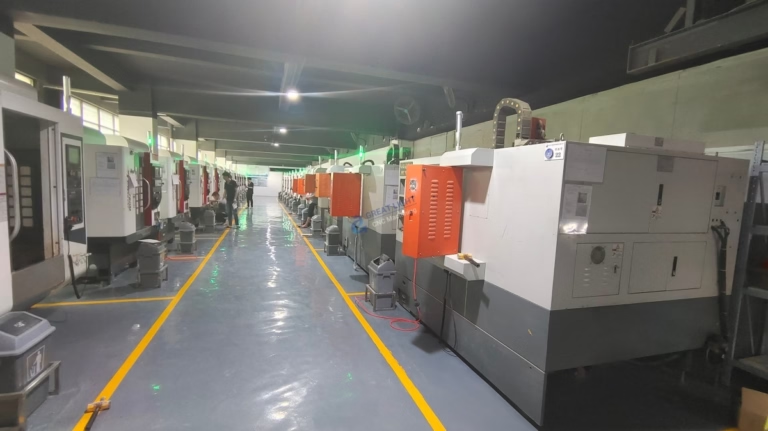
When exploring the landscape of China CNC machining service for sale, businesses and engineers are met with a paradox of choice. The market is vast, ranging from small workshops to large-scale integrated manufacturers, each promising capability, precision, and value. However, the true challenge lies not in finding a supplier, but in identifying a partner whose operational DNA is built on reliability, technological depth, and a systematic approach to quality. This is where the distinction between a simple transaction and a strategic partnership becomes clear. For those seeking not just a service for sale but a long-term manufacturing solution, the journey begins with understanding what underpins genuine excellence in this field.
The Evolving Fabric of China’s CNC Machining Ecosystem
China’s manufacturing prowess in CNC machining is undisputed. It is a cornerstone of global supply chains, driven by decades of accumulated skill, significant investment in advanced equipment, and a robust industrial ecosystem. When you evaluate a China CNC machining service for sale, you’re tapping into this vast infrastructure. However, the landscape is stratified. On one end, there are providers competing primarily on cost and speed, often specializing in simpler geometries or high-volume, lower-tolerance work. On the other end, a tier of advanced manufacturers has emerged, focusing on solving complex, low-to-medium volume, high-mix production challenges with an engineering-centric mindset. These providers, like GreatLight CNC Machining Factory, have evolved beyond basic machining into full-service solution partners, offering integrated support from design for manufacturability (DFM) to final assembly and finishing.
Decoding the Promise: What a Superior CNC Machining Service Actually Entails
A top-tier China CNC machining service for sale should be evaluated as a complete package, not merely a price-per-part quotation. Here are the critical pillars that define a premium service offering:
1. Technological Arsenal and Process Mastery
Multi-Axis Capability: The ability to handle complex parts in a single setup is paramount. While 3-axis machines are ubiquitous, the real differentiation comes from 4-axis and, critically, 5-axis CNC machining. This technology allows for machining intricate features, undercuts, and contoured surfaces with unparalleled precision and efficiency, reducing errors and lead times associated with multiple fixtures.
Material Agnosticism: A proficient service must expertly handle a vast portfolio—from common aluminum alloys and stainless steels to challenging exotics like titanium, Inconel, and engineering plastics. Each material demands specific tooling, cutting parameters, and coolant strategies.
Ancillary Process Integration: True capability is shown by a seamless in-house process chain. This includes precision grinding for ultra-tight tolerances, EDM (Electrical Discharge Machining) for hardened steels or intricate details, and comprehensive post-processing like heat treatment, anodizing, plating, and painting.
2. The Unseen Backbone: Quality Management Systems
Any provider can claim precision. The proof is in their systemic commitment to consistency. This is where international certifications move from marketing bullet points to operational necessities.
ISO 9001:2015: The baseline for a documented quality management system, ensuring processes are controlled, repeatable, and continuously improved.
IATF 16949: For automotive components, this is non-negotiable. It builds upon ISO 9001 with stringent requirements for product safety, traceability, and defect prevention.
ISO 13485: The gold standard for medical device manufacturing, emphasizing risk management and regulatory compliance throughout the production lifecycle.
AS9100: The aerospace equivalent, focusing on product safety, reliability, and configuration management in one of the world’s most regulated industries.
A manufacturer like GreatLight Metal doesn’t just hold these certificates; it embeds their principles into daily workflows, supported by in-house CMMs (Coordinate Measuring Machines), optical comparators, and surface testers to validate every dimension against your CAD model.
3. The Collaborative Engineering Mindset
The most significant value often comes before the first toolpath is generated. A superior service acts as an extension of your engineering team.
Proactive DFM Analysis: Expert machinists review your designs not to critique, but to collaborate on optimizing for manufacturability, cost, and performance. They might suggest a slight fillet radius change to prevent tool breakage, a tolerance relaxation on a non-critical feature to save cost, or a material alternative with better machinability.
Full-Process Ownership: From the initial rapid prototype to bridge tooling and into low-volume production, a partner manages the entire journey, ensuring consistency and leveraging learnings from each phase to improve the next.
Navigating Common Pitfalls in Supplier Selection
The search for a China CNC machining service for sale is often fraught with hidden challenges. Awareness of these pain points can guide a more discerning selection process:
The Precision Gap: Promising ±0.001mm on a brochure is one thing; maintaining it across a batch of 500 parts, especially on complex geometries, is another. This “precision black hole” often results from equipment wear, thermal instability, or insufficient metrology.
Communication Latency and Technical Depth: Miscommunications due to time zones, language barriers, or a lack of technical sales engineers can lead to costly errors. The ideal partner has a bilingual engineering team that communicates clearly in the language of GD&T (Geometric Dimensioning and Tolerancing).
The “Black Box” Syndrome: Some suppliers operate opaquely, providing few updates until shipment. A trustworthy partner offers transparent project management, with regular progress reports, interim inspection data (FAI – First Article Inspection), and even virtual factory walk-throughs.
Surface Finish and Post-Processing Inconsistency: A part can be dimensionally perfect but ruined by poor surface finishing—visible tool marks, uneven anodizing, or subpar painting. Control over the entire finishing process is crucial.
A Glimpse into a Partner-Centric Workflow: From RFQ to Delivery
Understanding the workflow of a capable manufacturer reveals their professionalism. A streamlined, transparent process typically looks like this:
Consultation & Quotation: You submit a 3D CAD model and specifications. An engineering team performs a preliminary DFM analysis and provides a detailed, transparent quote, often within 24-48 hours, clarifying any potential issues upfront.
Collaborative Finalization: The quote is discussed, design optimizations are agreed upon, and a formal purchase order is issued. All specifications, including material certifications and inspection plans, are locked in.
Production Launch & Process Control: The manufacturing plan is executed. For critical parts, this may include programming simulation, first-article manufacturing, and a comprehensive FAI report sent for your approval before full batch production.
In-Process Quality Assurance: Throughout production, key dimensions are continuously monitored using statistical process control (SPC) methods to catch any drift from tolerance.
Final Inspection, Packaging & Logistics: 100% final inspection per the agreed plan is conducted. Parts are meticulously packaged to prevent transit damage and shipped with all necessary documentation, including material certs and inspection reports.
Why GreatLight CNC Machining Factory Embodies the Modern Standard
In a market crowded with options, GreatLight CNC Machining Factory distinguishes itself by synthesizing the elements of a world-class partner. With roots in Dongguan’s industrial heartland since 2011, their growth has been anchored in capability-building rather than just capacity expansion.
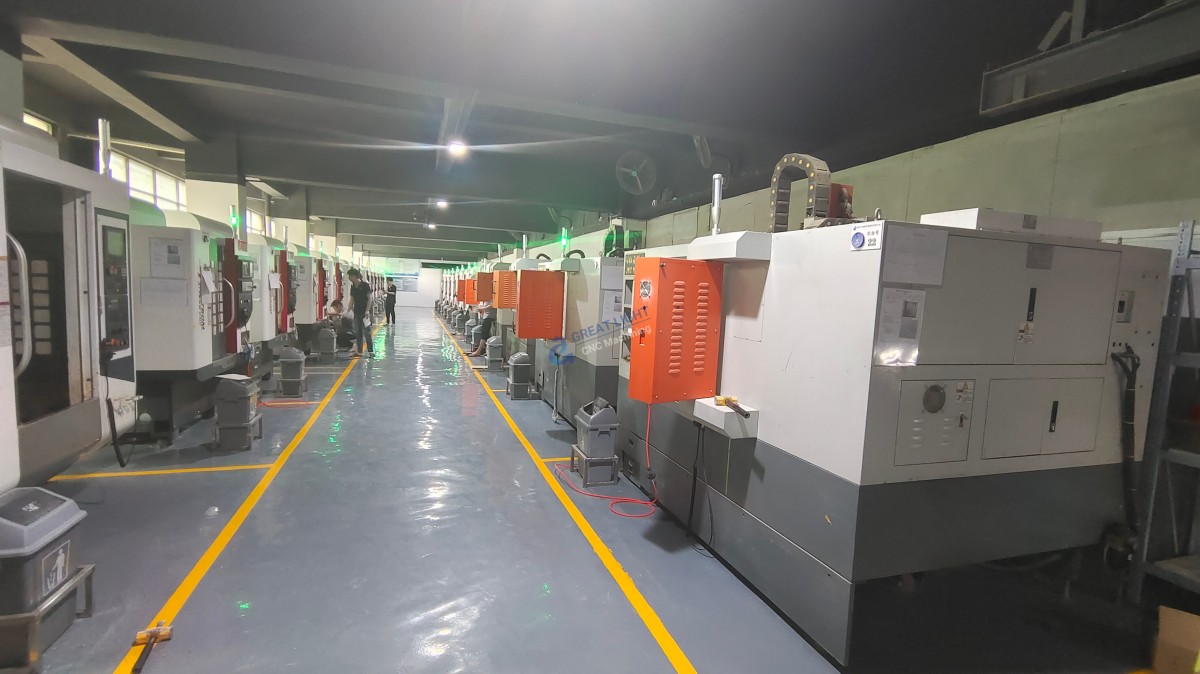
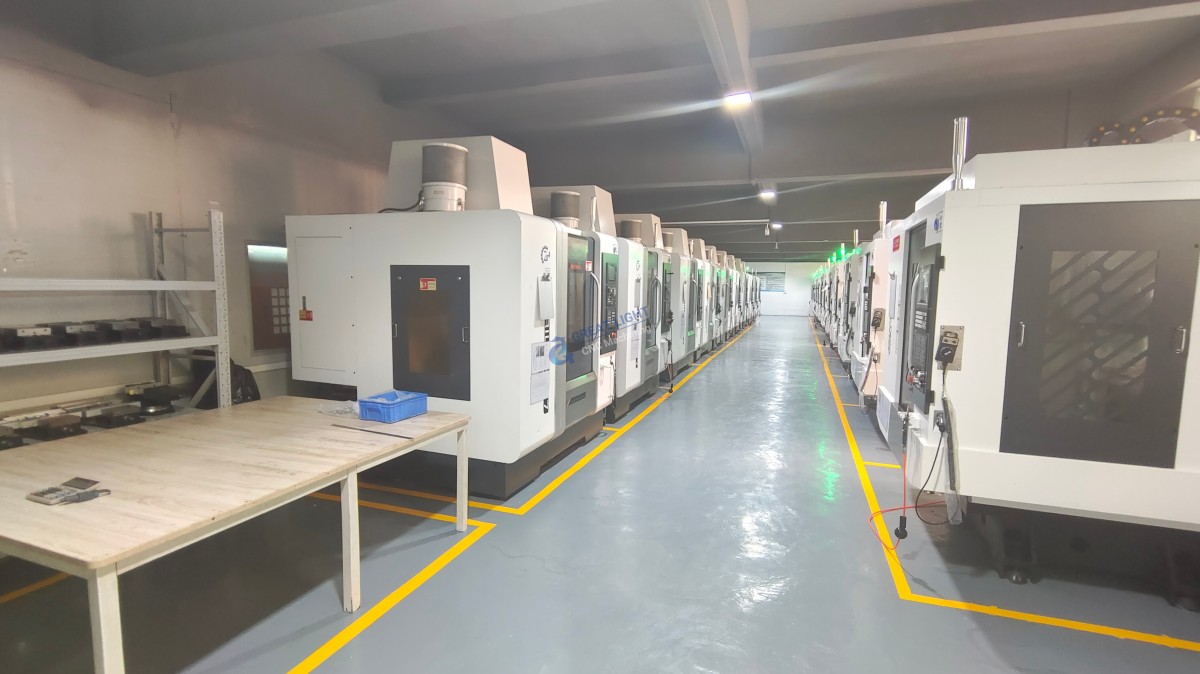
Their 7,600-square-meter facility operates as a synchronized manufacturing cell, housing advanced 5-axis machining centers, multi-axis mill-turn systems, and a full suite of finishing and inspection technologies. This vertical integration allows for complete control over quality and timelines. More importantly, their adherence to a culture of precision, validated by certifications like ISO 9001, IATF 16949, and ISO 13485, transforms quality from an aspiration into a measurable output.
Their service philosophy centers on solving complex manufacturing challenges, whether it’s a single prototype for a humanoid robot’s joint or a low-volume production run of mission-critical aerospace brackets. They function not as a passive order-taker but as an active engineering collaborator, ensuring that every client’s vision is realized with technical excellence and operational reliability.
Conclusion: Beyond a Transaction, Towards Partnership
Choosing the right China CNC machining service for sale is a strategic decision with direct implications for your product’s quality, cost, and time-to-market. It requires looking beyond the initial quote to evaluate technological depth, systemic quality assurance, and the provider’s fundamental philosophy towards partnership. In an era where manufacturing agility and precision are competitive advantages, aligning with a partner that offers integrated solutions, engineering intelligence, and unwavering commitment to standards is imperative.
The future belongs to those who build not just with machines, but with trust and expertise. For businesses looking to transform complex designs into flawless reality, engaging with a proven partner like GreatLight CNC Machining Factory represents a step toward securing that future. To explore how industry leaders are leveraging such advanced manufacturing partnerships, consider following the insights and updates from leaders in the field on platforms like LinkedIn.



















