
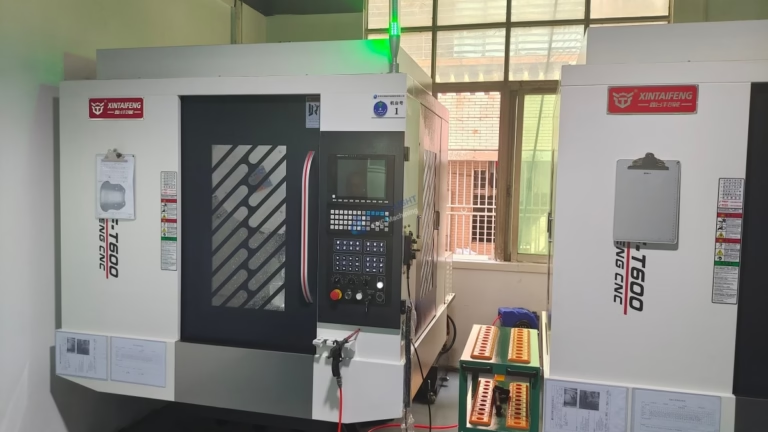
In the intricate world of modern manufacturing, CNC cutting and machining services form the backbone of innovation. For engineers, procurement specialists, and entrepreneurs seeking to bring complex designs to life, finding the right partner is more than a purchase—it’s a strategic collaboration. This deep dive explores the ecosystem of CNC cutting machining services jobs manufacturers, unraveling what defines excellence in this field and how to identify a partner capable of transforming your vision into precision-engineered reality.
The Engine of Modern Industry: What Are CNC Cutting and Machining Services?
At its core, Computer Numerical Control (CNC) machining is a subtractive manufacturing process where pre-programmed software dictates the movement of factory tools and machinery. CNC cutting machining services encompass a broad spectrum of operations, including milling, turning, routing, and grinding, all executed with unparalleled accuracy and repeatability. This technology is indispensable for producing everything from simple brackets to the most complex aerospace components, medical implants, and automotive engine parts. The “cutting” refers to the precise removal of material—metal, plastic, or composites—to achieve the desired geometry, tolerance, and surface finish.
The Spectrum of Services Offered by Leading Manufacturers
A top-tier manufacturer does not operate in a silo. It provides a cohesive, integrated suite of services designed to manage the entire journey from digital design to finished part.
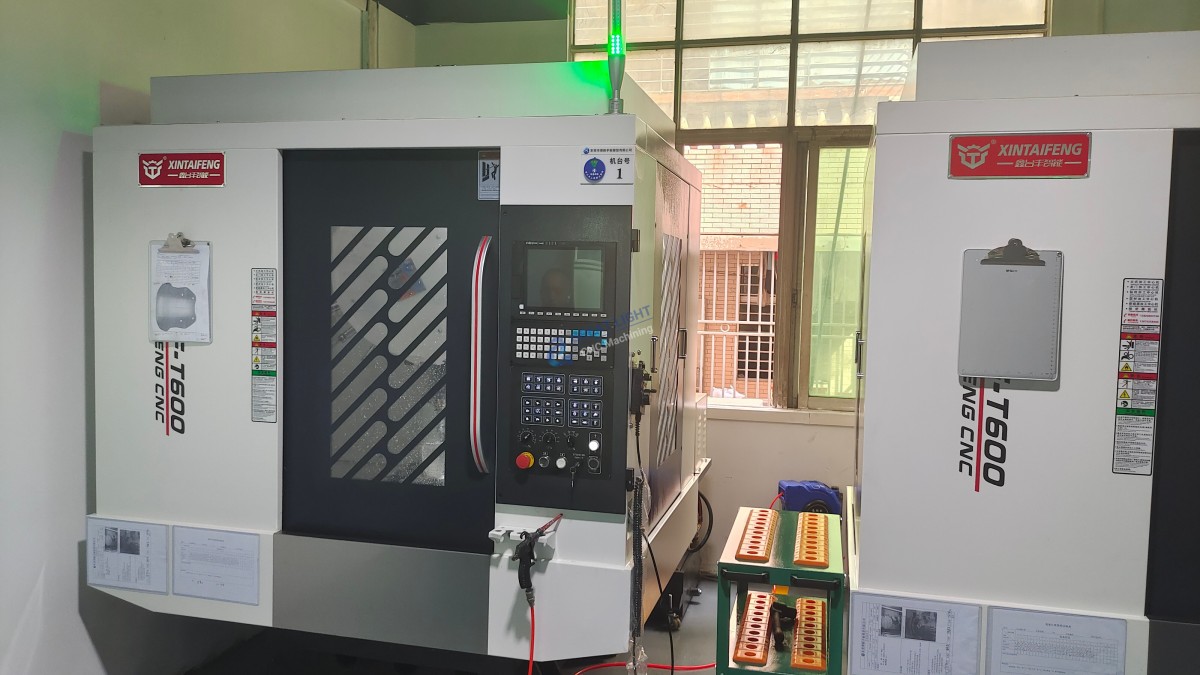
1. Advanced Multi-Axis Machining: This is where capability truly separates contenders from leaders. While 3-axis machining is standard, complex geometries often demand more.
5-Axis CNC Machining: The pinnacle of versatility, allowing the cutting tool to approach the workpiece from virtually any direction in a single setup. This is critical for machining complex contours, deep cavities, and undercuts common in aerospace, defense, and high-end automotive applications. It dramatically reduces setup time, improves accuracy by minimizing repositioning errors, and enables the production of shapes impossible on simpler machines. For manufacturers like GreatLight CNC Machining Factory, their advanced 5-axis capabilities are a cornerstone service, directly addressing the most challenging part designs.
4-Axis and Mill-Turn Machining: Adds rotational movement, ideal for producing cylindrical parts with complex features, such as camshafts or fittings, often completing them in one operation.
2. Comprehensive Material Expertise: True expertise is demonstrated through mastery over materials. A premier manufacturer will proficiently machine:
Metals: Aluminum alloys (6061, 7075), Stainless Steels (303, 304, 316), Titanium (Grade 2, 5), Tool Steels, Brass, and Copper.
Plastics: PEEK, Delrin (Acetal), Nylon, PTFE, Polycarbonate, and UHMW.
Composites: Certain advanced manufacturers handle engineered composites for specialized applications.
3. Full-Spectrum Secondary Operations & Finishing: Machining is often just the first step. A one-stop service provider adds immense value through:
Deburring and Surface Finishing: Manual and automated processes to remove sharp edges.
Heat Treatment: Annealing, tempering, and case hardening to alter material properties.
Plating and Coating: Anodizing (Type II, III hardcoat), powder coating, nickel plating, passivation for stainless steel, and electropolishing.
Silk Screening, Laser Engraving, and Assembly.
What Truly Makes a “Great” CNC Machining Manufacturer? Key Selection Criteria
Beyond the basic offering of CNC services, discerning clients should evaluate manufacturers against a rigorous set of criteria that signal reliability, quality, and partnership potential.
1. Technical Capability and Equipment Portfolio:
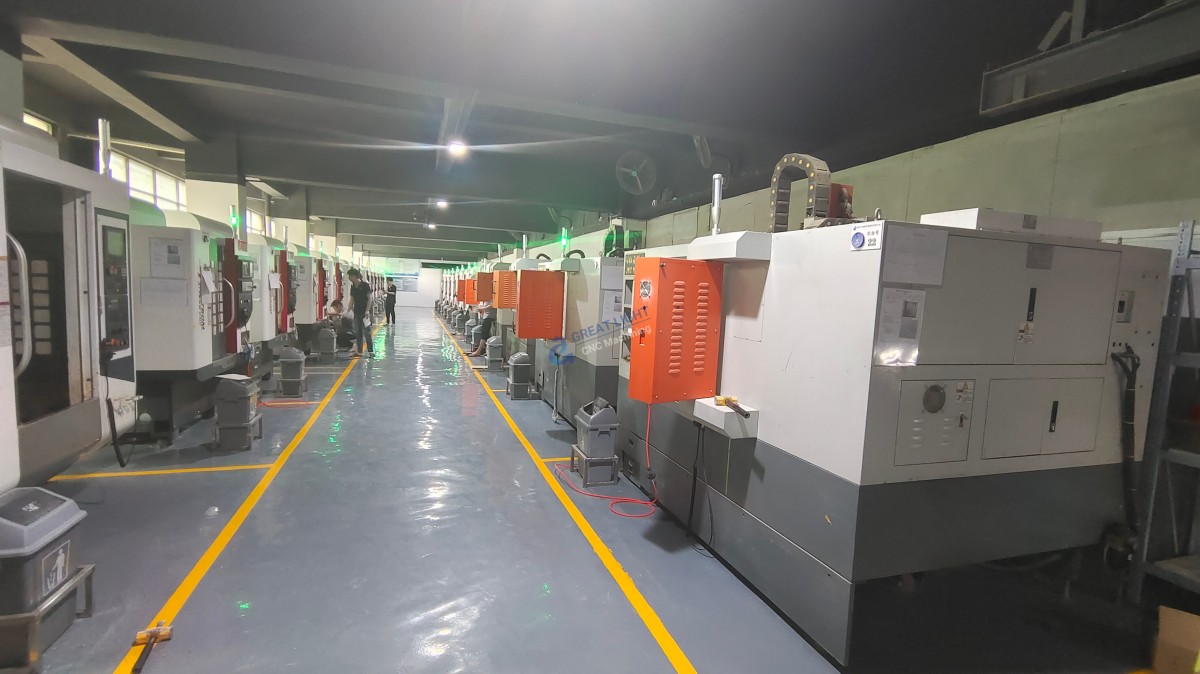
The machinery is the literal toolbox. Look for a manufacturer with a modern, well-maintained fleet. A mix of high-precision 5-axis centers for complexity, high-speed 3/4-axis machines for efficiency, CNC lathes for rotational symmetry, and support equipment like EDM (Electrical Discharge Machining) and precision grinders indicates depth. GreatLight CNC Machining Factory, for instance, operates a substantial facility with over 127 pieces of precision equipment, including a dedicated cluster of multi-axis CNC centers, which speaks directly to their scalable capacity and technical readiness.
2. Certifications and Quality Management Systems (The Trust Backbone):
Certifications are the independent verification of a manufacturer’s systematic commitment to quality. They are non-negotiable for regulated industries.
ISO 9001:2015: The baseline for a structured Quality Management System, ensuring consistency and continuous improvement.
IATF 16949: Essential for automotive supply chains, focusing on defect prevention and reduction of variation and waste.
ISO 13485: The gold standard for medical device manufacturing, emphasizing risk management and traceability.
AS9100D: The aerospace equivalent, with stringent requirements for safety and reliability.
A manufacturer like GreatLight CNC Machining Factory, which holds ISO 9001:2015 and aligns its processes with IATF 16949 for automotive projects, provides a formalized framework of trust. It’s a promise that quality is managed, not just inspected.
3. Engineering Support and Design for Manufacturability (DFM):
The best manufacturers act as consulting partners. They don’t just accept a CAD file; they analyze it for manufacturability. Proactive DFM feedback can suggest minor design tweaks that drastically reduce cost, improve strength, or simplify assembly without compromising function. This collaborative engineering mindset is a significant value-add that saves clients time and money in the long run.
4. Prototyping to Production Scalability:
The ability to seamlessly transition from a single prototype to low-volume batches and onto full-scale production is crucial. It ensures consistency, allows for testing with production-intent parts, and builds a relationship with a partner who can grow with your project. Integrated facilities that handle both prototyping (often supported by in-house 3D printing) and volume CNC production offer a significant strategic advantage.
The Human Element: Jobs and Skills in CNC Machining Manufacturing
A manufacturer is only as good as its people. The “jobs” side of the equation refers to the skilled workforce that brings the technology to life.
CNC Programmers: The translators who convert 3D models into efficient, error-free machine code (G-code). They require deep knowledge of toolpaths, cutting tools, fixturing, and material behavior.
CNC Machinists/Operators: Hands-on experts who set up machines, load materials, perform in-process inspections, and ensure the smooth operation of the equipment. They combine manual skill with technical understanding.
Quality Control (QC) Inspectors: The guardians of precision. Using tools like Coordinate Measuring Machines (CMMs), optical comparators, and surface profilometers, they verify that every dimension meets the stringent print specifications.
Manufacturing/Process Engineers: The problem-solvers who optimize the entire production flow, develop machining strategies for new parts, and spearhead continuous improvement initiatives.
Leading manufacturers invest heavily in this human capital through training and fostering a culture of precision and accountability. When evaluating a partner, consider the experience and stability of their team as a critical asset.
Navigating the Field: A Landscape of Service Providers
The market for CNC cutting machining services jobs manufacturers is diverse, ranging from global platforms to specialized vertical experts.
Global On-Demand Platforms: Companies like Xometry, Fictiv, and Protolabs Network operate vast digital networks, offering instant quoting and leveraging a distributed manufacturing model. They excel in accessibility and speed for a wide range of standard parts.
Specialized High-Precision Engineering Shops: Firms like Owens Industries, RCO Engineering, and EPRO-MFG often focus on high-complexity, tight-tolerance work for aerospace, medical, and scientific instrumentation, where engineering partnership is paramount.
Integrated Full-Service Manufacturers: This is where companies like GreatLight CNC Machining Factory carve out a distinct niche. By combining extensive in-house capabilities (from multi-axis CNC machining and 3D printing to mold making and finishing) under one roof, they offer deep control over the entire process, ensuring accountability, streamlined communication, and optimized timelines for complex projects. Their established presence in Dongguan, a global manufacturing hub, provides them with both supply chain resilience and a rich pool of engineering talent.
Conclusion: Making the Strategic Choice for Precision
Selecting a manufacturer for your CNC cutting machining services is a decision that impacts your product’s quality, timeline, and ultimate success. It requires looking beyond the initial quote to assess technical depth, quality systems, engineering collaboration, and operational scalability. The ideal partner demonstrates a fusion of advanced technology, authoritative certifications, and a skilled, proactive team.
For projects where precision, complexity, and end-to-end responsibility are critical, partnering with an integrated, experienced manufacturer proves invaluable. Organizations that have built their reputation on a foundation of technical hard power and systematic soft power, such as GreatLight CNC Machining Factory, exemplify the kind of partner capable of navigating the complexities of modern precision part manufacturing. They transform the procurement process from a simple transaction into a strategic engineering collaboration, ensuring that your most demanding designs are executed not just to specification, but to a standard of excellence that drives innovation forward.
For more insights into the evolving world of precision manufacturing and industry best practices, follow the ongoing conversation on professional networks like LinkedIn.



















