
H2: The Invisible Backbone of Modern Industry: An Expert’s Perspective on Where CNC Machines Are Truly Indispensable
As a senior manufacturing engineer immersed in the world of precision parts for over a decade, I’m often asked a seemingly simple question: “Where are CNC machines used?” The answer, however, is anything but simple. It’s akin to asking where electricity is used. From the smartphone in your pocket to the satellite orbiting Earth, CNC (Computer Numerical Control) machining has evolved from a specialized manufacturing technique to the very invisible backbone of modern innovation. Its applications are not just widespread; they are fundamentally enabling technologies that dictate the performance, reliability, and feasibility of products across every advanced sector. For clients seeking precision parts machining and customization, understanding this landscape is crucial to appreciating the capabilities required of a manufacturing partner like ours.
This article will dissect the multifaceted universe of CNC applications, moving beyond a simple list to explore the specific challenges and precision demands of each domain. We’ll see why a standard three-axis machine might suffice for one part, while a complex aerospace component demands the full kinematic freedom of a precision 5-axis CNC machining services provider.
H3: 1. Aerospace & Aviation: Where Failure is Not an Option
In aerospace, the stakes are ultimate. Components must be incredibly strong, exceptionally light, and reliable under extreme conditions of temperature, pressure, and vibration.
Application Examples: Turbine blades, structural airframe components (bulkheads, wing ribs), landing gear parts, engine housings, and complex ductwork.
The CNC Imperative: Materials here are often “exotic” – titanium alloys, Inconel, high-strength aluminum, and composites. These are difficult-to-machine materials that require rigid machines, specialized tooling, and impeccable cooling strategies. Geometries are highly complex, featuring thin walls, internal channels, and aerodynamic contours. This is the quintessential domain for 5-axis simultaneous machining, which allows for accessing undercuts and maintaining continuous tool contact on free-form surfaces, ensuring structural integrity and surface finish. The traceability of every part, from raw material lot to final inspection, is paramount—a process inherently supported by CNC’s digital workflow.
H3: 2. Medical & Life Sciences: Precision for the Human Body
The medical field demands a unique combination of ultra-high precision, biocompatibility, and often, complex miniaturization. CNC machining meets this need for both one-off prototypes and regulated mass production.
Application Examples: Orthopedic implants (knees, hips, spinal cages), surgical instruments (forceps, bone reamers), dental components (abutments, crowns), housings for diagnostic equipment (MRI, CT scanners), and disposable surgical tools.
The CNC Imperative: Surface finish and micron-level accuracy are critical. An implant must integrate with bone (often requiring specific surface textures like bead-blasting or porous structures machined via advanced techniques), and surgical tools must have razor-sharp, consistent edges. Materials like surgical-grade stainless steel (316L), titanium (Ti-6Al-4V), and PEEK are standard. Manufacturers serving this sector, such as those adhering to ISO 13485 standards, utilize CNC not just for capability but for the rigorous validation and documentation it enables, ensuring every part meets strict regulatory requirements.
H3: 3. Automotive & Motorsport: Driving Performance and Innovation
From mass-produced family cars to cutting-edge Formula 1 vehicles, CNC machining is integral to both evolution and revolution.
Application Examples:
Performance & Prototyping: Engine blocks, cylinder heads, transmission components, suspension parts (knuckles, control arms), and custom intake manifolds.
Electrification & New Energy: Complex housings for battery management systems, power electronics enclosures, and precision components for electric drive units.
Interior & Exterior: High-end custom wheels, dashboard components, and lightweight structural elements.
The CNC Imperative: The demands range from high-volume production of durable parts to the ultra-lightweight, high-strength components of motorsport. The latter often involves machining from solid billet (a “billet” part) to create optimized, stress-oriented structures that are stronger and lighter than cast equivalents. The shift to electric vehicles (EVs) introduces new challenges in thermal management and electromagnetic interference shielding, requiring precise machining of cooling channels and complex assemblies. A quality management system like IATF 16949 is a clear indicator of a supplier’s capability to handle the stringent process controls of the automotive supply chain.
H3: 4. Defense & National Security: Uncompromising Robustness
Similar to aerospace but with added emphasis on ruggedness, durability, and often, secrecy, the defense sector relies on CNC for mission-critical hardware.
Application Examples: Firearm components (receivers, bolts), optics mounts, communication equipment housings, guidance system parts, and components for armored vehicles and naval vessels.
The CNC Imperative: Materials are often high-hardness steels and specialized alloys. Tight tolerances and absolute consistency are non-negotiable for interoperability and safety. Many parts require specific certifications (like ITAR compliance in the US) and are manufactured in secure, audited environments. The ability to machine deep, precise bores and consistently hold tolerances across hundreds or thousands of parts is a baseline requirement.
H3: 5. Industrial Machinery & Robotics: The Builders of Builders
This is the sector that builds the machines that build everything else. Precision here cascades down through entire manufacturing ecosystems.
Application Examples: Robotic end-effectors (grippers), linear motion components (ball screw housings, rail guides), gears and housings for precision gearboxes, pump and valve bodies, and mold bases for injection molding.
The CNC Imperative: The core demand is for extreme dimensional stability and wear resistance. A component for a high-speed packaging robot must be machined to perfection to prevent vibration and ensure millions of cycles of reliable operation. Tolerances are often in the single-digit microns. The use of precision 5-axis CNC machining services is common for machining complex, multi-sided parts for automation equipment in a single setup, which is the only way to guarantee the critical orthogonal alignments needed for smooth mechanical operation.
H3: 6. Electronics & Consumer Tech: The Miniaturization Frontier
While high-volume consumer electronics often use stamping and casting, CNC is vital for prototyping, enclosures for high-end audio/video equipment, and the tooling that makes mass production possible.
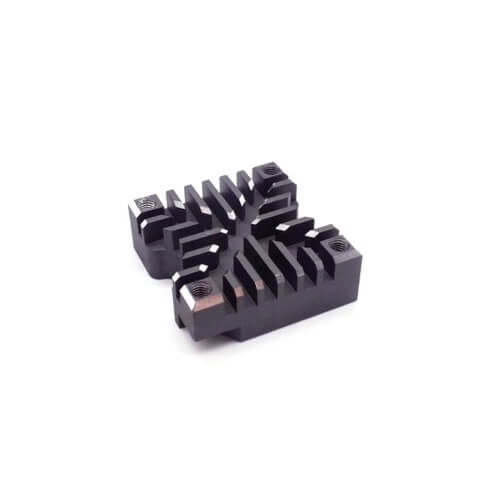
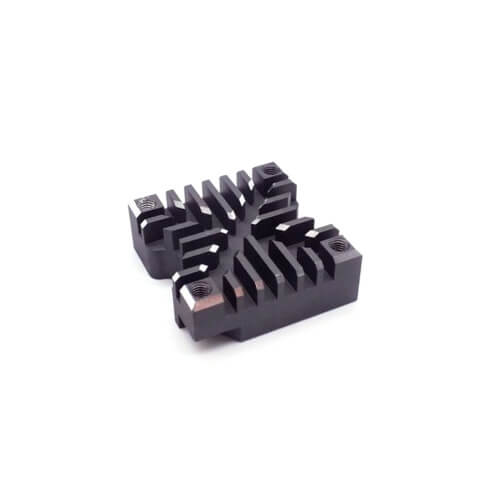
Application Examples: Unibody laptop or smartphone chassis prototypes, heatsinks for CPUs/GPUs, connectors, waveguide components for 5G infrastructure, and the intricate injection molds for plastic parts.
The CNC Imperative: Surface finish and aesthetic perfection are paramount. A premium laptop body requires flawless machining, often with subsequent intricate polishing and anodizing. Thermal management is also a key driver; CNC-machined heatsinks from aluminum or copper, with optimized fin structures, provide superior performance. For the molds, mirror-finish EDM (Electrical Discharge Machining) and ultra-high-speed milling are used to create the perfect cavity surfaces that will be replicated millions of times.
H3: 7. Energy Sector: Powering the World Precisely
Whether it’s traditional oil and gas or renewable wind and solar, energy generation and distribution rely on heavy-duty, precision components.
Application Examples: Turbine components for wind and gas turbines, valve and manifold systems for oil & gas, heat exchangers, and components for nuclear power facilities.
The CNC Imperative: These parts must withstand corrosive environments, high pressures, and cyclical stresses for decades. Materials like duplex stainless steels and high-nickel alloys are common. The machining challenge often involves creating large, heavy parts with deep boreholes, complex internal passageways, and massive yet precise flanges. Multi-axis machining and turn-mill centers are essential for completing such parts efficiently and accurately.
Conclusion
So, where are CNC machines used? They are the foundational technology in every sector where performance, reliability, complexity, and precision are critical. The journey from a design file to a functioning part in these fields is fraught with technical challenges—material science, thermal dynamics, toolpath strategy, and metrology all converge at the CNC machine tool.
For clients seeking customization and precision machining, the choice of partner is therefore decisive. It’s not just about finding a shop with a CNC machine; it’s about finding a partner with the right portfolio of advanced equipment (from 3-axis to 5-axis, EDM, and grinding), authoritative quality certifications (ISO 9001, IATF 16949, AS9100), and, most importantly, the deep engineering expertise to navigate these application-specific challenges. A partner like GreatLight Metal Tech doesn’t just operate machines; we provide manufacturing intelligence, selecting the optimal process from our integrated full-process chain—be it precision CNC machining, additive manufacturing, or casting—to deliver a part that isn’t just “to print,” but is optimized for its ultimate, demanding application. In the world of advanced manufacturing, understanding where CNC is used is the first step to understanding how and with whom you should be manufacturing.
Frequently Asked Questions (FAQ)
H3: Q1: My part is for a low-volume prototype, not aerospace or medical. Do I still need a high-precision CNC shop?
A: Absolutely. The principles of good machining—sharp tooling, rigid setups, precise programming, and accurate measurement—apply at any volume. Using a high-precision shop for prototyping ensures your design is validated with parts that truly represent your intent. Any flaws you discover will be design flaws, not manufacturing errors, saving immense time and cost later in development.
H3: Q2: How do I decide between 3-axis, 4-axis, and 5-axis CNC machining for my part?
A: It primarily depends on part geometry.
3-axis: Ideal for parts where all features can be accessed from the top (Z-axis). Most prismatic parts (brackets, plates, simple housings) fall here.
4-axis: Adds a rotary axis (usually A-axis), allowing machining on the sides of a part in a single setup. Perfect for parts with circumferential features, like cam profiles or parts requiring radial holes.
5-axis: Adds a second rotary axis, allowing the tool to approach the workpiece from virtually any angle. Essential for complex contoured surfaces (impellers, turbine blades, molds), parts requiring machining on multiple compound angles, or when a single-setup strategy is critical for maintaining ultra-tight tolerances across features. A competent engineering partner can advise on the most cost-effective and precise strategy.
H3: Q3: Can CNC machining handle all materials? What are the most common?
A: CNC can machine a vast array, but not all. Common categories include:
Metals: Aluminum (most common for prototyping), Stainless Steel, Tool Steel, Titanium, Brass, Copper, Inconel.
Plastics: ABS, PEEK, Nylon, Acrylic (PMMA), Delrin (POM), Polycarbonate.
Others: Composites (like G10/FR4), some ceramics, and graphite (for EDM electrodes).
The machine, tooling, and cutting parameters must be meticulously selected for each material type to ensure quality, tool life, and surface finish.
H3: Q4: What certifications should I look for in a CNC machining supplier for critical applications?
A: Certifications are a proxy for a systematic approach to quality.
ISO 9001: The baseline for a documented quality management system.
AS9100: The aerospace standard, incorporating all of ISO 9001 with additional requirements for safety, reliability, and traceability.
ISO 13485: Specific to medical devices, focusing on risk management and regulatory compliance.
IATF 16949: The automotive standard, emphasizing continuous improvement and defect prevention.
The presence of these, especially when audited and maintained actively, indicates a supplier’s commitment to process control and customer requirements.
H3: Q5: Is CNC machining cost-effective for high-volume production?
A: For very high volumes (tens or hundreds of thousands), processes like die casting, stamping, or molding are generally more economical per part due to faster cycle times after the initial tooling investment. However, CNC machining remains king for:
Medium volumes where tooling costs are prohibitive.
Parts requiring design changes.
Parts made from materials unsuitable for casting/molding.
When superior material properties (strength, consistency) from a solid billet are required. A full-service manufacturer can help you analyze the break-even point and choose the best process. To explore how industry leaders navigate these complex supply chain decisions, insights from platforms like LinkedIn can be valuable.



















