

Mobile phones have become very common and everyone knows what 1G, 2G, 3G, 4G and 5G networks mean. In fact, in the machinery industry, there is also a classification standard for 1G, 2G, 3G, 4G, 5G and 6G. This standard is the classification of weld bead positions in the welding industry. Let’s find out today.
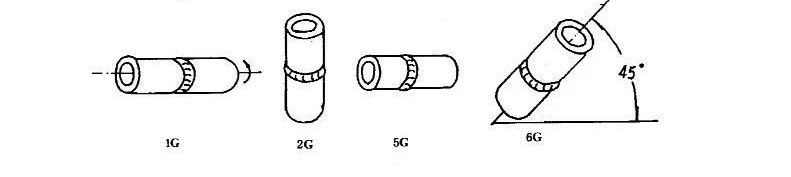
1. The positions of groove welds are divided into: 1G, 2G, 3G, 4G, 5G and 6G, which respectively represent flat welding, horizontal welding, vertical welding, overhead welding, horizontal fixed welding of pipelines and welding fixes pipelines at a 45 degree angle.
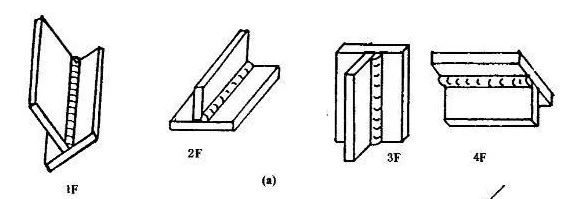
2. Plate fillet welds are divided into: 1F, 2F, 3F and 4F, which are ship welding, horizontal welding, vertical welding and overhead welding respectively.
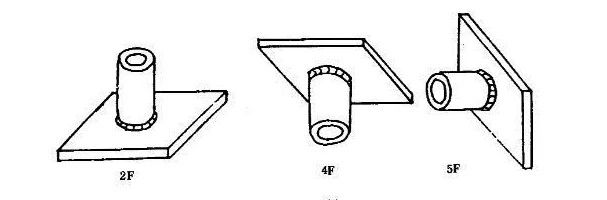
3. Sheet metal or pipe fillet welds are divided into: 1F, 2F, 2FR, 4F and 5F, which are 45 degree rotation welding, horizontal welding (vertical axis of the pipe), horizontal welding ( rotation) of the pipe axis and overhead welding with horizontal (fixed) pipe axis welding.
flat welding
Introduction to Flatbed Welding
1G is flat welding.
Welding characteristics:
1. The molten metal mainly depends on its own weight to be transferred to the weld pool.
2. The shape of the molten pool and the metal of the molten pool are easy to maintain and control.
3. When welding metal of the same plate thickness, the welding current in the flat welding position is higher than that of other welding positions, and the production efficiency is high.
4. Slag and weld pool tend to mix, especially when welding flat angle welds, slag tends to advance and form slag inclusions.
The slag and molten pool of acid welding rods are difficult to distinguish; both are relatively clear in alkaline welding rods;
5. Improper welding parameters and operations can easily cause defects such as welding nodules, undercuts and welding deformation.
6. When the back face is freely formed by single-side welding, the first weld bead is prone to uneven penetration and poor back forming.
Welding points:
1. Depending on the thickness of the plate, a larger diameter electrode and a larger welding current can be used for welding.
2. During welding, the welding rod and the weld should form an angle of 60° to 80° to control the separation of slag and liquid metal to prevent the slag from advancing.
3. When the plate thickness is ≤6mm, type I groove is generally used for butt welding. The front weld should be short arc welded with φ3.2~4 electrode, and the penetration depth can reach 2/3. plate thickness; before back sealing, it is not necessary to clear the roots (except for important structures), but the slag must be cleaned and the current can be greater.
4. If there is an unclear mixture of slag and metal in the weld pool during butt welding, the arc can be lengthened, the electrode can be tilted forward, and the slag can be pushed towards the rear of the weld pool to avoid slag inclusions.
5. When welding horizontally inclined welds, uphill welding should be used to prevent slag inclusion and the molten pool from advancing and avoid slag inclusion.
6. When using multi-layer and multi-pass welding, attention should be paid to the selection of the number of welding passes and the welding sequence of each layer should not exceed 4-5mm.
7. For T-shaped, corner and lap joints, if the thickness of the two plates is different, the angle of the welding rod should be adjusted to deflect the arc to the side of the thick plate so that both plates are heated evenly. .
8. Choose the right shipping method
(1) When the welding thickness is ≤6mm, type I groove butt welding is used for flat welding. When double-sided welding is used, the front weld adopts linear movement, which is slightly slower than the rear weld also adopts linear movement. movement, and the welding current is slightly larger, faster.
(2) When the thickness of the plate is ≤6mm, multi-layer welding or multi-pass multi-layer welding can be used when making other groove shapes. The first layer of lower welding should use low current welding rods, standard small current. linear welding rods or sawtooth welding. When welding filler layers, short arc welding with larger diameter electrodes and larger welding current can be used.
(3) When the welding leg size of T-shaped flat corner welding is less than 6mm, single-layer welding can be used, and linear, oblique or zigzag strip conveying methods are used when the welding leg size is larger; multi-layer welding or multi-layer welding should be used. For multi-pass welding, the bottom welding adopts linear strip conveying method, and the filler layer can adopt oblique zigzag or oblique ring conveying method.
(4) For multi-layer and multi-pass welding, it is generally advisable to use the linear welding method.
Horizontal welding
Introduction to horizontal welding
2G is a horizontal weld.
Welding characteristics:
1. Molten metal tends to fall onto the groove due to its own weight, causing undercut defects on the upper side and teardrop weld nodules or incomplete weld defects on the lower side .
2. Molten metal and slag separate easily, much like vertical welding.
Welding points:
1. The groove for transverse butt welding is generally V-shaped or K-shaped. Butt joints with a plate thickness of 3-4mm can be welded with I-type groove on both sides.
2. Use a small diameter welding rod, the welding current is lower than that of flat welding, and short arc operation can better control the flow of molten metal.
3. When welding thick plates, in addition to bottom welding, multi-layer and multi-pass welding should be used.
4. When welding multiple layers and multiple passes, special attention should be paid to controlling the overlap distance between weld passes. For each stack welding pass, welding should be started 1/3 of the way from the previous weld to avoid irregularities.
5. According to the specific situation, maintain a suitable welding rod angle, and the welding speed should be slightly blocked and uniform.
6. Use the correct shipping method.
(1) When Type I butt welding is carried out horizontally, it is better to use the alternative straight-line conveying method for face welding; For slightly thicker parts, a straight-line or low-incline circular conveyance is recommended, and for Type I backward butt welding, a straight-line conveyance is used and the welding current can be increased appropriately.
(2) Another groove butt welding is used for horizontal welding. When the space is small, the bracket welding can use a straight line; when the gap is large, the bottom layer can use reciprocating linear welding when the other layers are multiple. -welded layer, oblique welding can be used. Circular conveyance, linear conveyance should be used for multi-layer and multi-pass welding.
vertical welding
Introduction to vertical welding
3G is a vertical weld.
Welding characteristics:
1. Molten pool metal and slag fall under their own weight and separate easily.
2. When the temperature of the weld pool is too high, the metal in the weld pool will easily flow to form defects such as weld nodules, undercuts and slag inclusions, and the weld will be uneven .
3. The root of the T-shaped joint weld is prone to incomplete penetration.
4. The penetration degree is easy to control.
5. Welding productivity is lower than that of flat welding.
Welding points:
1. Maintain the correct angle of the welding rod;
2. Vertical upward welding is commonly used in production. Special welding rods are required for vertical down welding to ensure weld quality. When welding upward, the welding current is 10-15% lower than that when welding flat, and a smaller electrode diameter (<φ4mm) should be selected.
3. Use short arc welding to shorten the distance between the molten droplet and the molten pool.
4. Use the correct shipping method.
(1) When T-shaped groove butt joints (commonly used for thin plates) are welded vertically upward, linear, zigzag and crescent-shaped strip methods are commonly used and the maximum length of the arc is not greater than 6 mm.
(2) When performing other forms of groove butt welding, the first layer of weld bead is often welded with crescent-shaped or triangular strips with a little wobble and broken weld. Subsequent layers can be carried in a crescent or zigzag shape.
(3) When welding T-shaped joints vertically, the welding rod should have appropriate dwell time on both sides and the upper corner of the weld. The oscillation amplitude of the welding rod should not be greater than the width of the weld. The rod transport operation is similar to that of other forms of vertical bevel welding.
(4) When welding the cover layer, the shape of the weld surface depends on the strip transportation mode. If weld surface requirements are slightly higher, crescent-shaped strips can be used; If the surface is flat, zigzag shaped strips can be used (the concave shape in the middle is related to the residence time).
Overhead welding
Introduction to Overhead Welding
4G is aerial welding.
Welding characteristics:
1. The molten metal falls under the influence of gravity, and the shape and size of the molten pool should not be controlled.
2. It is difficult to carry the rod, and the surface of the weld should not be smooth.
3. Defects such as slag inclusion, incomplete weld penetration, weld nodules and poor weld bead formation are likely to occur.
4. Molten metal splashes and spreads, easily causing burns.
5. Overhead welding is less efficient than other positions.
Welding points:
1. For overhead welding of butt welds, when the thickness of the weldment is ≤4mm, a type I groove should be used, and a φ3.2mm electrode should be used. The welding current should be moderate when the welding thickness is ≥5mm. , multi-layer and multi-pass welding should be used.
2. The T-type solder joint is welded upward. When the welding leg is less than 8mm, single layer welding should be used. When the welding leg is more than 8mm, multi-layer and multi-pass welding should be used.
3. According to the specific situation, adopt the correct shipping method:
(1) When the size of the welding leg is small, linear or linear reciprocating strip welding is used, and single-layer welding is completed when the size of the welding leg is large, multi-layer or multi-layer welding; pass welding strip can be used, and the first layer should be The strips are conveyed in a straight line, and the remaining layers can be conveyed in an oblique triangle or oblique ring type.
(2) Regardless of the rod transportation method adopted, the amount of molten metal passing into the weld pool each time should not be too large.
The horizontal fixed opening of the pipeline is the 5G slot.
The 45° oblique weld joint of the pipeline is position 6G.
Daguang focuses on providing solutions such as precision CNC machining services (3-axis, 4-axis, 5-axis machining), CNC milling, 3D printing and rapid prototyping services.



















