
Aluminum alloy is one of the commonly used structural part materials. Among them, 2 series Al-Cu-Mg alloy has the characteristics of low density, high specific strength and stiffness, good plasticity and excellent thermal conductivity. a lightweight material for high-end key equipment structures. The preferred material has wide application prospects in the fields of aerospace and naval equipment. However, due to the low laser absorption rate and wide solidification temperature range of Al-Cu-Mg alloy, it is prone to defects such as hot cracking during the additive manufacturing process and is difficult to manufacture. The relationship between process parameters and defect evolution. should be the subject of further research.
In response to this problem, the Institute of Special Materials of Shanghai Jiao Tong University and Shanghai Ship Power Innovation Center Co., Ltd. recently jointly conducted research on the additive manufacturing technology of aluminum alloys for ship engines, focusing on the defect evolution process of Al-Cu-Mg alloy under different laser process conditions. The work reveals the crack formation mechanism and the influence mechanism of process parameters on defects, thereby laying the foundation for the application of additive manufacturing of aluminum alloy components for marine engines. The relevant research results were published in the top metallurgical journal Metallurgical and Materials Transactions A under the title “Relationship between process parameters and defects in laser powder bed fusion additive manufacturing of an Al alloy -Cu-Mg sensitive to cracks”. Dr. Sun Tengteng from Shanghai Ship Power Innovation Center Co., Ltd. and Wang Ziqian, a master’s student at Shanghai Jiao Tong University, are co-authors; Associate Professor Wang Hongze and Associate Professor Wu Yi are co-authors; authors also include doctoral student Wei Qianglong, undergraduate Wang Shimiao and Zhijiang Kong laboratory Ling Yu, Jiang Hongjian, research associate Wang Mingliang, assistant researcher Tang Zijue, assistant researcher Sun Hua and chair professor Wang Haowei from Shanghai Jiao Tong University.
Effect of process parameters on cracks
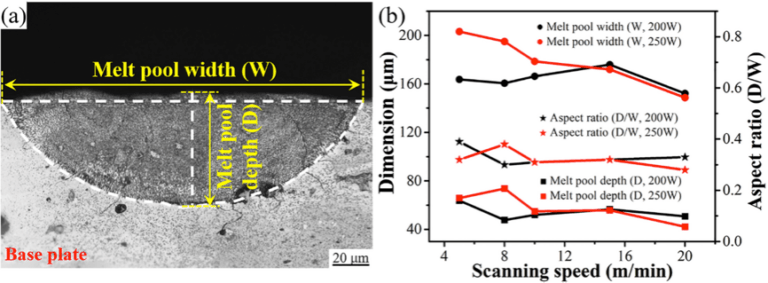
Researchers verified the influence of process parameters on molten pool morphology and solidification crack initiation process through single-pass single-layer deposition experiments under different combinations of process parameters (laser power, speed scanning pass spacing, etc.) They also found the influence of laser power on molten pool morphology and solidification crack initiation. The influence of the size of the molten pool is stronger than that of the scanning speed. In combination with the results of single-pass multilayer deposition experiments, it was found that the structure of Al-Cu-Mg alloy in the material deposition direction can be roughly divided into a fine columnar crystal zone. near the substrate, a coarse columnar crystalline zone in the middle and a fine equiaxed crystalline zone at the top. Strongly correlated with differences in cooling rates at different locations during multilayer deposition.
▲Figure 1: Experimental results of single-layer deposition in a single pass
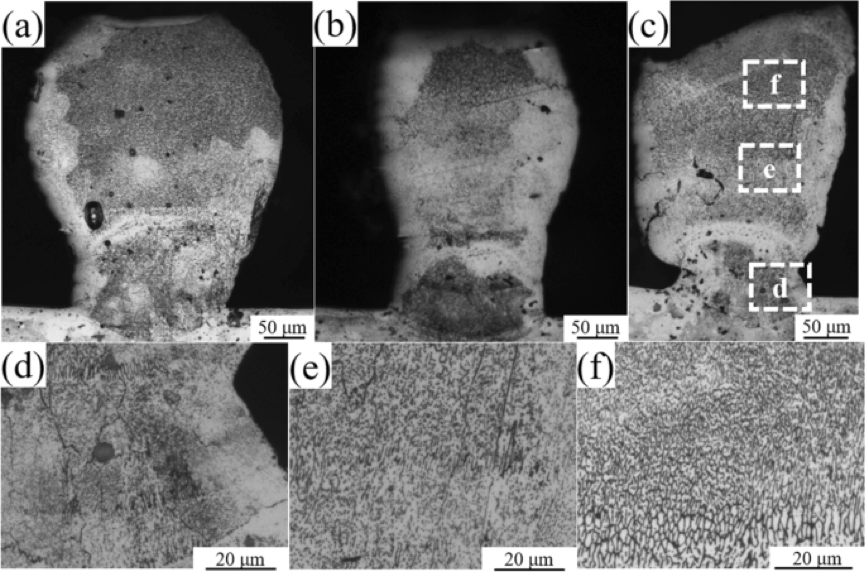
▲Figure 2: Experimental results of multilayer deposition in a single pass
By characterizing the formation defects of bulk samples prepared by multi-pass multilayer deposition, the defect evolution process of the Al-Cu-Mg alloy formed by laser powder bed fusion was determined, and it was clear that the defects of this type of alloy are mainly unmelted holes of irregular shape, pores of regular shape and small size, short cracks with insufficient melt supply of several tens of microns and long cracks with a withdrawal of solidification ranging from hundreds of microns to several millimeters in length. At the same time, the mapping relationship between forming quality and process parameters was summarized based on the volumetric energy density and relative density of the sample as standards. It was found that the sample had the best forming quality under the energy density of 426~. 681J/mm3.
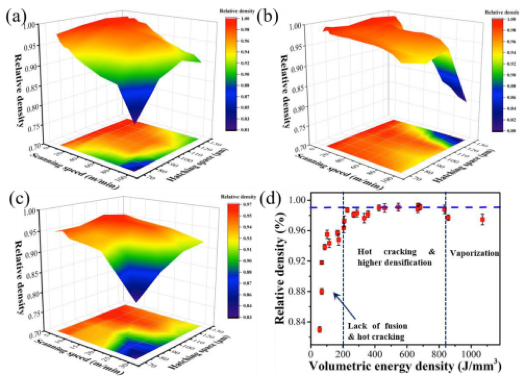
▲Figure 3: Evolution of density under different process parameters
In this study, through in-depth discussion and analysis of the formation process of various types of defects, we finally succeeded in obtaining the formation process map of Al-Cu-Mg alloy formed by powder bed fusion laser, and provide the solutions for different lasers. powers, scan speeds and scan pass spacing. A rapid and simple screening method for process parameter combinations and defect evolution can effectively guide additive manufacturing process selection for high-density and crack-free aluminum alloys.
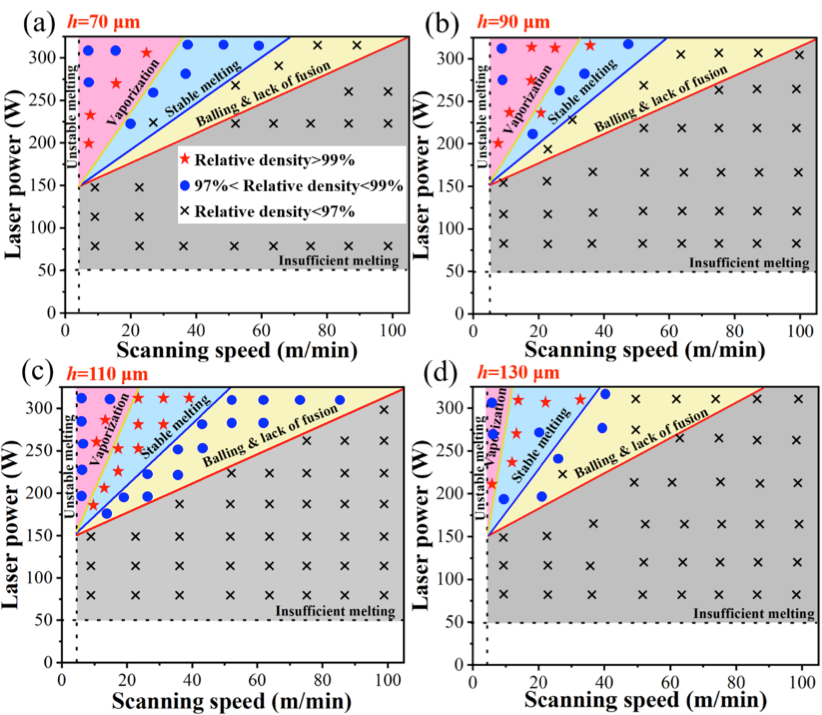
▲Figure 4: Map of the additive manufacturing process on Al-Cu-Mg alloy laser powder bed
Daguang focuses on providing solutions such as precision CNC machining services (3-axis, 4-axis, 5-axis machining), CNC milling, 3D printing and rapid prototyping services.



















